CLASSICS MADE IN THE USA

If classical music’s to find a fuller audience in America, the works of our own composers need to be presented. Especially those I call the Illuminists, after the great painters who finally have found widespread appreciation.

I love the orchestral works of John Knowles Paine, George Whitefield Chadwick, Amy Beach, Arthur Foote, MacDowell, Griffes … and no other composer spanned so much change within two decades as Charles Ives.

We know only the surface. Listen closely, and you’ll find none of them sounds truly German, despite the accusations. Even were it true, we need to remember (a) German was the standard for classical music, so much so that even Dvorak suffered, and (b) German was a central component of American culture at the time, anyway – it was even a required language in many major city high schools.

Acknowledging this puts Aaron Copland within a longer tradition, and all of those who follow.

Now, if our major orchestras would only live up to the challenge. Is it really to much to ask that they play a fourth of their repertoire from their home base?

BREAKING THE STEREOTYPES

She never did drugs, and she married a soldier. She was a faithful mother and wife. She doesn’t even know the smell of marijuana, and she talks to her legislators rather than standing in a demonstration.

But in my book, she’s still a hippie. There’s no question where she falls on the granola-heads to fundamentalist spectrum.

I’d give you my reasons she’s a hippie, as far as I’m concerned. But I bet you know others who are something like her. So I’d like to hear some of the qualities you perceived that help us break the stereotypes, at least when thinking of hippie.

YEARBOOK CONFESSIONS

There was the night when my daughters – at the time, one in college, the other beginning high school – had been chattering about something that prompted me to get out the yearbooks. Show them what things had been like back then, when Bob Dylan was just going electrified, Vietnam was ramping up, and hippies, well, were still more than a year away in the future. (My wife insists this came up on my birthday.)

Their reactions weren’t quite what I expected. Yes, there was the giggling, especially over the girls’ flip-style hair and A-line dresses. And their dismissal of some beauties I’d lusted after, as well as their agreement on others. Initially, they couldn’t find me in the pictures, and then, when they did, they started laughing: “You’re everywhere! Is there a group where you weren’t an officer? Hey, he even has some poetry here!” As well as my wife’s, “My, you were cute back then.” Which pains, in a way: I’m not now? Of course, I was the skinny, clueless intellectual back then – and generally unloved. To my further surprise, my girls declared that the boys in my high school class were generally pretty attractive – “They look put together,” as they put it – compared to those today. Maybe it was all the ties and shorn heads. I thought we looked pretty dorky. Still do, looking back.

A bit later, one night at the office, as one of my coworkers was complaining to another about the latest machinations by her son’s teacher, and his high school’s draconian response, I remembered that I’d been having a fleeting sense that this would have been the year for my 40th reunion – that is, if anyone was still in charge. With all of my moves about the country, though, they’d long since lost track of me. I’d never made any of the reunions anyway, either being unemployed at the time (and thus short of cash), unable to get the vacation time off or budget for the air fare, or even learning of the last one a couple of months after it happened. Lately, though, there have been some tentative Web searches for individuals, which did lead to a posting of some items from The Hilltopper, from when I was editor-in-chief. So now, around midnight, I decided to Google, just in case, a reunion notice might be posted, somewhere. And lo and behold, there it was. The Victory Bell, and then photos from their 35th anniversary gathering.

The Web site itself wasn’t in the best shape. A bit of nosing about did turn up a notice that there would, indeed, be a 40th observance, though because “we’re especially short of funds,” no mailings would be sent out. (As if they had my address.) But do I want to spend an evening in an American Legion hall with a DJ and people trying to make happy? The idea gives me the creeps. I’m a country dance kind of guy, or would at least prefer a setting where conversation would be facilitated, rather than masked.

Still, something in my awareness was pierced, and the emotions could not be restrained. For 40 years, from my perspective, at least, these classmates have been frozen in time. Their supple flesh and worldly inexperience, preserved intact. Jarring, then, comes the notice on the site, informing of the death of one who had been incredibly desirable, with side-by-side photos of her at 18 and then aged. As are notices of a cluster of others, now deceased. I click again, to photos from the 35th reunion, and am appalled. I recognize no one. They’re loud, badly dressed, and have not aged well. Finally, I find a few photos with the people identified, and then admit some are actually in pretty good shape. Another icon leads to a listing that includes married surnames, and the trail of these classmates is no longer lost from my sight. Further Web searches, for instance, present one I’d idealized who is now spouting political drivel, while another – once the epitome of cool sexuality and now apparently divorced in the past five years – is teaching knitting or quilting in a fundamentalist church. I return to the class Web site. Wonder about the Adonis club males, and just how did so many become so grotesque? As for the dress, strange tans, paunches, and wrinkles, the gray or dyed hair, or lack thereof: this is what I thought I wanted to return to, after college. Here, I must confront the reality that some – essentially the reunion crowd – were able to stay in town, largely on the one side of town, at that – while some others have been scattered to the winds. After all, I am among those “location unknown.”

How could I possibly begin to relate to them all of the twists in my own life – the ashram experience, the orchards and mountains of the Pacific Northwest, the St. Helens eruption, my Quaker progression and return east, publication of experimental novels and countless poems, the divorce and finally coming to have children when many of them are enjoying grandchildren, to say nothing of having a wife who’s nearly the age of their own children?

I looked at the posted photos and wondered, who are all these old people? Wondered, too, how I ever escaped that circle. (Oh, vanity!)


WITHOUT A DOMINANT LEADER

As I wrote at the time:

My spiritual work from my Yakima years on has always been within a collegial circle, rather than with a dominant leader. In this, much of my reading/study of Scripture has been along the lines of Arthur Waskow’s book, Godwrestling, a Jewish communal tradition of arguing with the text, asking if the writers had it right, if there were alternate outcomes, and so on. This is quite different from the legalistic approach taken by fundamentalists of all stripes or even much of the mainstream.

Quaker Theology has published my piece, “The Quaker Enterprise of Metaphor,” laying out an alternative way of thinking, one based on personal experience more than speculation or splitting hairs. Your mention of Kaballah reminds me of a volume I got as a present, The Jew in the Lotus, about an individual who discovered the mystical and varied sides of his heritage while traveling in a small delegation to the Dalai Lama, who was curious not just about angels being everywhere but also about keeping a faith alive in Diaspora.

Over the past few years, I’ve been connecting the dots of an alternative Christianity, one that apparently flourished before the Nicene Council in 325 C.E. and resurfaced in the early Quaker movement, which had to couch its articulation because the Blasphemy Act still included capital punishment. This line of reasoning remains controversial, and I hesitate to say too much too early in my writing. Essentially, “Christ” is something other than the historic person known as Jesus – more along the lines of the Judaic Sophia and the Greek Logos concepts or principles. (So I had to laugh when you reminded me, regarding the spelling of Chanukah, of Jesus’ last name! No, it’s not Christ! It would have been Joshua bar Joseph!) This version also points away from the conventional teaching of Trinity, or of Jesus as God incarnate, and toward a different framework. Just don’t try this on your more conventional neighbors, even with chapter and verse from the New Testament. They’d be really baffled by the short version: Christ is bigger than Jesus.

In all of this, I recognize that something happens in the meditative silence, or “waiting worship,” no matter how we try to define it. In sitting, especially among others, I’m somehow reconnected to intuition and deep emotions, as well as to the other people in our circle. And without it, I really can’t write poetry. (Prose is another matter.)

Still, as my wife asks, how does this make me a better person? I hate to think what the replacement would be!

WORKING BEHIND THE SCENES

For me, one line of career growth involved a growing recognition of the importance of working behind the scenes. As I watched the conductor Max Rudolf eschew stardom and New York for music-making in Cincinnati, I perceived something quite different from Leonard Bernstein or Herbert von Karajan’s being in the celebrity spotlight. Similarly, Glenn Thompson, the first editor to hire me, had a knack for giving other people credit for his own ideas and visions, and then pushing them forward to completion – including the new Wright State University I attended my first year and a half of college. Glenn, too, was the one who impressed upon me the importance of keeping a personal journal.

Another line stemmed from the illustrations accompanying profiles of serious authors that showed intensive revision of a single page of work. This was much more complex than daily deadline writing, even when the copy desk had finished its round on the text itself. Extended interviews, such as those in the Paris Review, demonstrated how vastly different individual writers functioned, too: fastidious Nabokov, for instance, contrasted to runaway Kerouac.

Still another line reflected economic changes. A few months before my graduation from college, the Wall Street Journal, which had expressed interest in hiring me, instead laid off several hundred reporters and editors. Rather than moving to a big city, as anticipated, I wound up laboring in out-of-the way communities, which presented me with other experiences and insights. As my career grew, I worked largely behind the scenes, editing other people’s writing and presenting the day’s stories and photos for our many readers. I was fortunate to have a series of bosses I admired and respected, and making them look good was also one of my priorities. Again, it was working behind the scenes, an approach I later realize had also been my father’s. In the long run, the economic changes have continued to buffet the publishing industry, from books and magazines to newspapers themselves, all struggling against decline and marginalization. Over the years, we’ve watched the declining importance of reading and writing among the general populace: the term “famous novelist” going from Hemingway and Faulkner to Mailer and Heller to Stephen King and Anne Rice, for instance. Or who now can name a newspaper editor or publisher, after the likes of Scotty Reston, Ben Bradlee, or Vermont Connecticut Royster? Or a major poet, after Ginsberg or Plath?

From my college years on, I’ve taken a route tempered by the hippie influence, which initially challenged many of my assumptions and goals and led to the yoga ashram instead of graduate school – or even law school, which had once appealed. The ashram practice worked to crush much of my ego, instilled a degree of humility, and opened me to spiritual awareness and discipline, before sending me forth again on a journey that eventually brought me into Quaker circles, or the Society of Friends, which I much later discovered was the faith of my Hodson ancestors. Crucially, the practice of meditation – first as a yogi, and then as a Quaker – also opened an appreciation and understanding of poetry for me in ways the classroom could not. Maybe it was just the silence as a breath of light.

In my personal writing, what has unfolded is more a practice of meditation, reflection, collection of otherwise random thoughts and feelings, and inner playfulness, than a quest for any “finished” product. Not that a set of poems or a polished novel in hand does not also give pleasure.  So here we are, backstage, as it were. Or, with the blog, in the loft. Not a bad place now, is it?

BUSINESS AT HAND: IN THE MINUTES

Much in our Quaker practice seems quaint, none more than our practice of minuting. It’s not the same as taking minutes of a company board meeting or city council session, but has a dimension all its own. Originating in the recording of persecutions in the initial decades of the Quaker movement, and in the subsequent petitions for redress and justice, our earliest minutes tell of “sufferings for Truth’s sake” and soon lead into the efforts of determining just what it means to live as a people of conscience.

Sometimes today we find the practice burdensome or unnecessary. Friends who follow the Old Ways in this matter will draft and read aloud the record on that part of the agenda, moving ahead only after that minute has been revised to satisfaction and approved. It’s slow and tedious, but it does focus the deliberations.

Here, the concept of clerking – especially for the recording clerk – has a meaning related to “clerk of court,” where the official records decisions from the bench above. In our case, Friends traditionally feel the high judge as Christ, and the meeting gathered as witnesses who would voice the sense of the resolution. I suppose we might see Friends attending our business sessions as a jury, then. If it were only as simple as guilty or not guilty!

Revisiting historic minutes, as I’ve done as a genealogist in the archives at Swarthmore and Guilford colleges, opens an appreciation for the practice as an art form. Perhaps no other records in America before the 1850 Census offer as much genealogical information as ours do. Even so, one discovers how faulty even the best efforts become. A individual simply fades from sight, a family moving away is recorded simply as “Robert and Sarah and children,” rather than naming them individually, as another clerk might have done, or the records might be lost to a house fire, as Centre, North Carolina’s, were, or simply lost altogether, as the first half-century of Dover’s were or West Epping’s were in our own lifetime. You might see an erasure, from first cousin to second, or a misspelling – and suddenly, you find yourself sitting with that clerk, somewhere in our history. This becomes something other than quaint, but personal engagement.

QUEEN SLIPPER CITY

The train station, perched at the side of downtown, includes Amtrak's Downeaster service to North Station in Boston, in one direction, and Maine in the other. (That run stops in Dover, New Hampshire.) There's also MBTA's Purple Line into Boston.
The train station, perched at the side of downtown Haverhill, Massachusetts, includes Amtrak’s Downeaster service to North Station in Boston, in one direction, and Maine in the other. (That run stops in Dover, New Hampshire.) There’s also MBTA’s Purple Line into Boston.

New England’s waterways are dotted with historic mill towns. The Merrimack River alone could boast of the water-powered industrial centers of Manchester and Nashua in New Hampshire as well as Lowell, Lawrence, Haverhill, and Amesbury downstream in Massachusetts, along with Newburyport and its harbor.

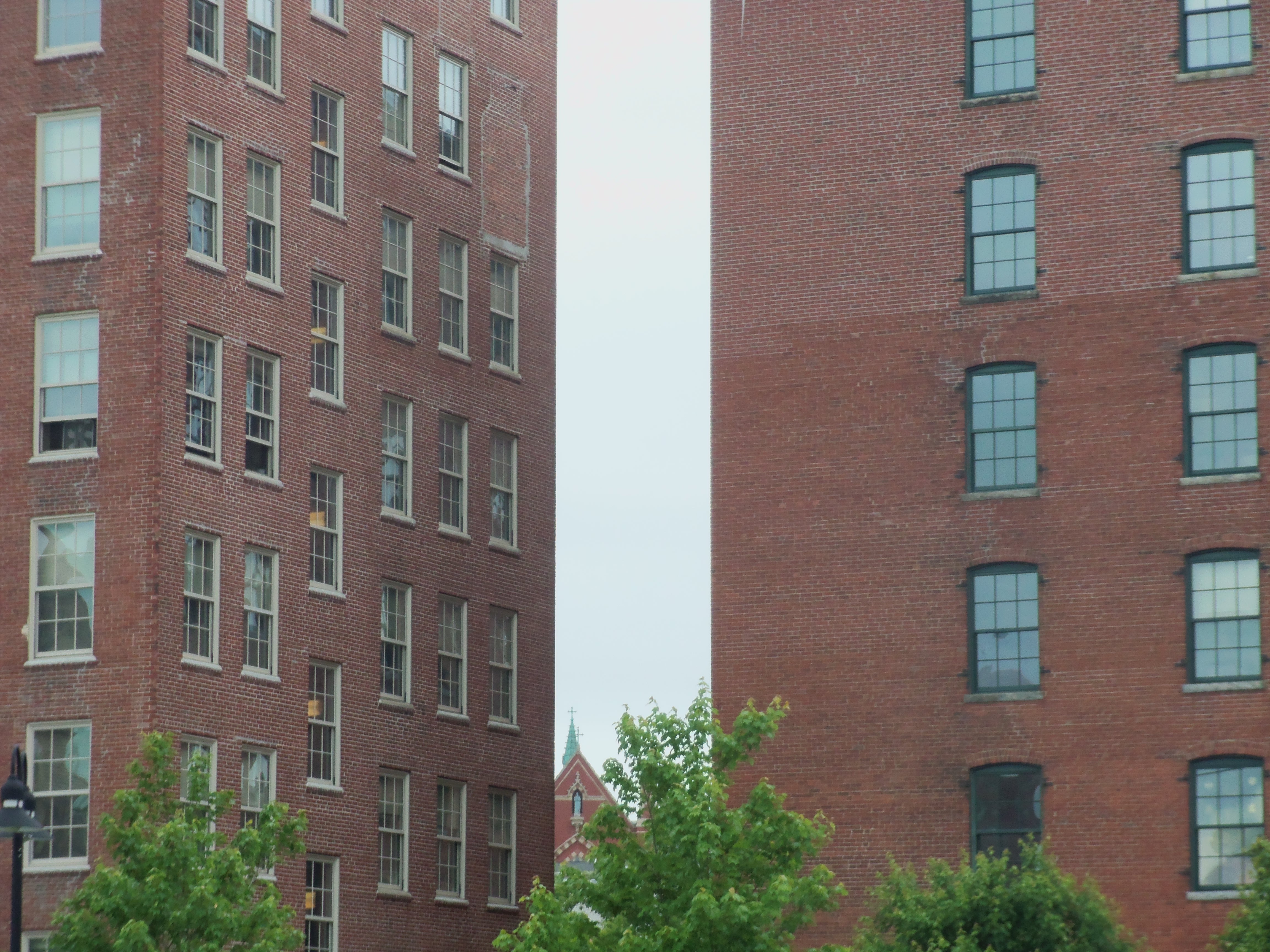
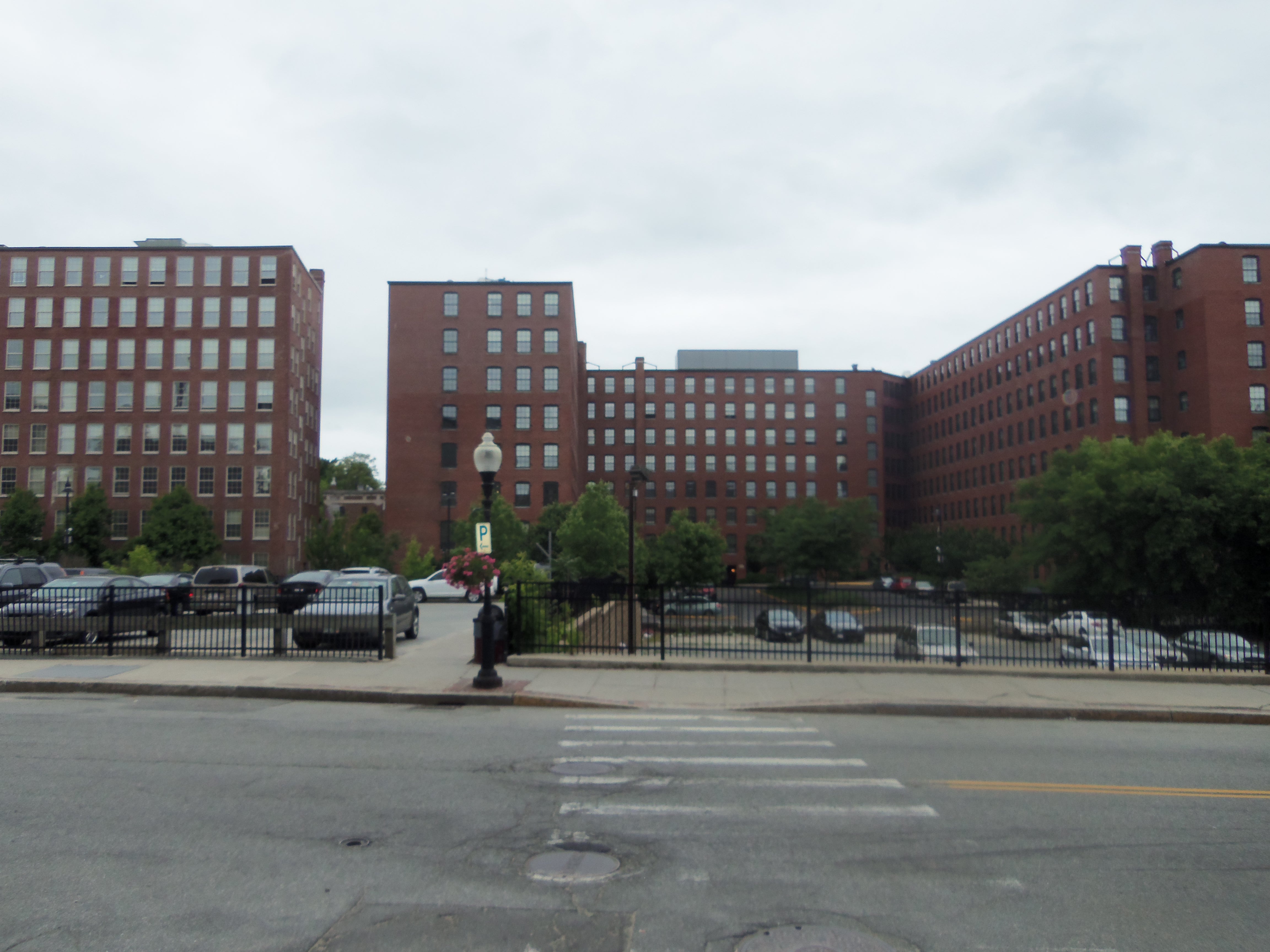
Some of the warren of old mills remains, including buildings converted to offices and housing.
Some of Haverhill’s warren of old mills remains, including buildings converted to offices and housing.
Catch the view of the distant church in the gap.
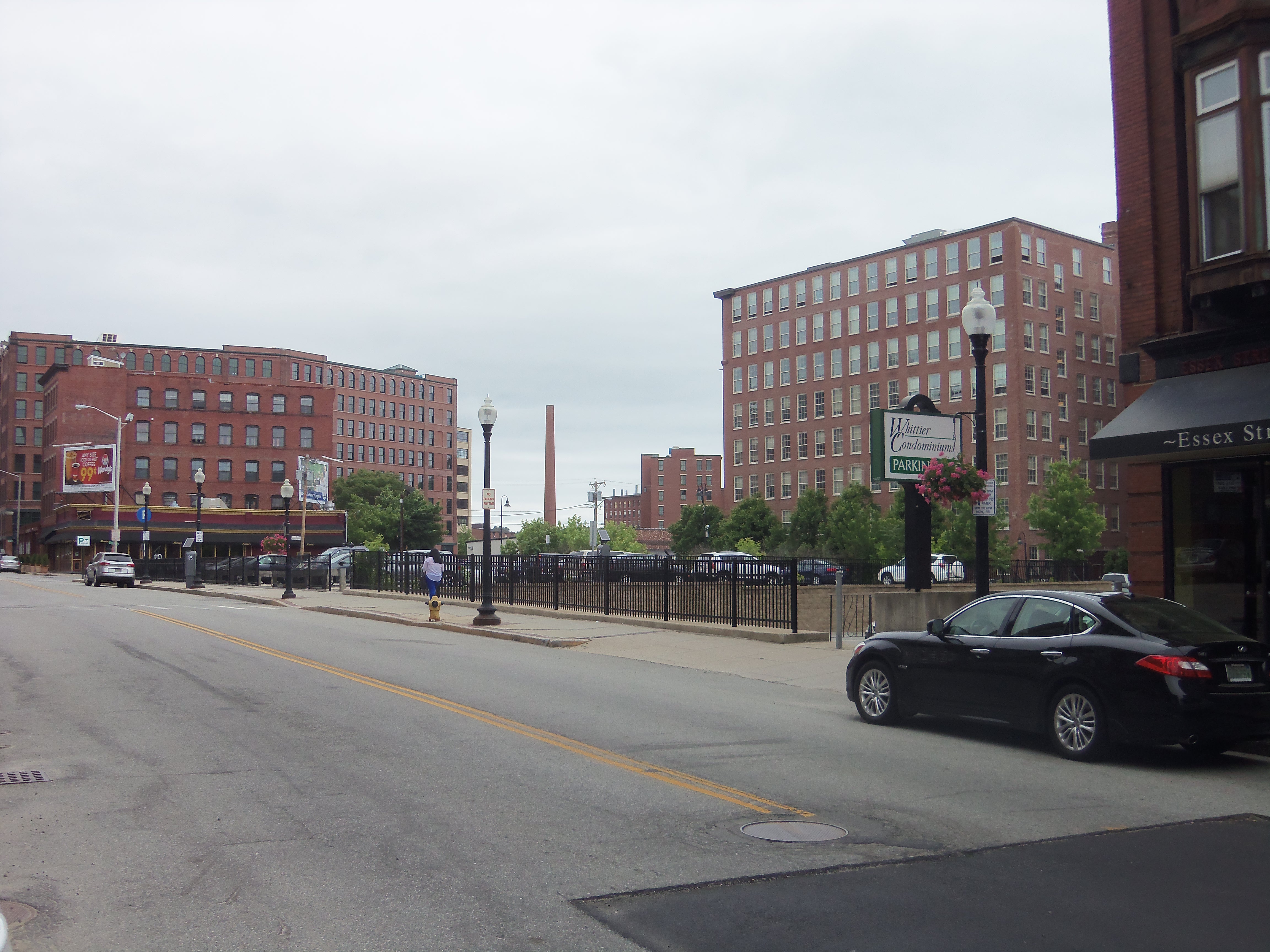
Much has also been razed, often for parking lots.
Here's a bit of scale.
Here’s a bit of scale.

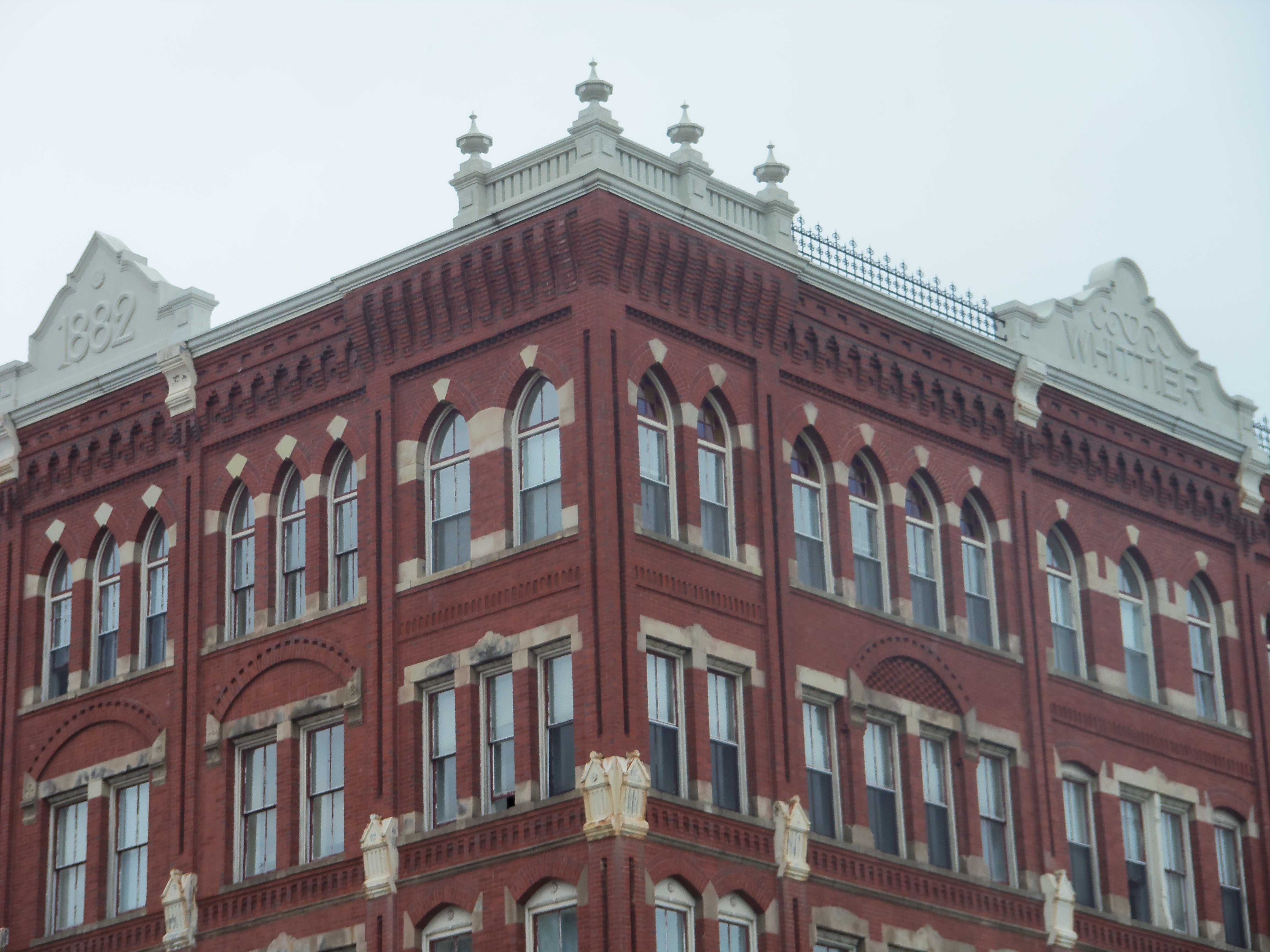
While textiles were the focus of much of New England’s mill output, the power was applied to other products as well. Haverhill, for instance, emerged as a center of shoemaking, by 1913 producing one of every 10 pairs in America and earning it a whimsical nickname of Queen Slipper City. Its earlier commerce rested on woolen mills, tanneries, shipping, and shipbuilding.

Downtown details.
Downtown details.
Still impressive.
Still impressive.
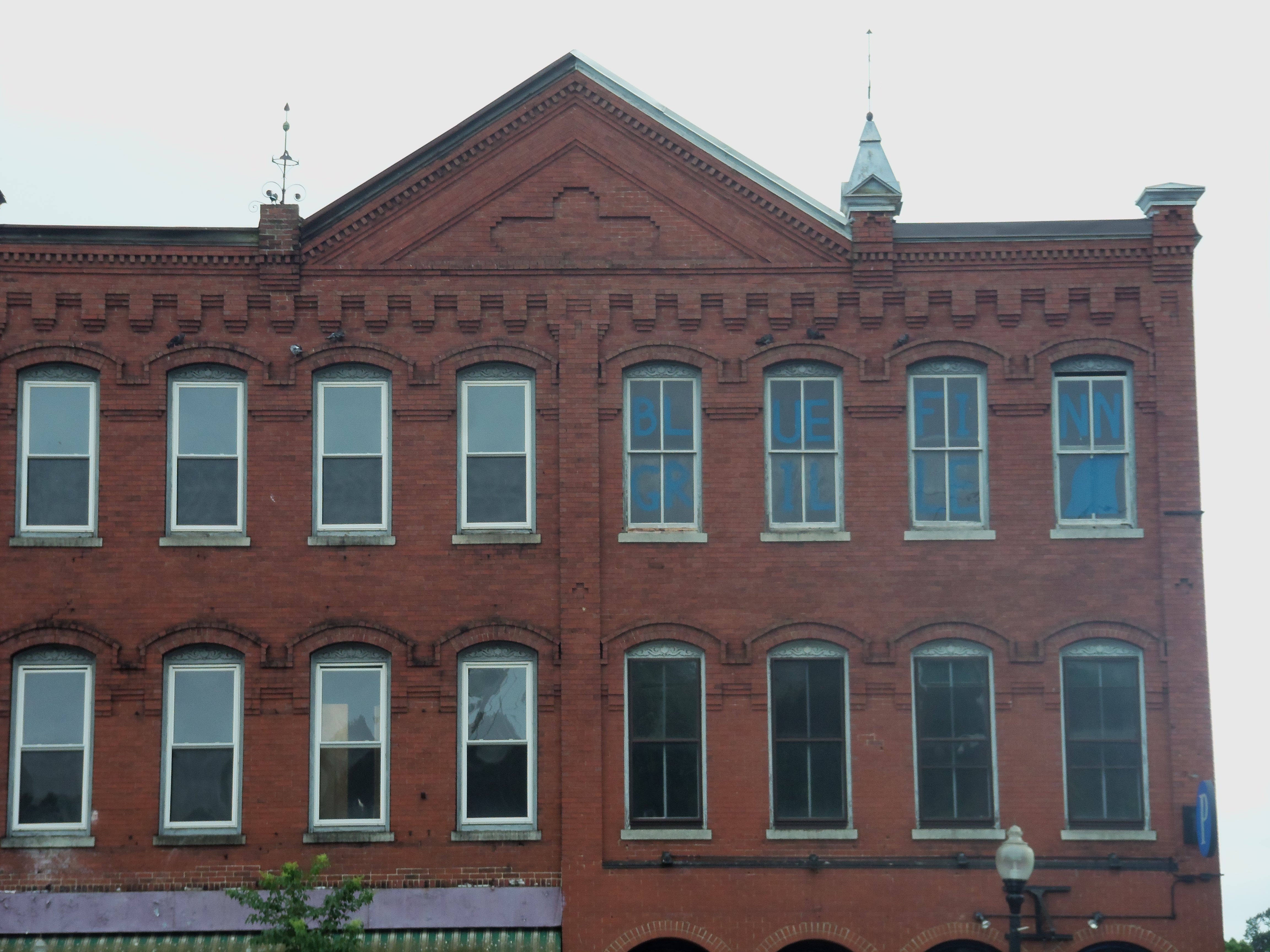
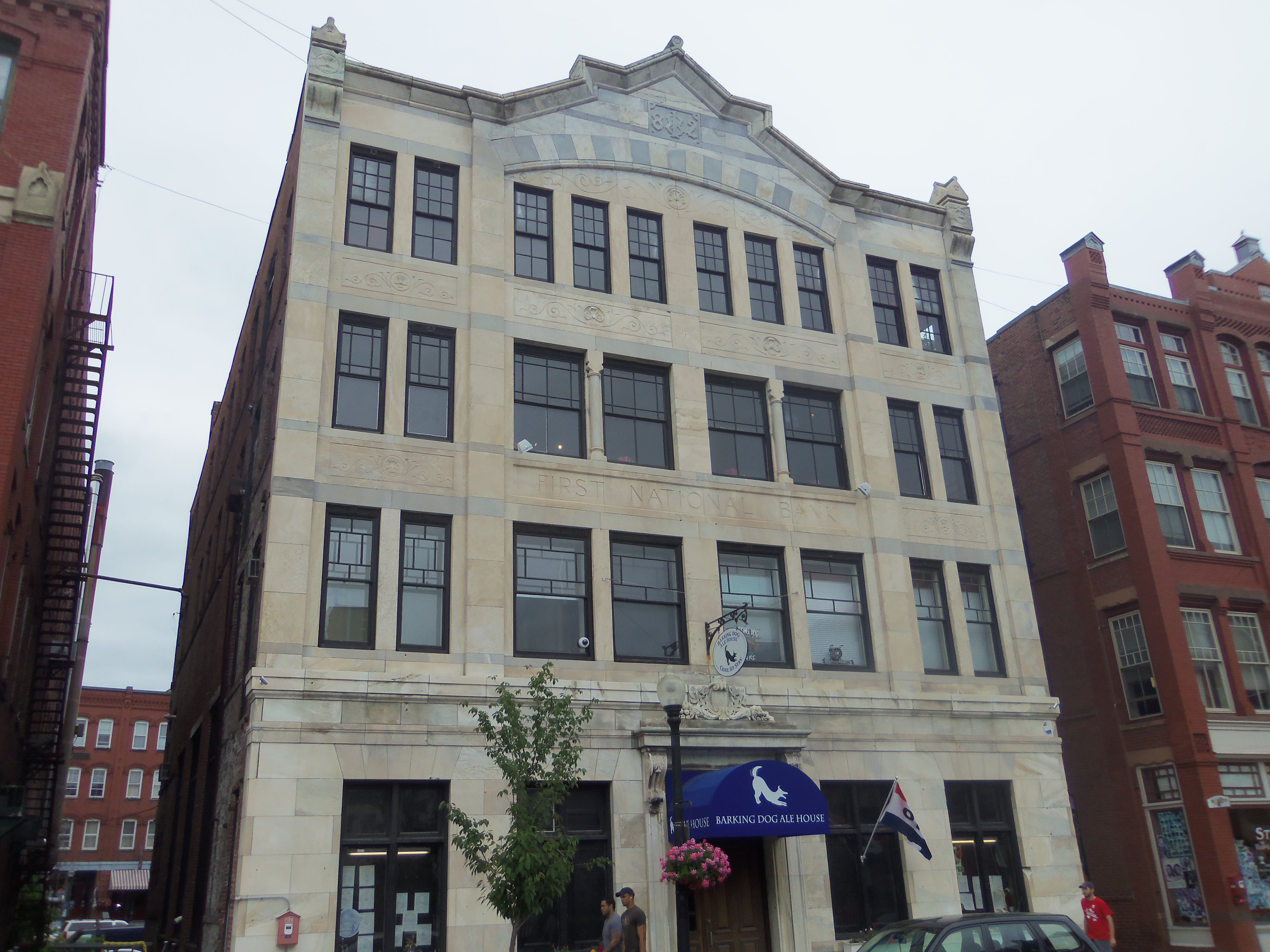
In those days, every building could be a "block."
In those days, every building could be a “block.”
Facing the train station, a reflection of earlier prosperity.
Down the street, around the corner.
Not everything was brick.

Like many of these once industrial centers, the city has been struggling to adapt to new directions and refit its legacy of old structures.

By the way, in Yankee style, it’s pronounced HAY-vril and is today a city of 60,000. But the river still runs through it.

The river flows toward the Atlantic.
The river flows toward the Atlantic. The tides fluctuate widely here twice a day.
The railroad crosses from downtown and then follows the river upstream to Lawrence. It's a lovely ride.
The railroad crosses from downtown and then follows the river upstream to Lawrence. It’s a lovely ride.


A WORLD QUITE ALIEN TO MY OWN

As we watched the movie (let’s withhold the title as being irrelevant to my point), I was struck that these were not characters I would – or could – ever draft. Even if I’d managed to conjure up the range of members of the extremely dysfunctional family, they wouldn’t be believable, arising as they do from a world quite alien to mine. (Not that my family didn’t have its, uh, dysfunctions.)

It’s an awareness I’m having with increasing frequency – or at least maybe it’s just a heightened recognition. It involves not just family dynamics, either, but extends to a perception of romantic attractions or destructive people in the workplace or political office and beyond.

In the case of this particular movie, each character was appalling in a distinctive way and played to perfection by a top-line cast, which only added to my admiration of the scriptwriter’s achievement, one author to another.

Could it be I’m simply becoming more and more aware of how wide and varied our world really is?


LOOKING FOR AN UNCOMMON GROUND

If you’re part of a faith community, you can ask this about your own circle: What do we have in common? That is, if we were required to write a “confession of faith” (in my case, for our Quaker meeting), what would we profess? What I’m envisioning is not a listing of what we do together, which our annual State of Society Report too easily becomes, but rather what lies under and behind our actions. I know that some Mennonite congregations from time to time draft what they call a “constitution,” although a corporate “mission statement” may also do here. The idea is to sharpen the focus of what a group already possesses and where it would like to go into the future. It’s a way of acknowledging and enlarging on the strengths and dreams of its members. Think of one retailer’s slogan, “Let’s build something together,” with its unvoiced understanding that they’re talking about people’s homes, rather than their investment portfolios, and maybe you get the picture.

I would hope that what we have in common is something other than similar tastes, income, educational attainment, lifestyles, party affiliation, or the like. Perhaps, in asking the question, we can even come to a clearer understanding of what diversity we, in fact, possess, and the potential it offers us.

Answering the question would, I suspect, be far more difficult than we might originally anticipate. On one hand, answering candidly might actually prove divisive. We’ve seen this as we responded to New England Yearly Meeting’s attempt to revise Faith and Practice for the next generation. On the other, delving into the question might also lead us into a clearer understanding of the core energies at the heart of our worshiping community. I recall Caroline Stephen’s amazement Friends can do anything, considering that Quakers are essentially a body of mystics. We’ve heard others compare trying to get us moving together like “trying to herd cats” or go somewhere with “a wheelbarrow full of frogs.”

What I do know is the difficulty of maintaining a witness – even plainness – apart from a community of faith. Community, with its definition of common unity. In the end, it requires far more than strength in numbers. It’s a matter, I’d say, of strength from our hearts.

*   *   *

Now, for my stab at the statement:

Dover Friends Meeting (Quaker) is a body of individuals and families who together encourage and pursue the New Testament goals of simplicity, equality, honesty, integrity, nonviolence and pacifism, and divine love in daily life. At its organizational core are the weekly hour of open, waiting worship in the presence of the Holy Spirit and the monthly meeting for business, both conducted in accord with the longstanding manner of the Society of Friends.

SKINK, I HOPE

A small lizard, part of a family of reptiles informally called skinks, rests on the roadway. At least I assume it's a skink. I'll leave the final identification to others. It's under two or three inches in length.
A small lizard, part of a family of reptiles informally called skinks, rests on the roadway. At least I assume it’s a skink. I’ll leave the final identification to others. It’s under two or three inches in length.
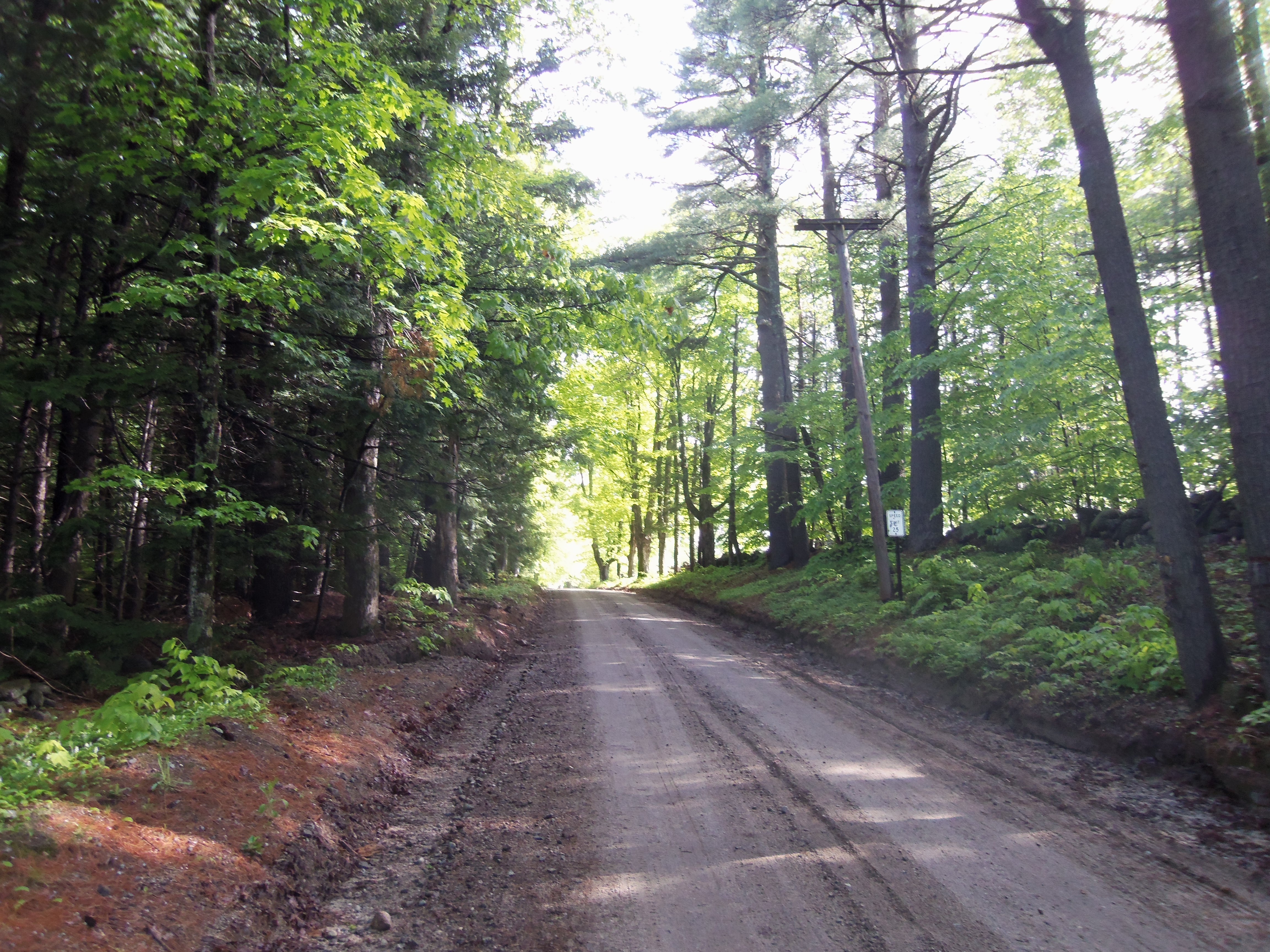
I encountered the critter at the top of this incline while walking in Henniker, New Hampshire.