CATCHING UP DECADES LATER

In moving around over my adult years as I have, I’ll probably never know the destinies of many of the individuals who’ve shared my life at crucial points. In many cases, even their last names slip away.

But I’ve recently learned of how things turned out for one small circle. It produced two women attorneys (one a federal prosecutor), an OBGYN female doctor, a food wholesale executive now turned United Way director, a technical support field manager, a retired six-figure systems analyst … for starters.

Looking at the service club logo behind one of them in a news story photo, it’s difficult to explain how far we’ve come in the decades since the early ’70s. Hippie, eh?

But from what I hear, some of them still like to party.

THE CAMPUS CONNECTION

A misunderstanding of the “turn on, tune in, drop out” motto popularized by Timothy Leary in 1966 likely blinded most of us to the extent to which the hippie movement was rooted in college campuses. That is, the “drop out” part was assumed to mean quitting one’s studies, even though Leary later insisted he meant it as a discovery of one’s unique nature and self-reliance, a mission that should have been central to the college experience itself.

Revisiting the era as it blossomed in the late ’60s and early ’70s, I see how much of its energy came from college students and the circles they supported – musicians, artisans and craftspeople, small-scale entrepreneurs of all stripes, social activists, dealers. Not just students, either, but hip young faculty and their families – all overlapping.

Essentially, it meant dropping a lot of old assumptions and embracing new experiences and values.

The reality, then, is that relatively few hippies dropped out of college, at least over the long haul. Talk all you want about Gypsies or vagabonds, few hippies stayed out on the road for long. Most remained grounded right in the center of the action.

SO WHAT’S THEIR EXCUSE?

Days after what’s been dubbed the Thanksgiving Nor’easter, much of New Hampshire was left without electrical power. It wasn’t just people out in the sticks either, where homes are scattered and require long lines for connections. No, major sections of the largest cities were also affected.

It’s not that this is an isolated incident, either. Officially, this was the fourth worst outage ever — following December 2008, February 2010, and October 2011.

The electrical grid has become undependable, and that should have the utilities worried. Customers are given more incentive for seeking not just backup relief, mainly generators, but energy independence by means of solar and wind sources.

While many of the big-bucks folks have been insisting that global warming — or more accurately, climatic instability and upheaval — is a fabrication, these kinds of disasters fit right into the predictions they’re denying. And these kinds of events will just keep coming. Or should I say snowballing? The four worst within eight years? Think about it.

The other argument that comes to mind has to do with line maintenance. Again, the four worst in eight years. The utilities can plead all they want for rate hikes, but they’ll be facing increased hostility. Folks will ask, “Just what are we getting for our money?”

It’s safe to say that for somebody here, things are going to get worse before they get better.  Or before the public, at least, turns the corner.

REMINGTON AND THE BIG DIG

Can’t drive through the Big Dig – the tunnels that take Interstate 93 under Boston’s downtown – without thinking of the story of Remington the Rabbit.

Seems his first owner, a teen, named him after her favorite TV show at the time, Remington Steele, in honor of its star. The one she had a crush on.

And then, when she and her mother moved to England, Remington became a feature in another household, at least until they, too, had to move, this time into an apartment that didn’t allow pets.

So Remington, in his long life, spent his final days surrounded by three children who, from all accounts, treated him well and found their delight returned.

And then, when Remington’s days ended, their father provided the crowning touch. Seems Daddy was an engineer working on the Big Dig in Boston. And that’s where Remington was clandestinely buried.

Somehow seems fitting, amid all that steel, knowing there’s a rabbit in the works, somewhere over my head.

ALWAYS LOW PRICES AND THE FALL OF AMERICA

As I said at the time …

Globalization is another name for the passing of world dominance from the U.S.A. to the People’s Republic of China.

A country that cannot make uniforms for its soldiers is ill-armed, indeed. Especially when its biggest rival and potential enemy holds IOUs on a national debt. The irresponsible and tragic consequences of waging an unnecessary war one refuses to pay off. Somebody will have to pay.

For starters: wait until interest rates rise again, and pay that much more.

What could we expect from a president who’d fly halfway around the world to serve a plastic Thanksgiving turkey to the troops, as W did?

Yes, as I said at the time.

WAKING TO THE FIRST SNOW

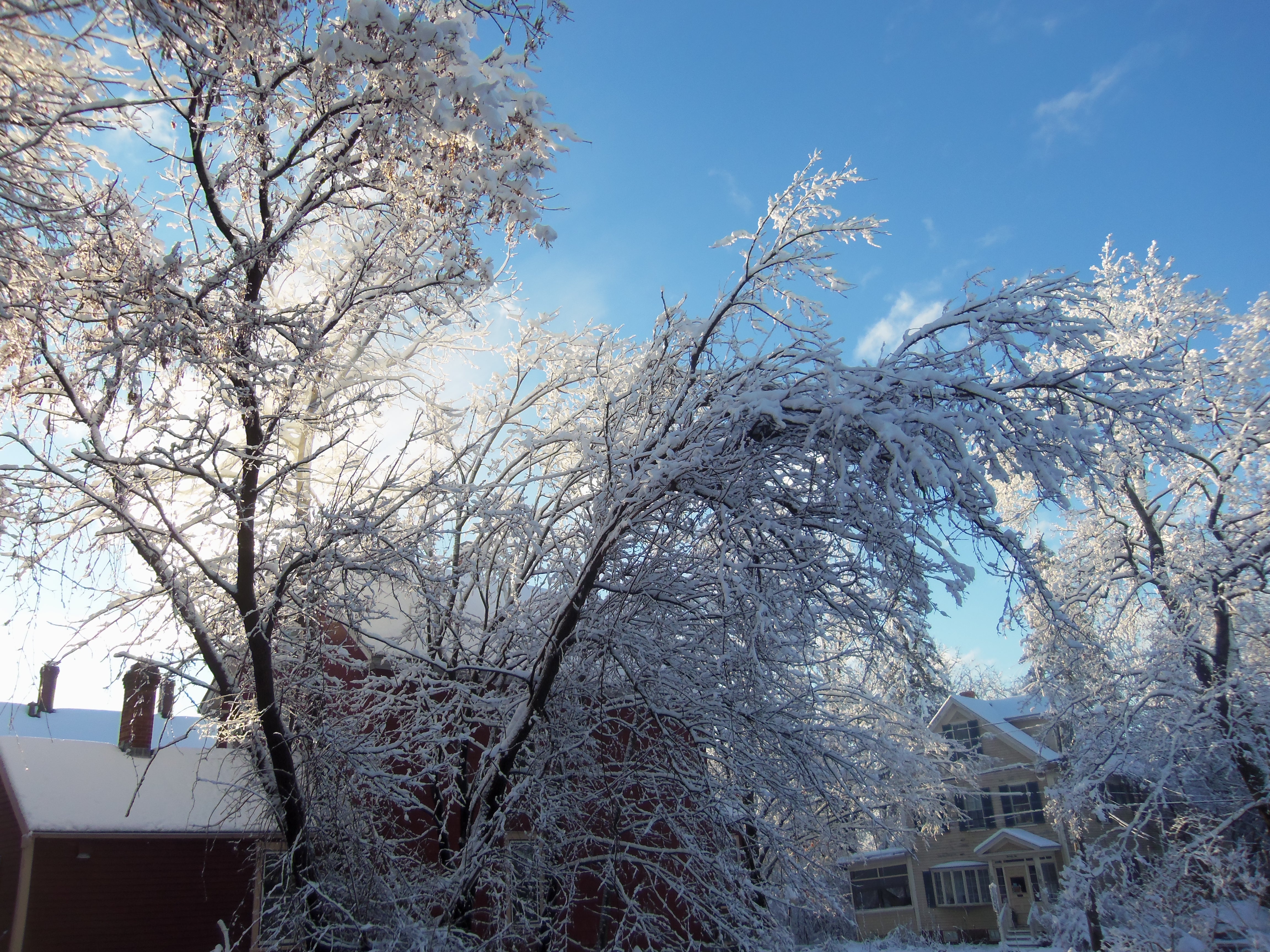
It's a lot of weight stressing those branches. Falling limbs through the night had the power flickering. We were lucky, though, the lines kept running.
There’s a lot of weight stressing those branches. Falling limbs through the night had the power flickering. We were lucky, though, the lines kept running.

It’s pretty but also heavy, wet, dense — you much prefer the lighter, fluffy stuff when it comes to shoveling. Still, you can’t help but admire it as the sunlight starts strumming through the branches.

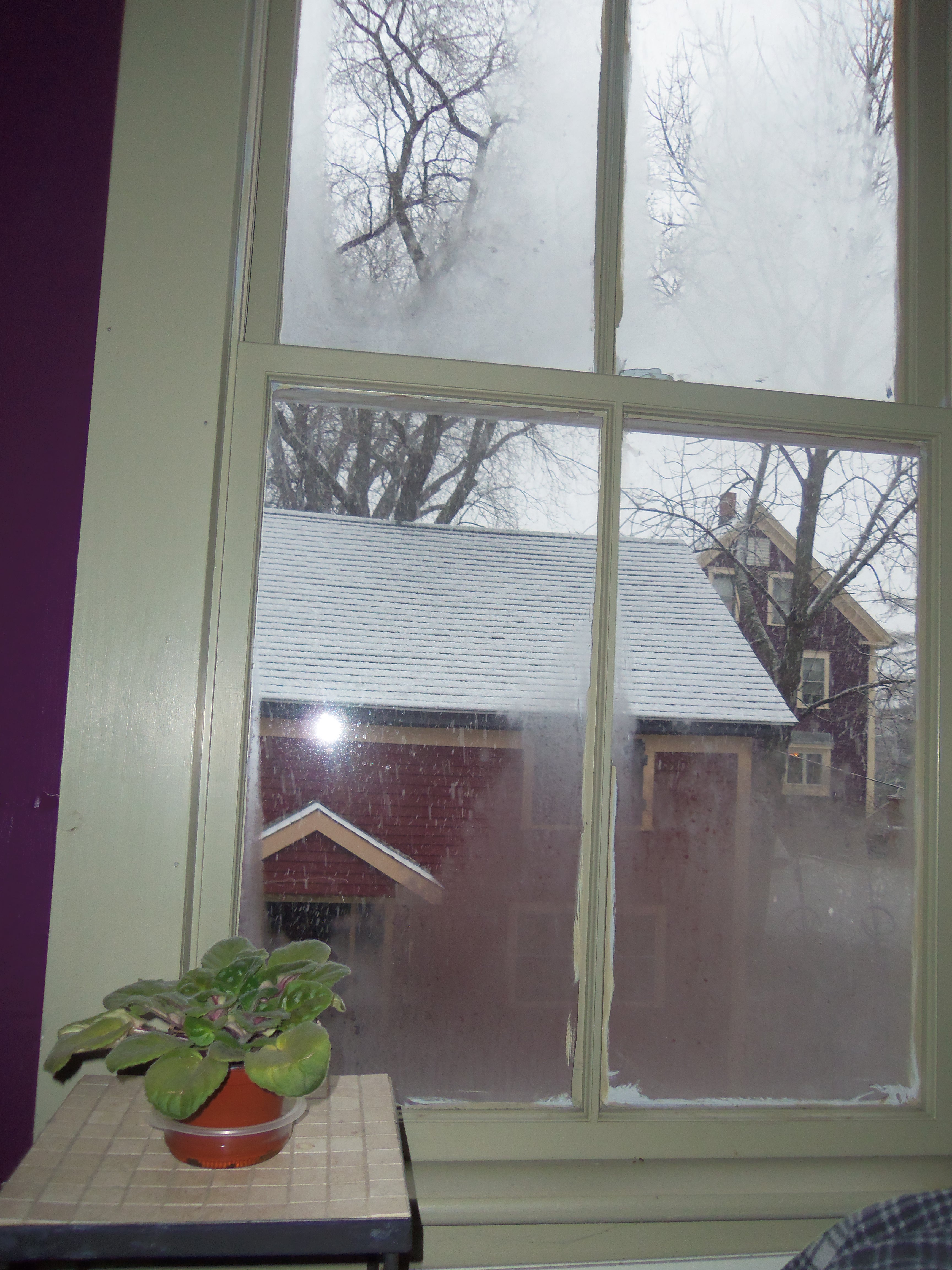
We’ve had several rounds of flurries before this, when some of the neighboring towns found their ground covered. Real snow, in my book, means digging out the driveway.

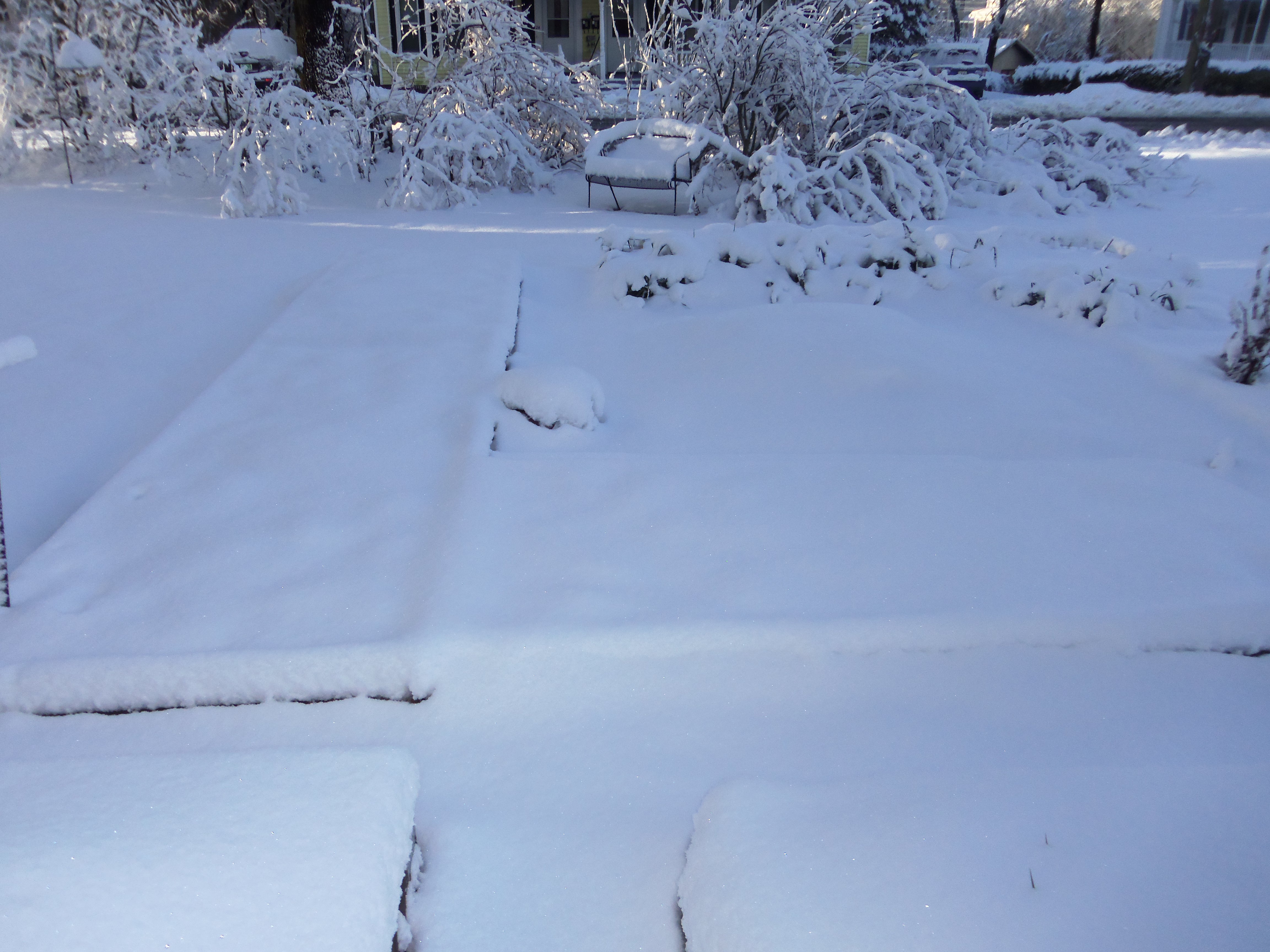
I like having the raised garden beds to be covered by a blanket of snow, especially when the thermometer plummets. The wrought iron loveseat by the bushes is one way I easily calculate the depth of our snowfall. I'm wondering how soon before it's completely buried.
I like having the raised garden beds covered by a blanket of snow, especially when the thermometer plummets. The wrought-iron love seat by the bushes is one way I easily calculate the depth of our snowfall. I’m wondering how soon before it’s completely buried.

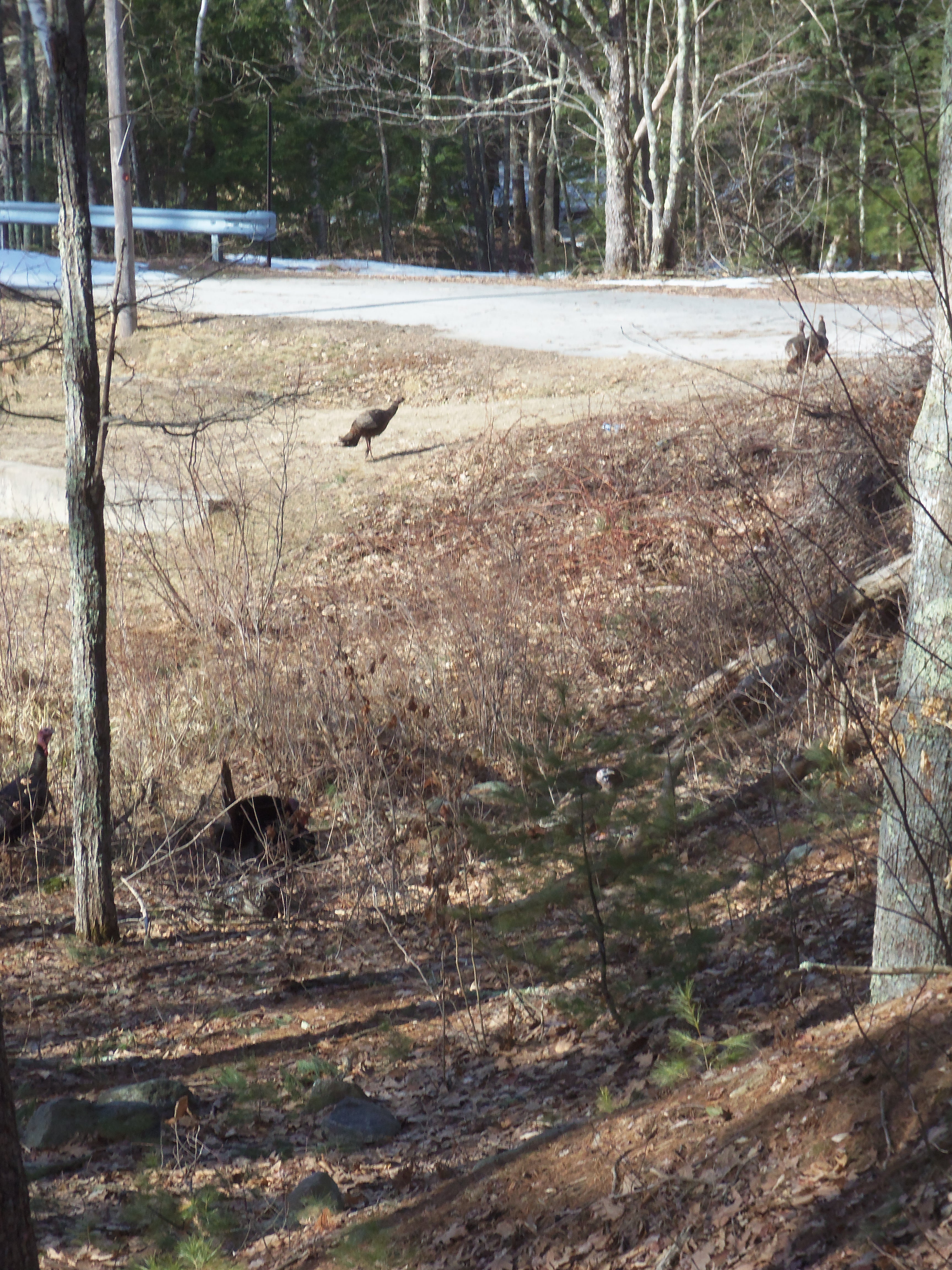
TURKEYS IN THE WOODS

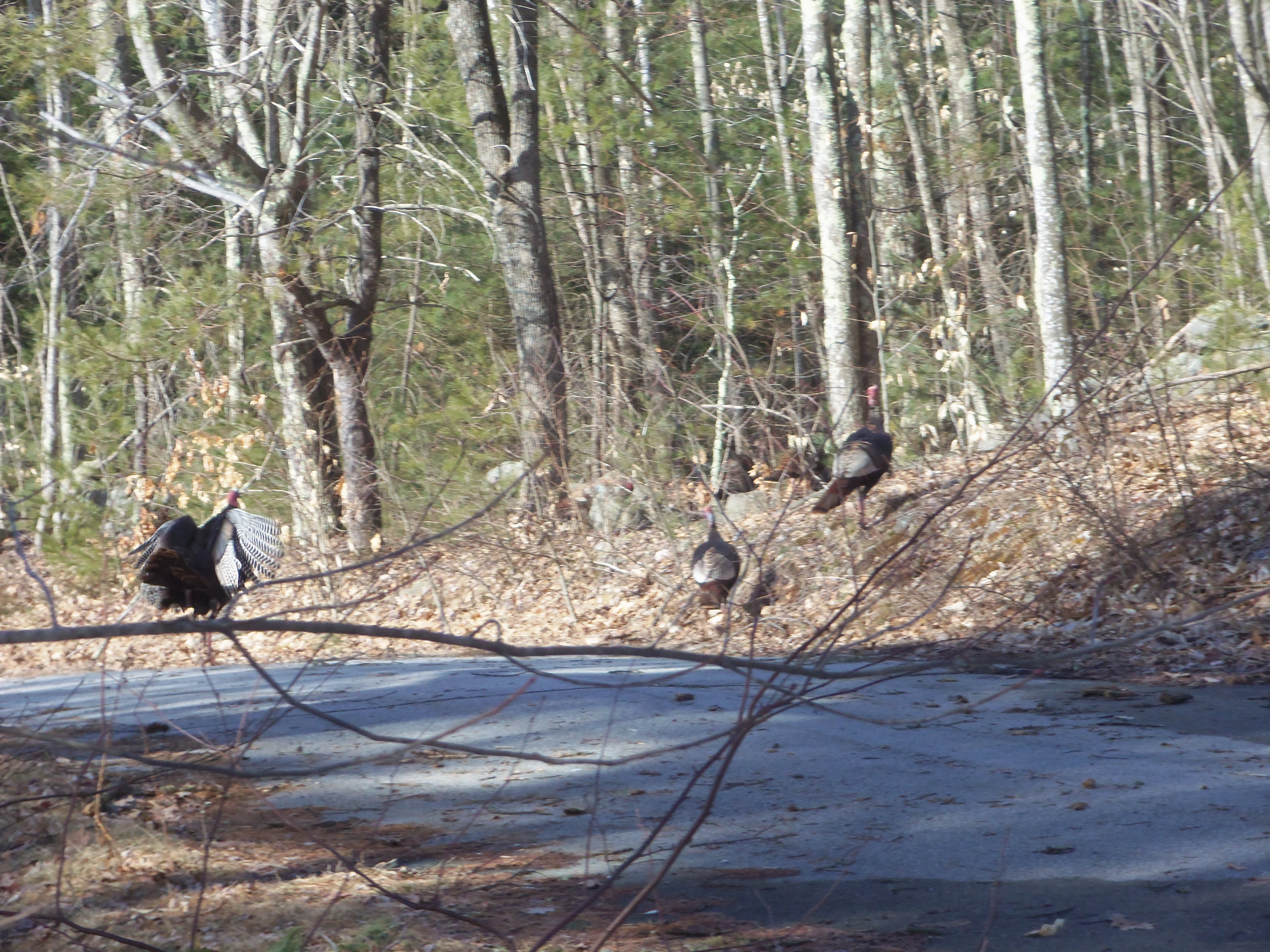
I pulled over to photograph some ducks on a pond, or so I thought. When I turned around, this is what I found.

There they go.
There they go.
Unruffled.
Unruffled.

Wild turkeys have made a remarkable comeback in New England. The other day, I had to stop behind a stopped car on the road. That’s when I saw the gobbler stroll off the pavement. There was even one in our yard, we’ve been told.

DON’T KNOCK VANILLA

There we were seated in the social hall, waiting for a final rehearsal to begin for our round of Christmas performances.

One of the baritones was nibbling away at a takeout carton of unmarked ice cream – as he admitted, from a top-of-the-line local hamburger joint. “I’m a New Englander,” he explained. “I eat ice cream all year.”

It was vanilla. I heard the echoes of mocking from a girlfriend’s mother way back, quite the New Yorker, something about being unimaginative.

I don’t care if she was a endocrinologist, she was so wrong.

As taste goes, what can be more heavenly than pure vanilla?

Actually, the simple things done well can be the best indicators of quality, even sophistication. Care to begin that list?

On the other hand, there are many ways to cover up flaws and errors. Just keep adding more doodads and trinkets. Not so when it comes to simplicity, which is all about truth.

If you think all vanilla’s the same, by the way, think again. Madagascar beans are the most popular, for good reason. But Tahitian is more floral and truly delightful, as I discovered in a gelato served at the Union Bluff hotel in York Beach, Maine. And then the Mexican beans have developed their own devoted following.

ENGAGING THE POWERS AND PRINCIPALITIES

Like it or not, practicing an art means wrestling with power, including, in St. Paul’s phrase, the “powers and principalities.” Powers of destruction, on one hand, and sustenance, on the other. Destruction that can, as we’ve seen too many times, include the artist. Hence, the fascination with Faust. With madness. Alcoholism. And on. Self-absorption and inflated self-importance rather than humble service.

We hazard much, often without the slightest awareness of the risks afoot. For the Christian, these involve Satan’s dominion over “the world,” which includes the realm of the arts; in Asian teachings, we can turn to the traps of Maya, that spider web of worldly attraction and deadly illusion. Either way, cause to be wary. Need for disciplined faith. Yes, let’s introduce something we’ll call Satan, just to thicken the drama.

Which raises an ancient point of conflict for a Christian artist: I’m not at all sure art is a proper activity for a Quaker. Through much of Friends’ history, most of the arts were considered superfluous and dishonest engagements taking our attention away from true worship. “We Quakers only read true things” is the way one expressed it while returning an unread novel to a neighbor.

Yes, “we Quakers read only true things,” or used to. The exclusion of not just fiction but theater and paintings and sports as distractions from worship. Traps of the flesh?

And yet: discipline is essential in spiritual growth. Self-discipline, route to true freedom. And where is the mind without imagination? I continue to read and write fiction and poetry. I love symphonies, string quartets, and opera. I’m a baritone or occasional tenor in four-part a cappella singing. When I practice my art, I am fed by this love/compulsion/infusion.

So we’re back to the ways and spirit in which we engage the powers and principalities, and the ways we order our lives.