From the other room
is she talking to me
the wall
or just herself
over the washing machine?
You never know what we'll churn up in cleaning a stall
From the other room
is she talking to me
the wall
or just herself
over the washing machine?
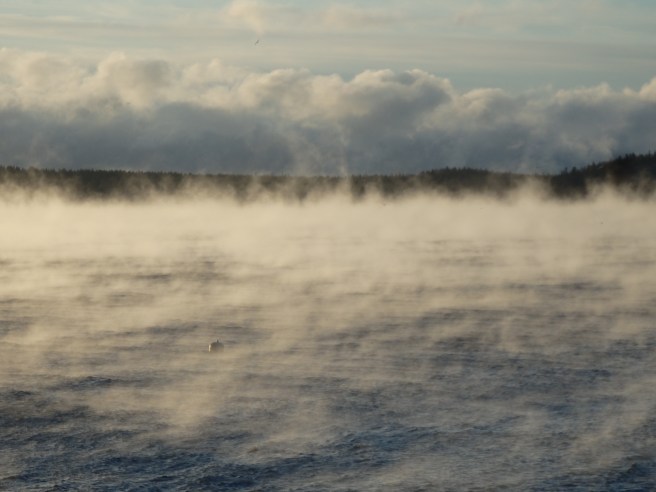
This happens when the air temperature approaches zero Fahrenheit, well below that of the Atlantic.
Eastport fell under British control in 1814 and was then attached to Canada for four years. Not that it went quite that easily.
As the conventional story proclaims, Captain John “commanded the first militia company organized in Eastport, his uniform consisting of an old Continental three-cornered hat, and he wore an old sword. His company was made up largely of veteran soldiers of the revolution, a wild set of fellows whom their captain found it difficult to control.”
More descriptively, in William Henry Kilby’s history volume, as Shackford’s grandson Samuel contended, “His men were of a sturdy, wild set of fellows, who appeared to think that the first duty of a soldier on training days was to drink toddy; and their captain had a hard enough time to control them. Many of them, having served half-clothed and half-fed in the Continental Army, doubtless felt that they had earned the right to an occasional frolic.”
I won’t question his sources, but he neglects to mention that Fort Sullivan and its commanding officer surrendered without firing a shot, as did Castine, Machias, and a fourth Downeast town. Still, continuing the Shackford account,
“When the British fleet captured the island and the commodore came on shore to take possession of the island, Captain Shackford met him at the shore, carrying a goad stick in his hand,” not the old sword, mind you, “and addressed him thus: ‘Well, sir! What brought you here? I am King of this island, and these are my subjects. If you behave yourself, you can come on shore. If not, you had better be gone.’ The commodore politely assured him that he had called on business, and trusted that he should conduct himself in a manner becoming a gentleman and to the satisfaction of his Majesty.”
Goad stick? Like for cattle? Captain John apparently had a flair for drama, as the next incident illustrates.
“After the English had taken possession of the town, all of the inhabitants were ordered to swear fidelity to the King, or leave the town and have their property confiscated. But the old soldier, when summoned to appear and take the oath, replied to the officer that he had fought under General Washington; that he might take four horses and draw him in quarters, but never would he swear allegiance to the King of England. It was probably on account of his eccentricity and boldness that the old gentleman was excused from taking the oath and allowed to retain his property.”
Follow that? Who would you nominate to portray Captain John in the movie? And, for that matter, the Brit? It’s still a great scene.
Beyond that, Lorenzo Sabine, editor of the Eastport Sentinel, later contended, “No privateer was owned here,” though Eastport was subject to heavy privateering (state-sanctioned piracy) during the War of 1812. The British cruiser Breame took prize of the Delesdernier with master John Shackford junior and Samuel Wheeler, an owner on board as a passenger. They paid ransom for their property and were released.
Another ship, commanded by Captain John’s son William and sailing from Eastport in early 1812 with a cargo of rice and flour, was captured 25 miles from the port of Cadiz, Spain, by three French privateers. He and his mate and cook were left destitute.
Another prize was a chebacco boat with Captain John’s sons Samuel and Jacob Shackford, who paid a stipulated sum and were given up. The chebacco design, by the way, was a little two-masted boat, popular among New England’s inshore fishery, originating during the Revolutionary War. They were built by the hundreds and averaged from 24 to 48 feet in length, had two masts and no bowsprit. They were usually a flush-deck vessel with several cockpits, or “standing rooms” in which the fishermen stood to fish. A middle hatch gave access to the fish hold. They were also almost always built near the dwelling of the builder and sometimes no more than a few yards from the front door. Shackford Cove, then?
The third time John junior was taken prisoner was when the Delesdernier was captured off Cape Ann, Massachusetts. He and companion brother Samuel were taken to Halifax, Nova Scotia, where he was left without a hat and, one dollar excepted, entirely destitute in the streets.
Captain John’s son-in-law Darius Pearce/Pierce, in command of the schooner Sally, better known as Old Sal, was taken by the frigate Spartan and taken to St. John, New Brunswick.
Quite simply, the War of 1812 hit the Shackford family heavily. At one time, John and Samuel Shackford and Darius Pierce were all held captive by Lieutenant Blythe, who then released them.
All of it, of course, has relevance on the house we bought, as you’ll see.
Look in the public media around you and tell me where you see your life presented. Is there anywhere in TV shows, movies, advertising, magazines, newspapers, or novels that reflects life as you know it? Beyond that, is there anywhere that voices your aspirations and values? You know, where you want to be?
Writing this is a painful admission, but true. Somehow, though, I don’t picture myself in a typical suburban strip mall, either, no matter how often I’ve wound up there or been stuck in associated traffic.
What I do see, though, points to the reality that so much of what’s being presented and ingested is an escape from the daily grind. I don’t intend this as a judgmental stand, though I would counter it with the spiritual approach of trying to live in harmony with life as we encounter it in a specific place. Still, what I’m seeing generally rings hollow.
I’d issue a call for revolt but doubt that anyone would follow. Oh, well.
My, I didn’t expect to be hitting at the psychological malaise in the national soul, definitely not this quickly, but here we are. Just don’t hand me a cape and expect me to save anyone. I’m just a lowly writer, remember? Well, you could hand me a very dry martini (gin with an olive), but that would be my own favorite escape.
Now, to return more or less to the topic.
During my stint as a field representative for a major media syndicate, I called on newspaper editors in communities across 14 states. What struck me was how little sense their papers gave me of a unique local identity. There was rarely a distinctive voice in the generic mix. Maybe I’ll wax on some outstanding exceptions as a future post. I did try, mind you, to accomplish some of that where I was as an editor.
~*~
When I entered the workaday world, it was in the height of the hippie explosion, as well as the Vietnam quagmire and the first moonwalk and civil rights and, well, you could say generally everything was in flux and has remained so.
The pace of daily journalism, however, left me feeling there was so much change in the works that we were overlooking, especially in any in-depth way. For me, my impressions became fodder for fiction, which would allow me some leeway and definitely free me from footnotes and fact-checkers, not that I’ve veered from relating what I witnessed or even imagined as truthfully as I could, even with a degree of inventiveness and aspiration.
In that journey I wound up living in places that were outside of the big media spotlight, and what I faced ultimately differed from what was coming out of New York, Washington, Los Angeles, Chicago, San Francisco, or similar backdrops. My record reflected, I hope, just everyday folks who had to muddle on, best we could, in irreplicable circumstances of human progress or tragedy.
Ultimately, I tried to distill what I experienced from these unique viewpoints into novels that originated as “contemporary fiction,” though I’ve come to see the paradox of the label. Even without the scheduling conflicts of working a “day job,” I was caught in a time-delay of drafting and revising, even before trying to find publication. At the least, that would be a two- or three-year gap before a piece became public. Tastes and trends drastically change in that span. And here I am, shrinking from the crap shoot of fashion.
Or, now we are, decades later, perhaps trying to make sense of it all.
Not that I was alone. Every book author was running behind the frontlines where even the boldest got shot down, should they make it that far.
The consequence, quite simply, is that too much has gone unexamined beneath the superficial rush of what we once Baby Boomers and now creaky seniors and perhaps great-grandparents lived through, individually and jointly, from Watergate to today. No wonder things are such a mess. Look, kiddos, it wasn’t all our fault. Do note, I’m among those who wants to lend you a hand.
Mea culpa, then, though I’ve left some evidence of sorts to build on. Please stay in touch. That matter of “Don’t trust anyone over 30” was a brilliant slogan but ultimately BS.
As I’ve noted, we definitely needed elders. And so do you, on the frontlines now.
You can find my ebooks in the digital platform of your choice at Smashwords, the Apple Store, Barnes & Noble’s Nook, Scribd, Sony’s Kobo, and other fine ebook retailers. They’re also available in paper and Kindle at Amazon, or you can ask your local library to obtain them.
In the Literary Review of Canada, Stephen Marche profiled Canadians:
“To prove ourselves better than the Americans — more upright, more loyal — is the central tenet of Canada’s founding. The anglosphere divided itself up like a dysfunctional family: England the brutal bullying drunken father, America the glamorous rebellious son with a violent streak, and Canada the daughter always trying to smooth everything over, always trying to bury the dark secrets.”

A first attempt to photograph the northern lights using my cell phone. It does look like a sunrise except in the north. Next up is time-length exposures using a tripod and remote shutter. That’s when much fantastic color that isn’t seen at the time by the naked eye is detected.
I’ve even bookmarked the two-day forecast to keep me posted.
I don’t do “resolutions,” which all too easily become self-defeating. Goals are more like compass readings when you’re trying to get somewhere and want to leave some flexibility for when problems arise. So here’s what I’d like to improve in my life in the upcoming year.
 They’ll even shuck their treasures from the shells before returning to dock, no matter how cold.
After the close of the Revolutionary War, and by then disgraced as a traitor, Benedict Arnold took refuge among the Loyalists in neighboring St. John, New Brunswick, where he emerged as a merchant and shipowner. Once, he personally directed the work as Captain John Shackford and presumably a crew loaded a vessel at Campobello Island.
Shackford later recalled,
“I did not make myself known to him, but frequently, as I sat on the ship’s deck, watched the movements of my old commander, who had carried us through everything, and for whose skill and courage I retained my former admiration, despite his treason. But, when I thought of what he had been, and the despised man he then was, tears would come and I could not help it.”
The Loyalist impact on Eastport, as I’m seeing in this project, was immense. Neighboring St. Andrews, New Brunswick, and St. John further up the coast were both founded in 1784 by Loyalist families exiled after the American Revolution. Many of them later filtered back into Eastport, including some lines that owned our house.
All of it, of course, has relevance on the house we bought.
 Jnana's Red Barn