Consider this a footnote or two

I have several pairs of identical thick wool socks – all gifted, by the way – that I’ve worn the majority of the time since moving Way Downeast, summer or winter. You can say I’m quite fond of them and their cushiony effect. But then, the other day, one pair finally wore out – under the heel in one and a toe in the other.

Emotionally? Oh well, it’s about time. Or, I definitely got my mileage out of them. Or, in response, I could elaborate on my belief in having multiple pairs of identical socks so that if one gives out, you’ll ultimately have a new match when one in another set gives way.

Instead, I was left facing a situation where that didn’t exactly fit my model. Or, what is that people say about if the shoe fits?

A surprise dimension opened

Courthouse records go only so far in piecing together a story like this. But the names I had found did give me enough to start turning to online genealogies, Find-a-Grave posts, and related histories to augment the investigation, often including the exasperating process of eliminating possibilities before chancing upon nuggets.

A conventional telling I found repeated contained this: “Captain John Shackford died at his home in Eastport, Maine, on Christmas day, 1840, having attained the eighty-seventh year of his age, and his widow obtained a pension from the U.S. government by reason of his service in the American revolution.”

Christmas, by the way, was not observed in Massachusetts, and likely not Maine at the time, even now that it was an independent state. As many journals of the time noted, “It was an ordinary day.”

The quick mention of his widow slid by almost unnoticed. It seemed to be an error, no, considering that Esther had died a decade earlier?

My big “ah-hah!” moment came in coming across a free ebook copy of the 1888 Eastport and Passamaquoddy, a Compilation of Historical and Biographical Sketches compiled by William Henry Kilby. Of special interest was in the 506-page book was a chapter, “Captain John Shackford and His Family,” by his grandson Samuel Shackford, living in Chicago. I’ve already referred to it, but the most crucial part for me was this: “After his decease, his second wife, who was widow Elise Olmstead, obtained a pension from the United States government for his services in the Revolution.” The crucial points were that Captain John had married a second time, something not obvious elsewhere, and even better, I now had a name to focus on.

As I soon found, her name was Elsie, though it also appears as Elise, Elsa, and Eliza. She was the widow of Darius Olmstead.

~*~

The September 27, 1831, Eastport Sentinel reported the marriage of Elsie and John Shackford senior, with the Reverend Bonds officiating. In the Sentinel, her name was Mrs. Elsa, widow of the late Darius Olmstead.

Captain John would have been 77 or 78. Elsie, around 52.

She was born around 1779 in Chatham, England, to James Haddon and a presently unknown wife. He then then brought the family to Saint John, New Brunswick.

Elsie’s first husband, Darius Olmstead, was a merchant, “copartners in trade under the firm D&E Olmstead, with his brother Ethel. Between 1822 and 1825 they purchased sections of Central Wharf in Eastport from James Olmstead.

Darius died July 13, 1825, age 48.

He descended from a well-known and prolific colonial family in Connecticut., one that becomes difficult to follow in its many repetitions of Darius and Ethel across generations and geography.

In the instance at hand, Darius was born in 1776 to Aaron and Hannah Peat Olmstead.

His brother Ethel married Nancy Ann Haddon, presumably Elsie’s sister.

While Olmsteads appeared in historic roles during the American Revolution, Aaron was of the Loyalist faction and relocated to Saint John, New Brunswick, at the end of that war.

Partisan alliances aside, the border between the United States and Canada was loosely enforced. In 1798, Aaron drowned in the harbor at Eastport.

Among the children born to Darius and Elsie Haddon Olmstead was son Ethel (a name also spelled Ethal and Ethell in the records). He was born in 1814 in Eastport. Another son was named Darius.

In 1826, Eliza Olmstead, widow, and Ann Olmstead, wife of Ethel, sold a property on Key Street that Darius had purchased from John Shackford in 1810.

With the widow’s remarriage, her son Ethel, around age 16, would have become Captain John Shackford senior’s stepson.

I have nothing more on his brother.

All of it, of course, has relevance on the house we bought.

What is poetry, anyway?

After a couple dozen or so years that have been focused largely in the revision of fiction and then the roots of Dover Quaker Friends Meeting, itself a challenge to conventional New England history, I’ve found myself revisiting my trove of poetry.

It’s part of a big cleanup project that’s accompanying our downsizing move from New Hampshire to the far end of Maine, and I’m at a point of trying to discard everything I no longer need and put in order anything else I feel is of value.

As a result, several central full-length collections that had been presented piecemeal as chapbooks at my Thistle Finch editions blog are now released as ebooks at Smashwords.com and its affiliated digital bookstores. You’ll be hearing more about those as the year progresses.

In their place in the Thistle Finch lineup are new chapbooks of sets of my more recent poems, meaning ones from this century, though their origins go back further.

The task has come as a revelation, watching the evolution in my style and underlying voice. Each stage, reflecting geographical moves in my life and the upheavals of my closest relationships, edged me away from narrative-driven content to increasingly image and confetti centered clusters. Don’t ask me to explain them, they just are, whatever.

For me, poetry is a kind of mysticism – one foot in the inexplicable wondrous, the other in everyday life. Prose, of course, is more secular.

My newly released chapbook Aquarian Leap leads off the new run at Thistle Finch. Frankly, looking back over these, I’m not sure what to make of them other than the wild energy they inhabit. I certainly wouldn’t – or couldn’t – draft them today.

These poems, in some manner, still reflect the working of my multi-layered, mercurial thought process. (Never mind my heart, all the more elusive and often contradictory!) I love those lucid moments – sharp, brief – when everything, including thought and emotion, is centered, full, and stilled. Rarely, however, does my intellect flow in such a focused narrative. That requires more effort.

More typically, it flashes on something and then leaps to another, seemingly miles away. Some say this is characteristic of my natal sun sign. That is to say, the typical Aquarian will hear one subject and shuffle through fifty-two logical connections in a flash, and then blurt out something that will leave everyone else in the room wondering, “Just where did that come from?” (Except, perhaps, for another Aquarian, to whom it will seem perfectly logical.)

Often, my writing was constructed and amplified and then distilled from notes, many of them scratched out on a daily commute or on a hike in the woods, or sometimes even a twist while journaling. Curiously, when I assembled these into collage-poems, I was conscious of an underlying logic. That is, many snippets did not fit the emerging sense and must be laid aside. But a few others did, leading to what I hope is an internal thesis/antithesis/synthesis that’s ultimately beyond any surface or attempted cleverness. I prefer for my work to discover and uncover rather than invent.

The result in this set and a few ahead feels more like confetti. So there!

Something similar happens in disciplined meditation, such as traditional Quaker worship, where routine thoughts are patiently laid aside while one’s awareness clears and sinks to a more intuitive and integrated state. Perhaps some of that also infects these pieces.

I should confess to a few works by two poets, G.P. Scratz and Aram Saroyan, I’ve long admired, poems that defy explication or understanding yet spring from the intuitive burst that takes us beyond apparent meaning – and closer to a jewel-like condition.

Or even the freedom of dancing, which I find in a similar vein in the work of Philip Whalen, especially.

Consider the linguist’s Wolves and Consonants. (My reading of “Vowels” in a book title my elder daughter was reading.)

The growling of wolves adds a whole new way of following the Voice here.

As for any effort to define poetry itself? I guess I prefer the wilder side. Go figure.

You can find Aquarian Leap at Thistle Finch editions.

Getting the rest of the story about one of my heroes from adolescence

One of the joys of blogging has been the way it’s opened connections I wouldn’t have otherwise found.

An example of that came after an email exchange with Paul Glover, who had come across my references to Hub Meeker, who had been the fine arts columnist at my hometown newspaper, the morning one that later gave me an internship as my first professional stint.

Hub had a position that was long my dream job, but a rarity in American journalism. Fine arts coverage is marginal, at best, and these days often limited to press releases rather than performance reviews. Even the Washington Post is a near zero on that front.

And there I was in the same newsroom, sometimes even going to lunch or dinner with him.

You can imagine.

Shortly before my graduation from college, Hub moved on from Dayton and eventually from sight altogether. And his position went to another, more established figure, rather than me, despite my own little fan club in the room. At this point, I’m thinking it would have turned out disastrously.

(I need some time for that thought to sink in.)

~*~

Turns out Paul knew Hub from a different perspective, a stepson of sorts, though falling in that range of family relationships that currently lack an exact word that fits.

He related that Hub had recently died and was wondering if I had any memories

or stories of interest that I could send his way in British Columbia.

So here’s my quick stab.

~*~

Naturally, you’ve stirred up so much more.

For starters, I’m not sure what high school he attended or even college. Ohio University? As for a major? Or even how he got hired at the Journal Herald, though Glenn Thompson had an eye for the unusual. Glenn hired me because of a letter to the editor I had submitted and then talked me into changing my major at Indiana University, from journalism to political science.

I graduated from Belmont in ’66 and gather that you’re a decade or so younger. Do fill me in.

The art institute, as you probably know, was undergoing a major shift at the time, from a collection that had included samurai armor and an Egyptian mummy in its displays to instead focus on picking up first-class works in a particular style or period rather than second-rate works by big names. Hub was happy to proclaim the purchase of pre-Columbian pieces at a time when nobody else was aware of their glories.

The DAI was also on the cutting edge of the arts scene, including its degree-producing art school, which several of my friends attended. Or, as my high school art teacher once said during a visit to her home when I was home from college with my girlfriend (from the other side of town), it was the kind of place that displayed the constructions of my girlfriend’s mother and her close friend slash mentor. Don’t know if she called it rubbish, but she certainly didn’t see it as “painting.”

By the time of Kent State, Dayton was already in a downward economic cycle — National Cash Register had laid off almost all of its workforce and was demolishing its factories, and General Motors’ five divisions were all getting hammered, too. The dysfunctional school board’s refusal to work on racial imbalances led to court decisions that, well, pretty much destroyed public education in town.

You were lucky to escape.

You touch on your parents’ marital difficulties. From meeting Hub’s wife a few times, I got the feeling that their relationship was rocky. Yes, she was British and daffy and likely neurotic — a smoker? — all with their charms, and, yes, quite pretty (brunette?) to my 20-year-old eyes. I later wondered how much of that factored in the decision to move to Rhode Island. Looking back, I do believe she really was hitting on me late one afternoon, though I rather brushed it off at the time. (Gee, I was still virgin. Hard to admit that, even now.) (Ditto, for another encounter, at school a few months earlier.)

I’m also wondered how Hub managed financially after leaving Dayton. Writing is rarely lucrative, even for some major authors, as I’ve learned from one friend who envied my steady income while I envied his New York Times critical acclaim. Well, Paul, you know the arts scene. Did you continue in that vein or find another path?

Being together 50 years, though, is quite an achievement. I always saw Hub as a gentle soul. I hope he was that in your relationship, too. Stepping in as the new male authority figure is rarely smooth, as I found in my own remarriage.

I am impressed by your efforts on the memorial service and hope it brings comfort to your mother, you, and the rest of those closest to you.

Oh, yes, and thank you for visiting the Red Barn. I was surprised to see I had mentioned Hub five times over the past dozen years.

~*~

This must have been in a follow-up dispatch:

Hub had what for me was a dream job on a newspaper. His wasn’t just a column – ideal enough – but one covering the fine arts, all of them – visual, literary, and performing – just as they were becoming important in my own adolescent life.

At the time, Dayton was a thriving industrial hub that also had a heavy Air Force presence. It wasn’t someplace you thought of as having an artsy side, even as the ‘60s took shape.

Glenn Thompson, editor-in-chief of the morning newspaper, one of a moderate Republican stance, believed in raising readers’ visions a bit higher. Somehow, in recognizing Hub’s potential, he created the State of the Arts beat.

For Hub, this was an opportunity to discover creative work in many veins, and in doing so, he nurtured a growing scene. Vanguard Concerts surfaced to bring top-notch chamber music to town; an opera company was formed, presenting some up-and-coming stars along the way; his coverage of new architecture was cited by, I believe, it was Time magazine. The local art museum was hailed by the New York Times as, “Dayton, Dayton, rah-rah-rah,” no doubt influenced by Hub’s columns.

He did get to cover the arts elsewhere, too. Some of his columns reveled in the richness of London, which had all of five symphony orchestras.

Turning to Cincinnati, with its zoo, he opened a report with “Hip, hop, hippopotamus, it’s the zoo. Where …” and then took us behind the scenes with a world we’d otherwise never see. The story was accompanied by a page-wide photo of a giraffe’s neck stretched out to an ice cream cone.

Every fall he and the outdoors writer headed off to the hilly part of Ohio to review the fall foliage. Their columns then ran side-by-side. Fun stuff, seeing the same event from different perspectives.

And then, in my sophomore year of college, I got to intern at the Journal Herald and actually meet the guy, go out to lunch – I remember the open-face cheeseburgers from one of those at an old-fashioned downtown dive, even share a staff party or two.

He admitted feeling he was on thin ice, trying to cover so much. I think the spirit of wonder and curiosity he conveyed made up for any lack of formal expertise. He did come from humble roots on the wrong side of the river, as I recall – well, my part of town wasn’t exactly classy, either. And then there were rumors of a used hearse Hub and his wife drove, perhaps somewhat scandalously.

And then, shortly after I transferred to Indiana University, the paper announced that Hub was off to Rhode Island.

It hit me as a shock. He had been a crucial influence shaping my own artistic tastes and outlook.

~*~

What I learned in return was that Hub had left journalism but done some writing along the way. Spent his later years in Canada and serving in community service of various strands. In the photo that was enclosed, both he and his longtime sweetheart look very happy.
Behind the first English ocean-going vessel built in the New World

Most Americans, dare I venture, have vast gaps in their knowledge of the history we inhabit. And inherit, as well.

Even though I had visited the site several decades before I wrote my book Quaking Dover, the impact of the attempted Popham settlement came back with a whammy in the developments that followed.

More recently, a post-concert conversation with Fred Gosbee of the folk-music duo Castlebay thickened the plot.

Here we go with ten points.

  1. As far as North America goes, the French had already failed with their St. Croix Island settlement, 1604-1605. I’ve posted on that previously, since it was only a few miles from where I now live. Quite simply, New England winters can be brutal. The English established a toehold in Virginia, at Jamestown, 1607, and were attempting a twin in today’s Maine, at Popham. Again, weather would be a factor.
  2. Sir Ferdinando Gorges, the godfather of New England, as I describe in my book, was the major mover behind the project. As I’ve argued, he’s largely overlooked in his impact on what would become New England. The Native honored today as Squanto actually lived for a few years in Gorges’ manor in England, where he learned English. (Alas, he had been kidnapped. Another story, no matter that Gorges was appalled.) The Puritans would arrive in New England only because they ran a successful end play around Gorges, and then had King Charles I, fatefully, fall prey. Not that I’m particularly pitying the king.
  3. Back to Popham, 1607, where the settlers at the mouth of the Kennebec River somehow managed to build a seafaring vessel during their dark winter. Try to picture them felling and shaping trees in the depth of winter, and then framing them into a ship. Where did they get the sails, nails, and other essential items? They were barely surviving as it was.
  4. The ship, which they named Virginia or Virginia of Sagadahoc, was a pinnace, a small tender. Even so, once a supply ship arrived in 1608, they were able to use it to abandon the new colony and sail back to England. The small ship not only made it but later returned to the New World.
  5. The second and third “local” pinnaces (Deliverance and Patience) were built soon afterwards in Bermuda following the loss of Sea Venture, another story altogether. Let’s just say that conditions in Jamestown were dire.
  6. One of the Popham colonists, a young boy named David Thomson, was intrigued enough to return in 1623 to the mouth of the Piscataqua River and briefly lead the settlement in what’s now New Hampshire. That plays into my Dover book, even though he vanished before he could claim any title. His colleague Edward Hilton, however, stayed on and earned due rewards.
  7. Gosbee also told me that one of the Popham leaders had also received a major inheritance during his New World sojourn. Hearing the news of his windfall, he joyfully headed a return to Merry Old England on the new ship.
  8. The site of their colony later served the bunkers at Fort Popham and Fort Baldwin on the opposite side of the river, defenses against intruding vessels. The beach, meanwhile, is a very popular state park with some of the best swimming along the Maine coast.
  9. The Jamestown colony, meanwhile, could be the basis of a big, juicy, scandalous streamed series. Folks who are opposed to “woke” would be truly rattled by the turns in Virginia’s origins.
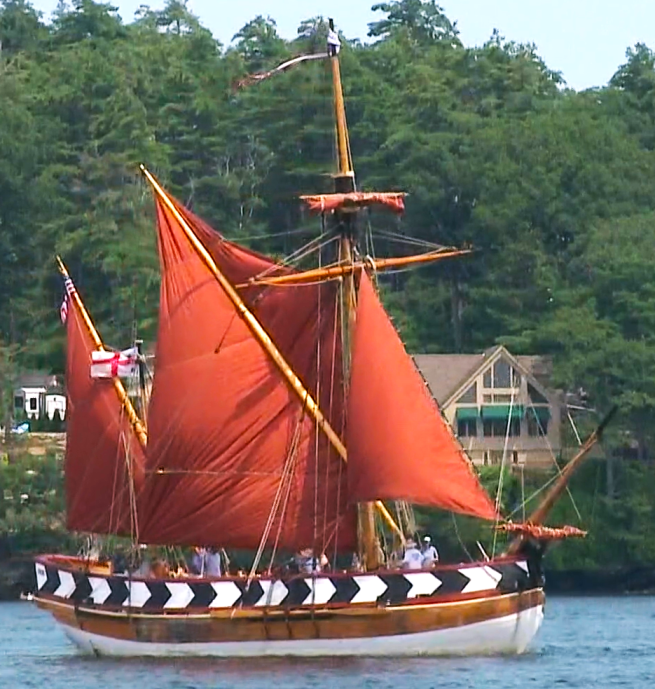
  10. A replica of the Virginia now has naval scholars wondering about some of the rigging. She is a most unusual vessel, from today’s perspective.
A replica of the Virginia of Sagadahoc plies the waters of the Kennebec in Bath, Maine, upriver from the site of the ill-fated Popham Colony. Can you imagine crossing the Atlantic in such a small craft?

Parts of my life I likely won’t be doing again

For me, this stage of winding down, or at least refocusing, includes recognizing realities of aging and finances while living in a remote area of the country. Here are some things I’d say are in my past, no matter how actively I pursued them:

  1. Hiking to the top of a mountain.
  2. Climbing a ladder more than a few steps.
  3. Hearing a full symphony orchestra in person.
  4. Ditto for attending an opera.
  5. Peyote, psilocybin, or acid. Not this far after taking up meditation.
  6. Some of the easier hatha yoga positions. Forget even attempting the harder ones.
  7. Writing and revising another novel.
  8. Sending out resumes.
  9. Camping in a tent or out in the open under the stars.
  10. Prolific orgasms.