
Compared to where I’m living, this is Bright Lights, Big City.
It was seen from the historic schooner Louis R. French before we set sail the next morning late last summer.
You never know what we'll churn up in cleaning a stall
Compared to where I’m living, this is Bright Lights, Big City.
It was seen from the historic schooner Louis R. French before we set sail the next morning late last summer.
Back to Elsie’s son, Ethel Olmstead. Several accounts have him marrying Abigail C. Harrington and having the son and three daughters, as recorded in the Census. She may be the Abigail Harrington born September 4, 1815, in Eastport to Andrew Harrington, who came to Moose Island from New Brunswick.
Another Loyalist connection?
Ethel’s gold-digger occupation noted in the Census leads us to the California Gold Rush. He died July 22, 1852, in San Francisco and is buried in Golden Gate cemetery, a potters’ field (the gravestone name has been transcribed as Esther and the birth date is 1812 by one source), although Yerba Buena is a second possibility. Both lines of argument have the same date of death but no cause. Natural or violent? Did he go by way of a sailing vessel around treacherous Cape Horn or perhaps crossing Panama? Perhaps working on one of the Shackford vessels? It makes more sense than a wagon train crossing the Prairie, considering the distance from Downeast Maine to the Oregon Trail and then points west. As for a cause of death? We can only speculate.
The Gold Rush angle thickens with the death of Major Ethel Olmstead of Calais, Maine, on March 15, 1856, at age 70, in El Dorado County, California. “No road leads up to the grave and the few trees and bushes surrounding the grave hide it from the outside world” outside the historic gold mining camp of Wild Goose Flat on the east side of the North Fork of the American River in the Sierra Nevada Range.
I do love the description of his final stop, “southerly from Rattlesnake Bar and easterly from Horseshoe Bar.” Those may be watering spots more than places in the river, should you wonder. Perhaps that’s gives you an idea of how widely some individuals traveled from the easternmost homes. His second wife, son, and daughter all continued in California after his death. In Calais, he had been a blacksmith.
This Ethel turns out to be the uncle of the Ethel of our house. I’m guessing neither of them struck it rich.
Since both Abigail and her son James were living at the time of the house sale to the next owner, more questions remain.
I’ll also note that having additional residences in Boston and New York was not uncommon for shipowners or captains, so I do wonder about Lucy Hooper’s husband’s occupation. One more thing to check out, when I can.
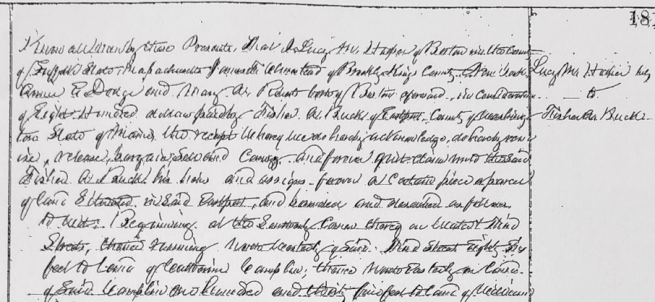
Curiously, the recording of that deed did not include a book-and-page citation to a previous sale, leaving me stymied on furthering the property’s earlier history. Still, as you’ve seen, I finally connected the line.
I doubt that I’ll ever get back to New York City in my remaining years. Even Boston seems like a rarity, though far more likely. Yet let me repeat my fascinating with subway trains and their tunnels.
And Manhattan was, after all, the center of publishing, including best-selling novels.
Tackle that from the perspective of where I live now, where the year-round population would fit on a single subway train. Add the flush of summer people and vacationers or even the cruise ships that visit and it still wouldn’t add up much more. Some of the visiting cruise ships would be like three or four trains arriving and totally discharging for a stroll around the village. A hiccup, then, in comparison to a Manhattan underground station.
My playful novel Subway Visions, grew out of my encounters in the Big Apple way back when.
As I once noted, growing up in a Midwestern city that was too small for rail mass transit, or maybe it was from an intellectual awareness of underground as a conduit of counterculture and spiritual wisdom, subways came to define a Big City for me and to symbolize the range of possibilities present therein. A subway transit system separates cosmopolitan from lesser cities. The trains are filled with real people – a cross-section of the populace between many diverse origins and destinations. As an underground, subways also present counterculture and surrealistic currents many of the riders fail to consider. Here, then, were snapshots from that route.
Later, with my wife and kids, came our outings in Boston and its MBTA.
Or my favorite Dover lifeguard’s revulsion and disgust after relocating to Beantown for college and having a drunken passenger vomit on her sandals on a hot, crowded platform.
So much for my perception of a carnival air.
Still, I think of subways the way I think of rollercoasters, even with our small downtown of boutiques, less pressured than the subway station settings of much of Boston.
Just how do those cruise ship passengers view our village, anyway?
You can find Subway Visions in the digital platform of your choice at Smashwords, the Apple Store, Barnes & Noble’s Nook, Scribd, Sony’s Kobo, and other fine ebook retailers. It’s also available in paper and Kindle at Amazon, or you can ask your local library to obtain it.
Indiana sometimes shows up as a symbolic state. It’s not just a “crossroads of America,” as it likes to tout itself, a blending of North and South or balancing East versus West. It’s an anomaly even in the Midwest, where it’s the only state not bearing an Indigenous name yet it’s named in supposed homage to the Original Peoples – INDIAN-a.
With a capital called INDIAN-apolis. Or Naptown, as it’s known in other parts of the state.
Not that there are any tribes remaining within its boundaries.
It’s not as industrial as Ohio or Illinois nor as agricultural as, say, Iowa or Minnesota – feel free to counter that with hard data, I’m just running on gut feeling here.
And just what is a Hoosier, anyway? There are theories, but it’s certainly not like a buckeye or hawkeye or badger or the Bluegrass State bordering its south or Prairie State on its west or Great Lakes State on its north. You can get a picture in your mind with those.
In short, it rather strives to appear just average, or maybe a level just below. Somehow, that’s what fuels its role as a symbol of America itself, especially the Bread Basket sprawling largely westward, even though it’s rarely in the spotlight, except for Indy 500 week, and even that reflects an earlier glory.
That wasn’t always the case, though. The place gave birth to some leftist progressives over the years as well as some vital inventors. It also gave us the likes of journalist Ernie Pyle, jazz lyricist Hoagie Carmichael, actor James Dean, radio storyteller Jean Shepherd, basketball great Larry Bird, rocker John Mellencamp, late-night host David Letterman. But no U.S. president.
Early on, it had a heavy Southern influence, especially as Quaker families fled the slaveholding economy of North Carolina, as I learned after taking up genealogy and uncovering my roots.
It also has some distinctly different regions, including the once dominant steelmaking crescent along Lake Michigan adjacent to Chicago; the hardscrabble rolling forests and quarries of southern Indiana; and the flat agricultural belt in the middle.
I got to know it first by family camping trips and Boy Scout overnight hiking excursions. Yes, in the southern tracts of the state. We also had journeys when my great-grandmother decided to visit from Missouri or central Illinois; her son and his wife lived in a dreadful corner of Indianapolis and served as the relay point. Later, I finished college, again in the rustic south, and returned four years after as a political science research associate.
I must admit my angst at what’s been happening politically and socially, even though the Indianapolis Star was always a pretty dreadful archconservative voice, proof for me that “liberal” journalism has always been in the minority.
~*~
Not that the state hasn’t had an artistic presence. Just think of the artist Robert Indiana of the iconic LOVE image (born in New Castle).
Novelist Kurt Vonnegut nailed the state for me, though other writers of note include Booth Tarkington, Theodore Dreiser, Ward Just, New Yorker regular Janet Flanner (from Paris), and young-adult superstar John Green. The poets Clayton Eshelman, with his collection Indiana, and Etheridge Knight also have had strong careers.
For my part, my novels Daffodil Uprising and What’s Left are both based in an imaginative reworking of Bloomington – I do play with geography, making the Ohio River a lot closer to Indianapolis, for one thing. My novel Hometown News could also be placed in the upper half of the state, though its setting is more generalized.
My poetry chapbook Leonard Springs definitely reflects the cave country around Bloomington.
I anticipated remaining there much longer than I did, but fate intervened. And after that, I’ve never been back, except in my memories.

Streams take off.
The era of commercial wooden ships under sail is long gone, and Maine played a big role in its glory days. The town of Searsport, in fact, late in the 1880s claimed to be home to a tenth of the masters of American full-rigged ships, and thousands of ships were built along the state’s shores. Do note, though, steamships and steel hulls were rapidly changing the business.
As I learned in researching the history of our house, built by a shipmaster who raised four captains of his own, there seems to be nowhere they didn’t venture.
Unlike many, though, the Shackford wives seem to have stayed on land rather than venturing forth with their husbands and serving as the trusty navigator.
Here are some other families for perspective.
For years, Vanity Fair closed each edition with its own Proust questionnaire of a celebrity, which I always read even when it was my introduction to the celebrity in question.
Turns out Proust merely prompted what became a popular party game and perhaps more.
Still, I’ve found that these can be a fine prompt for self-reflections, especially when I was drafting contributor’s notes to accompany my literary appearances in small-press periodicals.
Here goes.
What is your idea of perfect happiness? Being centered in the Holy Now within a circle of those I love and trust.
What is your greatest extravagance? Dining out. Or entry-level boutique wines.
What is your current state of mind? Littered across too many fields.
What is the trait you most deplore in yourself? Actions rooted in a sense of duty or obligation, rather than passion or desire.
What do you consider the most overrated virtue? Patriotism.
What is your favorite occupation? Deep writing and revision when the act becomes a form of prayer.
What is your most marked characteristic? Serious, with a twist of lime.
What do you most value in your friends? Spiritual warmth.
What do you most dislike / deplore about your appearance? Aging, and all that comes with it.
Which living person do you most despise? Besides Trump and his toadies on the Supreme Court?
On what occasion do you lie? Not lies, exactly, but less than full disclosure under uncomfortable conditions.
a historical reality
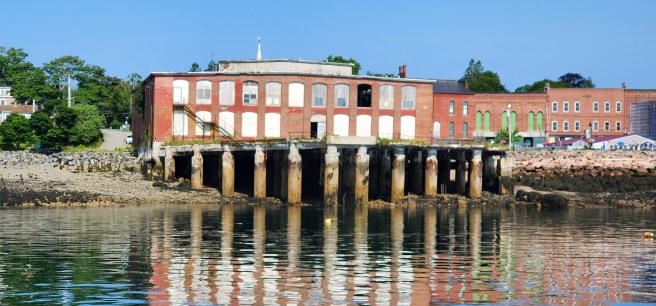 The legs of the former American Can Company factory on the Eastport waterfront are revealed at low tide if you’re out on the water. To see what’s behind them, go to my photo album, Can Factory Caverns, at Thistle Finch editions.
In a transaction dated December 27, 1859, Elise purchased the property from the Shackford estate heirs for twelve hundred dollars. In addition to Captain John senior’s sons Jacob, John, and William and daughters Esther and Hannah, grandson Samuel Shackford,, and their spouses as the sellers, we find the name Myrick D. Bibber, the furniture merchant who built at the corner of Water and Shackford streets around 1840.
Note that daughter Sarah Shackford Lincoln is not mentioned in this agreement (she died in 1846). In December 1841 she had sold “my right title and deed [?] to the estate of my Father John Shackford, late of Eastport” to William Shackford and Bibber.
In the 1860 Census, the household was enumerated under Elsie’s daughter, Abigail C. Olmstead, 46, dressmaker, personal value $15 or $1,500 — the script is difficult to read. Elsie — or Eliza, as the Census recorded her — was 83 and had a real estate value of two thousand dollars.
The household also had boarders: storekeeper Peter Kane, 21; Sarah Leighton, 72; and Sophia Gleason, 67.
Ten residents in our house would be tight, even if the two ells attached at the time had living space.
An inventory of Elsie’s estate was ordered in August 1868 after she had been declared non-compos mentis and placed under the guardianship of her step-grandson John S. Pierce [Pearce], by way of Hannah Shackford Pearce.
Her death, October 19, 1868, was reported in the Eastport Sentinel as “Mrs. Elizabeth, relict of the late Captain John Shackford, 78 years.” The age would correspond to Elsie’s.
In 1880, her daughter-in-law, Abigail Olmstead, was recorded as age 65 living in the household of her youngest daughter, Mary A. Roberts, 31, in Boston.
The linkage to Fisher Ames Buck and later owners was finally apparent.
That sale was by Abigail’s daughters.
 Jnana's Red Barn