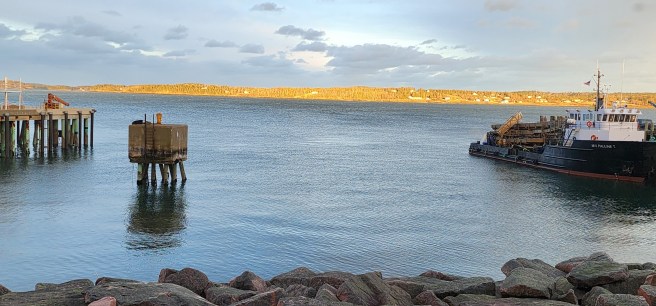
Time the view right and you may see Campobello Island, New Brunswick, turn buttery in the late afternoon sun. As an added touch, a few house windows suddenly burst into bright reflections. Here they’re simply vivid white boxes.
You never know what we'll churn up in cleaning a stall
Time the view right and you may see Campobello Island, New Brunswick, turn buttery in the late afternoon sun. As an added touch, a few house windows suddenly burst into bright reflections. Here they’re simply vivid white boxes.
New Englanders sometimes joke that a town name will be found repeated in five of the six states of the region. It can be confusing. You know, people moving from one place to a new one but keeping the town name.
Maine, however, has its own twist, since much of the settlement occurred after the American Revolution, especially in the early 1800s, when “singing schools” became a popular community activity. Many of these were related to church life and the spread of four-part harmony hymn singing. So what if someone else had claimed the town name you had hoped to repeat, here was a fresh source.
Today many songs in a hymnal carry a title reflecting the words, but in earlier times the name identified the music itself – many of their lyrics can be transported from one composition to other scores within a given syllable-count system anyway.
That older tradition is continued today in a style of a four-part cappella singing called Sacred Harp, reflecting the title of the hymnal of shape notes that it used. Shape notes, should you ask, are not all of the round kind you see in most musical scores. Instead, some are little flags called fa; others are little boxes called la; or diamonds called me but spelled mi; and the round notes are called so. And there are no instruments, not even harps, much less pianos or organs, in this often rowdy tradition.
So much for that arcane sidetrack. Back to the song names.
I had assumed that the composers applied them to honor where they were written or some such. “Detroit” is one that always makes me smile.
At any rate, during a sacred-harp singing session a while back, it was mentioned that some Maine towns were actually named for the tunes, rather than the other way around.
Bangor was one. Though not in the Sacred Harp collection, the tune was written in 1734, “Oh very God of very God,” and influential. The Maine city was incorporated in 1834 from what had been known as Sunbury or Kenduskeag Plantation. The name “Bangor” is said to have been taken from a Welsh tune. Voila!
Now, for ten examples drawn from the shape-note collection. The name of each tune and town is followed by its date of composition and then the first line of the text it accompanies in the Sacred Harp collection, the date of the founding of the town, and then by something about the Maine community.
There are arguments that some of the hymns were named after Maine towns. Just consider Mars Hill, 1959, or Mount Desert, 1985.
w i i n d
schooner or later

The first French attempt to colonize North America took place in 1604 on this island in the St. Croix River but ended disastrously. The historic site is now an international park between Maine, USA, and New Brunswick, Canada.
Access to the island itself appears to be problematic.
Here it is seen from Ganong Nature Park (east of St. Stephen, New Brunswick) at the confluence of Pagans Cove, Oak Bay, and the Waweig River while the St Croix River veers off to the west and quickly narrows before continuing the international border.
When the scaffolding around the front and side of the house came down after more than a year, the public could finally see what we had intended.
The result actually took off in some tweaks that left it looking, well, we hope for the better – things like the double windows upstairs, which I’ve discussed in previous posts.
In a small community like ours, people were bound to gawk and talk, and so far all we’ve heard has been admiration.

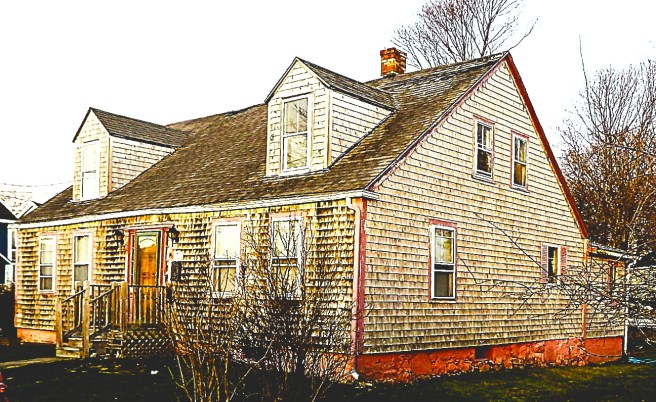
When we embarked on this project, I quipped that old-house fixes took three times the estimated time and budget, and ours (alas) has been no exception on both fronts.
Actually, more, or maybe less, if you consider the Covid whammy and inflation. Besides, we got into a great deal more than adding space overhead: many of the extra costs addressed items in our home inspection report, things like rot, wiring issues, plumbing, masonry. Oh my, it was a long list in addition to the more pressing roofing situation that concerned our insurance policy.
So much of what we paid for would be unseen: the aforesaid rewiring (throughout the house, cellar to roof), sculptural work to allow the new farming to sit atop the old (how this structure ever survived before this is a miracle), spray-foam insulation, caulking. The interior storage lofts weren’t as simple as promised but they add for architectural drama (and the name of our architect, mainly us and Adam), nor were some of the exterior efforts to preserve the Cape image as seen from the street while drastically altering the reality.
But then, when our new cedar shingling was finally finished and the construction scaffolds were removed after more than a year, how handsome, as one of the coconspirators put it. Or, from my perspective, dramatic.
I’m hoping both Anna Baskerville and Captain John Shackford, as previous residents, would approve. As well as the list of others who have left their imprint here.
Frankly, we treasure all of it.
One of the luxuries of not writing under deadline is that you can put a work aside for a while to let it season. Pick it up again a few months or even years later, and you may see so much that needs reworking or the trash can, but at other times the page can astonish you.
I’ve had that experience lately at the monthly open mic nights at the arts center, where I’ve been reading snippets from my published The Secret Side of Jaya as well as selected poems. As I was halfway through my time on the stage one night, I was struck by the thought, “Who wrote that!” It was a daring approach to fiction, completely contrary to what would emerge from the Iowa Writers Workshop, but it was mesmerizing my audience. I certainly wouldn’t write that way again, either. Still, I feel pride.
Sometimes, of course, that sense of “Who wrote that, it is so incredibly fine,” is countered by “Who wrote that piece of tripe? I’m glad it never saw publication.” Sometimes only pages apart.
Reading at an open mic or as a featured reader is a valuable test for how a page works, as you can feel from the energy in the room. Lately, I’ve been taking pages from the middle of a novel and reading them without an explanation of the previous action. Think of them as a trailer for a movie.
~*~
Well, mine is a contrast to the kids who get up on the stage and apologize for reading an old work, meaning something they wrote three weeks ago or even three months. Little do they know!
Parts of The Secret Side of Jaya go back 50 years.
~*~
At the moment, that has me wondering how non-writers revisit earlier times in their lives. Photos, old letters, trophies, musical albums?
The Argentine writer Borges took the concept so far as to ask himself about Borges and the other Borges – the one on paper and the other in the flesh – which one was which, at any given time? He no longer knew.
Or the Japanese composer who insisted he wasn’t the same person today he was yesterday, much less 30 years earlier.
Another consideration in revisiting earlier writing, especially as drafts, is that what we’re most fond of is likely to be what bothers others the most; what we’re about to toss out in the next revision may be what is most effective with our readers. The point was raised, I believe, by Joyce Carol Oates, but it’s true to my experience.
As critics of others’ work, by the way, we’re likely to be harshest on those whose work is most like our own! Too much mirror?
~*~
You can find my novels in the digital platform of your choice at Smashwords, the Apple Store, Barnes & Noble’s Nook, Scribd, Sony’s Kobo, and other fine ebook retailers. They’re also available in paper and Kindle at Amazon, or you can ask your local library to obtain them.
Contrary to widespread opinion, hell is air-conditioned, though prone to frequent power outages. This is crucial, according to the dream, since hades exists largely as something akin to cyberspace – that is, its endlessly interlocked and hushed interiors are covered with wall-to-wall carpeting and bathed in recessed fluorescent lighting, each room assigned to a particular array of deceased souls. There, they may be called up on large-screen, high-definition television screens, although addressing them is an experience akin to conversing with an advanced Alzheimer’s patient. Unlike most funeral homes, these room contain is little furniture and no flowers.
The experience of hell is not fire, as commonly thought, but rather that there’s nothing to do. The result is endless boredom, with only the memories of a single lifetime to reflect on. There’s no music, neither harp nor lyre, and singing never emerges from the throat. Here, insanity is not an option. Escape is impossible from the utter silence. This is solitary confinement amplified, without even periodic meals for variation. The basis of humanity is awareness. In damnation, the awareness is amplified – awareness of nothingness.
Visitors to this realm must be careful not to be separated when a power outage strikes. Do not go to the bathroom alone or attempt to double your productivity by working multiple rooms at the same time. Should two members of a family obtain an unequal knowledge of the deceased – information gleaned separately during their quest to better know the departed, but not yet shared with each other – they may be told they cannot leave hell, but must themselves join its ranks. This is, of course, a bald lie, but getting through its sales pitch is emotionally exhausting.
The power outages occur to reinforce the awareness of eternity. That is, they retain a rhythm of time within timelessness.
Dante, we should note, wrote of inferno before electricity became part of human life. Had it been, he may have placed the worst offenders in electrical chairs, with continuous executions. It’s possible that happens in the deepest recesses, contributing to the power outages. I report only on what I’ve seen, briefly. I remember nothing of our guide, other than his dark, single-color suit and highly polished shoes leading us down a set of three steps into our last room.
~*~
My, I don’t quite know now where that originated in my mind. But there it is, from some deep past.

Many of the lighthouses on our end of the Maine coast are hard to see, if at all, from the land. The Libby Island Light is a good case, glimpsed here from Bucks Harbor.
Should the opportunity to do a lighthouse cruise come along, I’m definitely game.
To explore related free photo albums, visit my Thistle Finch blog.
Whatever happened to the art of witty retorts? For that matter, the cozy gathering places of sophisticated regulars in urban centers, where at least one of the participants slyly made note of the ongoings?
Does this have anyone else evoking a picture of the New Yorker crowd at their daily luncheons at Manhattan’s Algonquin Hotel, where Noel Coward, Harpo Marx, and Dorothy Parker, among others, held forth. I’m surprised to see that cartoonist James Thurber wasn’t among them, especially since he resided in the hotel, nor was Cole Porter diddling away at a piano. Well, Thurber didn’t enjoy their penchant for practical jokes.
Still, on other occasions, the Algonks delighted in charades and the “I can give you a sentence” game, which spawned Parker’s memorable sentence using the word horticulture: “You can lead a horticulture but you can’t make her think.”
I’m assuming you groaned there.
Now, let’s consider ten more caustic wisecracks from Dorothy herself:
Let’s not overlook her classic verse:
I like to have a martini,
Two at the very most.
After three I’m under the table,
after four I’m under my host.

