Cassia gets her name from the flowering acacia tree. The honey locust is a related species.
Bella is a grandmother Cassia never meets in the flesh in my new novel, What’s Left, but she’s a vivid figure in the granddaughter’s life all the same.
Bella comes to be the colorful face of the family restaurant, Carmichael’s, a woman who seems to know everybody in town and brightens their lives as soon as they walk through the door.
She may be the mother of five children, but somehow she manages to juggle both work and family – perhaps thanks to the older generation’s active support.
Among the gifts I received at Christmas was a tablet laptop, with the expectation I’d be using especially for Kindle editions – including my own ebooks.
But so far what I’ve really appreciated is its ability to stream music.
For me, that’s meant Q2’s New Sounds and Operavore from WQXR in New York and WHRB from Harvard University in Cambridge.
With solid jazz from 5 a.m. till 1 p.m. and some adventurous classical continuing till 10 p.m., plus the Metropolitan Opera on Saturday afternoons and another opera on Sunday night, my listening is mostly on the Harvard station. Admittedly, the student announcers can be unintentionally amusing in their pronunciations and amateurish touches, but I usually find that more amusing than annoying.
This spring, though, I finally got to experience an amazing tradition on the station – the finals week Orgy, when the regular programming is set aside for in-depth presentations of specific composers or performers.
Do I really have to define this? To be honest, until recently about all I knew about the topic came from overhearing someone who’s truly terrified about it, but then you have to realize he’s terrified by everything, including his own shadow. A little research, though, casts the possibility in a much calmer light. For instance:
It’s essentially a suburban phenomenon, should it erupt, starting at the malls. You don’t go there, do you?
That also means it’s afraid to venture into the ghetto – and anything close to center city.
It self-selects for Trump country, something like the plagues of Egypt. By the way, there’s no harm in sprinkling your doorposts with sheep’s blood, just in case. (You may want to keep some on hand.)
It also heads straight for Walmart. Think of the cockroach hotel ads, “They go in but they don’t come out.”
It runs in terror at the slightest whiff of high culture – paintings, fine literature, jazz, classical music, opera (especially) ward it off. Keep a good supply of Shakespeare quotes at the tip of your tongue. They’re better than any arcane spell you could cast.
There’s some debate about whether it’s spread by infected people or by an airborne virus. Here’s a hint: It has no sense of humor – it’s completely defenseless against laughter. Or really bad jokes. (“You hear the one about two zombies go in a bar?”)
As people? Traditional slow zombies will get in the way of the newer mutant fast zombies. They’ll start tripping over each other, which will lead to biting their rivals. New research indicates their blood types won’t match and that will be that. End of the show.
Or consider traffic gridlock. Major highways and bridges stop moving at a given volume – and many zombies will expire right there. You really didn’t expect them to be walking anywhere, did you?
And as a virus? Simple. Stockpile your vitamin C. And take it faithfully.
They won’t want your home-canned green beans. Or any other greens, for that matter. It’s too quiet where I live. Zombies would be looking for live action. I’m more worried about garden slugs.
~*~
So what potential global catastrophes are keeping you up nights? And how would you advise coping?
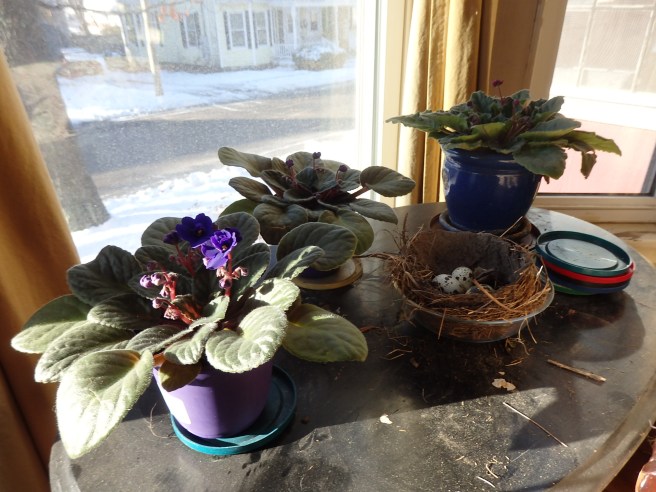
African violets in a cozy window.
Of course, this is totally unrelated to the theme. Just another thing on my mind.
First, my apologies for not being, well, as present and active as I would have liked over the past five months. When it comes to blogging, most of my material has flowed from what I scheduled before the end of last year. I haven’t added fresh dispatches or participation much at other sites, and it’s showing.
It’s not what I intended.
Let me explain.
Shortly after the release of the Advanced Reading Copy of my newest novel, What’s Left, back in the first week of January, I found myself in the emergency room for what I thought would be more inconclusive tests, but, well, my real-life plot thickened. We’d just had a big snow, and I was hoping to be out in it on my cross-country skis for the first time that winter. But I was having what I thought was a breathing problem, one that several buddies in the medical profession had informally thought might be a walking pneumonia arising in a bug that made the rounds last fall.
The previous week, though, I’d finally gone in to have my primary care physician check that out. The good news, he said, was that my lungs sounded clear. But he also ordered X-rays, scheduled a stress test, and then, instead of his usual droll humor, said very firmly if this happened again I was to go straight to the ER to have it checked out while the symptoms were still present.
Six days later – and two days before my scheduled stress test – we had that big snow. The symptoms were back. Despite my reluctance to go to the ER, my wife and elder daughter insisted otherwise, and since said daughter had just driven into town, her car was already cleared off and warm. She dropped me off at the hospital.
In the (still imaginary) movie version of my new novel, What’s Left, who would you cast as Cassia’s great-grandfather and his brother — our Aristotle and Pericles (Ari and Perry)?
~*~
The man behind the counter of this diner in West Frankfort, Illinois, is its proprietor, Gus Vardas. Photo from Kim Scarborough via Wikimedia Commons.
In my novel, the family restaurant could have been like this.
Carmichael’s, the restaurant her family owns in my new novel, has me looking more closely at others.
In his prime, as his parents and their siblings recede from the business, Stavros is free to operate largely as an autocrat.
Is that really such a good thing? Or does his wife, Bella, keep him in line?
As my draft once explained:
He’s not only preserved Papou Ari’s concept of our own Mount Olympus, he’s expanded and upgraded its holdings. The once neglected in-town blocks are gaining new panache.
~*~
I doubt Stavros would have seen his position as nearly so liberated. He probably would have seen himself hedged in by suppliers, prices, customers’ expectations, health inspectors, taxes – oh, can’t you just hear him rattling off a long list?
Imagine yourself as the boss in your own dream job. What would that be? And what policies or practices would you do uniquely your own way?
While Orson Welles usually gets the genius kudos, much of the creative brilliance in this 1941 masterpiece arises in the seasoned experience of his collaborators Herman J. Mankiewicz and Gregg Toland.
The nature of the story itself. It’s not exactly likeable. We want to befriend Kane but can’t. He starts out as charming but more and more becomes a sphinx. The newsmen themselves are nobodies. As for his wives and lovers? And yet there’s something gripping in the rise and fall of this spoiled rich boy turned tycoon and populist turned brutal cynic and failure, plus his times. (Sounds topical, considering the White House now, doesn’t it?) Pulling this off is much more difficult than it sounds, and yet we’re swept along throughout. In short, anything but a conventional screenplay.
The soundtrack. Welles and Mankiewicz were grounded in radio drama, not filmmaking. And so they brought to Hollywood a revolutionary ear for not just dialogue but everyday detailing background sounds like footsteps and doors. Their radio perspective also meant they could envision a scene from the way it unfolded within a viewer’s head and not just how it might appear on a stage in front of us, the way directors and writers had framed movies before this.
Cinamatographer Toland. In his work with Hollywood great John Ford, Toland had begun exploring a new technique called deep focus, which allows multiple things to be present within a single shot. In Kane, this comes to full fruition. Tons have been written about what’s happening in the background or how multiple items come together to make their own statement or put everything into a fresh comprehension. And it holds opportunities for emotional depth previously absent in cinema.
Optical illusions. Again, give Toland credit. They serve as guideposts, according to film critic Roger Ebert in his lovefest to this film.
Visible ceilings. You never saw these in a movie before. Sometimes it required cutting a hole in the floor. But it made for some much more dramatic visuals. Again, Ebert has much to say about this, for good reason. I think the ceilings are an emblem of many other similar breakthrough touches that advance this movie light years ahead of convention.
The blending of drawings, real sets, and wipes. Welles was surprisingly economical in obtaining some of his spectacular impressions and moving the story across time.
The witness. Always in a corner, observing or even commenting. A great storytelling device.
Complete artistic control. RKO executives agreed to make no cuts in the footage. In addition to writing, directing, and taking the starring role, Welles had unprecedented complete artistic control. Amazing. The one compromise was forced by the film board, which nixed the brothel scene. Alas.
Common misperception. Unlike the widespread tale, the story’s not even about William Randolph Hearst, whose opposition undermined of its chances for commercial success.
Kane prompted Wes Anderson’s The Grand Budapest Hotel in homage. Not that I viewed them in chronological order.
Oh, yes, if you want to know about “rosebud,” you really do have to look up Ebert’s take. We do miss him.
~*~
What movie and its special effects have especially impressed you? These days we practically take them for granted.
Her uncle Barney undergoes a remarkable awakening in my new novel, What’s Left. Instead of going to college, he stays home and soon finds himself fully responsible for managing the kitchen of the family restaurant.
He has, though, tasted the social upheavals in the wider world and quietly rebelled at the strictures of his parents. The status quo is endangered.
The return of his older brother, Dimitri, changes everything. Barney is pressed to expand the menu into dishes drawn from unfamiliar cuisines, flavors, and ingredients, and that requires mastering more demanding techniques and advancing his ability to taste subtle nuances. All of that puts him at the center of intense debate and experimentation, abetted by his wife, the lively Pia, plus the family circle of Graham, Nita, Yin, and Cassia’s father, even before their business expands into related food fields including a bakery, a brewery, and a natural foods grocery.
It’s a lot to put on his plate, but I know it can be done. Barney has that kind of curiosity, for one thing, and a tongue to match.
As Cassia discovers, in a passage that’s evaporated from the final version:
Barney’s into astrology and palmistry, through the grandmothers. When I ask about drugs, all I’m told is, Not the hard stuff. And even with the Buddhism, for him, hippie is about the music, more than anything else – as you’d hear in Carmichael’s kitchen, night and day.
~*~
Let’s get back to basics. Imagine yourself sitting down with this group for a night off. They’re phoning an order for home delivery. What’s your favorite pizza? Why? Who do you think wants the one with anchovy?
~*~
Kore in Acropolis Museum. (Photo by Ricardo Andre Frantz via Wikimedia Commons.)
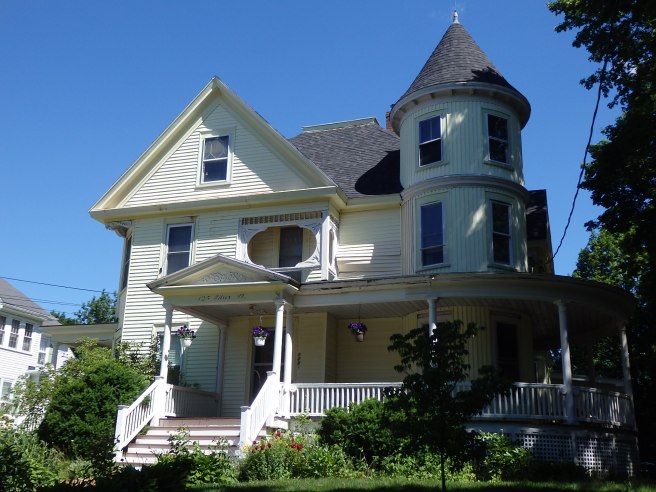
A large Queen Anne-style house with a distinctive witch’s hat tower something like this is the headquarters for Cassia’s extended family in my new novel, What’s Left. If only this one were pink, like hers.
A common question for novelists asks whether their book is driven primarily by the development of its characters or by the actions of its plot. It’s not one that had been front-and-center for me until my newest work began taking shape. For one thing, my previous fiction all falls under the category of Experimental, and, for another, I’ve usually been of a contrarian nature. Maybe the earlier stories were more event or episode driven than action propelled, and characters added whatever they had. As I’ll say, up till now. Or, as I might add, a journalist is more concerned about what’s happened than the motivations of the individuals involved.
My new novel, What’s Left, was initially envisioned as a kind of post-hippie history – an update flowing from the ending of my first published novel, in fact. But then it began turning into a different kind of history, going back further to her immigrant great-grandparents. Well, at that point the story could develop either way, based on the characters or their encounters. What clarified the direction for me was my decision to have her father vanish in an avalanche halfway around the globe, which precipitates her obsession to know just who he really was. And that made it character-driven.
As she discovered more about her father – and her colorful, extended family – I realized I wanted to know more about Cassia herself, starting with her reactions to the clues she was uncovering. In the end, What’s Left is about her, told in her voice from age 11 into her early 30s. As for the history? It’s bound to be in her blood.
Fresh asparagus. You can’t buy anything like this.
Our own lettuce in abundance.
Whales are migrating north — a great time to take a whale-watch cruise.
If you could only see my ferns in all their glory.
The kids are still in school … in case we decided to play tourist, things are still uncrowded.
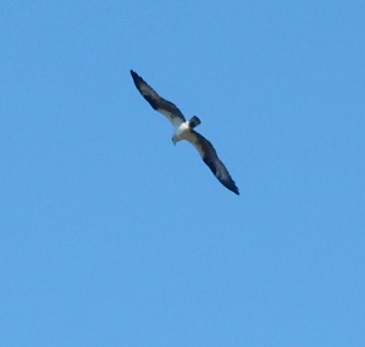
Alewives migrate up the river, pursued by cormorants, fishermen, and eagles, along with osprey.
~*~
What do you like about May?
Osprey are truly incredible birds. They can hover over a river, do a power dive into the water, and emerge with a fish that they then turn to face the airflow. Not that I’ve yet captured any of that on my camera — some photographers specialize in the challenge.