Think of this as a referendum. No nation can be great if its soul is ugly. Stand up for factual truth rather than unsupported claims.
As the bumper sticker says:

Love this bumper sticker. And to think, these days it’s a political statement.
You never know what we'll churn up in cleaning a stall
Think of this as a referendum. No nation can be great if its soul is ugly. Stand up for factual truth rather than unsupported claims.
As the bumper sticker says:
Love this bumper sticker. And to think, these days it’s a political statement.
When it comes to election results in most of the locales I’ve lived in, I’ve awakened to find myself in the minority. Sometimes, discouraged, I’ve wondered if it’s even made sense to show up to cast my ballot.
On the other hand, believe me, being victorious can feel unbelievably vindicating.
That said, let me argue that casting your vote is not about winning. It’s about taking a stand.
Here are ten reasons you need to do it – especially if you live in the United States today.
~*~
What reasons would you add?
How far can a restaurant extend its business base? Its “brand,” as they say. This passage is prompted by meals at restaurants that expanded into new revenues, even though I cut this from the final version of my new novel, What’s Left:
Still, the playful concept feeds into what emerges around the corner as an elegant multi-purpose restaurant, plus a bookstore, art gallery, gift shop, and even a small greenhouse.
And that’s before the bakery or brewery comes into sight. For whatever reason, though, I shied away from launching Carmichael’s own brand of bottled products.
This has me thinking of a couple of specialty food markets on the tourist trail that include a cafe featuring their products. Turns the concept I’m discussing around, in effect.
The identity, of course, is built on something that makes us go gaga. Something that makes us want to return again and again.
What’s someplace that features your favorite comfort food or special treat? Would you wear a T-shirt proclaiming it? What do you think of restaurants that have a gift shop attached? Does it add or detract from the mission?
~*~
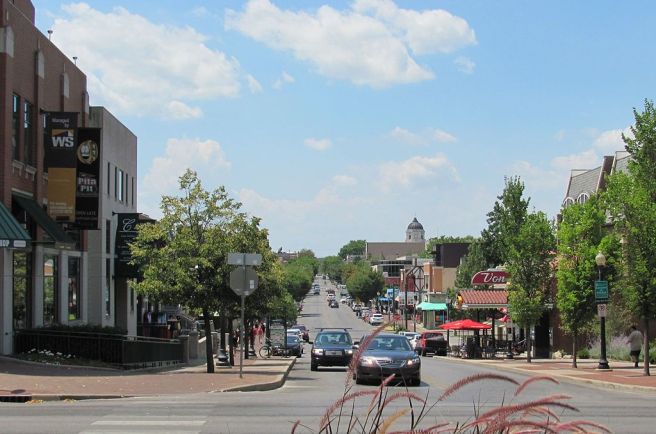
Her hometown may have been something like this.
I had long been perplexed why my modern American poetry class in the late ’60s had spent so much time on Edwin Arlington Robinson, especially since we never got up to more pressing figures like Kenneth Rexroth, Lawrence Ferlinghetti, Allen Ginsberg, or Gary Snyder.
I made a jab at this plaint in my Daffodil Sunrise novel, where our budding photographer was panicking while typing away on his take on Robinson.
More recently, when reworking that manuscript into Daffodil Uprising, I found myself running with the poet more fully.
For one thing, I had to admit he was more contemporary than I’d allowed back in college. His lines and insights are clean, prescient of new approaches, even snippy.
For another, he could be bitter, sarcastic, depressed – as were many beats and budding hippies.

His parents themselves weren’t that far from bohemian, either. His mother couldn’t even come up with a name for him, after all, and that fell to a circle of “summer people” visiting Maine. They put names in a hat or whatever and the slip of paper that came up was Edwin. The woman was from Arlington, Massachusetts. Bingo. We have a middle name.
His eldest brother went from being a successful businessman to bankrupt and alcoholic to die in poverty with tuberculosis.
His other brother, a physician, became addicted to morphine and died of what might have been an intentional overdose.
Living the past 31 years in northern New England, I’m now familiar with the culture Robinson grew up within. Gardiner, Maine, is a few hours up the road from us. I have friends whose roots are there.
Without giving a spoiler, let me say Robinson is now an active figure in the new novel. He infuses some wonderful, if sardonic, perspectives to the younger generation, and becomes a foil for similar spirits from the Edwardian past that sway the photographer’s girlfriend, too.
Would he talk this way, though? Who knows.
By now we’re dealing with fantasy, anyway, and that’s so unlike the concrete details of his verse. Again, we’ll excuse ourselves with poetic license.
Okay, I know churches don’t have podiums for their music directors, but Rick Gremlitz at First Parish Church (UCC) in our town does conduct with a short white baton. What’s amazing is that he’s been doing this, in that venue, for a half century.
Among other things, the house of worship – serving the oldest congregation in the state – has its Belknap concert series where world-renowned organists perform on a remarkable hybrid organ. Parts of it are historic, as it Hastings and Hutchins, and part are state-of-the-art electronics, probably installed during Rick’s tenure. Any doubts in my mind about the sound itself vanished when bete-noir Cameron Carpenter did one unforgettable, amazing workout on the machine one afternoon a few years ago. It survived. The audience was left in a swoon.
Look, I’m a purist and lean toward the E. Power Biggs line of thinking that contrasts sharply with the Virgil Fox excesses that Rick adores. He addresses the man as the great Virgil Fox. I forgive him. We all have our icons.
So be it.
In his ministry, Rick’s led a number of Handel Messiah performances in the sanctuary. Last year it became an open sing with prepared soloists and two guest conductors. Seated between two seasoned voices, I discovered that the choruses are easier than they sound, not that I was anywhere near perfect. It was a most exhilarating event.
Today, though, Rick’s acclaimed friend Hector Olivera returns to the console, with a twist.
An ecumenical community choir, including yours truly, has been rehearsing to join in the performance.
We’ll be performing the world premiere of an anthem composed by Kevin Siegfried for the occasion, and we’ve been rehearsing weekly since mid-September at the Methodist church. How can you possibly keep something like this a surprise?
We’ll see. It’s still a special occasion. And, I might add, one of the joys of living in a relatively small community.
I’m hoping it comes off well. Especially if I don’t miss a cue while we’re singing.
The Mixmaster is back.
When my first novel was published, back in 1990, I was described as “a mixmaster of ideas, images, jokes, philosophy, and nonsense that defies categorization” – as well as “very eclectic and ebullient.”
I’m realizing how much that still fits, and so I’m returning to it as a core of what some might call branding.
As one longtime friend recently described me, I’m “an eclectic human being with a funky sense of humor and a large perspective.”
That’s what I like to do as a writer and thinker – toss a wide range of colorful things together and concoct fresh and exciting connections.
So if that’s what I do and, as I hope, do well, that leads to a new label: Mixmaster Supreme.
Now, where are the frozen strawberries?

Maybe I really am afraid of nearly everything. Here are 10 more.
~*~
It’s your turn to come clean.
~*~

Of course, this is totally unrelated to the theme. Couldn’t pass it without getting out the camera.
As writers, most of us start with particulars we’ve known and try our best to abstract them – that is, make them more universal.
The dorm quad I now call Mulberry Row in my novel Daffodil Uprising is loosely based on one where I lived, though there was none of the clandestine financial intrigue I create to symbolize the old-boy network and its manipulative contortions. No, when I lived there, it was all simply a tad dowdy.
The dining hall, too, was far from the gloriously remodeled Annenberg Hall in Harvard’s great Memorial Hall – everyone who peeks in seems to utter something about Hogwarts – but it had its own low-key potential.
When I drafted the earlier novel, I had no idea what was about to happen in reality. The quad has since been renovated and refocused. From this distance, it all looks pretty exciting, actually.
I’ll assume the fictional benefactor Mildred Chouthonian would be proud.


Last week, I wrote about relearning Spanish and the tree of Crowns the online Duolingo course uses.
As I’ve been earning Lingots for rebuilding those, I’ve had a series of sessions where I’m presented with a sentence or phrase to translate and a set of mosaics or buttons to choose from, one word on each. It’s kind of like a Magnetic Poetry Kit, except that you have to click on the word you want.
In the first hour of my day, my mind wants to run off in whimsical directions.
Here are a few examples.
Approved answer: The girl wants sugar on her apple.
Rejected answer: The girl wants sugar on her husbands.
(Or just a sugar daddy?)
Approved: Are you going to school today?
Rejected: Are you going downstairs today?
(There are days we don’t want to get out of bed, right?)
Approved: I want to go to the movies with my friends.
Rejected: I want to go to the movies with my girlfriend.
(Except that she doesn’t like the action-adventure stuff we do?)
Approved: I always go to work by bus.
Rejected: I always go to work by duck.
(There’s an opera about a guy who goes to work on a big swan. I’d settle on a big yellow duck, wouldn’t you?)
Approved: Do you have to work today?
Rejected: Do you have to speak today?
(Some days simply speaking is a lot of work … especially if it’s in Spanish. That’s the polite explanation. The other one is “Firme la boca,” I think.)
Approved: We don’t open the messages.
Rejected: We don’t open the refrigerator.
(You never know what’s inside.)
Approved: We are buying a car.
Rejected: We are buying a brother.
(Hope he’s worth it.)
Approved: My husband never gets up with me.
Rejected: My husband never gets up on me.
(That would lead to a lot of words we haven’t learned yet.)
Approved: I want a modern kitchen.
Rejected: I want a modern husband.
Also rejected: I want a modern dog.
(Oh, don’t even try to make the connection. Puleeze!)
My new novel Daffodil Uprising is a meatier, more emotional work than its earlier incarnation, Daffodil Sunrise.
Here are ten reasons.
Be among the first to read my newest novel.


