IVY TOWERS? OR IVORY TOWERS?

Well, it was fun trying to envision the possibilities of the new operation. But I left plenty of detail in the final version of my new novel, What’s Left, as it is.

In contrast to her father’s desire for a bold contemporary design, here’s a whimsical touch from an earlier draft:

Graham suggests we plant climbing ivy. Says it’s subdued, reflects the campus across the street and softens the harshness of the old textbook building itself. He’s right.

Why stop there?

In the emerging design, a permanent awning extends over the sidewalk. Graham’s suggestion of not just ivy on the wall but flowerboxes under the windows meets widespread approval. And the entry opens into a light-filled atrium.

~*~

Well, I’m starting to like the look of it. Now, to see what happened to this.

I do have to remember that all of this is a backdrop for a bigger story – Cassia herself.

Which reminds me. There are many fun movies about food, wine, and restaurants. Which of your favorites would you suggest we see?

~*~

A Greek Orthodox icon of St. Nicholas by Nicholas Hartmann. (Via Wikimedia Commons.)

Cassia’s roots included inspiration like this.

WHO WOULD PLAY HER BABA?

One of the glories of a literary work comes in creating the entire scene and its characters in your own head. Still, a common referent nowadays is in our familiarity with movies and television actors and actresses. Many of them even become “celebrities” whose every sneeze is flashed across social media.

In an imaginary movie version of my new novel, What’s Left, who would you have portray Cassia’s father, Baba?

I’d be tempted to have him be rather faceless, actually, maybe ethereal or even a large puppet. But you probably would go for something far more realistic.

~*~

Dinner at Elia restaurant in Kos, Greece. (Photo by Michal Osmenda of Brussels, Belgium, via Wikimedia Commons.)

In the family, Cassia may have had food like this.

TEN THINGS I LIKE ABOUT REVELS

Boston Revels is an organization – maybe I should say institution – devoted to keeping community tradition alive through music, storytelling, dance, and the like. It has affiliates in nine other cities.

Here are 10 examples of its activity:

  1. The annual Christmas production. Revels packs Harvard’s historic Sanders Theatre for 17 performances of its holiday show. Each year, there’s a new theme – Renaissance Italy, Wales, Spain’s Camino de Santiago, Victorian England, Canada’s Acadians combined with Louisiana’s Cajuns, for instance – along with some crowd pleasers that can never, ever, be omitted. It’s a great way to introduce children to theater and live music and dance, but adults are all enthralled by the action. These shows sell out quickly. And one thing I value especially, there’s no mention of Santa Claus.
  2. The CDs. Revels recordings become quite a library of world music.
  3. George Emlen. The now retired music director of 34 years seemed to know all of his musicians by name – and something about their families, too. He was a wonderful, caring conductor, composer, pianist, organist, and arranger building on a unique sound for the company and helping shape the annual productions. Working in his chorus was a lot of fun. I remember hearing him converse in Mandarin with one of our altos after one rehearsal. And to think, he’d once earned his living as a blacksmith!
  4. George founded the Revels Singers, a community chorus that includes a lot of people who’ve performed in the Christmas productions. (That part’s by highly competitive auditions – thank goodness we’re open to all.) We sing quite a range, from the earliest written harmony in its Eastern European roots to South African and American shape-note and Shaker to, well, recently we were immersed in Gospel music. Our repertoire spans nearly 30 languages, and we sound incredible.
  5. Megan Henderson. Amazingly, we found a new music director who could be a reincarnation of George. As she says, We all love George.
  6. The friendships that emerge. It’s an incredible group. Sometime I might even tell you about Mike, whom I join for half of my weekly commute. He drives the Boston traffic part.
  7. Our gigs. Among Revels other events throughout the year are some for our chorus. Performances are always a revelation for me, music-making quite different from rehearsals. Each one has been memorable.
  8. Our rehearsal space. We meet in the social hall of an 1895 church in Watertown, a room with bright acoustics. The adjacent sanctuary has marvelous stained glass, including five windows by the Louis Tiffany studio, and a four-manual Aeolian-Skinner pipe organ that was left untouched in the ’60s and ’70s, when many others were reworked to match a change in tonal tastes. This one’s still mellow and sweet.
  9. Patrick Swanson. The artistic director of the operation, he developed the theatrical dimension, taking the Christmas shows from the hodge-podge of the earliest day into the sophisticated themes they now develop. It’s amazing what he and his team can do within the confines of the open Sanders stage, which was built more for lectures and maybe chamber music than for theater or dance. He has a sharp eye for detail and watches over all like a hawk.
  10. The children’s chorus. Performing with them is a delight.

~*~

What’s one of your own special group activities?

~*~

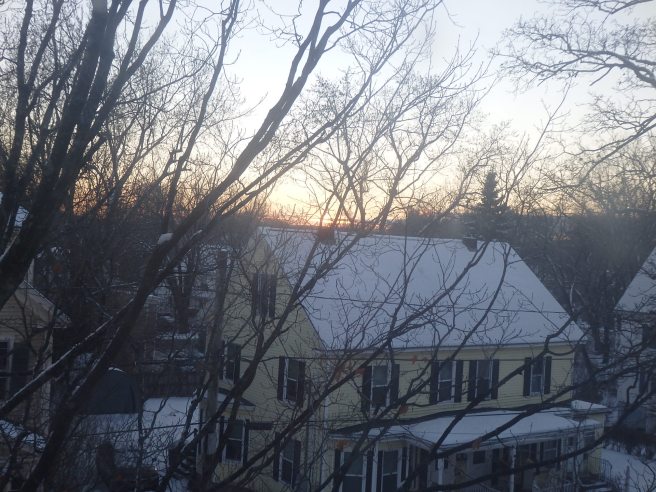
Where I live, we’ve already had our earliest sunsets. Revels celebrates the solstices and equinoxes each year.


NOT YOUR TYPICAL FATHER

The driving force for my new novel, What’s Left, is her struggle to recover her father after he vanishes in an avalanche halfway around the globe when she’s 11. It’s a tall order, even when it’s self-imposed.

She would say he’s not a typical father. He comes from mainstream roots in Iowa, becomes a professional photographer and starts practicing Tibetan Buddhism before marrying into her mother’s close-knit extended household, one based on running a family-owned restaurant where Cassia and her cousins all wind up working from an early age.

The crucial twist comes through her aunt Nita, who guides Cassia into a long, patient investigation of the photos her father left in disarray in his studio. Bit by bit, the focus shifts to Cassia’s discovery of her own nature, dreams, and destiny – one where her extended family plays a big role.

Continue reading “NOT YOUR TYPICAL FATHER” →

PLAYBOY CENTERFOLDS VERSUS MY OLD GIRLFRIENDS

Like many young males of his generation, Kenzie in my new novel Daffodil Uprising gazes on the Playboy magazine centerfolds as an ideal of feminine form.

In fact, he mysteriously receives a manila envelope containing about two dozen of them, and they wind up being taped to the ceiling of his dorm room. They fit perfectly in the recessed space between the beams.

Never mind that he still didn’t have a real love life. She would be coming along shortly.

Thinking of this while revising the book had me revisiting images of some of those classic “playmates” online. To my surprise, they’re far more ordinary than we guys would have admitted at the time. To be honest, I think of at least ten of my former girlfriends were more attractive.

My, have times changed! Just think of all the selfies floating around on the Net or all of the plastic surgery enhancements now considered routine. Baring skin no longer has the risqué air it carried back then, either.

Me? I still prefer a natural look. As did Hef back then, when the mansion was still in Chicago.

Note the space between the beams in the ceiling. Perfect for displaying Playboy centerfolds, back in the day. By the way, we never had bookcases as standard furniture. Had to make our own with boards and concrete blocks.

TEN MORE PERSONAL TRAVEL DESTINATIONS

Travel’s been largely on hold for me – just too much to do at home, for instance, especially when it comes to writing. But what if that were to change?

  1. San Francisco, Seattle, and Yakima. I haven’t been back to my beloved Pacific Northwest since leaving in 1990. This would provide a basis for an memorable sweep.
  2. The East African Quakers have much to teach the rest of us, and I can’t think of a better introduction to this mysterious continent.
  3. Cumbria, England, and Lurgan, Northern Ireland. These two places, a short hop apart on the Irish Sea, are central to my Hodson ancestry. I’d love to see where we’re from.
  4. Apart from the museums, classical music, and theater attractions, I’d want access to some early Quaker minute books – especially those pages marked “too faint to microfilm” in Lurgan’s surviving records.
  5. Alsace, France/Germany, and Switzerland upstream. On my Grandma Hodson’s side, these are my places of origin.
  6. Kyoto, especially. Did I mention my long fascination with Zen Buddhism or Japanese cuisine?
  7. The Himalayas. Or my interest in Tibetan Buddhism along with the world’s tallest mountains? (Yes, I know it will make it more difficult to appreciate the summits back home, but that’s got to be well worth the encounter.)
  8. Canadian Maritime Provinces. These are just up the coast from us but have remained a world away. Think I can fix that in the upcoming future?
  9. Anasazi ruins and Albuquerque. The American Southwest is a huge blank in my explorations. This sweep would end with a visit to some very special friends in their new locale.
  10. Australia and New Zealand. From here, they seem incredibly unimaginable. Only one way to fix that.

~*~

What’s on your travel dream list?

~*~

Continuing the poetry parade, see what’s new at THISTLE/FLINCH.

BOTH NOVELS TAKE PLACE IN THE SAME TOWN MANY YEARS APART

My newest novels are both set in the same college town, but each one focuses on a different locale within it.

Daffodil Uprising takes place largely on the campus, and even when three of the characters move off into a shabby apartment, their focus is on college. It’s an outpost in more ways than one.

What’s Left, in contrast, settles into a neighborhood between the school and the courthouse square. The town and its university aren’t even named in this account. Instead, Cassia’s family’s restaurant is the center of attention, along with their surrounding properties. This story has a strong sense of the town itself, including the river, and the family’s impact on the community.

One thing I’ll confess is that in abstracting the location, I’ve created a place that doesn’t actually exist in the state. There’s nowhere along the Ohio River that’s just an hour from Indianapolis. Consider it as something like the visual tricks Edward Hopper performed in his paintings. Things feel right, despite the realities.

Southern Indiana, with its hills and forests, really is defined in large part by its relationship to the river. I hope I’ve heightened that sense.

AN UNCOMMON FAMILY

The close-knit extended family of Cassia’s childhood is quite different from her father’s. Hers is the one he leaped into when he married her mother. What was he escaping? And what was he embracing in the act?

As my newest novel, What’s Left, unfolds, hers is a family with a mission and a place in the world. Everything her father accomplishes in the ensuing years is enabled by their enterprise and unity.

For Cassia, her brothers, and her beloved cousins, the big question becomes: Will this be too confining for their personal ambitions and dreams? Or will it assure them a secure future if they settle in and stay put?

Do they ever think of themselves more as a tribe than as individuals? We follow our elders in decisions and wisdom?

A family business is full of peril. How will they choose?

~*~

In a passage I cut from the final edition, the family’s spiritual practices are considered. On one hand there’s the Orthodox Christianity; on the other, Tibetan Buddhism.

Well, you could also see it as a refuge for my family. As a calming influence guiding us through some turbulent times. Through it, our eyes returned to the greater good in our shared mission. We were given a vocabulary and fresh ways of thinking about the eternal elements of life. We accepted its reliable foundation in teaching these to our children – including me.

~*~

Well, that could be one uniting factor. I see another family that’s held together by its emphasis on sports and sports medicine. As for others?

What holds your family together? How far does it extend?

~*~

A large Queen Anne-style house with a distinctive witch’s hat tower something like this is the headquarters for Cassia’s extended family in my new novel, What’s Left. If only this one were pinker, like hers. (Rochester, New Hampshire)

TEN THINGS I LIKE ABOUT DECEMBER

  1. The Metropolitan Opera broadcast season begins.
  2. Asteroid showers. Some of the year’s best, and the night sky can be intensely sharp.
  3. Bundling up … including sweaters.
  4. Advent … seriously … and its end.
  5. Candlelight.
  6. Brussels sprouts.
  7. Christmas cards and letters.
  8. Christmas Eve … the tree comes in, gets decorated, then we hit the ‘nog and cookies. They’ve been off-limits till now.
  9. Christmas morning … where gifting is an art.
  10. Boston Revels’ production at Harvard’s historic Sanders Theatre.

~*~

What do you like about December?

~*~

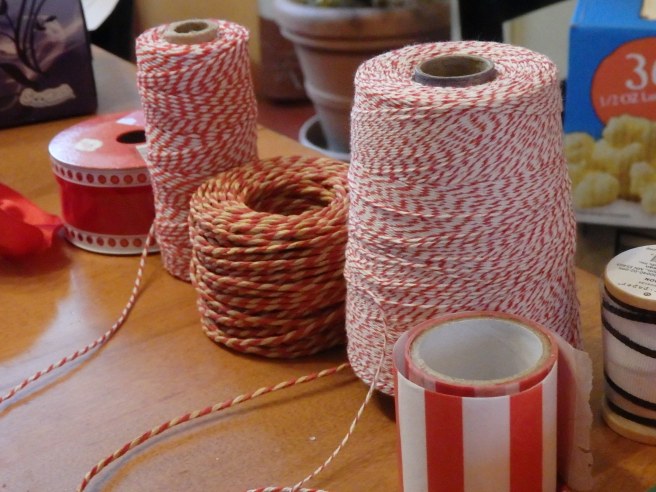
Wrapping doesn’t always have to involve ribbon.