Ten once-exotic foods that have become commonplace

Americans’ food choices expanded unbelievably in the generation between the events told in Daffodil Uprising and What’s Left. Admittedly, Cassia’s mother had grown up with a wider awareness of dietary options than had her father – her mother’s Greek heritage relied on olive oil rather than Crisco, for starters, and running a restaurant meant keeping an eye open for new options. Roasting a lamb for Easter would have been in her mother’s background but probably made her father’s side cringe. Still, it’s mindboggling to think how exotic some of today’s common dishes were just a half-century ago.

Here are ten:

  1. Broccoli. And zucchini and summer squash, which show up on a lot of national chain restaurant plates. Hey, even fresh parsley.
  2. Yogurt. Seriously, even before you add granola, another upstart.
  3. Tacos. For that matter, anything Mexican like burritos or quesadillas or margaritas. We’ve even added a holiday every May just to celebrate this development.
  4. Salsa. And sriracha and any of those Texas hot sauces. Whatever happened to ketchup?
  5. Sushi. I still can’t believe you can get it at the grocery.
  6. Thai. For that matter, anything Asian. You know, this extends to Vietnamese and Indian and even authentic Chinese. For me as a child, chop suey on top of wormy dried noodles, both out of a can, were as adventurous as it got for miles around.
  7. Pasta. Yes, any of those various Italian noodles. Our spaghetti used to come with sauce in a can. Seriously. And a spaghetti dinner was typically a fundraising event in a church. Oh, and it was still pronounced EYE-talian. Ouch!
  8. Espresso. The word itself conjured up images of beatniks. And now? Just think of all the gourmet coffee storefronts and drive-throughs. Not just Starbucks, either. You no longer have to explain cappuccino or latte or café au lait apologetically, thank goodness. Many of us even make our own.
  9. Flatbreads. As in wraps, especially, though they can be the foundation of a good pizza. Well, speaking of breads, add baguettes and croutons to the list of advances. We’ve really come a long way, baby.
  10. Real cheese. Not the processed stuff. We now have so many glorious choices we could do another Tendril on just this one item. Hallelujah!

History? Pizza had recently entered the mainstream. And wine was still a daunting frontier.

What would you add to the list?
When the author starts choking up

One of Kenzie’s lovers in Pit-a-Pat High Jinks had long puzzled me. In the earlier versions of the story, I pretty much ran with a set of details mirroring those I had encountered in real life. I refrained from speculating on what she wasn’t telling me – or, by extension, Kenzie.

In the latest set of revisions, though, I ventured beyond that self-imposed taboo. I had learned from two other girlfriends how devastating childhood abuse could be. Yes, in this fictional case, the hypothesis fit. Not that it had to be factually true, but rather that it was a plausible possibility – that was enough for a novelist. As I fleshed out that incident and its impact, I began weeping. If only I had known more of her at the time or more of all three, would the course of our relationships gone differently? The feeling of deep loss and grieving was pervasive, all these decades later.

Likewise, as I was reworked the text that morphed into Daffodil Uprising, the focus shifted from the lighthearted face of the hippie experience to a broader comprehension of its desperation and even destructive fringes – and that sensation also had me grieving. As a deep sense of loss regarding the promise we saw on the horizon but failed to reach and fulfill washed over me, I began seeing the novel as a requiem for the hippie dream.

With Kenzie’s daughter Cassia at my side, though, I started thinking about the way dreams work. They have one foot in the past and the other in the present. And then, even when she was looking at her father’s history, she had her own generation in mind. From where I stand, their situation looks even more confusing than ours had. What can we who did change so much of society, pro and con, offer them now in continuing that vision?

These are dire times, friends. Anyone else feeling some déjà vu and unease?

First anniversary of a big day

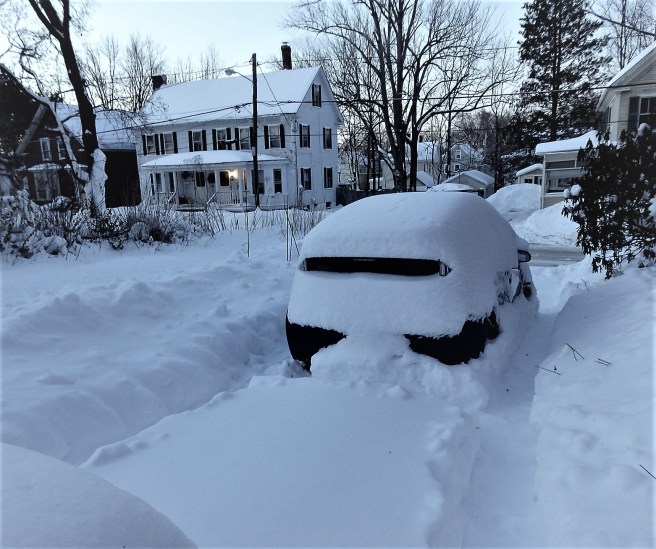
On this day a year ago, we woke up to a big snowfall – the biggest of the season, as it turned out. It was coming down like crazy, and I was even hoping to get out on my cross-country skis, at least do a few loops around our yard, unlike the previous year.

Thought I’d clean off my wife’s car first and the steps and walkway out front, just in case.

But that’s when I had to stop and try to catch my breath. I’d felt this sensation, something like what I’d heard asthma described like, several times in the past few months. I thought it was the aftermath of a nasty bug the previous fall, and several people in the know said it sounded like a walking pneumonia. Once, in particular, it hit me at the end of a length in the indoor swimming pool. Another time, while carrying a three-year-old down from Mount Agamenticus. After the third time, I went in to see my primary care physician, who said my lungs sounded fine, ordered an X-ray, and scheduled a stress test. Oh, yes, and if the symptoms returned, go straight to the emergency room.

Yeah, yeah. Just what I needed – more inconclusive tests.

So as the snow hit just two days before the stress test was scheduled and the symptoms returned, I figured I could ride it out until my appointment.

That’s when my elder daughter showed up. “My Prius is cleaned off and warmed up. Get in.” My wife seconded the motion, and reminded me they had my doctor in their corner.

OK, drop me off. I’ll give you a call when I’m done.

Remember, there was no pain. No chest pain, especially. This was a breathing problem.

Continue reading “First anniversary of a big day” →

You can join in ‘Pit-a-Pat High Jinks’

Pit-a-pat is the sound of hands drumming as well as rain on the roof. Both fit my newest novel, which is being released today at Smashwords.com.

The book continues Cassia’s discoveries about her future father’s mysterious adventures before he meets her mother and settles down into marriage.

Here he heads for the hills after graduating from college, moving into a dilapidated farmhouse he shares with a dozen or so other young rebels and recluses. He goes back-to-the-earth with his housemates and their dogs and cats and chickens as well as their fields and abandoned orchard plus the surrounding ponds and forests. Nude swimming, anyone? Off they go.

He’s also coming to grips with his first full-time job, working as a photographer at the local small-town newspaper, where his bohemian ways don’t always fit well. Still, a job’s a job.

His life really perks up through eccentric new friendships around the campus in the valley, especially a young dreamer known as Drummer.

Sometimes it all resembles a three-ring circus.

In his heart, though, he’s looking for love – along with healing after being jettisoned by his college sweetheart. Running through Pit-a-Pat High Jinks is a series of lovers and passionate encounters that ultimately advance his erotic experience and understanding. Please note that the story can be rather graphic. (You will need to set the adults-only button to find it at Smashwords.) The tale is set, after all, in an era of free love and recreational substance exploration.

It’s a poignant and timeless mix of youthful escapades and mayhem.

Be among the first to read my newest novel.

Lamprey River Band

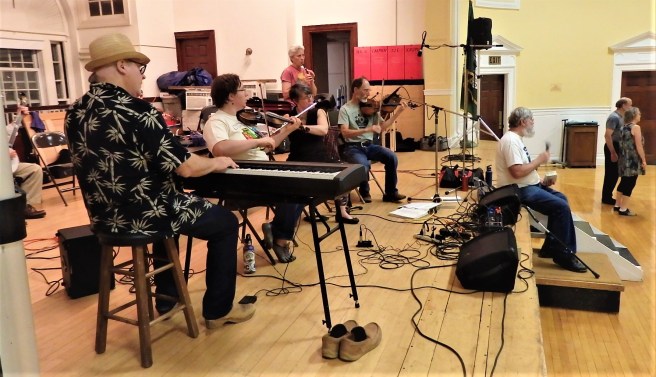
This country dance band has been together since 1983, performing principally in the Seacoast Region of New Hampshire. Its first-Thursday-of-the-month New England contradances in Dover’s city hall welcome sit-in musicians and guest callers. That event started out in a neighboring town as band practice … and if the band was practicing, so could the callers … and if they were calling, why not have dancers? It’s a great event, and beginning dancers are always welcome.

My existence as an ‘extra’ in the photos

Curious to see if Portsmouth had its Greek festival last year – an event that was cancelled the previous summer – a Google search informed me it had returned but, alas, I had missed out. Besides, the date’s been moved up a few weeks.

So with the web page announcing this year’s event still up before me, what dawned on me that the featured photo was from the previous occasion. While staring idly at the screen, I recalled being at that dance demonstration and, lo and behold, I then noticed an acquaintance watching from one of the tables under the big tent. Finally, in the shadow beside him, there I was, too, quite faintly.

Well, a similar thing happened in the online videos of the Dover festival where I’m moving in a line of dancers. I’m not exactly a standout.

In any number of photos of my choir in performance, the same thing happens. I usually need a magnifying glass – and that’s if the conductor’s head is not in my way. (See that bald spot? The top of my head, the only part visible.)

Makes me feel something like Woody Allen’s Zelig. If only I could intentionally be such a “human chameleon” in so many major events.

Yes, I know a good journalist tries to render himself invisible when covering a story, unless it’s a rowdy news conference, but this is ridiculous. It could lead to an inferiority complex, no?

So how do you think you look in a photo?

On to a new generation

My newest novel, What’s Left, springs from the ending of my first published novel, where her future father lands in a bohemian band of siblings who’ve just taken over the family restaurant after a car crash killed their parents.

It’s a lot of responsibility on young shoulders.

~*~

Sometimes, when you put a dish together, the balance is off. It can even mean starting all over. What do you think of this?

At home, Tito and Diana, still in school, need to make sure their siblings are up to the job of parenting and running a house. What about their grades, the laundry, cleaning the bathrooms? Who pays the bills? Who’s really in charge, for that matter? The two youngest do work part-time at Carmichael’s, where they don’t need to be told they’re under public scrutiny. The balance at Big Pink, meanwhile, is undergoing adjustment.

The two youngest do work part-time at Carmichael’s, where they don’t need to be told they’re under public scrutiny. The balance at Big Pink, meanwhile, is undergoing adjustment.

In his final half-dozen years Pappa Stavros had been uncharacteristically aggressive in his dealings, not to mention bad loans to his buddies or timing.

~*~

What I know of the food business is all second-hand, but I still wonder about taking leadership of an enterprise as a young adult. In my early 20s as second-in-command of a small newsroom, I was given surprising leeway and yet I’m still grateful for the stability provided by my older boss – even though I’m not sure he was always the most mature in some of our gunfights with the wider community.

We did have a great corner restaurant, though, run by two brothers and their wives. Just a coincidence, if you’re thinking of Cassia.

Have you ever worked in a restaurant? Doing what? What’s your strongest memory?

~*~

A large Queen Anne-style house with a distinctive witch’s hat tower something like this is the headquarters for Cassia’s extended family in my new novel, What’s Left. If only this one were pink, like hers. (Manchester, New Hampshire.)