Ten ways the Eastern Orthodox differ from other Christians

The world’s second-largest Christian body, with 250 million members, is officially known as the Orthodox Catholic Church. It shared communion with Roman Catholics until the schism of 1054.

Here are ten ways it varies from its Western counterparts.

  1. Unlike the Roman Catholic denomination, the Orthodox operate as a communion of autocephalous churches, each governed by a bishop (often known as a metropolitan). In practice, these often have a national or regional identity, such as Greek Orthodox or Russian Orthodox.
  2. Metropolitans, rather than the pope, are the head of each of the self-governing churches, and together they form the Holy Synod. The Ecumenical Patriarch of Constantinople is recognized as the first among equals.
  3. Advent and Christmas. Advent is longer and Christmas isn’t celebrated until January 7.
  4. Lent and Pascha. The liturgical calendar differs from those used in Western Christianity, with Easter (Pascha, the Greek preferred term) typically being aligned to Passover. Great Lent is longer, too. The Feast of the Assumption and Pentecost are holy days nearly equal to Pascha.
  5. The Theotokos. The Virgin Mary, Mother of God, is venerated and central in the liturgical worship. More nuanced, too, than in Roman Catholicism.
  6. Greek, rather than Latin, as the basis of its Scriptures and theological discourse. It’s a language more suited to nuance and philosophy, so I’m told.
  7. The priests may marry (unlike Roman Catholicism) but the bishops cannot (unlike Protestants).
  8. Sensuous richness. Incense, bells, chanting appeal to the nose and ears. An abundance of iconography, especially, surrounds the eyes.
  9. The iconostasis. An elaborately decorated wall stands between the altar and the congregation. It has three doors – the angel doors, to either side, and the blessed door in the center. The priest passes repeatedly through the central door, which is left open during the service, while the deacon or others may use the side doors, as required.
  10. You show up for the Sunday service – the Divine Liturgy – you’re likely to think you’re late. The priest, deacon, and psalmists have already been celebrating the Orthos for an hour, sometimes alone, in preparation.

~*~

AS AN ASIDE: In 978, Vladimir the Great sent emissaries to study four religions in neighboring regions – Judaism, Islam, Latin Rite (Catholic), and Eastern Rite (Orthodox). Reputedly, he rejected Judaism as lacking power, since it had lost Jerusalem. Islam, because it banned alcohol. Latin Rite because of the political power of its pope. But Eastern Rite, with the sumptuousness of its liturgy in Hagia Sophia in Constantinople, won him over. As they wrote, “We no longer knew whether we were in heaven or on earth.” And thus, the Russian Orthodox church was born.

~*~

Admittedly, this is a superficial overview. I’m hoping for a lot of clarification from more knowledgeable readers.
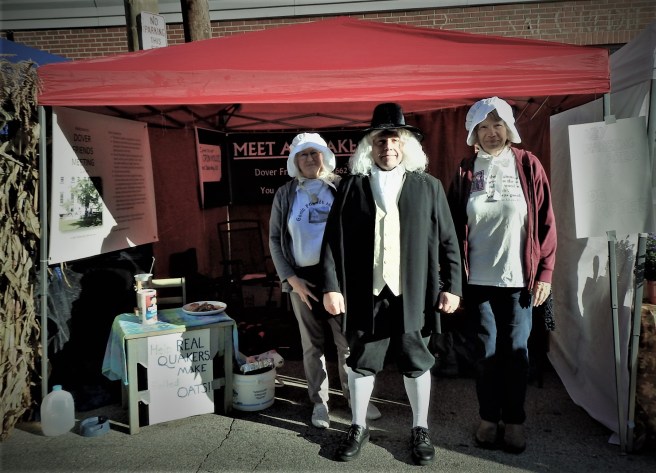
 

Meet a Quaker

Many of the Dover’s churches have their booths at the city’s annual Apple Harvest Day festival, and the Quaker meeting is no exception. Here we are making the most of our past to let people know we’re still thriving today. We handed out homemade cookies – 1,162 of them baked the night before – and had kids pitch in to hand-crank grains of oats into oatmeal. The Quaker Oats company, by the way, was never owned by Quakers – they just liked our reputation for honesty and quality.

A missed opportunity

One of the delights of my small city is the waterfall at the heart of the downtown. It has powered mills since 1642, and with the addition of the dam atop the cataract, ran the textiles looms that made Cocheco calico world-famous.

The Central Falls and the dam atop it span the Cocheco River where it drops to the tide.

The river – seen here resting at the end of summer – rages in the springtime, with snowmelt and heavy rains, and plunges into the tides that fluctuate eight to ten feet every six hours. Hence, the fish ladder for salmon, herring, and migrating eels.

With the retraining wall on the south side of the site in danger, a new wall was installed during the summer – a major construction project that tied up traffic for months.

The new retaining wall is seen from the Central Avenue bridge.

When the old wall and the ground behind it were being removed earlier in the year, the excavation suggested that a much different design was in the works. Getting a clear view of the falling water has been difficult. The old walkway was charming, but you really wanted to get down lower and closer to the water. I envisioned a set of small terraces stepping downward beside the fish ladder.


The fish ladder ascends next to the retaining wall.


Here’s how the ladder and wall appear from a pedestrian bridge next to the mill.

Alas, that’s not what happened. We don’t even have the charming walkway anymore.

I’m hoping the new wall weathers quickly. Right now, it strikes me as an eyesore.

They bill this as Fish Ladder Park. No kidding. The tree-lined walkway and quaint lamps are gone.

Cassia as small-town royalty

From one perspective in my novel What’s Left, Cassia’s family begins to resemble royalty in a small-town setting. It’s not that they’re living a life of ease – far from it, everyone works hard, including long hours at the family restaurant. But they do inhabit an old Victorian house that resembles a small castle, and they are known throughout the community and are financially secure. For the record, even pampered royalty must perform daily duty and live up to standards.

I’ve sometimes joked that if were emperor, I’d eliminate some pet peeve of the moment, like maybe banning onions or requiring everyone to do something like go to the opera rather than another soccer match. Luckily, you’re spared the consequences.

What would it be like to be born a princess? Or even a prince? (Well, while we’re at it, is there even a country – real or imaginary – you’d prefer to rule over?)

Ten pioneering leaders in American yoga

When I took up yoga in the early 1970s, it was still pretty exotic. In fact, a fair question would ask if yoga was mostly happening in New York. That was my impression from the ads in the weekly Village Voice newspaper, which listed many visiting teachers from Asia, especially.

Not all of the teachers were exactly kosher, either.

The model of the maverick guru was Robert Crumb’s Mr. Natural cartoon, inspired by the Sufi and Zen Buddhist Samuel Lewis, but my own teacher, Swami Lakshmy Devi in the Pocono mountains of Pennsylvania, and Swami Rudrananda at Big Indian in New York’s Catskills, would also fit much of what I describe in my novel Yoga Bootcamp. All three were born in America.

Here are ten more teachers who advanced yoga’s popularity in that era:

  1. Richard Hittleman, New York, beginning in the 1950s. Hatha exercises.
  2. Walt and Magana Baptiste in San Francisco, early ’50s. Hatha exercises.
  3. Swami Vishnudevananda, arriving in 1958, San Francisco, a student of Swami Sivananda in the Himalayas. While emphasizing hatha, he also advanced other aspects of yoga, including meditation. My teacher was trained at Visnu’s Manhattan center. The network now headquartered in Montreal.
  4. Maharishi Mahesh Yogi and Transcendental Meditation in the early ’60s. With the Beatles and others as celebrity followers, his emphasis on teaching meditation rather than the physical exercises became trendy.
  5. Swami Satchidananda, arriving 1966, New York, also a student of Swami Sivananda. His invocation at the Woodstock festival made him celebrity material. With his big beard and smile, he looked the part.
  6. Swami Prabhupada, founder of what were best known as the Hare Krishnas, or the International Society for Krishna Consciousness. Arrived 1966, New York. Brought kirtan, or chanting, and the Bhagavad Gita scriptures to public awareness.
  7. Amrit Desai, arriving in 1968 in the Philadelphia area. His influential organization continues as the Kirpalu Center in the Berkshires in Massachusetts and is known for training and certifying yoga instructors.
  8. Yogi Bhajan presented his Kundalini yoga as hatha and chanting with a Sikh infusion. He founded his Happy, Healthy, Holy Organization in 1968.
  9. Ram Dass, formerly a prominent Harvard psychologist and psychedelic pioneer, published the seminal book Be Here Now in 1971 at the Lama Foundation in Taos, New Mexico. We all wanted to go there, wherever or whatever it was. Its focus was on the philosophy, rather than the exercises – a huge breakthrough, from my point of view.
  10. B.K.S. Iyengar, arrived in 1973 in Ann Arbor, Michigan. His focus on technical precision in the hatha exercises influenced many teachers.