
Here comes peppermint!
You never know what we'll churn up in cleaning a stall
I really didn’t use this online, but it did give me a focus:
But now I’ve packed up and relocated. The way this Red Barn blog functions, though, Dover will continue to be a big part of the lineup. It’s a happenin’ place, for one thing, and my next book is a unique history aimed at the community’s 400th anniversary, which takes place in 2023.
As I refocus, I’m open to suggestions. Officially, the heading’s subtitle used to proclaim “a space for work and reflection.” Somewhere along the line, it became “come view the world from my loft,” but now even that is, no pun intended, up in the air.
This blend of here and there has me thinking of dreams, which have one foot in the present and one in the past, or so I’ve heard. From previous moves, I know that my previous home will be part of my awareness for a long time ahead.
Thanks for the memories. And for the new adventures.
Now, though, how should I define my new reality?
Apart from a short spur to the Portsmouth Naval Shipyard, all of the railroad traffic to and from Maine and the rest of the United States runs through Dover. (I’m not sure how much, if any, goes through Canada.)
When we first moved into the house, our younger one started complaining about all the train noises in the night as sand and gravel moved to Boston’s Big Dig construction.
More recently, one my my regrets about the Covid shutdown has been that a number of Amtrak trips I’d hoped to take – to museums and the Boston Symphony’s Friday matinee concerts, especially – instead got scrubbed. And since the Amtrak station was in walking distance of our house, I loved joking about walking to Boston. Ha-ha.
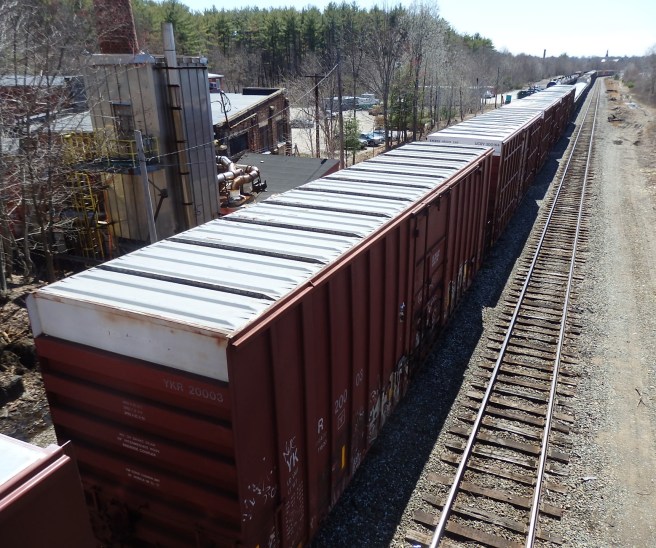
On the other hand, it can be annoying when you get stuck at a railroad crossing downtown while a long freight train passes. I usually lose count somewhere around 120 cars.
Here’s one I managed to shoot from the Oak Street bridge as it waited for the all-clear to continue rolling. Rail traffic, I’ve heard, doesn’t go north-south but rather east-west. Well, Portland’s north of us and Boston’s south. Make of it what you will.

Can’t see the engines up front, can you?
There are 21 Native American reservations in Washington state. As Joshua and Jaya discover in my novel Nearly Canaan, living adjacent to one, they are home to a unique culture.
Here are the ten largest by area.
~*~
~*~
Have you ever attended a powwow?

Family-run businesses present their own unique operating models.
Under the ideal version, the members have an understanding of each other and their mission along with a loyalty that’s unrivaled. The business is part of their identity. Each member of the family understands his or her abilities and place in the enterprise. Often, they learned the operation from childhood on, starting at entry level. For their employees, however, that can come at the price of exclusion and upward mobility.
Sometimes the organization is headed by a patriarch or matriarch with the authority to make and enforce difficult decisions. In this model resentments and perceived sleights can mount over the years before erupting. Or the family head may no longer fit the kind of executive the company needs at a particular stage of its growth; a founder, for instance, may have technical expertise but not the people skills for marketing or adapting to a changing market.
What have you seen or experienced?
GREEN LINE
RED LINE
BLUE
ORANGE
RACKET

What do asparagus stems and lobster shells have in common?
They typically go in the trash, while the tender asparagus heads and the claw and tail meat go on the plate, maybe accompanied by melted butter.
I our household, though, we freeze the stems and turn them into cream of asparagus soup later.
And the shells, often roasted, though it’s not necessary, are simmered down into a lobster stock, which can hold its flavor for up to three months if frozen.
The stock makes for a great lobster bisque or lobster butter or fish chowder.
In essence, we wind up with more meals than one out of each ingredient – and thus getting more for our money.
What strategies like this can you share?
as for the cure to feeling oh so blue center (as in meditation or prayer) untangle knots or go out weeding by the kitchen (see the worshiping community as a kitchen, too) go off to any place where there’s nurture and a certain kind of warmth then prepare a decent meal, slowly concentrate on digging out, one emotion at a time, not just feelings or thoughts on the run before my flight from the opera

