
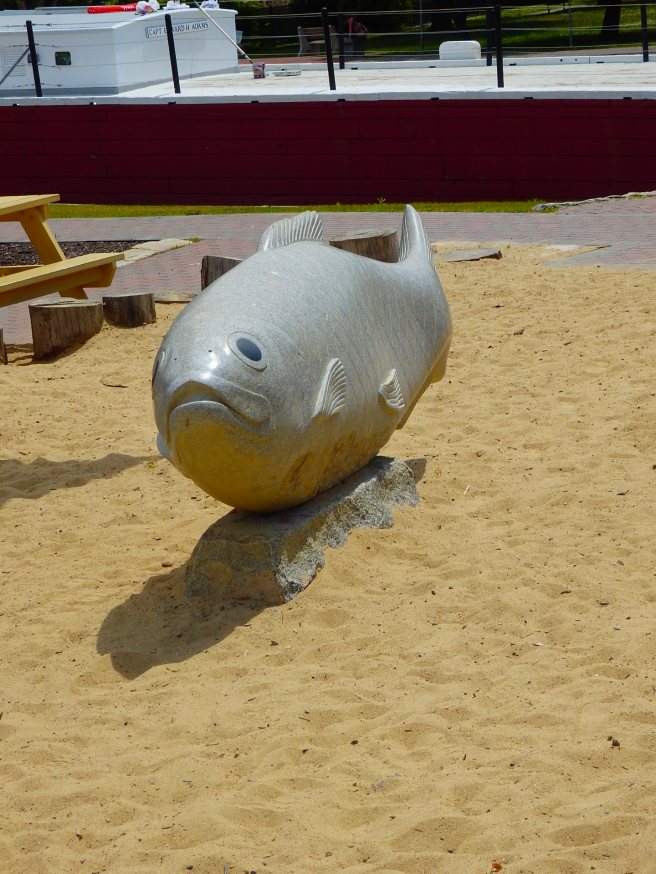
You never know what we'll churn up in cleaning a stall
Cinema critic Roger Ebert was talking of the importance of the witness in every movie and pointing to the places where the character appeared in the film under discussion, mostly in a lower corner. The comment flashed me to the reality of how often the hardest thing to see is what should be the most obvious. It’s not just the elephant in the room, it’s things we take for granted.
One way or another, all fiction is built on the observer, who is also to some degree an outsider or misfit, too. (If there are any exceptions, I’d love to hear them.) Four of my novels, for instance, were intuitively built around a photographer, a profession that makes Cassia’s father a well-trained witness. In turn, as she investigates his archives, she, too, becomes a witness, even before she starts commenting on his earlier life.
Of course, as a reader, you also become a witness. Or even a voyeur, as Camille Paglia has contended. It’s almost like every page is a microscope slide to be interpreted.
Curiously, I now see this also at play in a long-term non-fiction project in my life. Forty 40 years ago, seemingly by accident, I became involved in trying to uncover my father’s ancestry. I thought we were simply homogenous Midwesterners who had always been in Ohio from its beginning. What I discovered, though, was that one branch was – but German-speaking and largely akin to Amish. My name-line, however, was Quaker by way of North Carolina and its slaveholding culture. Both strands were outsiders to the larger society and also pacifist. It opened my eyes to alternative histories and to a recognition that stories don’t always have to resolve nicely – three people may record their memories quite differently, and maybe all three are true, if not factually accurate.
Oh yes, the research was often collaborative, with correspondence going and coming from others working on parts of the puzzle. It wasn’t always quite as lonely as drafting fiction or poetry.
To my surprise, as my novel What’s Left was taking shape, Cassia started assembling bits about her Greek-American grandparents, who had died before her birth, and then beyond to her great-grandparents, who brought the family to the New World. Like me, she found valuable clues in the surviving snapshots and formal portraits regarding their personalities, as she also did in the letters and other documents.
None of my ancestors came by way of Ellis Island, and on Dad’s side, they were all in this country by the time of the Revolutionary War. I once pondered doing a series of novels on them, but I’m still intimidated by the technical challenges – a realistic language they can speak and we can understand being high among them.
Witness, I might add, has an extra dimension in Quaker thinking. It’s not just what one sees or hears but how one lives. The goal is integrity, as in wholeness or consistency. Is that what others see in us or our lives and work? Or even as our goal and ideal, even when we fall short reaching for it?
Let’s skip past Jesus and Lincoln and King David and Gandhi, Martin Luther King, etc. Go to more regular folks who also had everyday lives.
~*~
Well, this list has changed over my life!
Who would you name?
Using skills and connections he acquires working in a shipyard in Greece, Aristotle relocates to Indiana in my novel What’s Left.
How did your grandfather wind up pursuing the work he did?
the scarred moon
a time of bright awareness


In the morning
fittingly ends spooky summer mostly continuous deluge (four Yuppieback novels and a collection of essays) a Labor Day weekend reading binge as its best of thee often . hoping for all perfection, write sometime, OK? I never could keep up with developments / Everlastingly
This has been a summer unlike any other in my life, and it’s not over yet. Here in northern New England, the first weeks of September are typically among the best, especially for swimming in the ocean, though the water still hasn’t warmed up enough for that where I’m now living. It’s still in the upper 50s, like most of the nights.

While the Red Barn’s been posting mostly what I had scheduled before we landed the 1830s’ Cape where I’ve been living since the beginning of the year, blogging has felt like a special kind of housecleaning for me – this is the cycle I’ve left behind while gathering a ton of new material that will be featured in 2022.
One difference is that I’ve been largely on my own up here, but not alone. There’s teamwork involved, with visits as well as daily phone calls. And Zoom’s kept me in touch with many good friends and introduced me to more.
There’s a respect I get in being a year-’rounder in a small city where three-quarters of the population is what Mainers call Summer People. Now they’ll soon be going-going-gone and we’ll get back to our more essential, barebone state – what I call the remote fishing village with a lively arts scene.
Still, summer is when this place takes on a special life, one that often feels like a big daytime party that attracts people from all over the country. (I’ve seen license plates from all but seven states, but wouldn’t be surprised if Hawaii shows up.) And this has been the first time I experienced that as well as the ideal of summering on a Maine island. (We are connected to the mainland by a pair of causeways that lead through the Passamaquoddy’s Pleasant Point reservation.)
Here are ten highlights of my summer:
~*~
Let me also add observing deer closeup from my windows. You know, looking up while washing dishes or keyboarding.
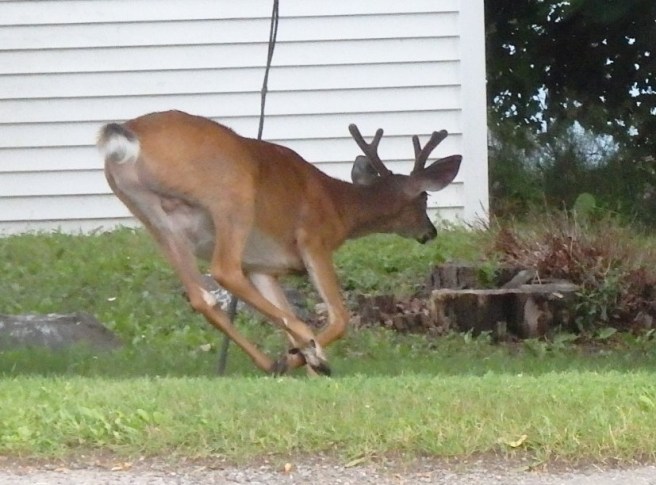
Sometimes they hang around long enough I can really study them – a few spotted fawns for several hours, actually I love it when the adults rise up on their hind legs to pick apples from a branch overhead. They’re still enchanting, but when it comes to trying to garden, they are vermin.

So how’s your summer been?

