I was tempted to call them ‘staterooms’

A full Cape is a classic American design with some good traffic flow downstairs, but it has drawbacks on the second floor, where rooms can feel cramped by low ceilings and be too hot in summer and too cold in winter. Our house was no exception, something we hope we’ve rectified.

In maxing the ceiling heights by following the new roofline, we gained both headroom and air circulation. That move also adds character to each of the resulting rooms, making them something more than rectangular boxes with holes punched in them for windows and doors. (See the ongoing argument in previous posts.)

The sprayed insulation also enhances year-‘round comfort by reducing radiant summer sun impact as well as invasive winter cold.

In addition, the setting of the windows in all four bedrooms provides cross-ventilation, as needed, and the casement windows in the two smaller rooms reduces any draft entry. Each bedroom has windows on two walls, not just one.

We’re especially happy with the resulting four bedrooms, what I was tempted to call “staterooms,” as they are on a ship. There, the chambers follow the contours of the hull and deck overhead, and ours do something similar.

The front two also have a commanding view of Friar Roads, the channel between us and Campobello Island, Canada, while another looks out on a street of a distinctly New England fishing village nature. The fourth looks into trees and the village, giving it a sense of being a treehouse. Rather heavenly, as I’m finding.

For now, I’ll turn your attention to the front two, which overlook Eastport’s principal north-south street, not that it has heavy traffic. Remember, our fair city doesn’t even have a stoplight. Not one.

The front two bedrooms have the quirk of a panel that follows the original roofline before the dustpan dormer kicks in. This results in a small cubby space that creates a small storage cabinet in one bedroom but is left free to run to the floor in the second.

The main differences between the two bedrooms springs from working around the existing stairwell. Our historic stairwell, definitely pre-1830, from the hand-cut oak lathing.

If you divide those two rooms apart by drawing a line halfway between the north and south exterior walls, you’d see that the north bedroom would have been smaller than the south room because it had to accommodate the stairwell. What it gained in the renovation, though, was a charming nook between the stairwell and the outside wall. The space between the stairwell and wall had been a mystery, a wasted space where we  thought we might find any buried skeletons in the house. Alas, only dust and spiders.

The nook, as we discovered, had to stretch a bit beyond that halfway line north-south, because the room’s window was centered there (above the front entry door). Our solution was to have that extension be matched by a closet running along the stairwell in the south bedroom.

The nook does make for a nice, slightly secluded study with that stunning view, especially around dawn and sunset.

Let me remind you that all of that distance to the exterior wall was space added during the renovation.

~*~

As we approached the time for priming and painting the upstairs, we had to admit we had more than 3,000 square feet of drywall to cover with primer and paint, even before considering the flooring. More decisions! As well as delays. 

There, I settled on a brilliant white for my walls and ceiling and what Sherwin-Williams called Smoky Blue for the floor.  

~*~

The cathedral ceilings not only enhanced our celebration of the natural light in our house, they also gave us something we didn’t anticipate: loud rain on the now metal roof, something we usually find comforting, so far. Not that everyone would.

But these rooms are also free of any rolling you’d endure on a ship.

Everybody’s mostly happy with the resulting twists. Remember, nothing in life is perfect, no matter how hard we try. 

What makes a particular writer stand out?

More directly, the question comes down to this: What makes my work unique? What makes me unique? (My niche?)

As I once would have answered, somewhere back along the path to here:

“My work largely seeks to map organic geo-history, the overlapping energies of a locale and its spirit(s), as truthfully as I can, however fragmentary the result. Since personal relationships, including marriage, appear as places hovering within this landscape – both influencing and influenced by the larger ecosystem – I investigate them often with a concern for the larger, more timeless harmony (Logos).”

My, my, what can I say about that now? Or:

“This investigation of the invisible vibrations has also led me to cherish alternative cultures that embody healing energies – Native cultures, Amish, Mennonite, Quaker, and so on – in contrast to our increasingly rootless, violent, unstable society at large.”

As for the question, “What do you want to be different after this effort? This project?” Well!

“I hope to renew an awareness of the wonder of the universe and an appreciation for our own unique places within it. Out of that, roots and a radiance of peace.”

Or: “How do you want to be remembered? Then think of your customer (reader). What exactly do you want people to say when they speak of you to others? Are you representing your quintessential self consistently? (Image is everything. Brands need an unchanging core.)”

And so, to continue: ”Jnana – a unique, distinctive name – reflects my originality in bridging of many diverse currents into a larger vision. Compression, clarity, highly polished with a raw edge.”

Or a mission statement?

“I summon others to join our waiting Quaker worship and community. (This is how I got here and what I’ve experienced along the way to Truth … ) (Look for young adults, especially.)”

What have I not asked that people ought to know?

“I am part of a generation that has not come to terms with its hippie past – both positive and negative. While we’ve retreated from the general effort to push the envelope, to advance to Edge City, to demolish boundaries, we’ve also failed to examine what we learned and carry from that experience. Instead, there’s a society-wide state of denial that is bound to erupt in unanticipated ways – likely, without any sustaining wisdom.

“When radical currents from both coasts connected in academic nerve centers in the Midwest, furious confrontations erupted, overturning repressive constraints of institutional America.

“The hippie movement that is usually thought of as the Sixties actually appeared most fully during the Nixon administration, 1969-74, and brought changes that younger generations now take for granted.

“Crucial to the outcome were personal transformations that few today will speak of.”

~*~

Well, that’s some of what I’ve wrestled with in my zig-zag journey to here. Other writers will have to speak for themselves. Some of my responses sound today pompous and airy, but I’ll leave them at that for now.

A writer is allowed to aspirations, no?

~*~

You can find my novels and poems in the digital platform of your choice at Smashwords, the Apple Store, Barnes & Noble’s Nook, Scribd, Sony’s Kobo, and other fine ebook retailers. They novels are also available in paper and Kindle at Amazon, or you can ask your local library to obtain them.

What an example of tangled romance

As overheard at a Major League Baseball game, according to a reliable source:

“We giving Mike a chance. Tess is a good judge of character, she likes you. Do I think he is right for Tess? No. Do I think Mike is fully divorced yet? No. But Tess likes him so we are giving him a chance.”

WTF? Can any of you decompress this for me? Does it go anywhere as a possible novel or movie? Is this in any way an accurate reflection on our times?


Lorenzo Sabine was a Yankee, all the same

After running across his name repeatedly while researching the history of our old house, I decided to look him up. Lorenzo Sabine turns out to have been a remarkable character. Best known today for his two-volume, provocative 1864 book Loyalists of the American Revolution, his adulthood included an influential span in Eastport.

Here are some highlights.


  1. He was born in 1803 in what’s now Lisbon in the White Mountains of New Hampshire, with a Methodist minister for a father and roots going back to French Huguenots who arrived in Rehoboth, Massachusetts from Wales in 1643. Lorenzo moved with his parents to Boston in 1811, and then to Hampden, Maine, in 1814, where he completed his preparatory studies. His father had been taken prisoner by the British in the War of 1812 while working in a military hospital.
  2. At age 18, following his father’s death and his mother’s remarriage, he came to Eastport not long after Maine gained statehood from being a district of Massachusetts. At first, he was employed as a clerk, then tried his hand at his own business but went bankrupt, followed by working as bookkeeper of Passamaquoddy Bank and then engaging in a series of enterprises, including stints as a mercantile partner with William and Jacob Shackford, sons of the Revolutionary War veteran who built our house and much more. He shows up as a witness on many property deeds and other court records.
  3. He was editor of the weekly Eastport Sentinel newspaper to 1834, during Benjamin Folsom’s time as publisher. He was also founder of the Eastport Lyceum, and incorporator of the Eastport Academy and Eastport Atheneum.
  4. He served as a member of the Maine House of Representatives, 1832-33, and was deputy collector of customs at Eastport, 1841-43.
  5. From early childhood, he was what he called “revolution-mad,” something that grew in other directions after his move to Eastport, abutting Canada and having many residents descending from Loyalist lines. This led to his insight that “there was more than one side to the Revolution.” Prior to this “every ‘Tory” was as bad as bad could be, every “son of Liberty” as good as possible.” During the 1840s, the results of his research appeared in the North American Review, America’s first literary magazine.
  6. Quite simply, his work was not favorably received by “patriotic” Americans though it did receive support from several important historians. Lorenzo then revised and expanded his material into an 1847 book The American Loyalists, or Biographical Sketches of Adherents to the British Crown in The War of the Revolution; Alphabetically Arranged; with a Preliminary Historical Essay, erupting a firestorm of controversy. The work received a more thorough two-volume edition for its republication in 1864. You can read it online to see why it challenged many of the conventional treatments of the Revolutionary War and the tensions leading to the War of 1812 from the British side. He did, do note, receive honorary degrees from Bowdoin College and from Harvard.
  7. He moved to Framingham, Massachusetts, in 1848 as a trial judge and was elected to Congress in 1852 to fill a seat vacated by death but did not run for reelection.
  8. Appointed secretary of the Boston Board of Trade, he relocated to Roxbury and also served as a confidential agent of the U.S. Treasury Department.
  9. He was married three times, to Matilda F. Green in 1825, Abby R.D. Deering in 1829, and 1837 to Elizabeth M. Deering, who survived him. Only one of his five children survived him.
  10. He died in Roxbury in 1877 but is buried in Eastport’s Hillside Cemetery.

Back to the press and a personal debt

The first printing press in Britain was established at Westminster in 1476 (during the reign of Edward IV, 1461-1483) by William Caxton. Modern movable type had been invented not that much earlier around 1450 by Johannes Guttenberg.

Caxton is considered a central figure in establishing Chancery English to the standard dialect used throughout England. In his haste to make translations for publication, he imported many French words into English.

Well, England did rule much of France during the century.

As a reader and writer, I’m indebted to both men and a host of those who followed.

Lately, I’ve been returning to the Baskerville typeface, which we used for our high school newspaper, though now its in honor of an earlier resident of our house. The face dates from the 1750s.

One classic I’ve long been fond of is Caslon, from the 1720s, by another English designer. It’s similar to Goudy, a 1915 American design based on historic Italian faces and one I’ve been using on my Thistle Finch publications. It really is elegant.

Sometimes the very appearance of a word in type or a well-designed page will make my heart sing.

Just so you know what happens when ink gets in your blood.

Looking for whales

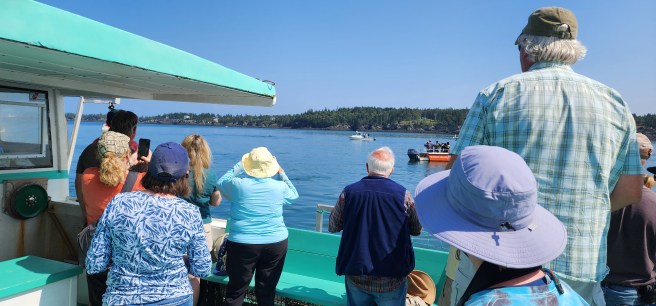
Everybody on board the Eastport Windjammers’ Ocean Obsession was engaged in looking for the next whale to appear, as were a few other vessels beside Campobello Island in New Brunswick, Canada.

We did observe humpbacks, finbacks, and minkes on the outing, but the rare right whales are less frequently seen.

For more whale-watching experiences, take a look at my Lolling with Whales photo album at Thistle Finch editions.