The site in south Boston where two Quaker missionaries were hanged less than a month after visiting Dover, New Hampshire, was eventually christened – get this – Dover Street.
The street was later renamed.
Another of the four who died on the gallows there had also apparently visited Dover a year or two earlier.
Who made the decision – and why? They couldn’t be that oblivious, could they?
Once the surrounding water was filled in, the street came to have a long history of immigrants and seedy characters, perhaps doomed by its bloody past, before part of the neighborhood was razed for the urban renewal that brought the Boston Herald newspaper plant and later removed the elevated subway station after the Orange Line was rerouted to the west in 1987.
Today it’s known as East Berkeley Street, hoping for a new image.
Check out my new book, Quaking Dover, available in your choice of ebook platforms at Smashwords.com.
Through the waves of warfare between the English settlers and the French and their Native allies to the north and the east, Dover Friends were caught in a bind.
Quakers espoused a pacifist Peace Testimony as part of their Christian faith, but in New England all fit adult males were compelled to participate in the militia. In some cases, accommodations may have been made, such as allowing the Friends to not carry arms or to serve as watchmen or in other non-combatant service. But some no doubt refused to do even that because it still supported the fighting.
Quaker testimony of non-violence was anything but an idealistic, abstract statement. It meant placing their lives – and their children’s – in jeopardy. The final fatal forays in Dover were on a Quaker family.
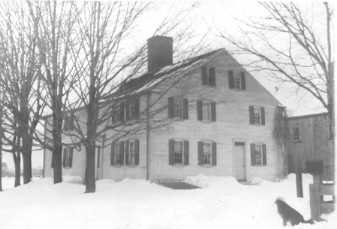
John Hanson’s house at Nock’s Marsh (more commonly known as Knox Marsh) was in an exposed position. Because of the renewed troubles, he was advised by neighbors to move into the more compact area of Cochecho village. Instead, as a “stiff Quaker” upholding the Friends’ witness of good relations with the Natives, he stayed put.
Life looked good to him. On August 9, 1725, his eldest daughter, Hannah, and Israel Hodgdon junior wed in a Quaker service. Four days later, Hanson’s wife gave birth to daughter Mary (also known as Mercy).
Only two weeks after those celebrations, though, 13 Natives, including French Mohawks, lay in wait for several days, looking for an opportunity to attack. On August 27, while Hanson and daughter Hannah attended midweek Quaker worship and his two oldest sons were work at some distance, the Natives swept in and “all naked with their guns and tomahawks” entered the house.
Elizabeth Meader Hanson was at home, along with a servant and three children. Two young sons, playing in the orchard, would have escaped but just as the Indians had finished rifling the house, the boys – Ebenezer, age five, and Caleb, four – came in sight and made such noise that the invaders immediately killed them by bashing out their brains and scalping them – in front of their mother – to stop the alarm. Daughter Sarah entered the house and was also taken. The raiders promptly started for Canada, with their captives in tow – Elizabeth Hanson, who had given birth to daughter Mary just two weeks before, plus seven-year-old son Daniel, daughters Sarah, 16, and Elizabeth, 14, and the servant girl.
The attack and departure came swiftly and quietly. Newly-wed Hannah discovered the carnage on her return from worship.
Was the Hanson house this big at the time? Or was it enlarged over the years, as many others were.
Not knowing the Natives were resolved to strike again, her father stayed briefly with a brother who, though Quaker, had three lusty sons with firearms loaded for big game. Still, John moved back to the farm. When three men came by on September 25, 1725, the raiders hid in the barn before promptly shooting and killing either 37-year-old Benjamin Evans or his likely nephew William. Slightly wounded but profusely bleeding was John Evans, whom the Natives thought was dead. They scalped him, turned him over, pounded him with their guns, and moved on. Making their escape, they took 12- or 13-year-old Benjamin Evans as a captive. He was later ransomed. John Evans, meanwhile, was taken to a nearby garrison where he recovered to live another 50 years. He was the last Dover man to lose his scalp.
The large Evans family was no stranger to Native attacks. Among the victims were patriarch John Evans, chained to Major Waldron’s barn and burned in the 1689 carnage at Cochecho village, and his son John, who died in captivity in 1692.
Her recollections were republished over the years.
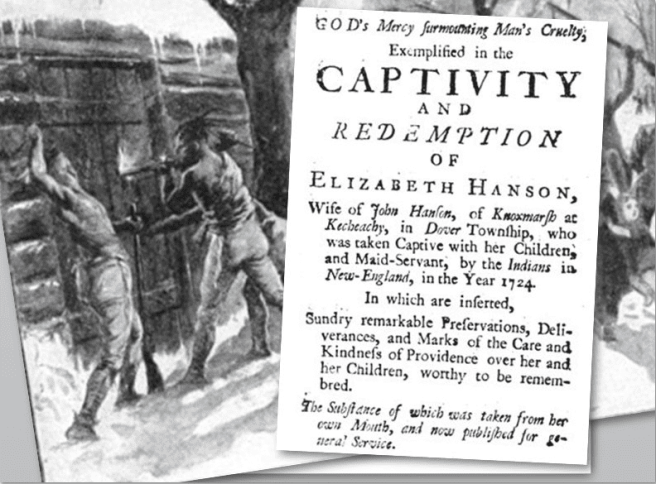
Elizabeth Hanson’s arduous ordeal, though, turned into five months of captivity, which she later related in detail. The trek to Canada was merciless, leaving the captives wet, cold, bruised, and hungry. At one stretch, they had nothing to eat but tree bark, and Elizabeth feared for her infant as her milk began to dry up. Once in Quebec, all her children except the baby were separated from her, and in one instance, she was informed that her captor was very displeased with her and was planning to murder her the next night.
Funds for the family’s ransom included a large sum collected by Philadelphia Yearly Meeting, and her husband quickly went to Canada to redeem them. The price for Elizabeth and baby Mary was around 700 pounds. He also obtained the release of son Daniel and daughter Elizabeth, but the Natives would not release Sarah on any terms, though they did allow the father and daughter several hours together.
The chief’s wife had plans of having the girl become their son’s bride, even though the name they gave her translated as “the woman of the burning of the cooking.”
Back in Dover, John and Elizabeth had yet another child, Abigail, but he could not be content until rescuing Sarah, too. On April 19, 1727, he set out with a kinsman for Canada but fell ill at Crown Point, New York, on the west bank of Lake Champlain, and died.
The kinsman, Ebenezer Downs, and his wife continued on in hopes of redeeming their own children as well.
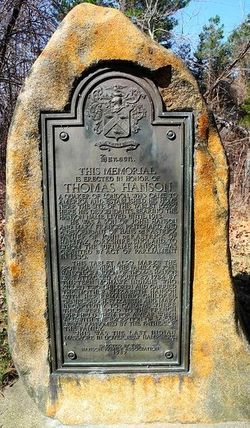
A marker along State Route 155 is all that remains at the site.
In Quebec, Frenchman Jean-Baptise Sabourin had interposed with the Natives and persuaded Sarah to obtain her freedom by marrying him, which she did on June 27, 1727. The record names her as Sara Ennson, daughter of Jean Ennson, deceased, and Elizabeth Midor, English of the village of Touba in the government of Boston.
Apparently, Downs had managed to meet with her and inform her of the death of her father. But she had been baptized at age 17 and renamed Catherine, perhaps as a step in gaining her release from the Natives.
With Jean-Baptiste, she had at least eight children, two of whom married children of Deerfield, Massachusetts, captives, two who died in infancy, and one who became a nun.
On March 24, 1730, her sister Elizabeth married Ebenezer Varney, the son of Ebenezer Varney, whose garrison had survived the 1689 attack on Cochecho village, and Mary Otis, who had been captured and returned.
Two first-person accounts of Elizabeth Hanson’s experience became widely known. The first, God’s Mercy Surmounting Man’s Cruelty, Exemplified in the Captivity and Redemption of Elizabeth Hanson, appeared in 1728 in Philadelphia.
A second, more detailed version was by English Quaker minister Samuel Bownas, who knew the Hansons from his travels to America. It was first published in London in 1760: An Account of the Captivity of Elizabeth Hanson, Now or Late of Kachecky, in New-England: Who, With Four of Her Children and Servant-maid, Was Taken Captive by the Indians, and Carried into Canada. This volume, especially, gives insights into life within a tribal culture. Both narratives lean heavily on a Quaker religious framework.
Kachecky, of course, was another variant of Cochecho, while Touba was a French attempt at Dover.
Widow Hanson, as Bownas repeatedly referred to her, never remarried and died in 1737.
~*~
Check out my new book, Quaking Dover, available in your choice of ebook platforms at Smashwords.com.
of heaven and earth and so right at the moment this righteousness struck a relationship without a tinge of merely imagined fragrance closer and more real, the daily repetition overflows into a sink of unwashed dishes of confusing lion and the lamb of dilemmas, paradoxes, even tedious crosscurrents the Adversary complicates a profusion of weeds just doesn’t ring clear the first time around oh, my poor memory, in callous fingers clutching whatever
As I’ve admitted, many of the historical persons in my new book, Quaking Dover, really deserve full-length biographical treatment or maybe individual operas or Hollywood blockbuster movies, if only we had time to linger. Four hundred years requires a lot of compression and that meant keep moving ahead. Anyone looking for a writing prompt can dig in with a host of possibilities on the list.
Retired librarian Olga R. Morrill, bless her, rises to the challenge with her historical fiction, Vagabond Quakers: Northern Colonies, published in 2017, focusing on the three women missionaries who came to Dover in 1662 and were whipped out of town in what was essentially a death sentence.
In doing so, she also portrays Richard Waldron and Nicholas Shapleigh as fully fleshed characters, even though they both have much more ahead in their lives after the three troublesome Quakers venture off-stage, the part she follows as the women venture south. (Yes, we need a full bio for each of the guys, please.)
As fiction, Vagabond Quakers resorts to some creative history and plausibility to fill in huge gaps. I see this in Waldron’s chronology, especially – with details where my findings and her tale conflict – but she does induce a compelling drama even in the minor players. She weaves fact and fiction seamlessly and manages a credible dialogue. (What they actually said would sound unintelligible gibberish to our ears.) If only I were sure which parts arise in her invention and which parts rest on solid evidence.
I’m happy to see that she examines Waldron’s life as a major figure in Boston, not just his existence as the most powerful man in New Hampshire, where he’s usually confined in the telling. Dover may have been his private fiefdom, out on the fringe of New England, but he wasn’t exactly provincial. She even manages to stir some sympathy for the man I dub the perfect villain.
She also gives full due to the deep conflicts in the town church before the Quakers arrive. Those are something I’ve long suspected contributed to the willingness of so many residents to join Friends early on. My one quibble is that I think Elder Starbuck would have been in the other party than the one where she places him.
For me, Morrill’s biggest contributions come in her envisioning the proceedings from the women’s perspective – not just the Quakers, but even those in the Waldron household. In the actual dates-and-names history, they’re mostly invisible. Many of Dover’s earliest wives remain ciphers, and even too many of their first and maiden names are missing. As for their language, demeanor, and dress? Morrill has me willingly suspending disbelief in her storytelling. Was one of the Quakers of short stature? Not that I’ve found anywhere. As for singing? Unlikely, but the quirk does pop the individual into three dimensions.
The events she describes in what would seem an out-of-the-way frontier settlement remain an important breakthrough in establishing religious freedom, anywhere.
Morrill and I both find these events to be endlessly fascinating, and hope you will, too.
Let me know of examples of courage you find that match the Quaker women’s.
There are reasons it’s also known as Charm City. Or, as they say of neighboring D.C., it has Northern charm combined with Southern inefficiency. By the way, don’t blame me for that perspective.
USS Constellation, built in 1855, graces the Inner Harbor. (Photo via Wikimedia)
Baseball great Babe Ruth was born here (1895) and poet Edgar Allan Poe died a drunk on its streets (1849).
Speaking of baseball, the Camden Yard ballpark spurred the return of smaller professional arenas to central cities across the continent. Now, if the Birds could only fly higher than the Yankees or Red Sox in their division. They really are doomed in that association.
Speaking of birds, the Baltimore Oriole got its name because its colors resembled those of the coat of arms of Maryland founder Lord Calvert. I have no idea about their religion, but he was an advocate of religious liberty.
The port was second only to Ellis Island in the number of immigrant arrivals in the 19th century. And while the city sits below the Mason-Dixon line and has a Southern outlook, it also has a strong German presence and Northern connection strengthened by the Baltimore & Ohio train tracks.
With his profits from those rails, Quaker Johns Hopkins founded the nation’s first research university in 1876. Today it and its related hospital and institutions are the state’s largest employer.
The metro area is also home to McCormick spices. You can smell it in the humid spring air.
The National Aquarium crowns the redevelopment of the Inner Harbor as a popular destination. The waterfront is also graced by the tall-masted USS Constellation of Civil War glory.
American Methodism was founded in 1784 at the site of today’s Lovely Lane church. And a 1789 conference at Old Otterbein Church led to the formation of the United Brethren denomination of German-Americans (it merged in 1968 with the Methodists, giving them the “United” in today’s name). Also in 1789, the nation’s first Roman Catholic archdiocese was founded in the city; its cathedral was finished in 1821. It even produced a saint, I believe.
A flag waving over Fort McHenry during the War of 1812 inspired Francis Scott Key to write the lyrics to the National Anthem, the one that was much in the air yesterday, but the music’s from a much older British drinking song. How ironic, especially since it challenges even the most professional singers.
The city doesn’t show up in my fiction, despite my living in the inner city’s Bolton Hill and suburban Owings Mills for three years. Even if the place is so hot and humid you have to turn on your air conditioner on the same day you turn off your furnace. Or, as they say of neighboring Worshington, it’s built over a swamp you know.
Though Eastport was settled relatively late – that is, toward the end of the Revolutionary War – it was instilled with a Colonial flavor by prominent early residents who were resolute veterans.
A continuing spirit of Tea Party and Minutemen makes Independence Day in New England feel different than those elsewhere. It’s not just the place of the Shot Heard ‘Round the World. It’s the region where thickheaded Yankees have always doodled.
Quite simply, history is palpably alive everywhere across New England.
Boston, of course, is the epicenter, but across the six most northeasterly states, local observations uphold distinctive traditions. Think of musketeers firing a round ever so often along the town parade route, along with fifes and drums.
As an independently enterprising oceanside village, Eastport soon had a reputation as a hive of privateering – that is, legalized piracy – and not-so-legal smuggling. That independent streak gets its own attention in the city’s annual Pirate Festival a week after Labor Day.
How joyous!
Unlike much of America, the city had frontline experience of the War of 1812. Fort Sullivan atop the bluffs surrendered to the British Navy in 1814, and Eastport then remained under the royal thumb until 1818.
Two years after its reunification with the United States, Maine became liberated from Massachusetts for the first time since 1653 and began to breathe into its own unique character.
For its part, Eastport rocketed as a center of shipping, shipbuilding, fishing, and sardine canning before the big decline of the 1900s set in.
Today, the tiny city’s locals remember a vibrant past and close-knit community, one that spanned the shorelines on both the American and Canadian sides of the watery border.
Is a renaissance on the horizon? There are signs for hope.
All of these strands infuse the holiday here.
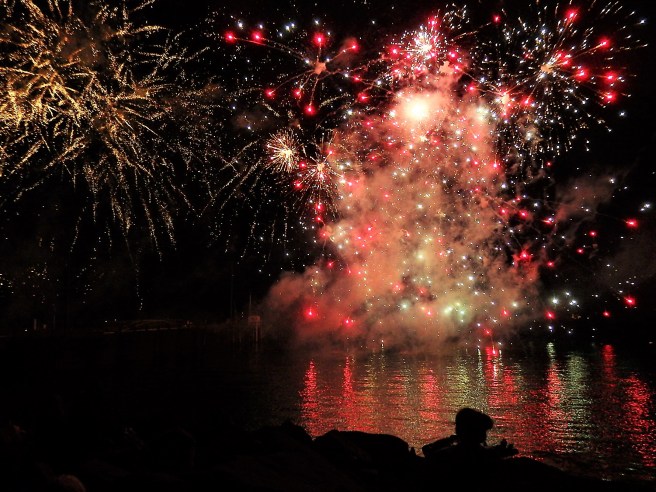
Here’s a taste of last year’s pyrotechnics fired off from the fish pier downtown.Yes, fireworks can be visually composed, leading your eyes around the sky.
The national holiday also marks the opening of New England’s short summer season. After a cold, dark, long winter, Eastport’s small year-’round populace can actually come out into the open air for long times together. The ocean and lakes are finally warming, to the extent that they do, and that attracts vacationers to join in.
After months when only a stray New Hampshire or Massachusetts auto plate is seen around here, I’ve now seen those of every state but Alabama, Hawaii, and North Dakota (not all at the same time), some seeming rather exotic.
And the Fourth includes the city’s Old Home Week, with high school reunions and the return of many summer residents.
A lot happens over a four-day span. There’s a doll carriage and wagon parade. A torchlight parade. Car shows, bike races, water games, pet show, rubber ducky race, festive all-you-can-eat blueberry pancake breakfast, free outdoor movie, contests, live music, and a street dance, all with a small-town flavor.
A traditional visit by a large U.S. Navy vessel failed to materialize, a consequence of being on Ukraine-related alert. Three different ships had expressed interest in landing at the Breakwater before the turn in world events.
While fireworks were displayed off over the harbor on the Fourth, America’s Independence Day (the beautifully designed and executed big show fired from the town’s Fish Pier was followed by a joyously rowdy encore from a diner’s smaller private pier), the companion July 1 presentation for Canada Day, in honor of our neighbors in New Brunswick, was still a victim of Covid cutbacks. Some residents, though, could view shows happening on Deer Island across the water.
Seems ever so fitting to shoot the works twice, considering Eastport’s dual connections.

 In doing so, she also portrays Richard Waldron and Nicholas Shapleigh as fully fleshed characters, even though they both have much more ahead in their lives after the three troublesome Quakers venture off-stage, the part she follows as the women venture south. (Yes, we need a full bio for each of the guys, please.)