Feel like I’m drowning in paper.
Even when it’s all digital.
Drafts and correspondence, especially.
You never know what we'll churn up in cleaning a stall
Feel like I’m drowning in paper.
Even when it’s all digital.
Drafts and correspondence, especially.
she sent her love
while screwing another
firsthand story of real life
his or hers
Closely related to poet John Greenleaf Whittier was the Cartland family in Lee. In fact, Greenleaf was especially close to cousin Moses Cartland, though their expectation of dying as bachelors was ultimately crushed when Moses wed a much younger first cousin, contrary to Quaker discipline.
My trail starts with Joseph Cartland, born in Dover in 1721, who moved the family to Lee and established Walnut Grove farm, which would eventually encompass two thousand acres. With first wife Lydia Allen, who died in 1758, and second wife Anna Hanson, he had 11 children, most of them active Quakers.
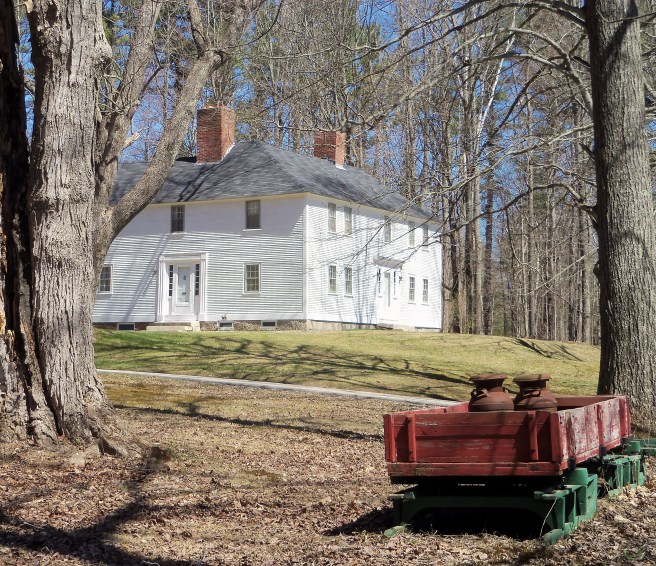
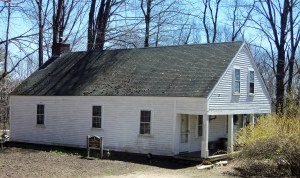
Their spacious home became a stop on the Underground Railroad, and the Quaker meetinghouse, which doubled as a Friends school, stood across the road.
His son Jonathan Cartland, married to Elizabeth Austin, and their children included the noted abolitionist and educator Moses A. Cartland, a confidant of second-cousin John Greenleaf Whittier, who was a frequent guest. Moses also served in New Hampshire’s House of Representatives and was a founder of the Republican Party. His brother Joseph Cartland, husband of Gertrude Whittier, headed Haverford College for four years before they became principals of the Friends School in Providence, Rhode Island. They retired to Newburyport, Massachusetts, which had a Meeting that was part of Hampton/Amesbury Monthly Meeting.
Cartland influence in Dover continued. In the late 1800s and early 1900s, William and Howard Cartland owned Cartland Grocery on Locust Street.
From there, my notes trail off.
~*~
Check out my new book, Quaking Dover, available in a Nook edition at Barnes & Noble.
Welcome to Dover’s upcoming 400th anniversary.
spent most of my spare time since one coworker helped me unload the last two-thirds seeking traction amid the confusion assumed new meaning with indications of clearing on the horizon {oh, how I wanted that forecast to turn truly true}) may beginning afresh bring only the best, don’t we deserve something like that?
It’s like a state fair in the hippie, organic, granola-mind reality. There’s no midway with carnival rides, for sure, but for truly inquiring-minds folk, it’s an autumn equinox slash harvest-time celebration.
Yes, let’s declare a true Thanksgiving, minus turkeys.
Shortened in its post-Covid resurrection, this year’s gathering in Unity, Maine, is the premiere event of the Maine Organic Farmers and Gardeners Association (MOFGA), and runs Sept. 23 through 25.
Now that we’re living in Maine, we can identify as members and look forward to attending, even though in New Hampshire we were surrounded by devotees. Yes, it’s that boffo.
As an aside, I can attest to enjoying my best-ever souvlaki ever, from a wood stove, no less, at an earlier fair. Gee, and I hate standing in line. It was worth it.
This is definitely a hippie-vision positive manifestation of the radical mindset of nirvana. And there’s no honky-tonk.
This year’s poster will no doubt be displayed on a wall of our new abode.
See you there?
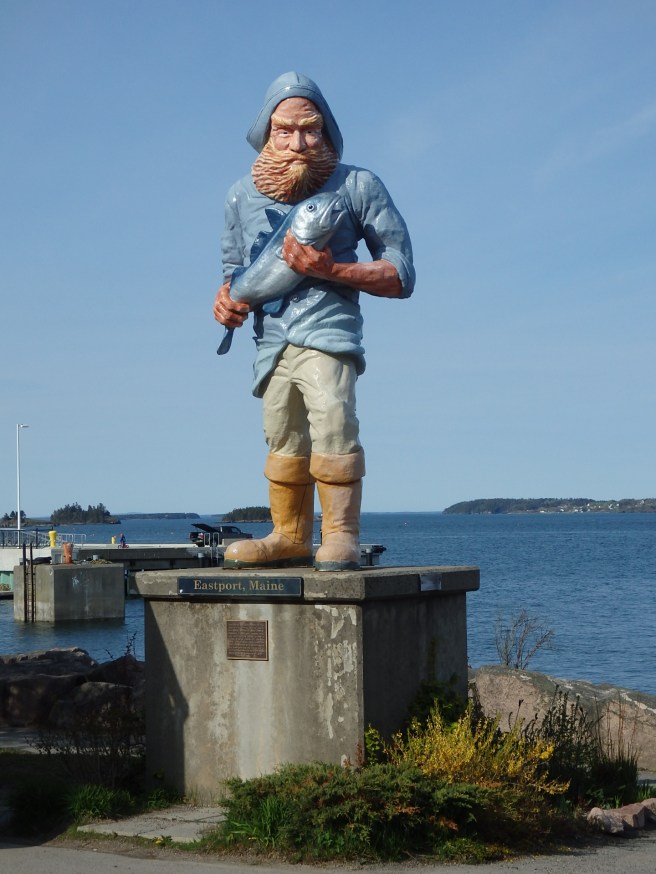
I thought the guy was kidding when he pulled up in town and confided that he was going to repaint Eastport’s iconic waterfront fisherman statue, changing the blue coat to a yellow slicker. I was sworn to secrecy at the time, but the next day, there he was, in full light, doing the deed.
The somewhat surreal, but shall we say fiberglass de facto emblem of the city, really got a fashion update. Or upgrade, in my opinion. Seems I’m not alone. Yes, that yellow slicker fits much better.

My kudos to Patrick Keough of Seward, Nebraska, for something that even included an imaginative eyepatch.
Some folks, however, are seeing a similarity with the Gorton’s guy down in Gloucester on Cape Ann, Massachusetts.
I think they have that backwards.
Eastport’s tap water last summer took on a greenish color and a definite off-taste. It got to the point that we started running everything we’d be drinking or using for cooking through an activated charcoal filter.
The explanation was that the supply came from a large but shallow lake a dozen miles away and that every summer the algae bloomed. The private company that provides water to the city then had to heighten its use of chemicals for treatment, resulting in the offensive character.
Water to the Sipayik reservation also came from the same source but was delivered via a different pipeline and was, by reports, much more troubling.
In its attempts to redress the issue, the company announced it would be using an alternative to treat the water, and I have to say we haven’t noticed the off-taste or discoloration this year. We haven’t yet seen a chemical analysis yet, however, or heard about the current situation on the reservation.
Still, public water quality is something most Americans take for granted.
Funny how often we overlook a problem, even when it has, as I hope, been clearing up.
Trying to get only three items to the dinner table at the same time had me thinking of this the other day.
It wasn’t like I had eight or nine tables awaiting some miracle, this was only me. The mathematical probabilities became rather staggering.
Quite humbly, it’s something every household more or less expects at least once a day, and it’s much more demanding than most of us assume.
My wife, bless her, is a wizard at this, as are our daughters.
But now, back to the rest of the universe.
This is one more case of where timing is everything.
It had me recalling my first visit to New Hampshire, where my traveling companion and I had to await breakfast on a one-order-at-a-time prepared by an amateur.
Next time you venture out to eat, please remember this.
There may be no excuse for much of the overpriced mediocrity that emerges after you ordered, but please, please, be aware of the skill when things do come together seemingly as expected. And do react appropriately, when the check comes.
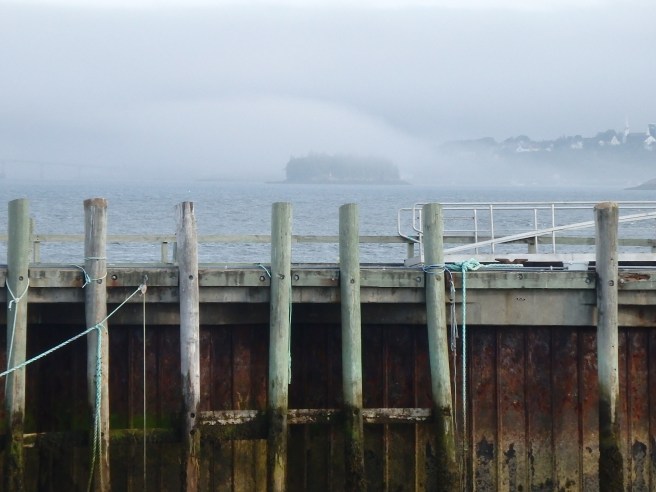
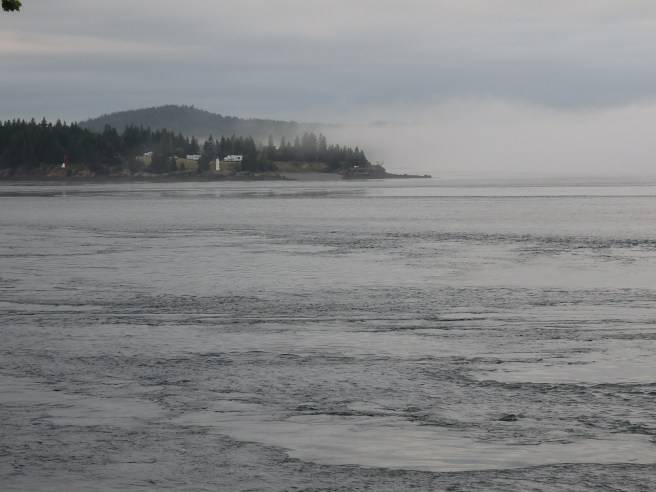
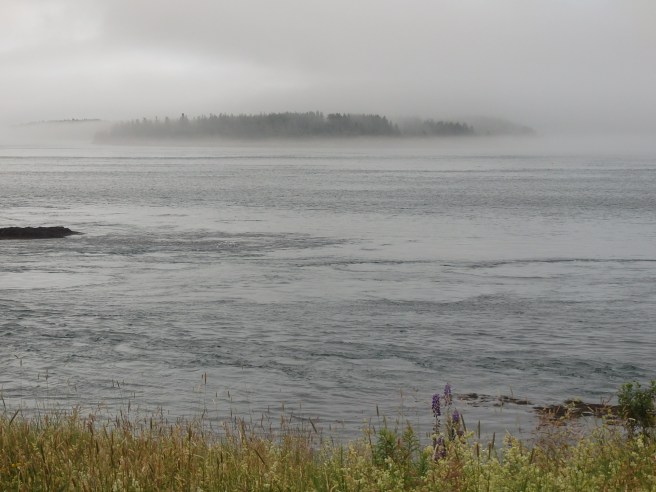
“Another crappy day in Paradise,” as one wit has been heard to say on a gray, chilly, wet morning here.

