Are all of those “Hi, how are you doing,” Facebook messages to me really from accounts that have been hacked?
Sure, I recognize half of the people, maybe more, but do they all come up with identical messages? How improbable. Makes me wary, especially after my own account had been hacked.
Apparently, it’s very easy to set up a counterfeit you and invite all of your “friends” to check in at the new address.
Just how secure is that party line, anyhoo?
If you think one of your real friends has been hacked, tell them, so they can alert FB security. Inform them that merely changing their password won’t fix it, too.
There’s just so much out there, in print and especially online, and it keeps proliferating daily, even hourly, and I don’t know about you, but I’m in the camp that finds it truly overwhelming.
Everywhere, each minute, make that second, we’re expanding outward, away, from any notion of a renaissance man, and woman, who could possibly be well informed on every facet of a civilized society.
Even in science – or maybe, especially in science – it’s become impossible to keep abreast of the flood.
Interdisciplinary collaboration has become more essential than ever, but also more elusive.
Is this leading toward disintegration?
Is this, in fact, the root of the reactionary backlash around the globe, not just the Trumpian cultists?
Yeah, the folks who rely on Fox TV biased “news” in the USA.
I look at the crises facing our children and grandchildren, and these are critical, but there are so many it’s mindboggling trying to decide where to pitch in taking a stand. Climate change, population explosion, racism, corrupt politics, the one percent and injustice, environmental protection, medical systems, education … Hey, I’m back to hippie era causes on steroids.
How are we supposed to preserve our sanity and still press toward a better future?
We still have to be informed, right? And thinking clearly?
The indicators started showing up by the last week of August but are inescapable now. Eastport’s locking up for the winter.
As evidence?
The passenger ferry to Lubec has already been hauled out of the water and is up on props in the boatyard for annual maintenance.
The Tides Institute Museum is closed for the season, with the Eastport Art Gallery set to do likewise at the end of the month.
I trot down to Horn Run Brewing and find it closed today. Gotta check the new schedule. Not that I expected its popular deck to be open all year. And other restaurants have curbed back as well.
Nobody’s out on the Breakwater.
Rosie’s hot dog stand is closed and its sign thanks us for a good summer.
I haven’t seen a super yacht for a month, much less tied up at the dock.
Most of the out-of-state license plates are gone, along with the luxury car models. It’s mostly Maine and New Hampshire now, and soon it will be about all Maine.
Well, there is a sole convertible stubbornly zipping about – but just one, with its driver bundled up.
There just aren’t as many folks around, period. At least the dog walkers are holding up their end.
There’s an uptick in the number of houses for sale as some Summer People realize they can’t keep up with another year. And the places are staying on the market longer.
Don’t know about where you live, but in New England, the front door typically is rarely used.
That insight was confirmed when I was canvassing for the Census and we had to leave a notice behind when nobody was home. Often, the real door is the one at the rear of the house.
It’s a curiosity that reminds me of something I once read about Zen temples in Japan, which were initially copies of ones in China.
The Chinese loved symmetry, which the Japanese detested, and so when the imported designs were expanded, they grew to one side or the other. Many old New England houses also have many additions, most famously the connecting barn.
Well, for the record, our back door is where the action is, and it runs through a mud room addition from the kitchen.
Now I’m starting to think about trying to enter by the right door as a metaphor for life. Like maybe there’s a hidden key, even. The one others know about, but not you or me?
As many fish stocks dwindle precariously, salmon farming and related aquaculture are hailed as a viable alternative.
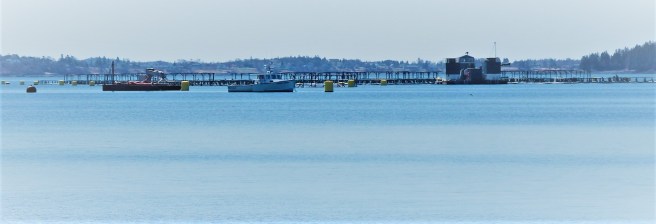
Salmon pens at Broad Cove.
Young salmon are placed in the circular enclosures when they’re about six inches long, where they leap and splash under netting that protects them from eagles, osprey, cormorants, and gulls. In about two years, they grow to a harvestable size of about two feet and ten pounds. A specially designed vessel sucks the mature fish from their pens and its conveyor stream immediately cleans and guts them.
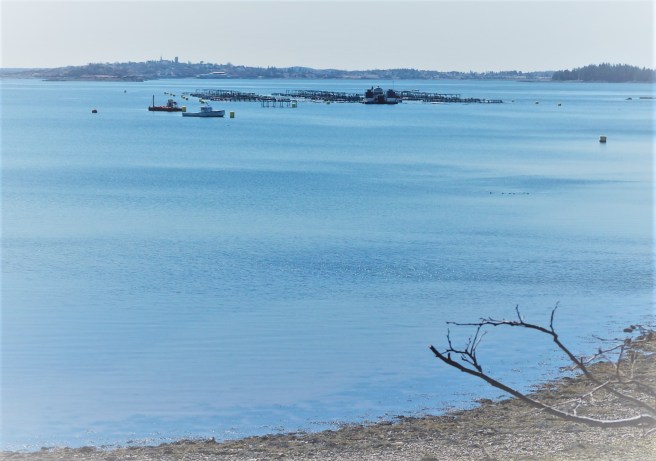
Lubec rises in the distance.
Cooke Aquaculture, based in Blacks Harbour, New Brunswick, manages 15 pens in Deep Cove and Broad Cove, operating from a former fertilizer plant on Estes Head. A feeding barge sits amid the pens, which house about 450,000 salmon. About one-third of the pens are left fallow at any time.
A pen like this can hold 25,000 fish. The netting protects the salmon from osprey, eagles, and other predators.
From our upstairs windows, we can see other salmon farms at Campobello Island across the channel.
I was feeling a little down as Eastport turned into its annual ghost town. Cooped up, too, especially under the tedious revisions to the Dover history, even before seeing how much I still don’t know and will likely never know, even if I spent a month at the University of Massachusetts going back through the Quaker archives.
Then I realized I hadn’t been anywhere other than eastern Washington County since mid-April. Six months confined to this sliver of rocky coastline and piney interior. The largest city has only ten thousand population and has commercially suffered under the Covid border restrictions. So I decided to see something new and finally settled on Aroostook County, widely known simply as The County, and thus hit the road at 7:15 Monday morning and headed up U.S. 1 without a plan other than turning back around noon.
I can now tell you it’s four hours to Caribou and a lovely drive, some of it through long stretches of forest, others through the tidy farmlands of The County itself. Yes, tidy, unlike many of the rural residences in this state.
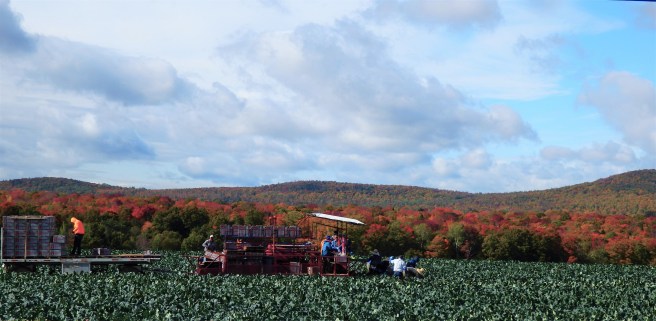
Remote Aroostook County is famed as potato farming country.
Turned out to be the perfect day. Sunny, foliage in its prime, little traffic, small roadside sheds selling new potatoes on the honor system. I really felt at home amid all the farmland wonder.
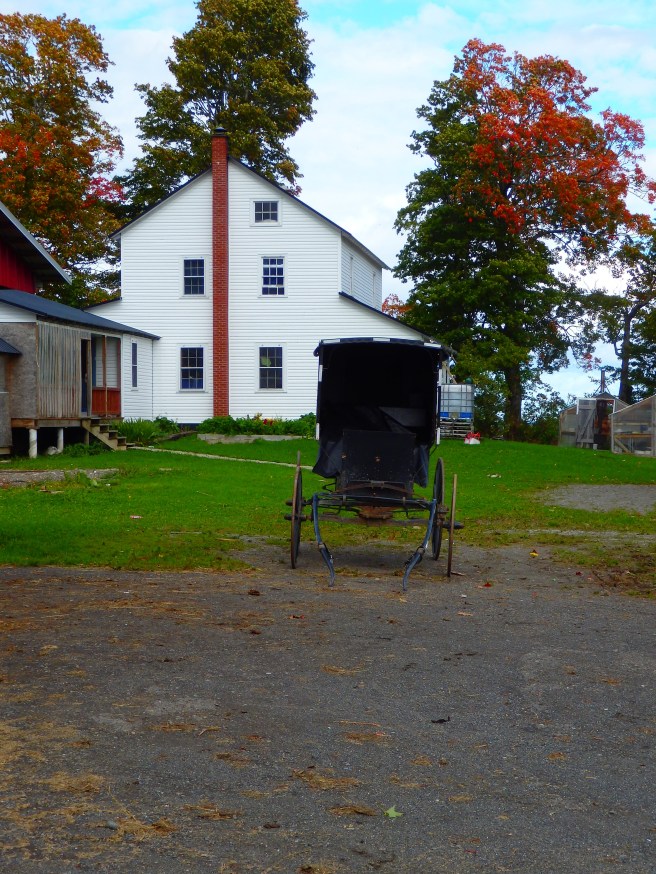
Feeling sated with the visual glory, I felt ready to head home. At Caribou, turned over to Fort Fairfield to follow U.S. 1A back to Mars Hill, and was surprised to find a yellow “share the road” sign with a horse carriage emblem. And sure enough, I found a large colony of Amish. I’ve missed them and Mennonites and Brethren since moving to New England, and this was exciting.
Amish families are finding a place here.
After passing one Amish farm and its bright red barn – yes, that seems to be the custom here, red next to the plain white farmhouse and laundry on the line – I noticed a small church and whipped around to take a closer look.
Never would have if a Friend hadn’t tweaked my interest by sharing something he found online.
The meetinghouse is one that escaped Silas Weeks’ research for his definitive book, too.
Afterward, I learned that one of our good friends was from Caribou, not further north as I’d thought. And then another was from Presque Isle.
So now I have a much better grasp of what folks are talking about when the say “The County.”
I should also mention I came home with 60 pounds of new potatoes from three different stands. Ten pounds for five dollars, three different varieties. Turns out they’re ones that didn’t pass the baggers’ standards, usually because of irregular shape or size, but that’s no problem for us. The skins of new potatoes are so soft and tasty – no need to peel them, even for mashed potatoes. You do need to unbag them, wash and inspect them, before storing. Otherwise, a few damaged ones can spread rot.
~*~
Next time I venture that far north, I plan to visit the entire solar system. Seriously. I caught a clue of it with a model of Saturn atop a pole beside U.S. 1 followed miles later by Neptune. Turns out all of the planets sit beside the road to Presque Isle, scaled in size and distance from the sun at the University of Maine branch campus. There really is a lot of emptiness in space.
After coming to New England and working as a farmhand at Oyster River, then part of Dover, John Meader (1625-1715) wed Abigail Tuttle of Ispwich, Massachusetts, in 1653. Granted 100 acres in 1656, he erected a garrison house by 1660.
He took the oath as constable of Dover, and on July 4, 1663 was ordered to tie Edward Wharton, “a vagabond Quaker” to “ye Carte tayle” and whip him out of town, administering not more than ten lashes. That didn’t stop two at least two of his sons from joining Friends.
In 1684, he was one of at least 34 landholders who refused to pay land rents to the Mason heirs and were disposed of their land titles. The next year, they petitioned King James II for relief from the arbitrary decisions of Governor Cranfield, and their representative, Nathaniel Weare, managed to get their lands and other rights restored.
In the 1694 Oyster River massacre, Meader’s garrison and the nearby house of his son, Joseph (1753-1820), were burned, but the family escaped.
Joseph Meader and his first wife, Abigail Field (1759-1784), had son Valentine Meader, born on August 6, 1777. He was a carpenter and a Quaker minister who traveled widely, dying of an illness during a religious visit in 1837.
Joseph later married Elizabeth Gould (1756-1814) and had son Joseph Meader on September 22, 1788. The son married Mehitable Varney in 1810 and was a farmer who became an acknowledged Quaker minister at Sandwich Meeting in New Hampshire’s White Mountains. In the Wilburite Separation, his family aligned with the conservative faction, in 1845. He died on January 28, 1864.
Quaker Meaders spread from Oyster River, or Durham, north into northwest Rochester, forming its Meaderboro village, and further north into Sandwich. Others were at Lee, with its Meeting.
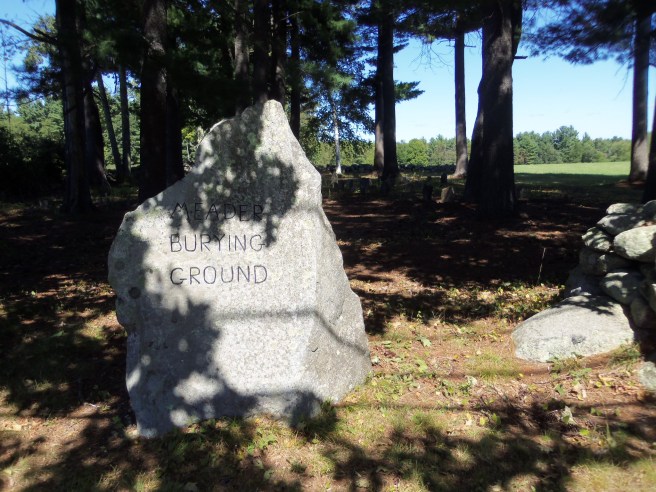
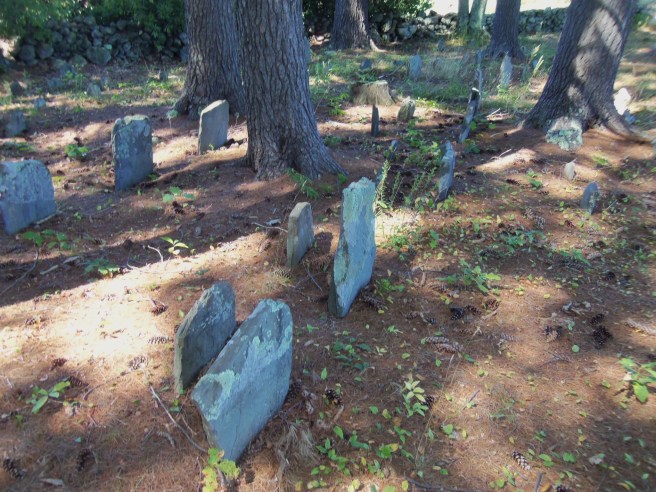
The family burial ground in Meaderboro embodies Quaker humility. The fileldstones mark the plots but are either left plain or engraved with nothing more than initials and dates. Others went unmarked altogether.
Meaderboro descendant Elwyn M. Meader (1910- 1996) was a University of New Hampshire horticulture professor famed for plant varieties he created for northern climates. As the Fedco Seeds website noted, “If you’ve ever grown vegetables or raised fruit or flowers, Professor Elwyn M. Meader’s work has probably touched your life. … At least half his introductions came after he ‘retired’ from a distinguished 18-year career as plant breeder at the University of New Hampshire. He could have gotten rich from royalties on all his releases, but instead he gave them away ‘as payment for his space on the planet. … I was working for the taxpayers,’ he would say in his broad Yankee accent, ‘and the results of my work belonged to them.’
His accent, I will confirm, was classic New England. At least one linguist recorded it for posterity.
Fedco’s profile continues, “A deeply religious Quaker, Meader was always modest about his creations, but not shy about his opinions. He disdained plant patenting. ‘Plants shouldn’t be patented if there has been one dollar of federal or state money used to fund development.’ At one point in the 1950s he refused to serve on university committees (except one to abolish all committees) maintaining he had been hired to do breeding work only. He offered inspiring advice to the wave of homesteaders who arrived in the ‘60s, ‘Try all things. Hold on to that which is good,’ but added curtly, ‘If you can’t make it without bringing along your TV, you’d better forget the whole thing.’
Dover Friend Silas Weeks drew heavily on him in researching what would become the book New England Quaker Meetinghouses, Past and Present.
And after Elwin’s death, when he had declined a memorial service feeling unworthy of one, I clerked a Quarterly Meeting session that discerned otherwise. The ensuing service was a glorious – and memorable – occasion.
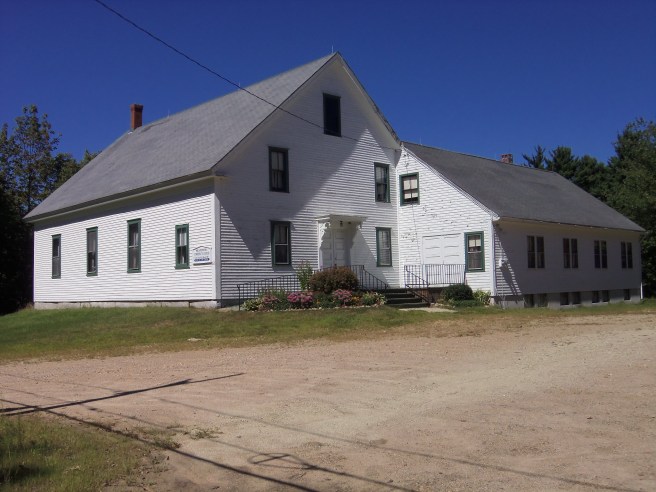
Meaderboro Friends Meeting disaffiliated from Quakers in 1963 and continues as a community church.
~*~
Check out my new book, Quaking Dover, available in a Nook edition at Barnes & Noble.