
cruise ship off Rockport
glare against haze of blue
Camden Hills a thousand-plus feet
other schooners out of Rockland
Eagle Island light
Mark Island light
Saddleback Ledge light
too far off to photograph
American Eagle
full sail
after a nap
You never know what we'll churn up in cleaning a stall
cruise ship off Rockport
glare against haze of blue
Camden Hills a thousand-plus feet
other schooners out of Rockland
Eagle Island light
Mark Island light
Saddleback Ledge light
too far off to photograph
American Eagle
full sail
after a nap
Three weeks into the project, I noted my wonder at how quickly the work was going.
The back half of the upstairs interior was now exposed, giving us a sense of how much flooring and headspace we would be gaining. And we could see all of the rafters. Unobstructed? Adam had set up an impressive indoor workshop on the back half of the second floor, while the front two rooms clustered many of our possessions, now under plastic.
That said, I also noted my concern at how slowly the work was going.
The old roof over the back half of the house was still in place, and the clock was ticking down toward winter.
What dawned on me as I gazed up toward to the peak of the rafters was that the ones from the back – which were about to disappear – secured the ones at the front of the house, the half of the roof that would have to stay well in place into late spring or early summer. A few of those charred rafters would actually be remaining like forever, a nod to history and all that.
In a flash, the urgency of the new laminated ridge pole and supporting columns made sense. Without them, the whole roof would come crashing down and, in turn, there would be nothing to hold up the new one. One earlier contractor’s proposal for premade trusses to create a gambrel roof on both sides now became comprehendible – so that’s what he meant? We weren’t exactly communicating, and his results wouldn’t have been our first choice. As we were hearing, not every carpenter today knows how to frame a roof from scratch.
~*~
The key to achieving this was a recommended custom-made laminated veneer lumber ridge pole running the length of the house. Or more accurately, three pieces that would be joined together once they were inside and raised into position. Each one was 1¾-by-14-inches by 40-feet and weighed 280 pounds.
In addition, another custom-made LVL 3½-by-3½-inches by 26-feet was delivered for the remaining supporting column. That one would run down the cavity where our second chimney had been, the bricks that had been on the verge of collapse when we bought the place.
~*~
The new ridge pole would have to slip in where the rafters from each side were now overlapping. What would hold them up as he sawed them asunder? The answer was temporary framing underneath.
We were really, really glad Adam knew what he was doing, though we suspect he was losing some sleep over it. We do know he was doing his research and some thorough calculations.
had 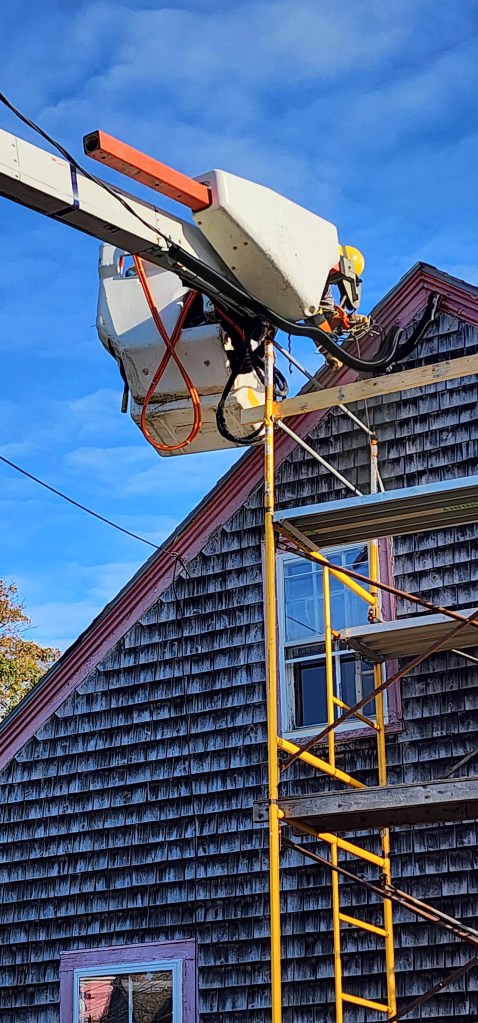
The electrical line coming into our house had to be moved to one side of the gable to allow for the ridge pole to come into the house. That meant getting the utility to come out for a free service.

Inside, our contractor was making cuts accurate to one-sixteenth of an inch. Sometimes the beam below, cut in the early 19th century, varied by a half-inch within the length of the two-by-sixes they would be supporting.
We were beginning to appreciate the fact that Adam was our contractor and not just our carpenter/electrician. He was making the arrangements and phone calls. Viking Lumber was making nearly daily deliveries from Machias.
After working largely solo, he lined up a crew to manage the pieces into the upstairs floor and then higher once inside. There was also the matter of a rented lift, positioned outside.
A lot of coordination had to come into place, even before discovering the power line coming into the house needed to be moved. Hello, Versant?
He had additionally expertly erected scaffolding by himself.
At that point, it really felt like this was happening.

So here we were, Week Four, the end of October, and the laminates were arriving – all four pieces. Well, make that five – Hammond Lumber had ordered a wrong size for the column and had to rush the corrected order down to our site.
While living in the small industrial city that’s the setting for Hometown News, I began exploring my genetic roots, at least on my father’s side. It involved a lot of correspondence, especially with a cousin of my dad’s generation, as well as probing whatever records we could dig up.
By this time, my spiritual practice had recentered in the Quaker stream, or Society of Friends, where it turned out my ancestors had been active from the early 1660s until my great-grandfather moved from North Carolina to Ohio and “married out” in 1893. I now had access to historic minutes, correspondence, journals, and other resources that proved helpful.
My findings are presented on my Orphan George blog, should you be interested.
What fascinates me in regards to my fiction is the fact that so many of my ancestors were essentially countercultural in regard to the broader society. They were pacifist, for one, and wore distinctive garb and used distinctive language. (Sound hippie?) In North Carolina, their community had the first manumission society in the state, buying freedom for slaves and transporting them to safer lands. This was not the Deep South of popular culture.
These findings, and the research methods, proved quite helpful when I drafted my nonfiction New England history, Quaking Dover.
The techniques and insights also played into my novel What’s Left, where I took Cassia’s lineage on both sides back to her great-grandparents, including their quite different faith traditions.
I am intrigued by the values and practices from one generation to another. What is rejected and what is embraced?
In my case, I discarded the mainstream Christianity and lifestyle of my parents and grandparents only to find myself later reconnecting with much of the radical Christianity and countercultural outlooks of my great-grandparents. Well, most of them on my dad’s side. My mother’s were an entirely different matter.
As I’ve found, genealogy often presents a much different history than we’re taught in the conventional versions, especially when our focus is on everyday people rather than the political and military leaders and the upper class. The lives can go ways we wouldn’t have plotted. For instance, my family in North Carolina had a gold mine.
The history of almost all the great councils and consultations, held among mankind for reconciling their discordant opinions, assuaging their mutual jealousies, and adjusting their respective interests, is a history of factions, contentions, and disappointments; and may be classed among the most dark and degrading pictures which display the infirmities and depravities of the human character.
James Madison in Federalist No. 37
Who was I to think I could say something fresh about underground public transit? Well, the outsider has long had a place in the arts … and in comedy.
I had expected to wind up living in a big city, where I’d have access to frequent symphony concerts and perhaps opera as well. Foreign films, well-stocked bookstores, kindred souls. All the rest. My life journey and my career went another way, but I still wound up as a subway rider, of sorts. I was far from a private jet or even taxi kind of existence.
My introduction to underground transit probably came in a series of big, cartoonish, wildly rendered Subway Riders canvases that received a special exhibit at the Dayton Art Institute sometime in my high school years. I think they were by a hot New York rising star who was visiting Ohio as an artist-in-residence or an arts school guest instructor, though his identity eludes me now. Flash in the pan? Rubes in the sticks?
I wasn’t exactly wowed, but I was intrigued. He wasn’t Rembrandt.
The furthest east I’d been was Pittsburgh. Perhaps the next year my family got to Toronto and Montreal, though I didn’t venture on the subway in either of those cities.
Do families even take such vacations on the road nowadays? We did have our camping gear in the trunk of our red Buick Roadmaster.
~*~
Writing about subways – becoming fascinated by them, their offensive grit, stench, and loud noises included – was about the last thing I would have expected when I graduated from college or even high school. I was a Midwesterner through and through. The closest I had come to what I saw in those Subway Rider paintings was on the City Transit trolleys at rush hour. We definitely weren’t flashing along a dark tunnel or loading by hoards or packed together like sardines.
But people kept telling me I wasn’t destined for my hometown, no matter how loyal I felt. Or was that defensive? The message they conveyed was that I should look to Manhattan or some equivalent opportunity. Even Cincinnati, an hour away, looked sophisticated.
The hippie outbreak, or Revolution of Peace & Love, was still somewhere in the future, though the Beatles were shaking the status quo and skipping around Elvis in what we’d now call the pop culture scene. Culture was, let me emphasize, concerned with things that would raise our vision and intelligence rather than merely mark social norms as in averages, either mainstream or ethnic.
By the time I actually rode a subway train, I was nine months away from earning an urban studies certificate, thanks to my multi-disciplinary college studies. The journalism career that embraced me would instead lead out in the boonies or an equivalent emotional wilderness.
~*~
My book that sprang from those encounters started out short and flashy as its first draft in ’73. Inspired, in part, by Brautigan’s Trout Fishing in America, I typed away sitting cross-legged before a converted coffee table and my beloved Olivetti Lettra 22 blue typewriter. The very portable one.
Graffiti, wild splashes. This was going to be my wild hippie book, the essence of it all. It had the Midwest – what would emerge as Daffodil – and it had the Big Apple, where so many of the freaks I knew after graduation had grown up. The movement was a confusing clash of youthful excess.
It was too much – way too much, actually.
By the time I distilled it down into what was published as Subway Hitchhikers, it was more of a lacy collage presented in a strobe-light kind of then/now alternation that I came to see was overly ambitious to be effective rather than confusing.
What I did sense was the way big cities draw on the interior landscape, almost like vampires on the innocent. Not that I ever expressed it that openly, but I am now thinking it fit Gotham if only I were usually trying to look at the bright side of life.
Was it even a novel? Short, and perhaps meta-fiction?
Unlike any other.
After recently tweaking the cover for my Hometown News novel, I found my eyes zeroing in on another volume and once again questioning its effectiveness.

What’s Left: Within a daughter’s own Greek drama had been especially difficult to develop, as I’ve explained in earlier posts, but ultimately ended up following a girl who lost her father in an avalanche on the other side of the globe when she was only 11. She then continues on into her emotional recovery and growth, rounding out in her mid-30s.
By the time the book appeared in both digital and print-on-demand options at Amazon, the cover image had settled on a photo of a Goth girl.
For technical reasons, she continues at Amazon, while my cover at other digital retailers got updated.
I wanted a better sense of the initial suffering, or even an edginess in her development, but nothing worked perfectly. I am still taken with the daring in her stare at the camera, but is that enough? (I did a post about the earlier covers on December 20, 2019, should you want to explore my archives. I was quite fond of the first cover, the one with its falling egg yoke, but nobody else seemed to get the connection.)
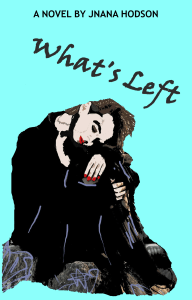
Furthermore, she’s genetically a mix of Greek and American Midwest and a tad on the pudgy side. I hate it when a story follows, say, a brunette but the cover shows an obviously dyed blonde.
Another challenge involved balancing the two words of the title. The second word, “Left,” should have the emphasis, but it’s only half the size of “What’s.” Nothing I tried corrected that. In many of the typefaces I sampled, “Left” simply didn’t read easily, either. It could have been “Lest” or “Lett” on first reading. In making a sales pitch, there’s no time for deciphering the message. “What’s” presented similar challenges in other typefaces.
The text had been difficult enough to nail down in a convincing voice, but the cover was equally problematic – especially finding an appropriate image. How do you summarize all this in a single graphic impression, especially one that works thumbnail size online?
Do note, there’s an ongoing argument about using a facial image on a cover, period. Does it grip a potential reader or does it turn one away? Will it even limit a reader’s impressions of the character at the heart of the book?
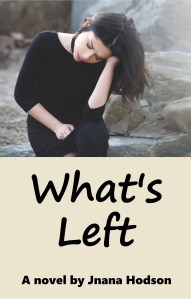
Remember, my budget wasn’t generous enough for a graphic designer, the kind who would create a flowing dust jacket replete with insider clues for a potential reader. I’m not particularly fond of those designs anyway. In general, I think photos pack more punch in a first impression. Just look at magazines at a newsstand. Remember those?
Cassia, or more formally Acacia, goes into mourning after her father’s death and then morphs into Goth dress and appearance through her teenage years, where much of the story develops.
The book doesn’t fall neatly into genres – part of it could be Young Adult, but I’d say the core of it is New Adult and beyond. So how old should she look on the cover?
Finally, in the latest stab at this problem, I decided to run with an image I’d settled on earlier. This time, it would bleed off the cover at both sides for maximum impact. I then decided to run it off the bottom, too. Somehow, that left the photo square, a format her photographer father pursued.

My reason for cropping the photo tighter was to give it more depth, putting the focus more fully on the girl and her emotion. I’m now seeing that the rocky background I eliminated had actually suggested another kind of story. No more of that distraction now. An artist might have replace it with her extended family, by the way.
In leaving the top open for author and title, rather than separating those elements with the photo in the middle, she has more presence and gravity.
I’m also glad I stuck with an impulsive decision to not fill in the remaining cover with a background color. A new typeface for me, Yu Gothic Semibold, seemed to work best for the title, though I’m not exactly happy with the single-stroke bar apostrophe. But “Left” carries its own weight in the dance of letters.
Book Antiqua, meanwhile, a fallback for me, does nicely in italic for the author.
That’s all – clean, simple, and somehow daring in its starkness. Without an obvious border, the design declares its independence from paperbook constrictions. It’s also quite contemporary, in a confident way. It even pops out on websites. And there’s no question that it comes together more harmoniously the one it replaces.
This one’s now available on your choice of ebook platforms at Smashwords.com and its affiliated digital retailers. Those outlets include the Apple Store, Barnes & Noble’s Nook, Scribd, and Sony’s Kobo. You may also request the ebook from your local public library.

Or so I’m guessing. The woods are full of surprises.

Sunrise County is laced with big lakes. In fact, 21 percent of it 3,258 square miles is water, including streams of all sizes, bogs and flowages, and ponds.
The largest lake, Meddybemps, covers more than 27 square miles within four towns, reaches a maximum depth of 58 feet, is dotted with islands, and is famed for its smallmouth bass fishing.
Light on winter ice provides a unique clarity in perceiving the lake’s profile, seen in part here from State Route 214.

I’m really in the dark about what’s “in” these days, though I do get some glimmers through family.
So let me ask.
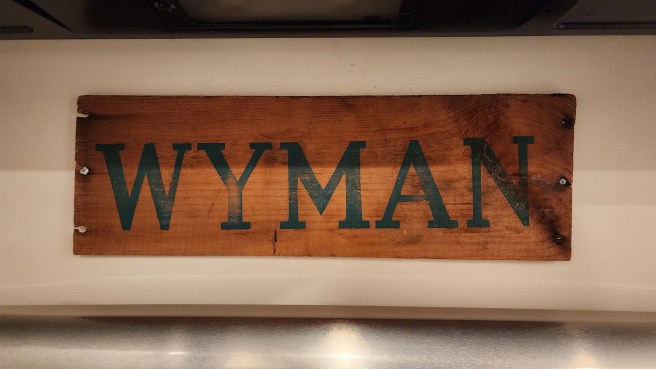
We recently had to flee our house for 24 hours after spray-foam insultation was applied to our second-floor renovations. That meant heading to an Airbnb in town.
This attractive wooden plaque above the stove caught my attention. Good use of a serif typeface in green ink.
And then it struck me: this was from the end of a blueberry-picking crate. I’m sure it’s been rendered obsolete.
 Jnana's Red Barn