Ever really look at those playing cards?

Yup, there are 52 in a deck, plus one to six Jokers, at least if you’re looking at what’s considered a standard commercial deck. There are, however, other traditional, and often older, suites to consider. Today we’ll put those off for another time and stick to the French-suited cards that are almost universally found in English-speaking countries. Got that?

To continue:

  1. The deck has four suits (clubs, diamonds, spades, and hearts) that come in 13 ranks, starting with the ten numeral or pip cards – if you’re wondering why there’s no “1,” it’s actually the Ace, despite its usual power. And then there are the three ranks of royalty, the court or face cards we know as Jack, Queen, King.
  2. Each numeral card displays the appropriate number of pips (the suit images) as well as the numeral itself.
  3. Early cards were single-headed, or single-ended, but that changed around 1860, when the double-headed versions appeared. These could be read without having to turn them to an up-position. Corner indices were added around 1880.
  4. The Jack of spades and the Jack of hearts appear in profile and are thus known as “one-eyed” Jacks. Likewise, the King of diamonds is depicted with one eye. The rest of the royals are shown full-face or oblique.
  5. Suicide kings appear in hearts, where he usually has a sword behind his head, as if stabbing himself, and in diamonds, where he has an ax pointed blade-down toward him. Adding to the nickname is the blood-red color on the card.
  6. The Queen of spades, holding a scepter, is also known as the black lady or bedpost Queen. She’s the only Queen facing left.
  7. The Ace of spades is sometimes called the death card. Those printed or sold in England from the reign of James I until 1960 carried an indication of the printer and that an excise tax on the deck had been paid.
  8. The 52 cards are said to represent the 52 weeks of the year, with 13 cards for each season or the 13 lunar cycles of the year.
  9. Possibly originating in China or India or Persia, the cards arrived in Europe from Egypt in the 1370s, perhaps in the hands of Crusaders. The first cards were hand-printed, limiting them to the wealthy classes. That changed with the arrival of the printing press at the end of the 15th century.
  10. Originally, the suit symbols were taken from everyday objects, which may have had any symbolic meaning: flowers, animals, birds, shields, crowns, pennies, rings, even pomegranates. I rather like the possibilities there, “King of bears” or “Queen of bananas.”

Acid test poet: Jack Spicer (1925-1965)

His wild poetics drawn on linguistics theory broke ground for a number of us. Quite simply, the narrative within a poem – or a series, as Spicer soon turned away from the single-page model – no longer had to conform with factual reality. I can only imagine what he would have done with Donald Trump as a figure. An image, however, took on a life of its own.

I didn’t realize how central the Los Angeles born character was to the West Coast poetry world. He was co-founder of the Six Gallery in San Francisco, where the Beat movement burst forth, and later in the Berkeley side of the Bay Area literary scene.

His collected poems, published posthumously by Black Sparrow and Grey Fox presses, remain core works on my bookshelf.

I also loved the way Ed Dorn picked up and continued Spicer’s stream.

Food along the way

Every night, the canopy is spread
every morning, stowed away

how he manages a wood cookstove
eludes me
the galley’s tight and must be a hot space
on a hot or humid day
regardless, he starts at 3 a.m.

and there’s coffee by 6:30 all the same


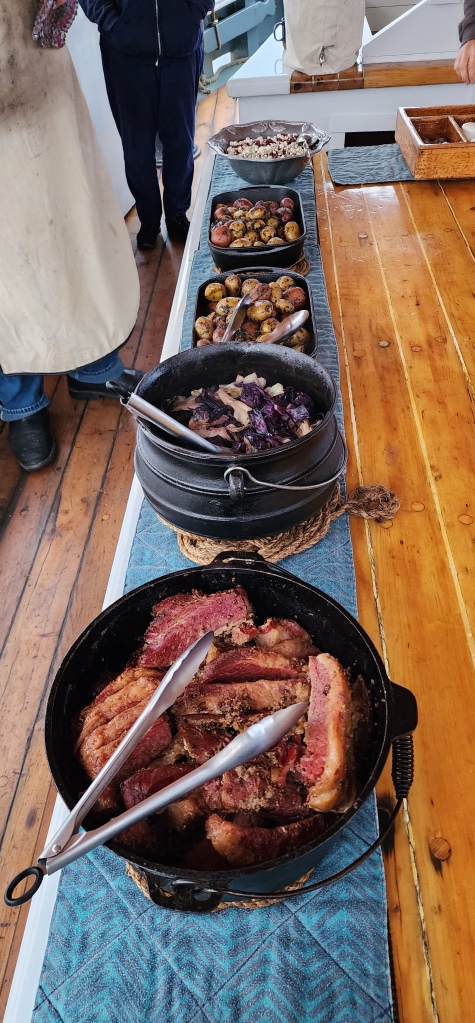
blueberry pancakes, slice of melon
cod chowder, a biscuit
roasted chicken drumstick, asparagus,
a risotto, Boston cream cake

lunch an excellent beef stew
and a great, crunchy sourdough bread

feeling like I’ve been here forever
in a good way
knowing it’s rarely this perfect

“no matter how much I eat
I keep losing weight on this ship”
sez male crew member

the cook’s apron
a variation on his overalls

the cook never learned wood-stove cookery
in culinary school
‘cuz he never attended one

in lighting a cook fire
the secret’s you have to stack
the firewood in tight

the galley’s quite crowded

the French burns four cords in a season in summer

Zen temple abbot and head cook
two most important personages

the cook also helps with the crew
mans an oar
hauls line, as needed

Over the hump?

Any expectation of having the back half of the upstairs finished before starting on the front slowly faded from reality. We definitely wouldn’t be moving goods from downstairs or storage into the new space anytime soon.

Just look at the ridgepole and it was obvious Adam would need to have elbow room to work freely up while attaching the new rafters before any wall could go in.

The rafters and roofing to the right of the new ridge pole are about to come off. It’s a miracle they’ve stayed up as long as they have.

He did have to demolish the drywall and framing that had separated the front and back rooms, and with that came my realization that putting up new drywall any time before the entire upstairs was ready for that phase of work was premature. As would be painting the walls, ceilings, and floors. Duh!

Adam’s big shock came when he exposed the top of the existing dormer and found that there was nothing to speak of holding the descending rafter. What were they thinking?

The rafter was simply cut short when the dormer was added. The plank under it was insufficient for the weight sitting upon it.

It was one more impending disaster that had somehow kept ticking until being defused now.

~*~

The front half promised to be less complex than the previous section. There was no plumbing and only two rooms rather than four. On the other hand, the top of the stairs might add some complications.