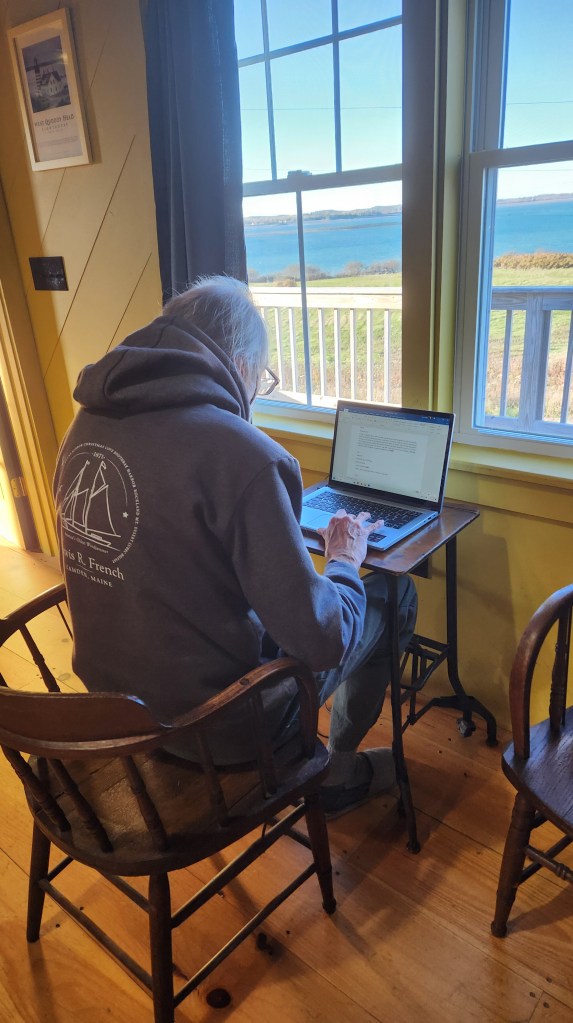
 Here I am at the keyboard while overlooking Lubec Channel from a rented cabin at West Quoddy Station, a former U.S. Coast Guard lifesaving post. We needed to vacate our home for two days during its renovation, and we settled on this, still in sight of Eastport on the water to the north and yet a world away.
Month: May 2025
My secret occupation?
Mapmaker of the Spirit.
When you’re lost in a fog, listen to this
Lighthouses do stir the hearts of many coastal residents and tourists, though foghorns have long provided at least as much foul weather warning for seafarers along the coasts. These horns do get overlooked, though.
Do note:
- The earliest known form of a fog signal comes from ancient China around 250 B.C.E., where bamboo pipes produced sound warnings in foggy weather. The concept was later adopted by other early civilizations such as the Greeks and Romans, who used trumpets made from animal horns or bronze. It was one way to keep musicians employed.
- Small cannons or other explosives were later used, though they were labor-intensive and time-consuming. Not much bang for the buck, ultimately.
- In 1851, a powerful steam whistle in Liverpool was first used, according to one version. As Emma Sullivan’s account at Working-the-Sails.com goes, “Its thunderous blast cut across thick curtains of fog with astonishing clarity.”
- Scotsman Robert Foulis apparently kept tinkering. While walking home one foggy night, he heard his daughter practicing piano and realized the lower notes she was playing came through most clearly. That led him to create what would become the first automatic, steam-powered foghorn in 1859 in New Brunswick, Canada, though the credit long went to others. The one in Canada, generally considered the first foghorn, remained in position on Partridge Island and in use until 1998.
- Crucially, lower notes have longer wavelengths, which allow them to pass around obstacles better than high notes do. As a result, the water droplets of fog do not diffuse the low notes as much as they do the upper ones. So the explanation goes.
- More common designs have relied on compressed air to create the booming alarm. Each of these horns requires a clever interplay of air pressure, diaphragms, and acoustic amplifiers. Other horns have used vibrating plates or metal reeds, somewhat akin to a modern electric car horn. Others forced air through holes in a rotating cylinder or disk, much like a siren. That may be why I’ve been unable to find much in the way of illustrations.
- More recent versions include electronic sirens and acoustic transducers. I’ll save the technical mechanics and their history for discussion in a museum setting or the like.
- A horn typically has a “sound signal” or frequency pattern, say an initial blast of about four seconds followed by a pause of a minute or so. This originated with a semi-automatic operation achieved by using a coder, or clockwork mechanism, to open valves for the air, giving each horn a timing characteristic to help mariners identify them. Today it’s probably computerized.
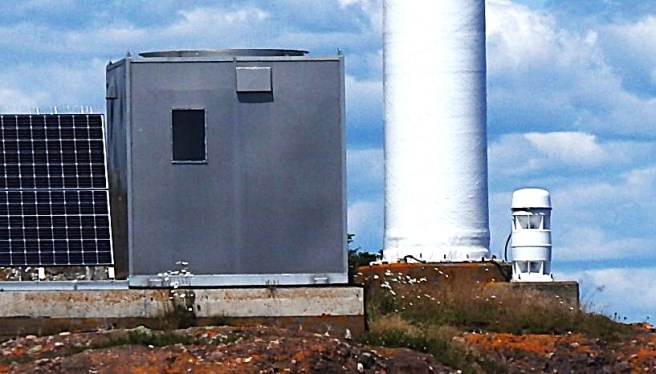
- They come in different sizes and shapes, depending on their mission and situation. Many but not all are associated with lighthouses, where the beacon of light can be obscured by heavy rain as well as fog. Many others, though, are on ships to warn others of their presence or even under bridges.
- Some foghorns can be heard up to eight miles away. Maybe not in a storm.
You don’t say, Charlie Brown
How about ten memorable quotes from the popular Peanuts comic strip character created by Charles “Sparky” Schultz? That kid really was a master of angst.
- “A friend is someone who knows all your faults, but likes you anyway.”
- “Absence makes the heart grow fonder, but it sure makes the rest of you lonely.”
- “Keep looking up … that’s the secret of life.”
- “My anxieties have anxieties.”
- “I’m already tired tomorrow.”
- “Be yourself. Nobody can say you’re doing it wrong.”
- “In the book of life, the answers aren’t in the back.”
- “What can you do when you don’t fit in?”
- “Whenever I feel really alone, I just sit and stare into the night sky. I’ve always thought that one of those stars is my star, and I know that my star will always be there for me. Like a comforting voice saying, ‘Don’t give up, kid.’”
- “Good grief.”
And here I had long dismissed him as somehow shallow, coming up with sappy lines like “Happiness is a warm puppy.”
Do kids today even know what a comic strip was?
Who said anything about my fiancée?
My question was only, “What’s going on with someone who has” a certain sun sign with these rising and moon signs.
The astrologer, Hollywood actress, then told me, “Let her go. She’s trouble. You love her very much, don’t you.”
I had witnesses who were astonished. My question had been gender-neutral.
Kinisi 262
rooots
caroots
Prime
 As seen from a cruise aboard the historic schooner Louis R. French on Penobscot Bay last summer.
For more schooner sailing experiences, take a look at my Under Sail photo album at Thistle Finch editions.
As for Shackford Head
While the 100-acre Shackford holdings along Water Street underwent subdivision and real estate development, the 100 acres at Shackford Head remained intact. So far, I’ve been unable to locate the original title that would have been bestowed by the Commonwealth of Massachusetts to Captain John Shackford senior, but the documents for the adjacent Coney or Cony Farm repeatedly refer to the land held by John Shackford, during his life, or later, “land formerly of John Shackford.”
In 1837, when Joseph Coney leased his 40-acre farm to his son, Samuel May Coney (1812-1895), the rent was recorded as one cent a year.
Samuel soon came into full possession. By the time of his death, he had added the Shackford property, too, as was noted in the sale from the estate (attorney John H. McFaul) to Charles O. Furbush in 1896. That transaction included an 1895 Plan of Shackford Head by surveyor H.R. Taylor.
All of this would become part of the controversial attempt of Pittston Company’s attempt to build a massive oil terminal and refinery on the site in the 1970s.
I can see why Shackford heirs living in Eastport would have held onto the rugged land. A house could go through 40 cords of firewood in a year, and with seven homes or more at times, having a large wooded reserve would have been useful. Depending on the proximity of a sawmill, the wooded land could have also supplied the Shackford shipyard or even the wood in our house.
Do you use storyboards and photos?
While these weekly Arts & Letters postings have been focusing on the writing life, at least as I’ve known it, some of the insights do spill over into regular life more generally. (I’ll leave that redundancy for emphasis.)
I am visually oriented, more so than many writers, and I did have four intense years of art training in high school. As a newspaper editor, I was regarded for my design layout skills and photo editing and presentation. I credit my high school teacher for much of that.
As a writer and designer, I’ve collected magazine photos, art books, postcards, and stray photos that happened my way. Use of a personal camera was more sporadic and problematic.
And then came digital photography, for me about the same time I started blogging.
But first, to back up.
Memory can carry you only so far, and even good notetakers miss much at the time. A story or poem can become vivid through a detail that pops a character or a scene. A sensitive writer might find that specific in a scent or a taste or motion or a particular word that’s voiced or sensed, but in many more instances, it’s something visual, the sort of thing you might find in examining a photograph or a painting. I’ve learned how those saved magazine photos as well as later images found online can be valuable that way. You or I can even build memory boards to support certain characters or locales, even a room in their house, to assist in our thinking. Some might use a website like Tumblr to do that, too, though I’ve found much more’s available more openly.
Much of my revision of the novels Daffodil Uprising and Nearly Canaan greatly benefitted from such prompts, as did the drafting of “Miller at the Spring” in The Secret Side of Jaya, and especially some books I won’t tell you about.
Some of these photo archives have become albums I’ve posted at Thistle Finch editions, should you be interested. Others you’ll find there, more recent, are images I’ve been taking in my new setting at the easternmost fringe of the continental USA. They’re more of what I’m considering an adjunct kind of journaling – impressions that might have spurred poems back when I was without a camera. I’m even finding a similar stream in what I’ve posted on my Facebook profile, where the images are more likely to be video. (Yes, today’s author is supposed to be active hustling everywhere.)
I hate to admit this, but the ubiquitous digital camera is greatly reducing my on-paper journaling.
Besides, just what are all of those people out there holding up their cell phones wherever they go planning on doing with all of those digital shots? It’s like they’re trying to confirm their own existence. Note the selfies. Or that what’s in front of them is actually happening.
Not that I’m trying to say I’m somehow nobly above that. (Well, maybe?)
As for photo inspiration? In my household, the collected images are impacting our thinking in the ongoing renovation of our historic old house. At this point, the kitchen, especially.
I am trying to be more selective in what I post here at the Red Barn, even if the subsidiary blogs are picking up some of the overflow. Maybe you’ll enjoy them there, too.
~*~
You’ll find my novels in the digital platform of your choice at Smashwords, the Apple Store, Barnes & Noble’s Nook, Scribd, Sony’s Kobo, and other fine ebook retailers. They’re also available in paper and Kindle at Amazon, or you can ask your local library to obtain them.
A half-dozen unrelated quips
Everything is theoretical until it happens to you.
Usually, everyone I see with a tattoo made a mistake.
In my eyes, my grandparents were always old. But now I’m so much beyond where they were.
Everybody’s fucked up. At least consider that as a starting point of observation.
Trying to deal with death before you’re really beginning to understand the mystery of life is out of sequence.
In the meditation of Quaker worship, a place I call the deep water. Only these days, I would also be concerned about sharks below.
 Jnana's Red Barn