The upstairs front half wasn’t nearly the snap we expected

Now, to update you on much of the demolition and rebuilding that transpired while we engaged in uncovering the history of our old house. Or as I can now say with confidence, our historic house. I do hope you enjoyed reading those findings.

While I’m confident we do not have ghosts in our crannies, unlike some of our neighbors in theirs, I can say that after learning of the families who previously resided here, I am conscious of the earlier residents’ imprints. Our is not just any old house, then, but a manifestation of Eastport itself. I do wonder how the parade of earlier inhabitants would react to what we’re doing to the home. The few still living whom I’ve spoken with have been encouraging. And Anna M. Baskerville is, I hope, smiling over all of it.

My biggest lesson to date is that ours is an ongoing project, a work-in-progress, far from finished much less ever perfect. Still, we keep trying to come a bit closer to that ideal.

~*~

As we entered 2024, we still had the front half of the upstairs to rip away and enlarge.

The biggest hurdle was already behind us — the insertion of the ridgepole the length of the roof and the four supporting columns. It was needed to hold up the old front rafters until they were replaced, and needed afterward, as well. The new front rafters would connect to it.

This round promised to be a piece of cake in comparison to what came before. There would be no plumbing to contend with.

We now knew how the roofing would come off, as well as the way that removing the knee walls would extend the wall of the new dustpan dormer out further than the two small dormers that were becoming history. Also, the color of the new metal roofing was already decided.

We even knew the brand and style of the windows.

If only it went that easily.

~*~

We anticipated resuming full-force in the spring, but it was closer to the beginning of summer. Our contractor had a few earlier commitments to follow up on, for one thing, and then rainy weather forecasts set us back, for another, as well as health issues for our hardworking contractor.

And then those little dormers turned out to be far more complicated than expected. When they were added, apparently sometime after 1850, the rafters above them were simply severed, with no structural support. Adam was appalled. What were they thinking? How did it ever hold up, especially once a slate roof was added?

Weather didn’t cooperate, either. And then when all the debris would have been generated, we couldn’t get a dumpster – turns out they get booked out a year ahead around here for the town’s big Fourth of July festivities. Who’d a thunk?

And there were other delays.

Our plumber, for one, wound up on a big project out in Indiana and then another in Seattle. He promised to be back.
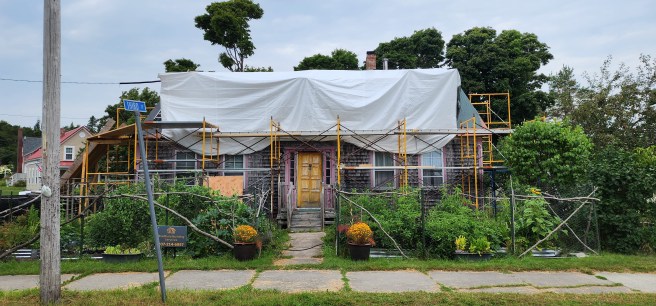
Some people thought we staged this as a theatrical statement, but the big tarp was a desperation replacement for several smaller ones – and it, too, got torn up in some fierce weather. We had some water “raining” in the two front parlors, despite the best efforts otherwise.

The roofing, eaves, window framing, new electrical lines, and spray-foam insulation all took time.

And there was the delay when the electrical panel in the cellar blew out and had to be replaced, along with the circuit-breaker box.

The upshot was that the front upstairs wasn’t buttoned up until Halloween, a bit over a year after we set forth, and then interior framed and drywalled finished just before Christmas.

Many people told us that was moving quickly by Eastport standards.

Uh-huh.

It has been an adventure, one that fluctuates wildly between elation and despair.

My literature and histories are not all about ‘back then,’ exactly

If it’s not personal, what’s the point? While I am talking about writing, in particular, let’s extend that to religion and politics and life in general, wherever we can.

Please make every effort to see those points where we may connect with mutual respect if we’re to advance the human condition. Period.

~*~

I’m left with the realization that my “serious” writing, meaning literary rather than the quickly perishable daily journalism, originated as contemporary poetry and fiction but now falls into historical.

So much has changed, it’s almost hysterical.

Photography, for instance – the career of a central character in four of my novels – no longer requires film, dark rooms and developers and enlargers, or light meters and F-stops.

As for rotary-dial telephones and thick books of people and their numbers?

Instead, I’ll start with the fact that America has never come to terms with its hippie past – positive as well as negative. At least my cool end of it. I’ll let the uptight ‘Nam side defend itself. For my side, it’s like we’re scared or embarrassed of what opened our hearts and minds. While we retreated from the general effort to push the envelope, to advance to Edge City, to demolish boundaries, we also failed to examine what we learned and carry from that experience. Instead, there was a society-wide state of denial that was bound to erupt in unanticipated ways – likely, without any sustaining wisdom. I’ll insist that’s why the nation is in the state that it is now.

For now, my novels stand as a witness to that era and experience and the root of many changes for the better we take for granted today. I do wish there were more voices to tell of that revolution, thwarted as it eventually was. Histories, whether of the scholarly sort or as the art of its time, sustain societies.

~*~

To that let me note that daily fresh air essential for my well-being. The outdoors counteracts feelings of entrapment or engulfment and depression I’ve been susceptible to otherwise. I need to get a taste of wild nature – my feet on the ground, my fingers in the soil, my eyes on the horizon and sky.

It’s part of my spiritual recalibration, even when I was living in the yoga ashram in Pennsylvania’s Pocono mountains.

In this, every day counts, good weather or bad.

~*~

Personal relationships have certainly changed within my lifetime. My parents’ generation suffered many more unhappy marriages in contrast to today, though many youths at the moment have only an envy of deep connection and commitment.

My love poems of the turbulent ‘80s and ‘90s stand as witness to that transition, as do my novels Daffodil Uprising, Pit-a-Pat High Jinks, and Nearly Canaan.

~*~

I am embarrassed for Ohio and Indiana since I’ve left. They had such greatness and potential.

~*~

You’ll find my novels in the digital platform of your choice at Smashwords, the Apple Store, Barnes & Noble’s Nook, Scribd, Sony’s Kobo, and other fine ebook retailers. They’re also available in paper and Kindle at Amazon, or you can ask your local library to obtain them.

If you rent an Air’B’nb in Eastport, here’s what you’re not going to do

Set out in your swimwear and hit the beach for a day in the water and sunning.

It’s too much on the chilly side, for starters. As for the beaches around here? They’re small, pockets of rocks and pebbles, mostly – rarely sand.

Dine out at a different restaurant every night. Not unless you want to drive a distance.

Go out dancing through the night. Midnight is 8 pm.

Just so you know what you’re in for.

Slatkins and the Hollywood String Quartet

From what I saw of the classical music scene in America when I was growing up, the West Coast in general and Los Angeles, in particular as its primary metropolis, were seen as something of a backwater, despite some of the city’s celebrity musicians such as violinist Jascha Heifetz, pianist/composer Sergei Rachmaninoff, and serialist composer Arnold Schoenberg.

In the classical field, the city’s music-making was dismissed as subservient to the film industry. There wasn’t even any opera, in contrast to San Francisco.

That perception has changed, especially since the opening of the Walt Disney Concert Hall along with the Los Angeles Philharmonic’s rise under Esa-Pekka Salonen and Gustavo Dudamel to what prominent critics have deemed the most important orchestra in the nation.

Meanwhile, LA’s earlier life is getting reconsideration these days, thanks to the Slatkin family and its history that centers, especially, on the Hollywood String Quartet.

Here’s why.

  1. The quartet, drawn from film industry musicians but known largely through its recordings on Capitol Records, was critically acclaimed as the best string quartet ever in America. But because of conflicting schedule demands among its four members, it was unable to tour outside of California except on rare occasion. That did dampen their awareness in the larger artistic world. Listen to their recordings, though, or view their only video performance on YouTube, and the case is compelling. We can argue about the amazing American ensembles that have come since. These days, I’ll say simply the Hollywood Four remain unsurpassed but are now rivalled, which I see as a blessing. And here I had dismissed their name as somehow celebrity gloss.
  2. Let’s start with the first violinist, Felix Slatkin. Born in St. Louis, Missouri, to a Jewish family from Ukraine, he studied violin under Efrem Zimbalist and conducting under Fritz Reiner at the Curtis Institute in Philadelphia. It doesn’t get any better than that. At age 17 he joined the St. Louis Symphony Orchestra as assistant principal violinist before becoming concertmaster for Twentieth Century Fox Studios, where he soloed in several acclaimed soundtracks. He and his new wife also cofounded the quartet in 1939. As a conductor, he founded the Concert Arts Orchestra, comprised largely of studio musicians, and led the Hollywood Bowl Orchestra, local professionals in the summer season. He recorded widely on the Capitol label with both the quartet and the two orchestras. He was also Frank Sinatra’s concertmaster and conductor of choice. He died of a heart attack at age 47.
  3. His wife was a New York native of Russian Jewish extraction, Eleanor Aller, the principal cellist of the Warner Bros. Studio Orchestra. Not only was she the first woman to hold a principal chair in a studio orchestra, hers was a position no woman held in any of the major orchestras of Europe or America, due to her sex. Kudos on the breakthrough. Oh, yes, she did make her mark as a soloist on major soundtracks as well as on the concert stage. Shortly after their marriage, the couple established the Grammy-winning quartet while continuing to work as studio musicians.
  4. Today, their son Leonard is the best-known family member. American conductors have faced an uphill battle against Europeans when it comes to prestigious positions, but this Slatkin has earned a well-placed distinction. At the early age of 33, he was offered the music directorship of three fine American orchestras and chose St. Louis over Minnesota and Cincinnati, in part because of the support the management offered in his development. As he led St. Louis to world-class recognition, many highly acclaimed recordings followed. Later appointments had him heading the National Symphony of Washington and those of Detroit, Nashville, and Lyon, France, as well as the BBC Symphony. He also had significant roles in Chicago, at the Aspin festival in Colorado and Blossom festival in Ohio, and even in Las Vegas. It’s quite a resume, even before getting to opera.
  5. Over its 22-year span, the quartet had two second fiddles and two violists. The original second violinist was Joachim Chassman, joined by violist Paul Robyn. With the outbreak of World War II, the quartet disbanded when the three males enlisted in the military. When the quartet resumed in 1947, Paul Shure replaced Chassman. Alvin Dinkin took over the viola chair in 1955.
  6. All of the members were leading studio musicians during a period noted for its vibrant, lush movie scores. How could that not influence their chamber music as well? They were all Jewish, trained at either Juilliard or Curtis, and of relatively the same age.
  7. Frank Sinatra, yes, Ol’ Blue Eyes, was accompanied by the quartet on several acclaimed records during the ‘50s. He even became a close professional and personal family friend of the Slatkins. For perspective, listen to Chuck Granata’s contention that “In Slatkin, Sinatra found a kindred spirit, as the violinist’s immaculate playing paralleled what Sinatra sought to achieve with his voice; serious listeners will note many similarities comparing Sinatra’s and Slatkin’s individual approaches to musical interpretation. One hallmark of the HSQ was its long, smooth phrasing which was accomplished through controlled bowing techniques; Sinatra utilized breath control to realize the same effect. Likewise, where Felix would frequently add slight upward portamento to a critical note and neatly strike an emotional chord, the singer would often inflect a note upward or downward or seamlessly glide from one key to another.” Friends, that’s real music-making.
  8. Capitol Records played a supportive role. Based in Hollywood, the label recorded not just Sinatra during this period but also most of the quartet’s albums and Felix’s Hollywood Bowl and Concert Arts Orchestra vinyl disks. It’s an impressive list.
  9. The parents did have a rivalry. Son Leonard was awed by his father’s being able to pick up the violin after three or four weeks of neglect (due to conducting demands) and still polish off the Tchaikovsky concerto or some other demanding solo work in contrast to his mother, who practiced up to five hours a day just to maintain level. He said it was a cause of resentment. Understandably. He also pointed out that his father’s bowing arm control was unsurpassed, something the video confirms.
  10. Victor Aller, Eleanor’s brother, appeared with the quartet as pianist. He studied at Juilliard under Josef Lhevinne and became a distinguished film industry pianist and manager.

My first encounter with the quartet was, I vaguely remember, on a Contemporary Records release I found at the Dayton Public Library, perhaps with a very young Andre Previn on piano. Alas, I find no reference to it now. Son Leonard’s rise as a conductor would have come much later.

So just how old is our house?

Real estate transactions did use the lot at the corner of Water and Third streets as a referent for other lots. We’ve already seen examples of John senior’s mention of “land owned by me” and the like. Later, we encounter “the homestead of my late father John Shackford” and “the old homestead of my father the late John Shackford.”

Yes, homestead.

This detail on our stairway resembles others from the 1830s and 1840s in town.

After considering the 1806 Samuel Wheeler house at 9 Washington Street and the Federal-style 1805 Hayden (the oldest two-story dwelling in town), the circa 1807 Lewis Frederick Delesdernier on Franklin Street, the 1810 Jonathan Weston, 1820 Daniel Kilby, and 1821-1822 Stetson-Starboard houses on Boynton Street as well as an 1812 Cape on Washington Street, the 1816-1818 Dr. Micajah C. Hawkes on Shackford Street, 1819 Jonathan Venzim-E.E. Shead on Middle Street, and 1821 William Bucknam and Captain Joseph Livermore houses on Key Street, I’m confident that ours predates them and may indeed be older than 1803, as the routing of Water Street route proposed.

I’m willing to venture 1780s. Feel free to argue otherwise.

The mortices and peg holes in this rafter from our house reflect timber framing techniques.

As for time? An Eastport Sentinel article on the Wheeler house, March 29, 1882, mentioned that under the ownership of Bion Bradbury, the home “was changed by the substitution of a pitch roof,” among other modernizations. I hadn’t really considered the pitch of our roof until this but now realize it is lower (or was, before our own modernizations) than many of the later structures in town. The Federal-style houses, of course, are an exception.

How young we were!

Fictional characters don’t come out of thin air, as far as I’ve seen. Instead, they’re prompted by real people the author has known and then, to whatever extent, abstracted. Better yet are the figures who emerge when two or more of these prototypes are crunched together.

Not uncommonly, over the years between the initial events and the revisions leading to the published book, I’ll even lose the original names (in part or in full) of individuals who prompted the eventual characters.

Still, I’ll venture that all the people in the worlds of fiction, cinema, and television were somehow inspired by real people. Forget the obligatory denial you view in the credits.

The writer’s job is to abstract that into something more universal and eternally new.

That said, I was recently startled to get a message relating that one inspiration was now 87. Here I had thought him “older” as Wes in Nearly Canaan, but now see he was in his early 40s at the time. And riding high, as I recall with admiration.

Photos of colleagues in the newsrooms that prompted Hometown News or in the Workshop in Political Theory and Policy Analysis at Indiana University – details that infuse Nearly Canaan, The Secret Side of Jaya, What’s Left, and likely more – have all elicited the shocking realization of how young we were at the time. Even our leaders.

Ditto for the ashram that inspired Yoga Bootcamp or the ghetto and hippie farm of Pit-a-Pat High Jinks.

The events that propelled the novels came in times of great upheaval in my own life. Like me, I think you would be surprised to learn that most of the Pacific Northwest is desert – that the famed rainy landscape occupies merely a narrow band around the ocean and its inlets. Yet the desert is where the apples – and much more – are grown. It’s a remarkable region, with four distinct seasons and cowboys, Indians, miners, and much more in the mix.

In the broader scene, my professional relocations meant that personal connections from one locale to the next soon ceased, meaning that individuals from one to the other became frozen in time. For me, everybody in high school was frozen in time, as were others in the later leaps.

Reconnecting with a few has felt strange and yet invigorating. As more than one has exclaimed, it’s like nothing has lessened in the gap.

~*~

You can find my novels in the digital platform of your choice at Smashwords, the Apple Store, Barnes & Noble’s Nook, Scribd, Sony’s Kobo, and other fine ebook retailers. They’re also available in paper and Kindle at Amazon, or you can ask your local library to obtain them.