The 1990 application to include the restored and repurposed Louis R. French in the National Register of Historic Places includes much more than a detailed physical description of the schooner and her history.
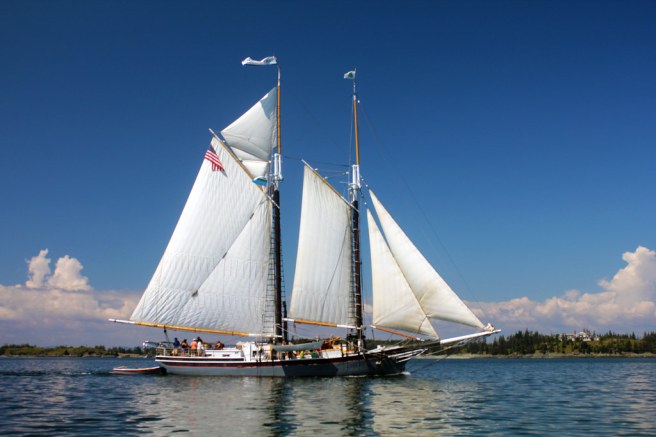
The National Park Service document, Louis R. French (Schooner), available online portrays the two-masted coasting schooner as the most common American vessel type, with tens of thousands of them functioning as the “freight trucks” of their time, carrying coal, bricks, iron ore, grain, oysters, lumber, and even ice between ports.
Yet, at the time of the application, only five of them were surviving in the United States.
In addition, the French was the oldest surviving sailing vessel built in Maine, the center for wooden shipbuilding in the United States after the Civil War.
As the application noted, until the outbreak of World War II, the coasting schooners were so common that nobody paid much attention to them. Designed to run fairly close to shore, the coaster lacked the fishing schooner’s ability to ride out a gale offshore on the fishing grounds. Nor did the coaster approach the scale of the great four-, five-, or six-masted coal schooners that transported coal from southern to northern ports.
Deepwater sailors, who occasionally took a large schooner across the Atlantic, scorned the useful and ubiquitous little coasters, sometimes accusing their skippers of “setting their course by the bark of a dog.”
The application quoted maritime historian Howard I. Chapelle, who observed “the straight fore-and-aft-rigged schooner is decidedly a coastwise vessel, and attempts to use such craft for long voyages have invariably been disappointing and disillusioning, if not disastrous to the adventurers.”
The schooner supplanted the square-riggers in the coasting trade for practical reasons:
Fewer sailors were required to handle the vessel, and a schooner could be worked into and out of harbors and rivers more easily than any square-rigged craft. Her trips could also, as a rule, be made in quicker time, as she could sail closer into the wind, and it was hardly necessary for her to sail from Maine to New York by way of the Bermudas, as some square-rigged vessels have done during baffling winds.
Put another way, they were the errand boys, the short-haul freight droghers, and the passenger buses for many a year, and their contribution to coastal community life, especially in New England, was substantial.

“Without them, the country could hardly have been settled,” as the report quotes one source.
These days, there’s nothing Plain Jane about them, though. Not in my boat – err, book.

 Jnana's Red Barn
Nice post 🌹🌹
Thank you!