- So what if it’s NOT historically true?
- Is there any egg in a Chinese egg roll?
- Who was Jack Russell?
- Has anyone used “Jack Russell Terrier” as a nom de plume?
- Can brilliance compensate for lack of depth?
- Enemies? Present within? Or without?
- How are you supposed to answer, “How ya doin’?”?
- What’s that noise?
- What do I have to do to get my books banned?
- Is it better to have no taste than bad taste?
Month: March 2024
Irish bar in an old dining car
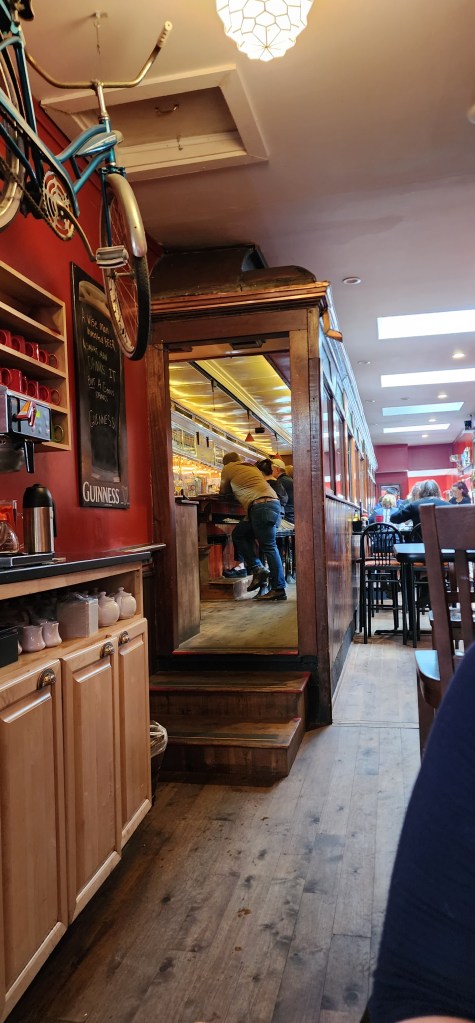
Finn’s in Ellsworth is bound to be getting crowded this time of year.
Acid test poet: Denise Levertov (1923-1997)
Levertov is a poet I began reading the summer after I graduated from college. There was something in her work that seduced me, something along the lines of Brahms and Rilke, as one early advocate said of her. (It was Kenneth Rexroth, whom you’ll meet later in this series.)
What I didn’t see straight-out was the religious underpinning of her work, even in her atheist phase.
I do remember an encounter after a poetry reading in Baltimore, where one audience member approached her and asked how one could sustain a pacifist stance while remaining an atheist. She replied that without faith, the practice was very difficult. A few minutes earlier, I had asked how she had come to become a pacifist and she replied it was through her first lover, who was a Quaker.
Kinisi 200
BALOON
BROOM
BLOOM
Islesboro ferry

that was the ferry in front of us
miles ago
that’s the ferry
heading back
Last of a rice noodle serving in a blue bowl

It was a really good homemade Thai dinner, thank you!
Our home’s new backbone was surgically inserted
The last Saturday in October arrived clear and cool. We were now officially a month into the project, and Adam showed up with a crew of three for the dramatic operation of inserting a ridgepole. It was rather like laparoscopy, if you want to consider the small incision he made near the top of a street-facing gable.
Here’s how it went.
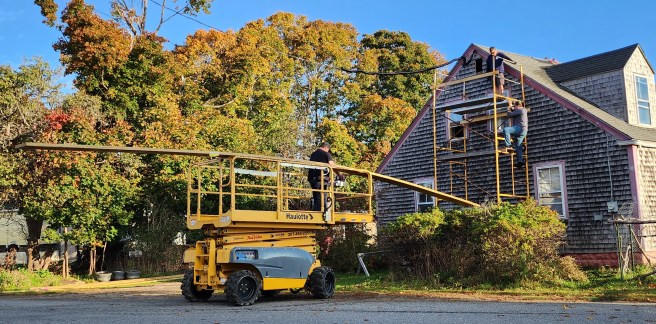
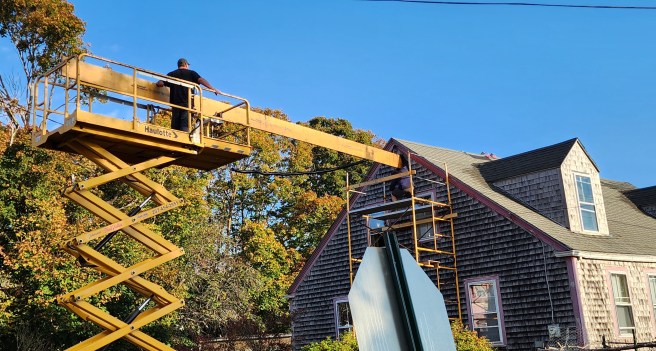

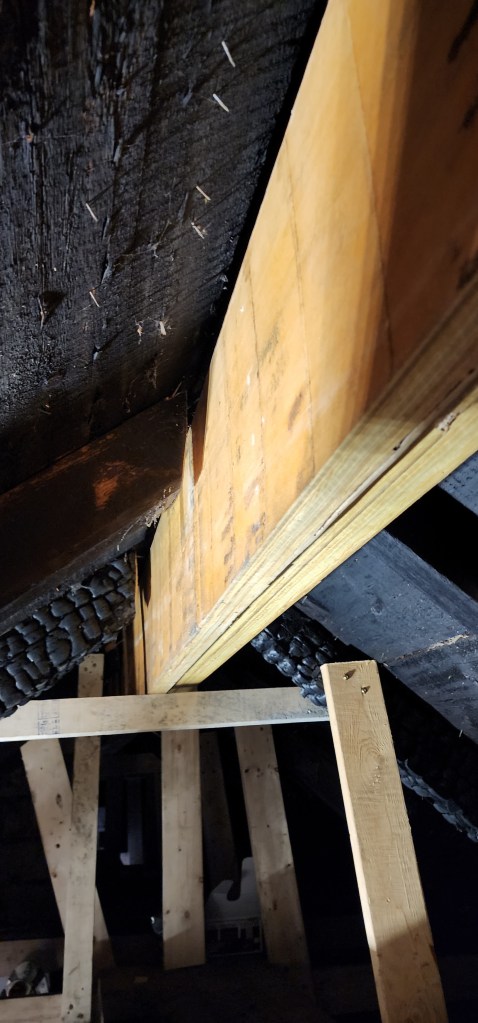
There was also the column to insert.
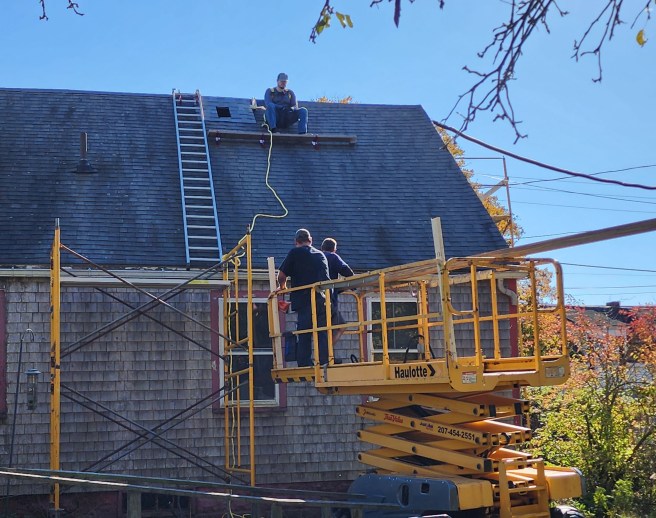


There was no anesthesia.
Two years on the road came as a welcome respite
The ‘80s hit me with a couple of hard setbacks. First, Mount St. Helens blew up, as did my job in what I had seen as my Promised Land. I went bouncing back east, first to a stint along the upper Mississippi in Iowa and then three years in the Rust Belt of Ohio, where my shirt-sleeve management position ate up 60 hours or more of my life every week. Shortly after my first marriage fell apart there, my job was eliminated. At least I had a hot love going, with an engagement to be announced once I could relocate to Baltimore, where she had moved for her studies.
Somehow, I landed a field representative job with the Chicago Tribune’s newspaper features syndication service, one that allowed me to move anywhere I wanted within the 14 northeastern states I would be covering. Baltimore was perfect.
Except, once I ensconced in the top floor of an 1840s rowhouse in a gentile in-town neighborhood, my beloved wasn’t. If only I could get a straight answer from her.
Complicating matters was that I was out on the road three weeks out of four, home only to unpack and repack on the weekends. The job introduced me to a world many American men know: frequent flyer lounges, taxis and limos, hotels and motels, expense and mileage reports, quarterly sales meetings, three-piece suits custom made at Joseph Banks, a company car, bonuses. Newspaper management, especially on the smaller papers that I had known, were nothing like that. You might get a nice note from your boss or someone up the ladder thanking you for a particular job well done.
Getting from one sales call to the next gave me a lot of time for thinking as I drove or even reading, if I was flying. The time allowed me to decompress from a decade that had included 11 addresses in seven states. I could journey at ease or read or revise earlier manuscripts at night in my room, whatever its number.
My personal life included some of the loneliest nights ever but also led to my best friendship ever, a Plain Quaker who worked as a supermarket meatcutter when he wasn’t working as a nurse. I also had a circle of Mennonites who introduced me to four-part a cappella part-singing, a step that would lead me to the excellent choirs I would join in Boston and Eastport. I also visited among Friends, aka Quakers, and sometimes managed a few hours for genealogical libraries and archives or walking through cemeteries where my ancestors are buried. I even revisited the ashram and my old stomping grounds in upstate New York.
None of this apart from the newspaper world has entered my fiction directly. I thought she would be a fine character to build on, except in retrospect it turned out all too banal. What these experiences did feed was my poetry later.
Thanks to my best friend from my junior high and high school years, who was now living an hour south – unlike the previous decade, where we kept landing on opposite ends of the country – I obtained my first PC, something some of his buddies were building. It had 5¼-inch floppy disks, which would be ancient history to so many tech-savvy youths today.
In my travels, I saw much industrial wasteland. Not just Pittsburgh and western Pennsylvania or Sparrows Point outside Baltimore, but also around Philadelphia, across upstate New York, in Worcester and Buzzards Bay and the Merrimac/Merrimack River in Massachusetts and New Hampshire.
The newspaper industry was also taking hard hits. As manufacturing jobs disappeared, so did readership for afternoon papers, which were read by people taking the bus home or waiting for dinner. That greatly reduced the opportunity to place new features in their pages. As I was told, only a few years earlier, I would have had no difficulty selling to editors. Now, the challenge was keeping them happy with what they were already buying. I also saw great turnover at the helm of papers. I would curry an editor and have promises for a sale once the new annual budget was approved, only to find that he was no longer there in a year. The position I had aspired to and been groomed for was now revealed to be something less than desirable.
What became clear to the five of us out on the road was that the business was in trouble. One or more of us would be cut. I was the one. Besides, I really never was much of a salesman.
My observations of visiting other papers did augment my actual newsroom experiences that would emerge as the novel Hometown News.
Given enough time
A bad cause seldom fails to betray itself.
James Madison in Federalist No. 41
Mill run

The pond’s still frozen.
 Jnana's Red Barn