What makes a place ‘home’ for you?

One of the big themes running through my novel What’s Left was that “family” can mean so many different things to so many different people.

Maybe it’s all the renovations going on in our old house, but recently I’ve been pondering many varied understandings of the word “home,” too.

For starters, sampling of what others have said, a home is:

  1. “Where one starts from.” (T.S. Eliot)
  2. “Where we should feel secure and comfortable.” (Catherine Pulsifer)
  3. “A shelter from storms – all sorts of storms.” (William J. Bennett)
  4. “Where there’s one to love us.” (Charles Swain)
  5. “Any four walls that enclose the right person.” (Helen Rowland)
  6. “Where my habits have a habitat.” (Fiona Apple)
  7. “Not where you live but where they understand you.” (Christian Morgenstern)
  8. “A place that gives you unconditional love, happiness, and comfort. It may be a place where you can bury your sorrows, store your belongings, or welcome your friends. A happy home doesn’t require the trappings of opulence.” (Simran Kuhrana)
  9. “A machine for living in.” (Le Corbusier)
  10. “The place where, when you have to go there, they have to take you in.” (Robert Frost)

Is it even a place at all?

Cecilia Ahern insists it’s a feeling. Lemony Snicket pegs that as homesick, “even if you have a new home that has nicer wallpaper and a more efficient dishwasher than the home in which you grew up.” Maya Angelou relates it to an ache “in all of us, the safe place we can go as we are and not be questioned.” For John Ed Pearce, it’s a state of  mind, somewhere “you grow up wanting to leave, and grow old wanting to get back to.” Edward Sharpe senses home as his beloved’s presence, “Wherever I’m with you.” Edie Falco connects it family when he returns to them from his paying job and realizes they make his labors “richer, easier and more fun.” For May Sarton, it must have “one warm, comfy chair” as the line between being “soulless.”
Acid test poet: David Smeltzer (1937-2016)

A longish poem addressing his father, The Eyes of Blood, and then the poems experimenting with Kabbala are what caught me either in my return to Bloomington or right after, in the Pacific Northwest. Neither example fit the typical 20- to -28-line poems that filled the literary magazines, and each one worked a different vein – one essentially lyrical, the other, bullets.

At the time, I was reading and enjoying a wide range of the San Francisco poetry outpouring – I’ve long felt more at home there than I did with the New Yorkers of the era. Smeltzer’s on my list over some other better-known colleagues, probably because of a feeling of connectedness.

Despite acquiring a handful of his chapbooks, I wasn’t aware of his role in the San Francisco Beat scene, including jazz performances, but that detail has me wanting to go back to revisit his work, once we have room here for what’s currently in storage at the other end of Maine.

Fire on board

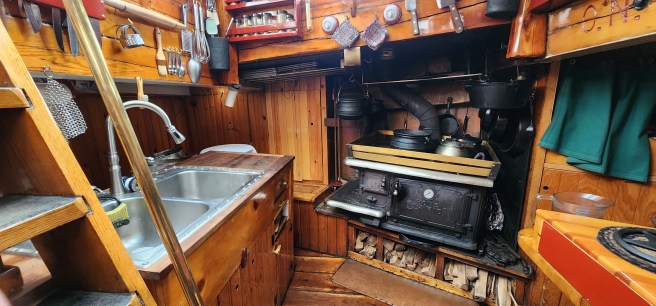
Wooden sailing vessels traditionally had only one fire onboard, the cook’s stove. I can’t imagine how cold sailors, much less passengers, were through most of the year.

Windjammers hew to that tradition.

a wooden sailing vessel
with a wood-fired cook stove
and kerosine lanterns

two iceboxes

Smoke from the cookstove goes
into a T-shaped chimney vent

don’t get too close

“Smokestack,” not “chimney”
maybe “noble Charlie”

As for a big hole in the middle of our house

While waiting three years for our big renovations to transpire, I often joked that living here was like camping. I won’t go into the list now, but I did accept defects that could have greatly raised my blood pressure if they weren’t already on the to-be-addressed list.

I could even go into the pro-gentrification argument that if big repairs weren’t being undertaken, these dwellings were well on their way to collapse.

Our renovation, daunting as it is, remains a minor effort compared to a few others in town, including true mansions being brought back from the brink. One is a fussy restoration project to keep the place as close to historic accuracy as possible, apart from wiring and a kitchen upgrade. Another is to improve its Victorian social showcase qualities.

I’m also finally understanding why so many old houses out in the surrounding countryside have been left to fall in. They simply weren’t worth the cost of upgrading, not when you could build newer, better, even closer to the world for less.

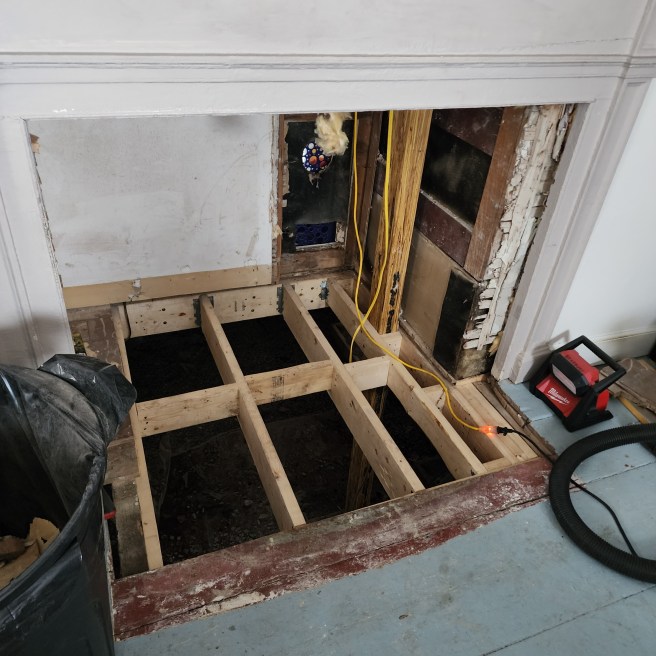
One of the annoyances we had tolerated was the big cavity where the second chimney had stood – the one that was about to collapse when we bid on the house.

We had passed on an offer to rebuild the brickwork, no matter how charming a working fireplace would have been. The chimney would have limited our remodeling options on the second floor, or so I argued, and without it, we do have a 2½-by-5-foot space to develop into a closet or something on the main floor. Patching the floor itself would be a huge improvement, as well, rather than having a light covering that couldn’t bear weight.

The cavity now provided a place where that 28-foot-long LVL column could run down through the house, as well as some new electrical wiring.

And, during a later break, Adam even fixed the holes.

Yes, step by step, it was all coming together.

How the style and ethics of my journalism career clashed with my literary ambitions

When I sat down to my personal writing, I felt an ongoing tension between the daily grind of newspaper editing that paid my bills, contrasted to my ambitions for something more permanent, more confidential, and more creatively advanced than the anonymous work that went into the next day’s trash. The pejorative “hack writer,” often applied to newspapermen from the early 18th century on, was what I aspired to rise above. The term has haunted me ever since reading Samuel Johnson’s derision.

In my private labor I aimed for something unique, thoughtful, sophisticated, meticulously developed, complex, and even challenging for both me and the reader. If news stories limited attribution for a quote as the neutral “said,” I nearly banished that colorless word from my prose, relying instead on everything from “answered” or “asserted” to “cried” or “swore“ to “wept” or perhaps “whispered,” with a wide range of variants in between. Do note, I’ve come to treasure a thesaurus for ways in can enrichen a text and sharpen the underlying thought and feelings, even though doing so requires additional time and consideration.

My journals, on the other hand, sought mostly to catch up on my life from the previous entry, often in cryptic terms I might get back to and fill in later, though that rarely happened.

~*~

Hemingway could write for a sixth-grade level reader because he was no longer in a newsroom. It could kill you, believe me, if it’s all you got to do.

I needed to foster my literary ambitions simply to keep my editing skills sharp.

It did make for tension in my private work, though. I still love a good 250-word sentence.

~*~

Let me also say something of the ethics. Being told not to wear a politician’s campaign button. No appearance of partisanship. Leonard Downing of the Washington Post even refused to vote in an election for fear it would taint his neutrality or objectivity.

Were we, as one girlfriend taunted me, ethically castrated? My first editor, Glenn Thompson, worked behind the scenes to get progressive things in motion and did urge us interns to have causes.

By the way, I have worked for some very conservative papers and also some very liberal ones. It didn’t affect what I did for them.