Big city, big dreams

Who was I to think I could say something fresh about underground public transit? Well, the outsider has long had a place in the arts … and in comedy.

I had expected to wind up living in a big city, where I’d have access to frequent symphony concerts and perhaps opera as well. Foreign films, well-stocked bookstores, kindred souls. All the rest. My life journey and my career went another way, but I still wound up as a subway rider, of sorts. I was far from a private jet or even taxi kind of existence.

My introduction to underground transit probably came in a series of big, cartoonish, wildly rendered Subway Riders canvases that received a special exhibit at the Dayton Art Institute sometime in my high school years. I think they were by a hot New York rising star who was visiting Ohio as an artist-in-residence or an arts school guest instructor, though his identity eludes me now. Flash in the pan? Rubes in the sticks?

I wasn’t exactly wowed, but I was intrigued. He wasn’t Rembrandt.

The furthest east I’d been was Pittsburgh. Perhaps the next year my family got to Toronto and Montreal, though I didn’t venture on the subway in either of those cities.

Do families even take such vacations on the road nowadays? We did have our camping gear in the trunk of our red Buick Roadmaster.

~*~

Writing about subways – becoming fascinated by them, their offensive grit, stench, and loud noises included – was about the last thing I would have expected when I graduated from college or even high school. I was a Midwesterner through and through. The closest I had come to what I saw in those Subway Rider paintings was on the City Transit trolleys at rush hour. We definitely weren’t flashing along a dark tunnel or loading by hoards or packed together like sardines.

But people kept telling me I wasn’t destined for my hometown, no matter how loyal I felt. Or was that defensive? The message they conveyed was that I should look to Manhattan or some equivalent opportunity. Even Cincinnati, an hour away, looked sophisticated.

The hippie outbreak, or Revolution of Peace & Love, was still somewhere in the future, though the Beatles were shaking the status quo and skipping around Elvis in what we’d now call the pop culture scene. Culture was, let me emphasize, concerned with things that would raise our vision and intelligence rather than merely mark social norms as in averages, either mainstream or ethnic.

By the time I actually rode a subway train, I was nine months away from earning an urban studies certificate, thanks to my multi-disciplinary college studies. The journalism career that embraced me would instead lead out in the boonies or an equivalent emotional wilderness.

~*~

My book that sprang from those encounters started out short and flashy as its first draft in ’73. Inspired, in part, by Brautigan’s Trout Fishing in America, I typed away sitting cross-legged before a converted coffee table and my beloved Olivetti Lettra 22 blue typewriter. The very portable one.

Graffiti, wild splashes. This was going to be my wild hippie book, the essence of it all. It had the Midwest – what would emerge as Daffodil – and it had the Big Apple, where so many of the freaks I knew after graduation had grown up. The movement was a confusing clash of youthful excess.

It was too much – way too much, actually.

By the time I distilled it down into what was published as Subway Hitchhikers, it was more of a lacy collage presented in a strobe-light kind of then/now alternation that I came to see was overly ambitious to be effective rather than confusing.

What I did sense was the way big cities draw on the interior landscape, almost like vampires on the innocent. Not that I ever expressed it that openly, but I am now thinking it fit Gotham if only I were usually trying to look at the bright side of life.

Was it even a novel? Short, and perhaps meta-fiction?

Unlike any other.

Cover update: One leads to another

After recently tweaking the cover for my Hometown News novel, I found my eyes zeroing in on another volume and once again questioning its effectiveness.

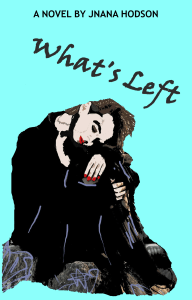
This design continues at Amazon. While Cassia goes Goth in the plot, I suspect this was a bit extreme for her style.

What’s Left: Within a daughter’s own Greek drama had been especially difficult to develop, as I’ve explained in earlier posts, but ultimately ended up following a girl who lost her father in an avalanche on the other side of the globe when she was only 11.  She then continues on into her emotional recovery and growth, rounding out in her mid-30s.

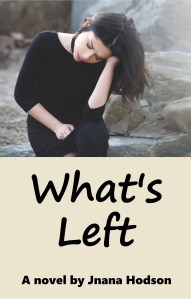
By the time the book appeared in both digital and print-on-demand options at Amazon, the cover image had settled on a photo of a Goth girl.

For technical reasons, she continues at Amazon, while my cover at other digital retailers got updated.

I wanted a better sense of the initial suffering, or even an edginess in her development, but nothing worked perfectly. I am still taken with the daring in her stare at the camera, but is that enough? (I did a post about the earlier covers on December 20, 2019, should you want to explore my archives. I was quite fond of the first cover, the one with its falling egg yoke, but nobody else seemed to get the connection.)

The figure appears more ambiguous in my attempt to do something more in line with some of the Young Adult covers I saw. Ultimately, this was a mistake.

Furthermore, she’s genetically a mix of Greek and American Midwest and a tad on the pudgy side. I hate it when a story follows, say, a brunette but the cover shows an obviously dyed blonde.

Another challenge involved balancing the two words of the title. The second word, “Left,” should have the emphasis, but it’s only half the size of “What’s.” Nothing I tried corrected that. In many of the typefaces I sampled, “Left” simply didn’t read easily, either. It could have been “Lest” or “Lett” on first reading. In making a sales pitch, there’s no time for deciphering the message. “What’s” presented similar challenges in other typefaces.

The text had been difficult enough to nail down in a convincing voice, but the cover was equally problematic – especially finding an appropriate image. How do you summarize all this in a single graphic impression, especially one that works thumbnail size online?

Do note, there’s an ongoing argument about using a facial image on a cover, period. Does it grip a potential reader or does it turn one away? Will it even limit a reader’s impressions of the character at the heart of the book?

At last I had a photo that more or less captures her despair. The title and author presentation never quite matched.

Remember, my budget wasn’t generous enough for a graphic designer, the kind who would create a flowing dust jacket replete with insider clues for a potential reader. I’m not particularly fond of those designs anyway. In general, I think photos pack more punch in a first impression. Just look at magazines at a newsstand. Remember those?

Cassia, or more formally Acacia, goes into mourning after her father’s death and then morphs into Goth dress and appearance through her teenage years, where much of the story develops.

The book doesn’t fall neatly into genres – part of it could be Young Adult, but I’d say the core of it is New Adult and beyond. So how old should she look on the cover?

Finally, in the latest stab at this problem, I decided to run with an image I’d settled on earlier. This time, it would bleed off the cover at both sides for maximum impact. I then decided to run it off the bottom, too. Somehow, that left the photo square, a format her photographer father pursued.

At last, we have this.

My reason for cropping the photo tighter was to give it more depth, putting the focus more fully on the girl and her emotion. I’m now seeing that the rocky background I eliminated had actually suggested another kind of story. No more of that distraction now. An artist might have replace it with her extended family, by the way.

In leaving the top open for author and title, rather than separating those elements with the photo in the middle, she has more presence and gravity.

I’m also glad I stuck with an impulsive decision to not fill in the remaining cover with a background color. A new typeface for me, Yu Gothic Semibold, seemed to work best for the title, though I’m not exactly happy with the single-stroke bar apostrophe. But “Left” carries its own weight in the dance of letters.

Book Antiqua, meanwhile, a fallback for me, does nicely in italic for the author.

That’s all – clean, simple, and somehow daring in its starkness. Without an obvious border, the design declares its independence from paperbook constrictions. It’s also quite contemporary, in a confident way. It even pops out on websites. And there’s no question that it comes together more harmoniously the one it replaces.

This one’s now available on your choice of ebook platforms at Smashwords.com and its affiliated digital retailers. Those outlets include the Apple Store, Barnes & Noble’s Nook, Scribd, and Sony’s Kobo. You may also request the ebook from your local public library.

Do take a look.

A sense of Lake Meddybemps

Sunrise County is laced with big lakes. In fact, 21 percent of it 3,258 square miles is water, including streams of all sizes, bogs and flowages, and ponds.

The largest lake, Meddybemps, covers more than 27 square miles within four towns, reaches a maximum depth of 58 feet, is dotted with islands, and is famed for its smallmouth bass fishing.

Light on winter ice provides a unique clarity in perceiving the lake’s profile, seen in part here from State Route 214.

Among trendy folk

I’m really in the dark about what’s “in” these days, though I do get some glimmers through family.

So let me ask.

  1. Are Carhartt pants continuing to overtake blue jeans?
  2. Is Apple still preferred to Android?
  3. Depop for second-hand clothing. Is it the next eBay or etsy?
  4. Are Gmail addresses still tops? Or is email essentially going over to texts?
  5. Wraparound sunglasses? I’m finally noticing them.
  6. Paypal for online use rather than cards themselves? What about Venmo?
  7. I’m finally aware of Reddit. But what about Twitch?
  8. As for snacks: Doritos chips and salsas? Goldfish crackers? Oreos?
  9. Are Ugg boots and Crocs really making a comeback? As for Vans shoes?
  10. How long can vegan hold on?

Wyman

We recently had to flee our house for 24 hours after spray-foam insultation was applied to our second-floor renovations. That meant heading to an Airbnb in town.

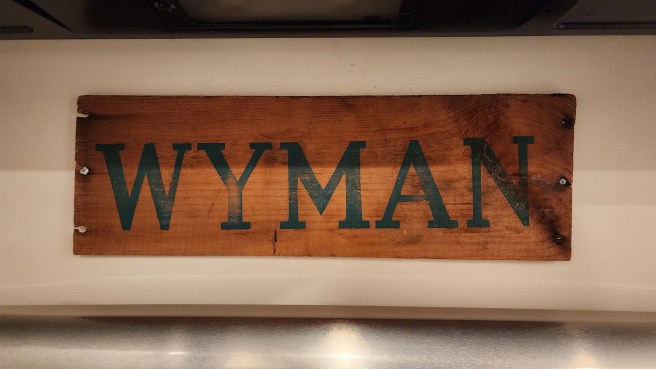
This attractive wooden plaque above the stove caught my attention. Good use of a serif typeface in green ink.

And then it struck me: this was from the end of a blueberry-picking crate. I’m sure it’s been rendered obsolete.

Acid test garden writer and poet: Celia Thaxter (1835-1894)

Although she was known as a poet and story writer, her book that I most value is An Island Garden (published the year she died), with illustrations by Childe Hassam, an Impressionist painter I admire highly. (He hated the term, by the way, and didn’t fit the label neatly, but it gives you an idea.)

The island, in the Isles of Shoals of the shore of Maine and New Hampshire, is a remarkable place, as I found in a visit I posted here on June 14, 2020, “Celia’s garden … on Appledore Island.”

Under her guidance, the hotel her family owned and operated became what can be seen as the nation’s first artists colony every summer, attracting a who’s who of writers, painters, musicians, and more. Her influence can be seen especially in many of New England’s authors of the period.

Reading about her, I’ll confess, can be as pleasurable as reading her work itself.

Hoisting the sail

perfect weather, sunny, 60s
a knot = 1.1 mph

a little more up
meaning into the wind

luffing, meaning chuffing in the sheets

no sea legs yet
wobbly

even on calm seas

bit queasy
edge of mal de mer?

slow lull

slow sun

will I feel a late-season burn?

“all on the bowline, we sing that melody
like all good sailors do when they’re faraway at sea”
a song our Dylan doesn’t know
in his impressive repertoire
a generational gap

116th Street Blues, starts out with Captain Ahab
then more nautical lines

find your own style

it’s an active experience
just relax

Preparing to reframe the top of our house while we still lived below

This was turning into a more serious project than simply raising the roof.

Had we merely replaced the covering itself – either with asphalt shingles or upgrading to metal – without expanding our usable floor space on the second floor, we would have been glossing over serious structural issues. It’s a miracle the roof held as long as it did. One insurance company had cancelled our homeowner’s policy when it saw the photos of the roofing, and another insisted on a replacement within a year. That route would have been a very expensive band-aid in the end.

We had a dream of making better use of that space, as you’ll see. And now, after three years, we finally had someone to pull the project off.

As a starter. Adam needed to address some serious structural issues.

Was anything holding our roof up? It may seem strange to find that concern intensifying as we set out to remove it and its rafters, but we would need something to keep half of it up while the other half got ripped away. As an additional complication, we’d be living in the house rather than gutting it and starting over.

The absence of a ridge pole meant there would be nothing to hold up the front half of the roof when the back half came away for the new. Its lack also meant the existing ridge wasn’t straight but rather serpentine.

Adam had to make room for a ridge pole between the existing rafters. It was tedious and required some precise calculations.

Structurally, all the weight of the roof for nearly 200 years was directed outwardly to the walls – and, as he was finding, they weren’t exactly perpendicular.

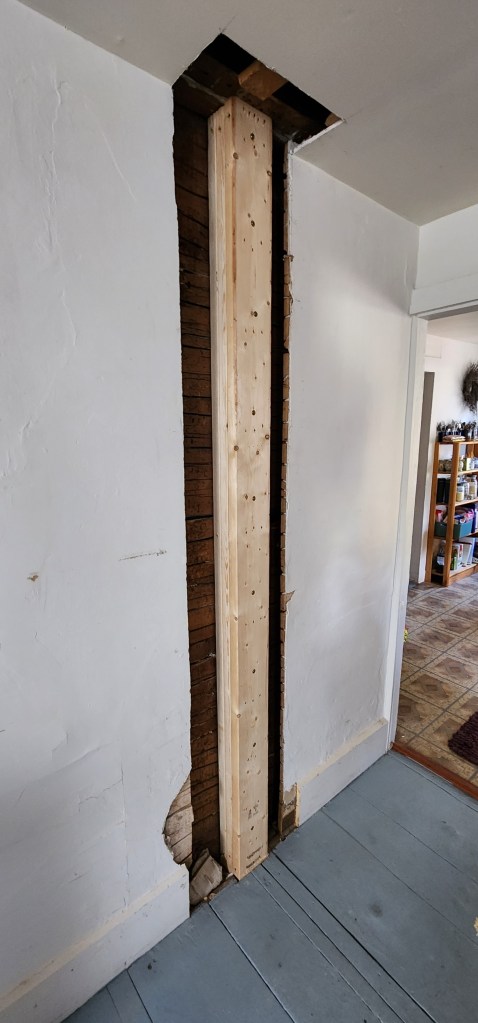
Now he needed to have something to support the weight of the ridge pole and roof, too. That meant constructing four columns from the crown of the roof down to the cellar – one on each end of the house, the other two spaced in-between. That required going through two floors as well, plus building concrete pads in the cellar.

This was time-consuming work, and he was racing winter weather. We had reason for concern.

As these findings sank in, we realized our earlier option of just putting new shingles on the existing slope would have done nothing for real issues lingering underneath. Even without raising the back wall or consolidating the dormers in front, we would have had a larger problem waiting to erupt overhead. Living beside the ocean exposes us to many gale-force blasts. It’s a wonder the roof hadn’t gone years ago.

After taking some deep breaths, we appreciated what our contractor was telling us. Now, just exactly where was the center of the roof or the alignment down under? He did have some amazing laser tools to determine that.

We were really glad Adam was a pro, maybe more than the others working in town. He was definitely earning our trust and respect.