Avoiding a hydra

The mere necessity of uniformity in the interpretation of the national laws decides the question. Thirteen independent courts of final jurisdiction over the same causes, arising upon the same laws, is a hydra in government, from which nothing but contradiction and confusion can proceed.

Alexander Hamilton in Federalist No. 80

Can you beat this?

Hello, Readers!

We’re fast approaching Read an Ebook Week, an opportunity that encourages readers to pick up the digital device of their choice and download a new book or more to own and read.

I’m excited to announce that three of my books will be available as part of the promotion on Smashwords to celebrate Read an Ebook Week 2024, March 3-9. Yes, starting Sunday. This is a chance to get these books, along with books from many other fine independent authors, at a discount so you can get right to reading.

I’m offering two of my poetry collections – Trumpet of the Coming Storm and Blue Rock – for free, along with my New England history book, Quaking Dover: How a counterculture took root and flourished in Colonial New Hampshire, at 50-percent off.

You can’t lose by participating. I look forward to your responses to reading these. Do check them out. It’s one of the joys of publishing online.

Thank you for your help and support.

Happy reading!

Things we still need a can opener for

I don’t eat canned soup anymore – can’t stand it, not after being upgraded at home.

Beer, meanwhile, has a tab or comes in a bottle.

So here are my reasons for not throwing our can opener into the trash:

  1. Tuna fish
  2. Tomato paste, as well as whole and diced tomatoes
  3. Sweet corn
  4. Sweet condensed milk
  5. Garbanzo beans (already softened)
  6. Pumpkin filling, not just for pies
  7. Coconut milk
  8. Chipotle
  9. Pineapple (not fresh)
  10. Baked beans

If we only had a dog or cat and their cans of pet food. 

Acid test poet and novelist: Charles Bukowski (1920-1994)

What is it that made Bukowski such an unmissable figure in the reading life of young poets and others in the ‘70s and beyond?

You probably wouldn’t want to meet him in person, he seemed to be rather obnoxious, even ugly, even before getting drunk or in a fistfight. He was, from evidence he presents, an abusive lover.

Even so, part of the appeal came, I sense, in his unflinching reflection of life in near-poverty, a world where many of us were also residing. His subjects, though, were everyday poor people, drudging away in marginal jobs when they could, rather than recent college graduates intent on moving on.

Another part of his appeal, though, was his embrace of being a Poet and the ways the daily practice of writing kept saving his miserable life. Black Sparrow Press, with its signature look and literary dedication, was created for his work, and the successful relationship provided a platform that gave exposure to many other poets and novelists – the “bird mob,” as one poet I knew said with outright envy.

Was there even a poetry scene in Los Angeles at the time? The focus in California was almost totally on the Bay Area to the north.

I was especially fond of his short novel, Post Office, but the spare lines of his poetry are unpretentiously masterful and sharp-eyed. He cut the BS, for certain, in a life of squalor that’s a revelation. It’s a life most of us would rather avoid yet somehow touches on our own.

At last, getting set for the big magic trick

Three weeks into the project, I noted my wonder at how quickly the work was going.

The back half of the upstairs interior was now exposed, giving us a sense of how much flooring and headspace we would be gaining. And we could see all of the rafters. Unobstructed? Adam had set up an impressive indoor workshop on the back half of the second floor, while the front two rooms clustered many of our possessions, now under plastic.

That said, I also noted my concern at how slowly the work was going.

The old roof over the back half of the house was still in place, and the clock was ticking down toward winter.

What dawned on me as I gazed up toward to the peak of the rafters was that the ones from the back – which were about to disappear – secured the ones at the front of the house, the half of the roof that would have to stay well in place into late spring or early summer. A few of those charred rafters would actually be remaining like forever, a nod to history and all that.

In a flash, the urgency of the new laminated ridge pole and supporting columns made sense. Without them, the whole roof would come crashing down and, in turn, there would be nothing to hold up the new one. One earlier contractor’s proposal for premade trusses to create a gambrel roof on both sides now became comprehendible – so that’s what he meant? We weren’t exactly communicating, and his results wouldn’t have been our first choice. As we were hearing, not every carpenter today knows how to frame a roof from scratch.

~*~

The key to achieving this was a recommended custom-made laminated veneer lumber ridge pole running the length of the house. Or more accurately, three pieces that would be joined together once they were inside and raised into position. Each one was 1¾-by-14-inches by 40-feet and weighed 280 pounds.

In addition, another custom-made LVL 3½-by-3½-inches by 26-feet was delivered for the remaining supporting column. That one would run down the cavity where our second chimney had been, the bricks that had been on the verge of collapse when we bought the place.

~*~

The new ridge pole would have to slip in where the rafters from each side were now overlapping. What would hold them up as he sawed them asunder? The answer was temporary framing underneath.

We were really, really glad Adam knew what he was doing, though we suspect he was losing some sleep over it. We do know he was doing his research and some thorough calculations.

had
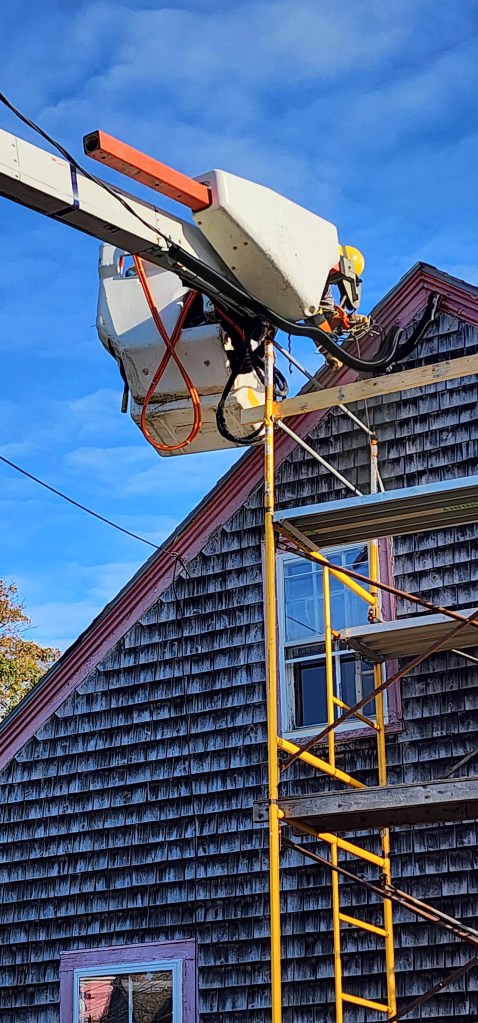
The electrical line coming into our house had to be moved to one side of the gable to allow for the ridge pole to come into the house. That meant getting the utility to come out for a free service.

Inside, our contractor was making cuts accurate to one-sixteenth of an inch. Sometimes the beam below, cut in the early 19th century, varied by a half-inch within the length of the two-by-sixes they would be supporting.

We were beginning to appreciate the fact that Adam was our contractor and not just our carpenter/electrician. He was making the arrangements and phone calls. Viking Lumber was making nearly daily deliveries from Machias.

After working largely solo, he lined up a crew to manage the pieces into the upstairs floor and then higher once inside. There was also the matter of a rented lift, positioned outside.

A lot of coordination had to come into place, even before discovering the power line coming into the house needed to be moved. Hello, Versant?

He had additionally expertly erected scaffolding by himself.

At that point, it really felt like this was happening.

So here we were, Week Four, the end of October, and the laminates were arriving – all four pieces. Well, make that five – Hammond Lumber had ordered a wrong size for the column and had to rush the corrected order down to our site.

Have you ever done genealogy?

While living in the small industrial city that’s the setting for Hometown News, I began exploring my genetic roots, at least on my father’s side. It involved a lot of correspondence, especially with a cousin of my dad’s generation, as well as probing whatever records we could dig up.

By this time, my spiritual practice had recentered in the Quaker stream, or Society of Friends, where it turned out my ancestors had been active from the early 1660s until my great-grandfather moved from North Carolina to Ohio and “married out” in 1893. I now had access to historic minutes, correspondence, journals, and other resources that proved helpful.

My findings are presented on my Orphan George blog, should you be interested.

What fascinates me in regards to my fiction is the fact that so many of my ancestors were essentially countercultural in regard to the broader society. They were pacifist, for one, and wore distinctive garb and used distinctive language. (Sound hippie?) In North Carolina, their community had the first manumission society in the state, buying freedom for slaves and transporting them to safer lands. This was not the Deep South of popular culture.

These findings, and the research methods, proved quite helpful when I drafted my nonfiction New England history, Quaking Dover.

The techniques and insights also played into my novel What’s Left, where I took Cassia’s lineage on both sides back to her great-grandparents, including their quite different faith traditions.

I am intrigued by the values and practices from one generation to another. What is rejected and what is embraced?

In my case, I discarded the mainstream Christianity and lifestyle of my parents and grandparents only to find myself later reconnecting with much of the radical Christianity and countercultural outlooks of my great-grandparents. Well, most of them on my dad’s side. My mother’s were an entirely different matter.

As I’ve found, genealogy often presents a much different history than we’re taught in the conventional versions, especially when our focus is on everyday people rather than the political and military leaders and the upper class. The lives can go ways we wouldn’t have plotted. For instance, my family in North Carolina had a gold mine.

On the difficulties of legislating

The history of almost all the great councils and consultations, held among mankind for reconciling their discordant opinions, assuaging their mutual jealousies, and adjusting their respective interests, is a history of factions, contentions, and disappointments; and may be classed among the most dark and degrading pictures which display the infirmities and depravities of the human character.

James Madison in Federalist No. 37