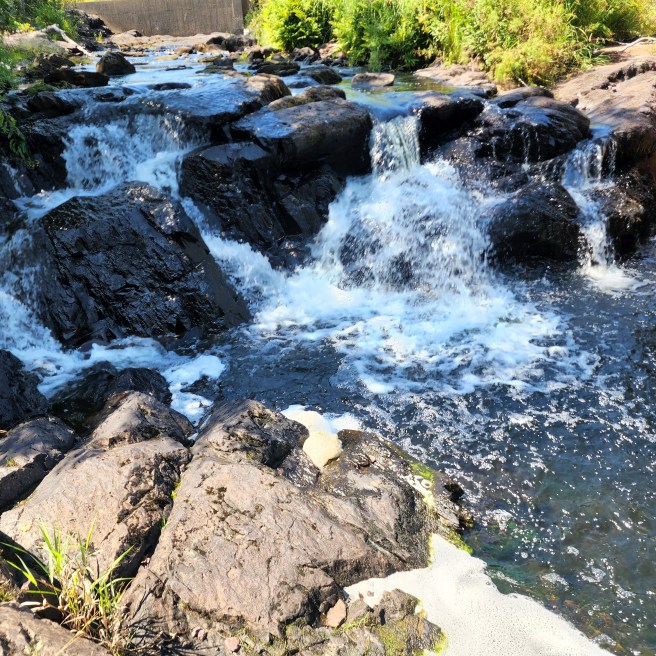
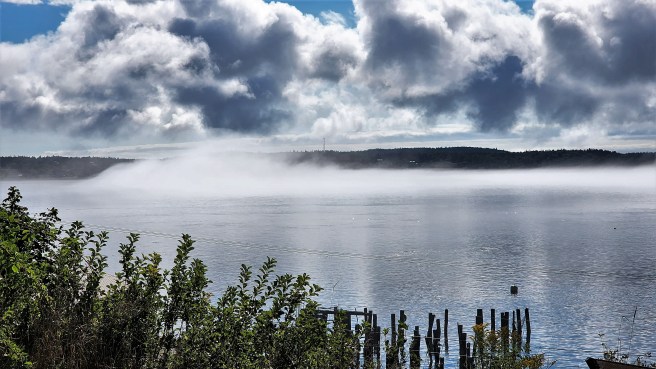
We’re stuck in fog, fog, fog

While I had heard that these stretches of a surrounding blur of dense gray could linger weeks here, I assumed folks were talking about March or maybe late November, not the height of glorious summer.

And then a friend told me of one summer in Lubec, a few miles over the water to our south, where it hit every day, often without any splash of sunshine.

It does dampen the emotional wellbeing of many.

As much of the nation – and world – suffers under recording-breaking heat, we’re having many days when the day’s high has barely reached much above 60, as in Fahrenheit. Only a few readings have even broken as far as the lower 80s. I’ve worn my beloved Hawaiian shirts only three times, and my shorts are still in the bottom drawer of the dresser. If you’re wondering, unlikely as that is, I’m not one of those guys who goes bare-knees in January, believe me.

Much of this has been accompanied by weeks of fog – morning and late afternoon through the night, especially – but sometimes without break during the day as well.

I’ve stopped reminding people that Seattle experiences something like this six-months straight every year or that San Francisco is accustomed to watching the ground-hugging clouds return every afternoon.

We do live on an island, so the temperatures just seven miles away on the mainland traditionally run ten degrees warmer, but those are still much more reasonable than the hellfire raging elsewhere.

None of the wider extremes should come as a surprise. True prophets had forecast them a half century ago, and we are running on those projections, contrary to the decades of denials and resistance of capitalist naysayers and their puppet politicians. Remember, too, it was “climactic instability” rather than mere “global warming.”

So, on a more mundane level, on those partly-cloudy to partly-sunny days in the forecast, we jump onto running the laundry early and then getting it promptly out on the line to breathe, and I attack the lawn with the mower as soon as the grass dries sufficiently. Not that I’m the only one, not by a longshot.

When I did live in the Pacific Northwest, I was in the interior desert with dreams of escaping somehow to a writing life somewhere along the coast, maybe in a cabin in British Columbia or Alaska.

Something like this, perchance.
Adding to the memories

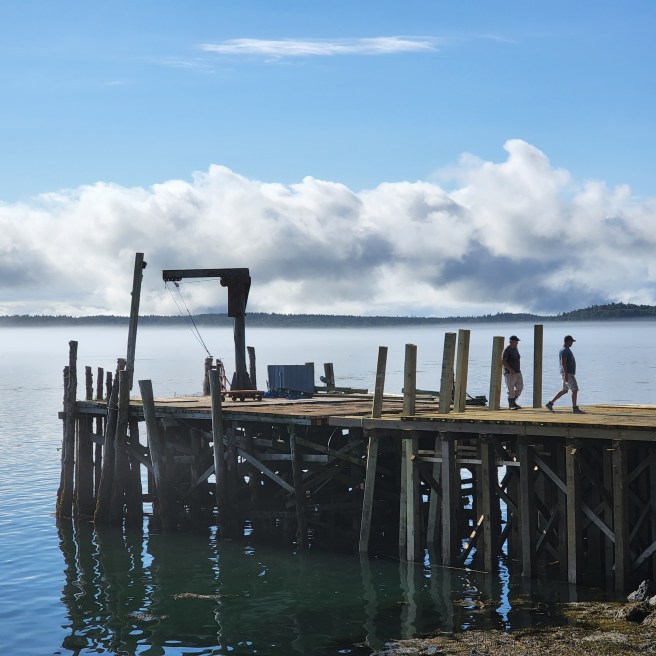
Sailors who visited Eastport for the Fourth of July voiced their amazement at the pilot who guided their U.S. Navy destroyer vessel at the Breakwater pier in some very dense fog.

They could hear the conversational voices of humans on the pier and shoreline but couldn’t see a thing. We could hear them but not see them, too.

And then they were landed, gently and safely.

They told us he was a magician, and from my angle of observation, it was true. Even the commanding officer was most amazed, in what became a memorable experience.

Redirections

“I’VE NEVER BEEN TOUCHED,” meaning love.

“My sisters have. They all have husbands and family, but I’ve never been touched.”


TRAVELING IN A TERRAIN LIKE the orchard country of Washington state – Naches or Cowiche, especially – in the car, we come across the top of a hill and find ourselves facing a band of four tornadoes, which we manage to drive past, after great fear and trepidation.

She’s no longer a goddess, but a traveling companion. Do the tornadoes reflect engulfing, destructive, and self-destructive figures of love?


ON A BOAT, THE RUDDER WORKS in the opposite direction of what feels right. Often seemed to have no effect, whatsoever.

In both cases, a sense of something important remaining unfinished.

Oh, those clean starched white dress uniforms

The 350 U.S. Navy sailors who descended on Eastport for our extended Independence Day festivities were the first to uphold the longstanding tradition since before the Covid pandemic.

They were a welcome contingent in our small community, often appearing in their pristinely ironed white uniforms, which do look impressive even though, as I was told, they can be a challenge to keep clean. You have to lean way over while eating, for instance, to keep from spilling anything on yours. Not that we noticed any dirt when they marched as a big bloc in the grand parade Tuesday afternoon. At least the sailors and officers who fielded teams in the very messy cod relay contest the previous day were more practical in their dress.

What they got was a six-day taste of small-town America having summer fun.

As the police chief reported, “the Fourth of July was relatively quiet, aside from a couple of fights involving sailors … which were handled by the crew from the Navy ship.”

Where to from here, as a writer or a person?

Creatively, I’m feeling a lull or perhaps more accurately adrift.

After my Cape Cod presentation via Zoom earlier this month, I have no other Quaking Dover events on the horizon. Nor do I feel compelled to undertake another big writing venture.

Authors these days are often saddled with the promotional end of any publication, and I’m coming up on a year of launching the marketing push on my latest book. Admittedly, I am proud of my public appearances on its behalf – each one unique, reflecting what another writer declared a “rich feast of a book” – but it’s also exhausting, especially, as I hate to confess, at my age.

Do I cut the ties and say it’s time for the book to sink or swim on its own, or do I find new ways to try to generate a buzz? It is the one book that seems to speak to a wider audience, especially, say, than poetry or my hippie novels.

The blogging hits have slowed down, perhaps as many viewers have shifted to other platforms. Social media and mass media both appear to be hemorrhaging there, so I can’t say I’m alone.

I’m certainly out of touch with youth and often can’t understand their conversations. That really hurts. I believe there’s so much knowledge that needs to be handed down but don’t know where to begin. Besides, I’ve often found them a source of great energy in my own outlook.

In short, I don’t have a big project calling for my attention and devotion. That part feels really weird.

I do have a big backlog of periodicals and books to finally tackle as well as a shelf of personal journals that deserve visiting, so that points to an overdue reading orgy.

There’s plenty of outdoors around here to indulge in, too.

I may even have to look at my remaining possessions and reorganize and cull them.

As I’m saying, I’m feeling a bit strange.

I’m sold on Maine’s crab

Ours are smaller than the glorious Dungeness of the Pacific Northwest or Chesapeake Bay’s popular Blue delicacy, named for the color of their tips.

But that’s not to say Maine doesn’t have crabmeat that’s as sweet. Ours comes from two species.

Here’s some perspective.

  1. Jonah crabs are the slightly larger and more celebrated of the two. They’re reddish with large, black-tipped claws, and found primarily in deep waters offshore.
  2. The meat comes from the claws. When Jonahs show up in a lobster trap, a fisherman typically removes one claw and throws the rest of the crab back. The crab, we’re told, can survive on one claw while the other grows back.
  3. Jonahs are regulated by an interstate commission that places a 4.75-inch minimum size on keepers and prohibits the retention of egg-bearing females.
  4. Atlantic rock crab, or “peekytoes,” live in bays and tidal rivers closer to shore. These measure just five inches across and are the most commercially caught crab in the state.
  5. Peekytoes cannot be shipped live, presumably because they’re too delicate. Instead, they’re cooked and hand-picked before shipment.
  6. Both commercial and recreational crabbers require a license from the state and must observe strict limits on their take. At least, those specifically going after them. See the lobstermen, above, for a clue to exemptions.
  7. Locals in the know say that picking the meat from a crab is a nearly lost art. They admit they can’t avoid getting hard bits of shell in the tender flesh, no matter how carefully they try. Instead, as they advise, go to Betty’s in Pembroke or Earle’s down in Machias for your supply.
  8. Favorite dishes around here are crab rolls, crab salad, and crabcakes. Our house also celebrates a heavenly crab imperial. Others make them into a dip or spread. And, in some circles, Jonah crab claws make an appetizer served like a shrimp cocktail.
  9. They can be harvested year-‘round, though fall, when crabs are most packed with meat, is the peak season.
  10. Smaller, invasive, nasty green crabs have been proliferating as Maine waters warm, decimating other marine species and their breeding grounds. Some enterprising chefs, though, see tasty opportunity in some dishes to counter that.

Me? I haven’t yet had to complain of having too much. Now, please pass the Old Bay.