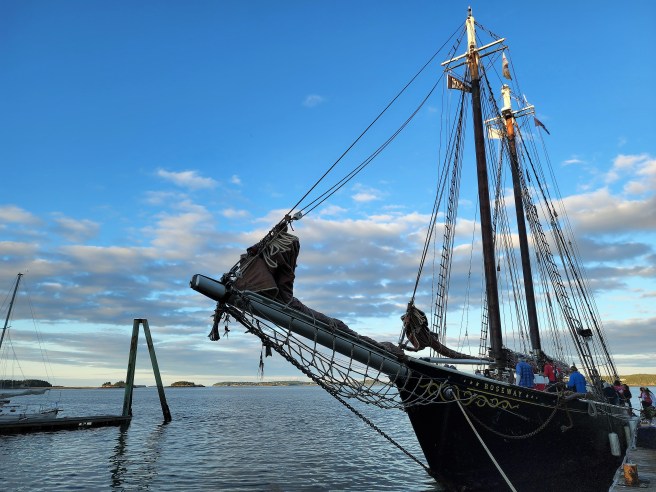
It’s been a slow season for tourism, and even the summer rentals are down

From the start of our travel season, things here have felt slow. I haven’t seen as many cars as I have in the past or as many states represented in their license plates, for one thing. While there are people on the streets, they’re not crowds.

Even down on Cape Cod, summer homes are available rather than reserved long in advance.

Somehow, we’re hearing that retail sales have been holding up, but we’re also seeing more vacancies in the Airbnb options, too. (The latter hits us as good news, considering how the investment buyers have been skewering the home market away from working families we desperately need.)

Still, visitors are the key to retail businesses in our part of Maine – our version of Black Friday has already passed or soon will, unlike the day after Thanksgiving push elsewhere. Maybe the visits by cruise ships in the foliage season will provide a much needed boost.

Could much of this reflect the reality that inflation is finally pinching family budgets?

Will they even be called sportswriters anymore?  

I’m still reeling from the decision at the New York Times to disband its sports department.

Admittedly, for much of my career, a newspaper’s sports staff was a mystery, set aside in a different room or even more elaborately from the rest of the reporters and editors. Sports seemed to demand a disproportional amount of newsprint, too, compared to, say, world news or even politics.

Only later, working at the fringe of Greater Boston with its intense team fanaticism, did I come to see things differently.

For one thing, the Boston Globe had some great sports coverage and I soon admired some of the writers. For another, I could see how the Red Sox, Patriots, Celtics, and Bruins held the region together at a gut level as an extended community. Many of our obituaries, for instance, included the line, “She was an avid Sox fan” or the like. Devoted? Sometimes “rabid” would have been more accurate, but “avid” was the term of choice.

As a journalist, I envied the excellence at the top papers that resulted from deep planning and commitment as well as top talent. I could see that a few papers stood head and shoulders above the rest on that front – the Globe, Washington Post, Chicago Tribune, Los Angeles Times, and, of course, the New York Times. Gee, they even had expense accounts and travel.

~*~

Thus, the idea of shuttering a first-class operation seems extremely drastic.

Yet, the Times does differ from most other dailies. It is, for one thing, a national newspaper far more than a New York paper. High school sports are trivial in its scope, as are many college games. The city itself has not just one or two professional teams – or even four, like Boston – but two in baseball alone and two in football plus two in basketball, does anyone even care about hockey or soccer or tennis or golf or whatever else in that crush? There’s only so much space in a paper, after all.

Much of the coverage will be drawn from the Times’ subsidiary website, The Athlete, which already has a national focus and staffing. There is reason for concern, though, that those positions do not have union representation, unlike the Times.

The decision likely reflects a recognition of major shifts in sports coverage across the city and the county as well. Internet access means that scores and other statistics can be instantly browsed from anywhere, rather than having to wait for the paper to arrive.

Cable has expanded game availability to fans, even those living far from the teams.

And then what’s there left to say after ‘round-the-clock sports talk radio and all the call-in chatter?

The Times’ arts coverage has already undergone a similar evolution, with less coverage of events and more emphasis on trends and influences. That seems to be what we can expect on the athletic front next.

In the newsroom, we were always perplexed that a section that generated so much readership – presumably male – failed to garner much advertising support. Department stores and supermarkets didn’t want to appear there, nor did auto dealers and parts stores. As for restaurants or movie theaters or politicians? Remember, advertising, rather than subscribers or newsstand sales, paid the bulk of the bills.

Deadlines, too, often hinged on the final score of the day, at least for the morning papers. Back in the day when we still had afternoon papers, you could get a more leisurely account there before the next game. Either way, those deadlines have moved up for other reasons. No waiting around breathlessly.

~*~

How this will play out on local papers remains to be seen. All I know is that staffing and space and advertising are all way down there, too.
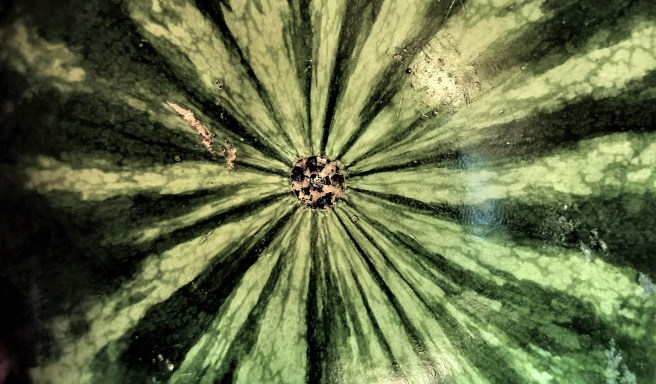
Does anything celebrate summer more than a watermelon?

And here I was about to investigate all kinds of melons, starting with cantaloupe.

That said, just consider:

  1. A watermelon is one of the few foods to be classified as both a fruit and a vegetable. Wish I could count it twice on my daily dietary requirements but guess that would be cheating.
  2. It’s a relative of both pumpkins and cucumbers.
  3. It’s far and away the most popular melon in America.
  4. There are more than 1,200 varieties, but the seedless hybrids are the only ones you’ll likely find nowadays at the market, at least in the USA.
  5. Those seedless versions aren’t genetically modified. Technically, they’re simply sterile with white seeds that are perfectly safe to eat.
  6. Watermelons originate in Africa and have been cultivated in Egypt for 5,000 years. That’s why they really do need a long stretch of summer.
  7. Based on weight, watermelon is the most consumed fruit in America.
  8. It’s 92 percent water yet rich in vitamins and contains only six percent sugar. By the way, there’s no bad fat or cholesterol.
  9. Its flesh isn’t always red – orange, green, yellow, or white are other options.
  10. In Japan they’re grown in glass boxes to maintain the unnatural cubed shape.


Sitting down to do our annual donations

Rather than making most of our charitable contributions ad lib during the year, we’ve adapted a new strategy since moving Way Downeast.

This is the time of the year when we decide what we’re supporting and then make those payments.

The process means deciding between giving smaller amounts to a wider range of organizations or instead sending somewhat larger amounts focused on a few recipients.

Mailing those checks off always feels good, though we also wish we were sending more.

That record flooding gets personal  

Looking at the news of Vermont’s flood damage, I’m seeing places I know and have traveled. Towns I pass through on my way to and from Quaker Yearly Meeting sessions at Castleton University, for instance, all now heavily hit. I wonder about some of the covered bridges I anticipate visiting or places I stop for a stretch, too.

I’ve been waiting to hear from a dear friend, especially, though I know his home is high above the stream running through town. Still …

My wife and I retain strong impressions from seeing the devastation from Hurricane Irene nine or ten months after it delivered its wallop. You wouldn’t believe the extent unless you saw the evidence.

The mountains become a funnel for the falling water, and many of the roads have nowhere to go but beside the streams. People, of course, live along the roads … many of them at the foot of natural chutes from the hillsides.

It’s not just water, either, but the boulders and gravel it unleashes.

There are real stories that will unfold long after the TV cameras and breaking news headlines have moved elsewhere.

But it does make a difference when events do somehow seem to reflect home for you. Or when you look for what I think of as “slow news.”

Our old garden has been obliterated

People used to walk down our street in Dover just to admire our garden. They told us how much pleasure and peace it gave them. It also attracted a range of wildlife, including hummingbirds, butterflies, or the occasional turkey or fox.

Throughout the year, the garden also led to many photos you can still find here at the Red Barn.

It was, by many standards, funky. The weeds were never completely controlled, but it was prolific and made good use of what we sometimes called the Swamp, after its mucky clay soil in late spring and early summer. Our pet rabbits delighted in much of what we picked there, too.

The new owners, alas, have bulldozed all that. The strawberries, raspberries, blueberries, currants as well as the raised beds and shrubbery screens – gone. Twenty-years of reclaiming the once tired soil and then dining well as a result – gone. Naturally, we’re lamenting, knowing how much more they must be spending on groceries that won’t be as fresh or tasty.

We have to recognize, of course, that we’ve left all that behind and no longer have a say in the matter.

But we still feel sad or even a tad angry. Ahhh!

So where were the Baptists in New Hampshire?

Dover’s third minister, Hanserd Knollys, no doubt laid a foundation for the Quaker message two decades after his brief tenure in the town pulpit. He was beset by controversy and even a physical skirmish or two, but he organized the church as a Congregational society even as his own theology was evolving into Particular Baptist.

Some of New Hampshire’s early Baptists did relocate to New Jersey, where they named a town Piscataway, in honor of Dover’s Piscataqua River. And Knollys himself became the pastor of London’s first Baptist church, once he had fled New Hampshire and the New World.

By the way, the number of colonists who returned to England from America still amazes me. How could they even afford it, much less the time involved?

Some of his challenges to conventional Christianity, like rejecting the baptism of infants, opened the way for Quakers to build on, once they arrived.

Still, I couldn’t get a clear picture of the existence of the Baptists as New England’s other dissident denomination in the colonial era. Was it all down in Rhode Island, where they contended with the Quakers over the governance of the colony?

My own book, Quaking Dover, concentrates on Dover Friends Meeting and its families, once they’re established, but the Baptists seem to be largely invisible until the Revolutionary War or so.

Carla Gardina Pestana’s Quakers and Baptists in Colonial Massachusetts now provides an understanding of the faith north of Rhode Island. Essentially, it was long comprised of one church in Boston, and its members were scattered across the region, rather like a network of solitary souls. The church underwent an evolution over the years, from lay ministry to ordained pastors, and ultimately presented less of a threat to the Puritans/Congregationalists than did the Friends.

Still, their insistence on a separation of church and state and their view of a church being comprised of fellow adult believers rather than a place one had to attend regardless of one’s heart and thinking were liberal and revolutionary.

Pestana’s description of the impact of the Great Awakening on the Baptist movement gives me a clearer understanding of why so many of its churches appeared in and around Dover – and the rest of New England – in the early 1800s.