Month: July 2023
Mount Jefferson
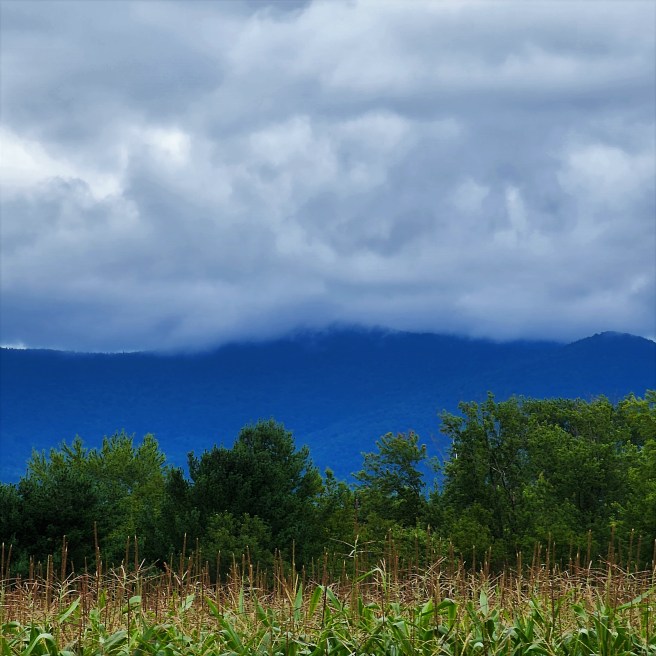
In New Hampshire’s White Mountains Presidential Range as seen from the Vermont state line.
Kinisi 168
“God!” he cries
seemingly to no one
Dipping in glorious waters
I haven’t written a real poem
in at last a decade
prose, especially fiction, has taken the fore
plus relocating to a remote Maine island
do I even consider the photography
How else do you think
other than by talking to yourself even silently
or through the fingers or feet
I’ve long preferred instrumental music, abstract
or airs in languages I don’t understand
and usually forget the lyrics and lines in scores
I’ve sung in concert
So I was swimming a half-mile a day
before the pandemic but haven’t been back
in deep water, fresh or surf, indoor or out till today,
my first venture in a little-known river pooling
too rocky for laps but perfect for extending myself
in the familiar chill under a cloud-strewn afternoon sky
yes, it’s glorious and refreshing
in a way I discovered my first year after college
in hippie abandon or the New England coast
and Dover’s Olympic pool later
it’s the sunlight and breeze
stretching above, around
a call to attend to my rooting as well
in meditation, prayer, Scripture, favored poets
all as seemingly impractical
It’s called a dolphin
Our waterfront contains two sets of steel pilings each capped by a concrete structure that sits apart from the pier and above the water line.
In Eastport’s case, these are mooring dolphins, where lines from a ship exceeding the Breakwater’s 400-foot dock length can be attached to help secure the vessel in port.
Here’s one in action.
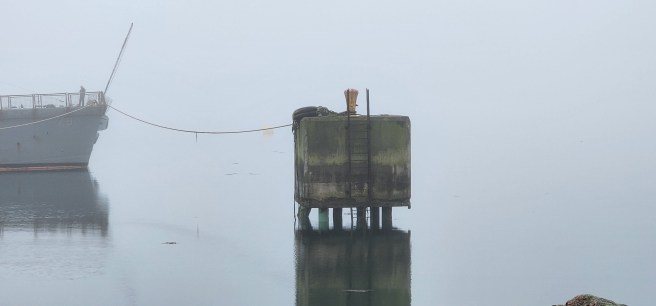
The line’s slack now but won’t be when the tide rises more.
As for a broad history of New England Quakers?
It would be an ambitious project, and I’m not sure quite how one would structure it, spanning six states and many subjects as it would from early colonial times to today.
Dover Friend Silas Weeks’ book of meetinghouses and burial grounds remains my go-to volume, but it’s mostly about buildings rather than people.
I’m still surprised to hear Rhode Island Yearly Meeting as the body’s early name, rather than New England Yearly Meeting. When did it change officially?
Well, I have seen some genealogies that get impossible to follow after, say, the third generation.
I even feel something like that in Dover, once the textile mills take over.
Still, the conventional histories of Quakers in America focus on Philadelphia, overlooking or slighting the unique challenges and characters of New England, North Carolina, Ohio, and more.
For now, my Quaking Dover is a microcosm of the bigger picture. I’m hoping it will prompt more.
The passing of my last aunt marks a generational change
News of the death of my dad’s youngest sister was not unexpected but a jolt all the same.
For years, she had been something of a cypher in my awareness, originally when she came home from college or later in her visits from California, far from our Ohio.
Mom’s family, apart from her stepmother, was largely non-existent, except for a few encounters in Indianapolis, central Illinois, and Missouri. And she had her differences when it came to Dad’s clan, which did filter my perceptions.
I really didn’t understand the array of uncles, aunts, and cousins until I got heavily into genealogy. Before that, I was rather amazed at (and baffled by) the connectedness of one girlfriend’s Jewish family, which seemed to have cousins everywhere. Just what was a second cousin, anyway, much less removed a degree or two?
When Dad died, though, after a decline to Alzheimer’s, his last remaining sister insisted on flying out to the funeral, along with her husband.
And that’s when I finally got to know them – personally rather than abstractly. Thankfully.
The revelation began when she and her spouse, my Uncle John, came down the gateway at the airport and he swept our youngest up in a big bear hug while proclaiming, “It’s so good to have another Democrat in the family!”
The kid had no time to be appalled. He was instantly high on her list of rare approvals.
It was an effusive side of him I’d never seen. He was, after all, a retired University of Southern California dean and an ordained Presbyterian minister. And he was a warm, fun-loving guy. Who’d a thought?
It was the beginning of many other revelations over the next several days.
Slowly, I realized that his wife, that baby sister my dad called T.J. rather than Thelma, stood halfway in age between my dad and me – much more in my direction, that is, than I had thought. And it also dawned on me that she was the last person who might be able to answer many of the questions I had accumulated regarding my grandparents. Except, that is, she was equally in the dark on many of the answers.
In the months after the funeral, that questioning led to a fascinating round of correspondence between her and me and, at her insistence, our cousin Wilma, six months Dad’s junior.
It was an extraordinary research project, actually, one you can read as the Dayton’s Leading Republican Plumber sequence on my Orphan George blog.
At last, I came to know my grandparents for who they were rather than what they were supposed to be or weren’t. But I also came to know and appreciate T.J. and John and Wilma, too, and so much of what I had been missing.
As I learned, only Dad called his sister T.J., so I felt a responsibility for keeping the moniker alive, especially for some of the reasons she expressed.
~*~
Leap ahead, then, to a letter I had from her a few months ago relating that Uncle John had died of cancer – and that she, too, now faced a terminal prognosis. She agreed to chemo only to buy time, as she said.
That led to a long, difficult letter from my end and then, to my surprise, two phone calls – we had never talked on the phone, for whatever reasons. These two, of course, were strong exceptions.
On the second call, I shared the news that Wilma had passed over after Christmas, having reached the 100-year-old milestone. T.J. was glad I had included her.
And then, a few weeks later, a first cousin reached me by email using an address he was uncertain still worked – I’m not sure we had ever communicated that way. Usually, it was the annual Christmas card and letter exchange.
He had the sad news, as he said, that T.J. had died after a week in hospice, her body weakened but her mind still alert.
~*~
Thus, within a few months, the last three of the generation before me in our family have died, and that places me next to the top in the senior generation that emerges. Or the oldest male, if that matters. Not that I’ve heard from most of the others in years.
What strikes me, though, is a sense of exposure or vulnerability, like having a roof or an umbrella blown away overhead. Like it or not, I’ve moved into that elders edge that they filled. No longer do I have those more experienced to turn to, and I’ve been feeling how inadequate I am in comparison to the best of them.
Not just in the family, either, but within my religious circles, too. I’m now the oldest surviving former clerk of Dover Meeting, for instance, with all of the institutional memory that’s supposed to embody, even as I now reside 300 miles away.
What I have to also observe, with gratitude, is that through them, I’ve also known blessings and perhaps even wisdom. May I pass those along, too.
Sloop at the pier
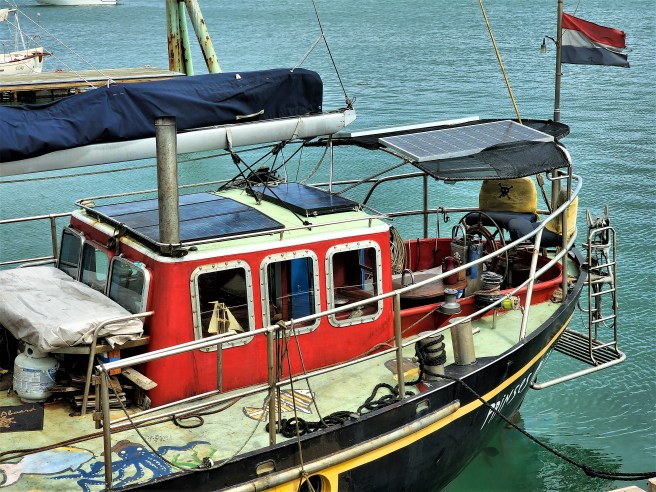
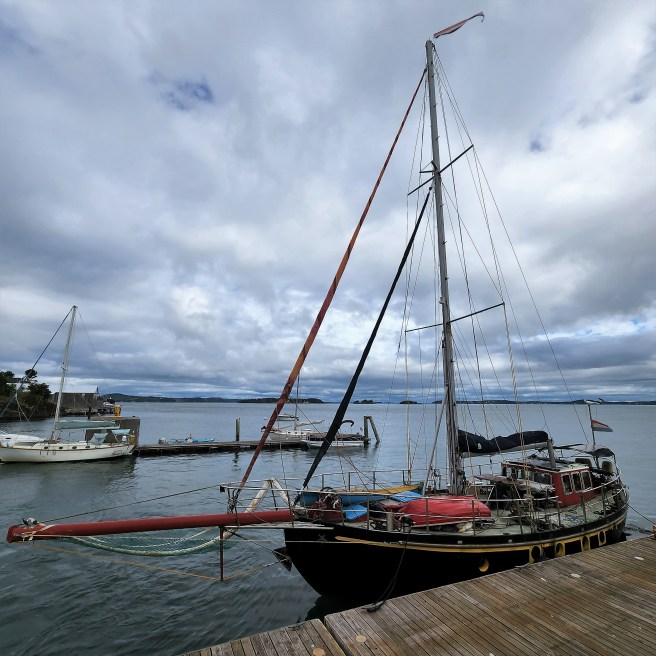
The Prinses Mia had been sailed across the Atlantic by one man.
On the continuing toll of the Internet on the livelihoods of creative souls
Fellow blogger Gary Hart recently had an eulogy for Outdoor Photography magazine, which prompted this comment from me:
“Your post mortem is one more story of the toll the Internet is taking on the income of many creative individuals. Freelance writers were devastated early on when their secondary markets for republication withered (anyone could already find the piece online). In professional photography, you lost sales to people who found your images posted online and were content with copies they printed out at home.
“Magazines faced a double whammy as content moved to the Web. Not only were sales and subscriptions shrinking, so was advertising, which paid most of the bills. In the case of photography, the products themselves were being rendered obsolete. Film, chemicals, papers, enlargers, darkrooms, and so on became ancient history and then, for the most part, so have cameras. What I’m getting with my cell phone, for instance, is unbelievable (though I know its imperfections, too). As a parallel, you can discuss what happened to the professional wedding photographer.
“Finally, as much as I love paper, I’m using far less of it as either a writer or a reader. Downsizing is one reason but not the only one.”
Just look at what turns up
I’m living in an apartment complex, at first something like the townhouses atop the hill, morphing into something more like the garden apartments with a central parking lot outside Baltimore.
We’re moving out or at least cleaning up, carrying stuff out to the dumpster.
I’m not sure who the “us” is, but soon it feels like just me, especially when body parts or something suspicious is found, say, under the front-door mat and then in strange corners within the house. Gotta clean ’em out before they start stinkin’. Into the dumpster, then, when nobody’s looking.
Early on, I’m trying to protect the chil’kins, not that I/we think she’s done anything but rather that she would be a prime suspect.
As this progresses, though, it’s my ex- who’s in question. For whatever reason, I’m still trying to help her, cover for her.
In either case, I’d be under heightened suspicion.
 Jnana's Red Barn