Month: June 2023
It’s not all water around here, not by a longshot


Kinisi 162
Fellow counselor giving cigarettes to his campers.
‘Living like God in France’
My late German mother-in-law was fond of the expression, and I do wonder what it lost in translation.
I never could tell if it was a grudging admiration or an underlying censure.
The times she used it, though, I felt we were actually living better – and more simply.
One site, three successive forts in colonial history
Coming to Colonial Pemaquid’s state-maintained historical site in Maine, I wasn’t prepared to find this.

It was far more than the wooden palisades found across much of early New England. It looked to me far more like something out of Scotland or a Monty Python movie.
This wasn’t even a reproduction of the first fort there, but rather the second.
The first was Fort Charles, built 1677 after the village had already been destroyed. That fortification was overrun and destroyed by the French and their Native allies in 1689.
Most of the usual attention to warfare between the English colonists and the Natives focuses on King Phillip’s war, which heavily impacted southern New England. Much of the heaviest toll, however, happened in the decades after that when the tribes allied with the French to the north. Those outbursts afflicted northern New England, including Dover, New Hampshire, for decades later.
That’s where Pemaquid, fortified to hold the Maine at the edge of English claims in the New World, comes into play with my story, Quaking Dover.
Dover was often on the frontier of English settlement, a thin ribbon along the coastline but barely reaching inland and thus nearly impossible to defend, at least much north of Boston.
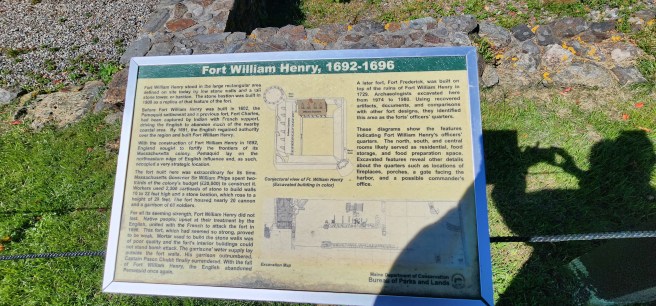
Once the English did reclaim this stretch of Maine from the French, the New Englanders built a new, second fortification, Fort William Henry, erected in the large rectangular area defined on the site today by low stone walls and a tall stone tower, or bastion. The stone bastion you see was built in 1908 as a replica of that feature of the fort.
As Maine’s online documentation explains, before the second Fort William Henry was built in 1692, the Pemaquid settlement and the previous fort had been captured by the French and their tribal allies, driving the English to abandon much of the nearby coastal area. By 1691, however, the English regained authority over the region and built Fort William Henry.
(I am fascinated by the tenacity of those who kept returning despite the costly odds.)
As you will find, with the construction of Fort William Henry in 1692, England sought to fortify the frontiers of its Massachusetts eastern district. Pemaquid lay on the northeastern edge of English influence and, as such, occupied a very strategic location.
The fort built here was extraordinary for its time. Massachusetts Governor Sir William Phips spent two-thirds of the colony’s budget (£20,000) to construct it. Workers used 2,000 cartloads of stone to build walls 10 to 22 feet high and a stone bastion, which rose to a height of 29 feet. The fort housed nearly 20 cannon and a garrison of 60 soldiers.
(Note that the costs were born by the New Englanders, not the British Crown.)
For all its seeming strength, Fort William Henry did not last. Native people, upset at their treatment by the English, united with the French to attack the fort in 1696. This fort, which had seemed so strong, proved to be weak. Mortar used to build the stone walls was of poor quality and the fort’s interior buildings could not stand bomb attack. The garrison’s water supply lay outside the fort walls. His garrison outnumbered, Captain Pasco Chubb finally surrendered. With the fall of Fort William Henry, the English abandoned Pemaquid once again.
(If this were fiction, I can’t imagine what to do with a name like Captain Pasco Chubb. Especially as an Englishman.)
Well, that’s an official account, one I for now I find no reason to quibble with. What does change my earlier perspective, however, is Fort Frederick, erected in 1729 and dismantled in 1775 to keep it out of British occupation in the Revolutionary war.
It never faced hostilities with the Natives, which seriously makes me reconsider a much earlier reoccupation of Maine by English settlers, something I had largely ruled out before 1763, the end of the French and Indian wars. Now see that’s not quite accurate, though it still seems to apply Downeast, where I now live.
So much for these confessions of an amateur historian.
This feels like a ‘welcome to the club’
Coming up at the Phoenix wine bar downtown on Thursday from 6-8 pm, I’ll be one of six local writers reading from our books.
It’s organized by Catherine SJ Lee, whose wonderful collection of short stories Island Secrets is well worth acquiring. One secret she doesn’t mention is how many fine writers and other artists dwell on the charming island I now call home. Honestly, I feel honored to be among those invited to read and am certainly looking forward to personally meeting others.
Each of us will present a 15-minute selection of our work and then engage in a meet-and-greet over a bookselling and signing at the end.
These days, presenting my case without including an accompanying PowerPoint does feel a bit strange. Still, as a writer, I do love having the text itself be the sole focus, as I have enjoyed in our monthly open mics at the arts center.
The wine bar event is part of the first ArtWalk weekend of the season in Eastport and Lubec. Other planned activities include gallery tours, rock painting, sidewalk chalking, games, musicians around town, an outdoor contradance, and perhaps a street dance or two.
Poppies


How to curb gun violence in America
Redefine them as books.
And then ban them.
(Maybe that will equalize their backers’ interpretation of the Second Amendment.)
Oh, freedom!
There had been endless dreams of chasing after her and trying to catch up but failing. Curiously little from the time we were actually together. But, then, one night, I have one where she’s trying to catch up with me but can’t, unlike all the other times when I had been trying to catch her. And at that moment, I was free.
And then?
TRAVELING, BACKPACKING, with a female companion. We stop for the night, a small hilltop lodge. Next morning, she cannot be found. Has taken a walk. Later, down the pathway, a cabin has burned. Something the hostess says about an old hermit who lived there. And the host, “You won’t want to look there,” a warning. She had insisted on going off on the walk alone. Finally, I realize I must move on, alone.
I’M RIDING A BICYCLE, MAYBE even in Ohio. Beside me, on my right, is a blonde, short athletic hair (blue eyed?), mid-20s runner. We share an attraction, but light, playful, not sticky.
From behind my left side, then, up comes running another figure – as she catches up, more or less, it’s the golden goddess of my past! Shortly afterward, the roadway begins heading stiffly uphill.
My attention – and desire – shifts to her, despite the fact the other is clearly healthier for me. But I determine to ride on and redouble my effort. Fading as I lurch uphill.
Significant I was going somewhere – on my way – this time I wasn’t being blindsided, either, yet she wasn’t ahead. Her darkness or danger became apparent as I retold the dream.
NOW AS A VAMPIRE, AN INSOMNIAC GHOST. Her unimaginably long hair’s cut short, a different nose, too. Leading me out of my way: Dayton, Wayne Avenue, and Seventh Street area – not that I’m in love with her or anything but rather holding her accountable. Not taking any shit from her, but firm.
And then dismembering her, for a change. Not that a dream offers details of the carnage, or that I would ever possibly be able to do such a thing in reality. But in this sense, I could detach myself from her piece by piece, and that has remained very terrifying.
SHE APPROACHES ME, REBUFFED. The golden goddess has aged, grown flabby, lost her girlish charm, even the edge of her serious demeanor. In their place, a stupor.
She falls behind, cannot catch up. I’ve gained strength and move on. There are no words that bridge us.
Regarding the median age of tradesmen
As a passerby noted while observing renovation work in town, the median age of tradesmen in the U.S. is 57. It’s no doubt higher here in Maine and Sunrise County, especially.
There’s a lot of work needing to be done, too: carpentry, plumbing, roofing, masonry, insulating, windows … We have a long list ourselves and are still looking for help.
Forget the “Go west, young man,” advice of yore. Many youths would be well-advised to go into the construction trades, pronto. Financially, they’d be way ahead of those with a college degree but heavily in debt. They could even live wherever they want.
Hey, kids, if you love to hunt and fish or sail and camp, Sunrise County would fill your dreams. You’d definitely be welcome.
On a more personal note, send me your references and let’s talk.
 Jnana's Red Barn