Join me virtually at Cape Cod

I’d love for you to join me on Cape Cod on Sunday, July 9, for a Zoom examination of ways a faith community can sustain a unique witness in the face of strong resistance. I do expect some lively discussion, based on my book, Quaking Dover, but you don’t need to be a Quaker to participate.

Do note that preregistration for the free event is required  (https://bit.ly/QuakingDover).

Hey, it’s a great place to be on a day in July!


As for another taste of scandal?

Dover’s second minister, the Rev. George Burdet, made a quick exit from town amid scandals, quickly followed by more in York, Maine. He had even briefly been “governor,” or the agent in charge of the New Hampshire province, making him in charge of both its religion and politics. Or, as historian George Wadleigh quipped, a wannabe pope.

Beyond that, as I observed in Quaking Dover, Burdet “was obviously on a downward spiral, as Thomas Gorges wrote to John Winthrop in 1641, noting that Burdet was at Pemaquid and ‘is grown to that height of sin that it is to [be] feared he is given over. His time he spends in drinking, dancing, singing scurrilous songs, and for his companions he selects the wretchedest people of the country. At the spring I hear he is for England.’ Later that year, the younger Gorges added of Burdet, ‘the dishonor of his profession and monster of nature, is now gone for England by way of Spain.’ That description of drinking, dancing, and singing rather seals the Robert Dover connection for me, even if Merrymount’s Thomas Morton, the more obvious reveling partner, wouldn’t return to Maine for another year or two.”

I do have to wonder where the wild tavern sat in the early Maine settlement here.

So here’s where he spent that wild binge – 110 miles or so from Dover, or a two-hour drive away today.

Recent research has come up with a site for the jail. I do have to wonder if the Rev. Burdet ever served time therein.

As for Robert Dover, who gave Burdet the inspiration for naming the New Hampshire settlement? He was an anti-Puritan wit and attorney. That, in contrast to the South English port famed for its white cliffs.

Reports of the cleric’s subsequent movements vary, possibly ending in Ireland, “where he was named chancellor and dean of a diocese. He died in Ireland in 1671, ‘after founding a much respected county family.’ Had he reunited with the wife and children he’d left behind?” As I say in my book, “Or was he, in fact, a bigamist? Also, there’s no mention of prison.”

Turn to Quaking Dover for the details.

What my Pemaquid visit made me realize is how little history of early Maine I had encountered in drafting my book, and how tenuous so much of it I’ve found since remains. Yes, the early settlements, including Pemaquid, were obliterated and abandoned during the decades of warfare with the French and their Native allies, but there had been significant settlement before that, something that kept getting swept away.


Thinking of Tim Gunn and those young fashion designers

Binge watching the episodes of the runway project, I’ve been struck by how many times his sage advice included basic English words the younger generation totally missed.

Well, words that seem basic in our household.

Look, kids: A big vocabulary takes you from black-and-white to full, vivid color. And then beyond. It’s full of nuance and possibility. A spice of life, even.

It’s kinda like that fabric store you raid. And one more reason your mentor on the show is as remarkable as he is.

I’m really looking forward to tonight’s reading

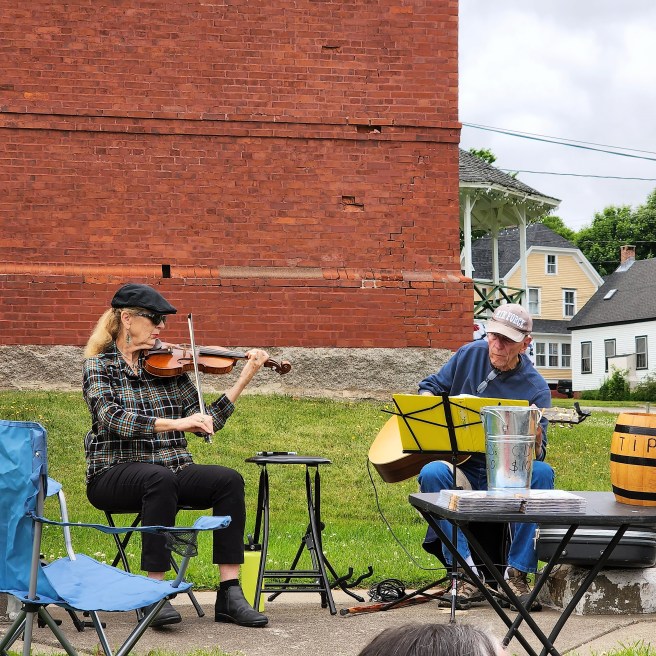
If you’re a musician or writer or some other kind of performance-potential artist, you probably find being part of an open mic event invigorating. Not just because you get to air your own work and see how it fares on exposure, but also because you’re amid so many kindred spirits.

Tonight has a kind of hybrid version — six featured published writers at the wine bar downtown — and it is creating a buzz in our small community. Each of us gets about 15 minutes in the spotlight, as well as a book-signing and chat time afterward.

I’ll be reading a chapter from my new book, Quaking Dover, one that details a remarkable but often overlooked outburst in early New England, the bohemian colony called Merrymount. I had settled on that excerpt, a side I hadn’t yet presented in my presentations, before realizing how appropriate it is for this weekend’s ArtWalk festivities, many of them reflecting Pride awareness.

So, here we go … just as the summer season is beginning in our oceanside setting.

Stranger trips

STAYING IN A VERY POSH HOTEL in Washington, D.C., where one exterior was angled so the rooms opened out on a large waterslide! I’m torn in making a decision between going to the National Gallery, a block down the street, or playing in the water instead.

The deal also includes a helicopter ride over downtown Dayton, just a few blocks away.

Obligations/seriousness versus fun/irresponsibility.


IN COASTAL FRANCE, RIDING IN a horse-drawn carriage, our guide leaves and I’m expected to pay the driver but I haven’t converted my currency. At last, I say MO-NAY and point to the dollars in my wallet. He laughs and points to a shoreside bank. We enter together, take an elevator down from street level, toward the water, I presume.


DRIVING WITH JAMES DOBSON THROUGH rich, plowed farmland – gently rolling, like southern Indiana – but also about to be turned into housing tracts.

We need to take a leak, so we park and climb a small green rise, and at the fence line while taking our pee, I gaze out on a sunny morning pond and see what I think’s an otter. “Look!” As we focus, we realize it’s a brown bear and its companion.


THIS TIME, WITH BLONDIE, BEGINS roadside Bucks Co. PA scene from an earlier HODGSON roots quest dream. Soon, however, we are interior, getting intimate – walls, ceiling painted black. We’re interrupted by “Annie,” who has me tied up, ready to be shipped out with burlap bags (of pot?) and recipes for its use. My head is against strange paperback drawings of couples with bizarre tats and piercings. At last Blondie senses Annie, having spaced off somewhere else, has forgotten, for now, unties me. “You’ve got to go, now,” coins falling from my pockets all over the dark place. Me, in overalls! No time to chase the coins. “You’ve got to go. NOW!” Expelling me out onto a downtown, then my high school, Watervliet, daylight, all from other recent nights. She cannot come along. Held hostage, by her kids.

This is a great place to enter the twilight zones

Here in Way Downeast Maine, many dawns would blow you away, at least if you’re awake in time.

It’s not just when our closest star comes into view but also the vast unobstructed sky over the bay and the ways neighboring Campobello Island interact with the growing light.

As I’ve been finding – and you’re seeing in some of the photos here at the Red Barn – much of the glory occurs in what’s officially the twilight zones, defined by how low the sun is below the horizon.

These zones are otherwise known as dawn and dusk, apart from Rod Serling’s once upon a time spooky black-and-white TV episodes.

And these are longer and more pronounced the further away from the equator they are.

I’m on the 45th parallel, halfway to the North Pole and its days of endless summer light or winter darkness. Meaning our twilights are much longer than what happens in most of the rest of the continental U.S.

Checking our local weather forecasts, I’ve noticed a few unfamiliar terms but not looked into them until recently.

The first is astronomical twilight, which I’ll skip over this round. It seems to apply mostly to the Arctic and Antarctic.

The second is nautical twilight, which apparently has its origins in the era when mariners used the stars to navigate the seas. In clear weather, most stars are still visible to the naked eye but also, finally, the horizon. You need artificial light to do much of anything outdoors.

Around here these days, it begins before 3:10  am Daylight time – or what would be 2:10 Standard. The wee hours, no matter how you slice it.

The next stage is civil twilight. It’s brighter, enough to mean artificial light may not be required for outdoor activities. Only the brightest celestial objects can be observed by the naked eye. These days for us, it’s around 4 o’clock. Yeah, 3 Standard time. Still really early for most folks.

And finally sunrise, about a more than quarter to 5.

That’s an hour and a half of magical natural light.

I think it’s why most people around here are up and about early. Even in winter, the roads are busier at 5:30 in the morning than 5:30 in the afternoon.

Of course, the reverse happens every evening.

The shifts also produce what’s called the Golden Hour, when sunlight turns warmer and softer. Or, in my thinking, buttery and magical. I place it mostly as the hour before sunset, especially when the light shoots in horizontally.

As well as the Blue Hour, when only a few stars or planets are visible. Painter Maxfield Parrish exploited it to the hilt.

During the day, much of our sunlight is reflected from the waters back into the sky, something many classic Italian painters explored as well as more modern artists here today.

So how’s the natural light where you are?

Have you ever been to Acadia National Park?

Maine likes to tout itself as Vacationland, and Acadia National Park is definitely a star attraction. I know people who gush that it’s their favorite place ever. Not that I’d go that far.

Still, let’s consider:

  1. With four million visitors a year, it’s among the 10 most popular national parks. Most of them crowd in during the prime summer months.
  2. The official version has the park being named after Arcadia, a region of Greece that it supposedly resembles. New France, however, referred to eastern Maine as Acadia before being expelled by the English in 1763. In their migration, some of those Acadians became known as Cajuns down in Louisiana. I’m siding with the French here, despite my fondness for Greek culture.
  3. It was the first national park established east of the Mississippi and encompasses 47,000 acres, mostly on Mount Desert Island. Not that there’s any desert, it’s just wild. Additional, less well-known tracts are on Schoodic Peninsula (my favorite) and Isle au Haut as well as smaller islands. And a fourth of the land total is privately owned but under easements and similar arrangements.
  4. With 108 square miles, Mount Desert Island is the biggest island in Maine and the sixth largest in the contiguous United States.
  5. The park has 158 miles of maintained hiking trails spanning mountainous terrain, panoramic views, rocky Atlantic shoreline, mixed forests, and lakes. Former carriage roads are also popular with bicyclists.
  6. There’s a private trolley service for those who’d prefer to view the scenery more than the traffic jam.
  7. Backcountry camping and overnight parking are not permitted, but there are campgrounds and lean-tos for those who plan well ahead.
  8. French explorer Samuel de Champlain gets the creds as the first European. He encountered the place in September 1604 when his boat ran aground on a rock. He applied the name Isles des Monts Deserts, or island of barren mountains, to the bigger scene. Well, some are pure rockface.
  9. In the 1880s, the island became a summer retreat for Rockefellers, Morgans, Fords, Vanderbilts, Carnegies, and Astors who built elaborate vacation dwellings they called “cottages.” Many of those were destroyed by a vast wildfire in October 1947.
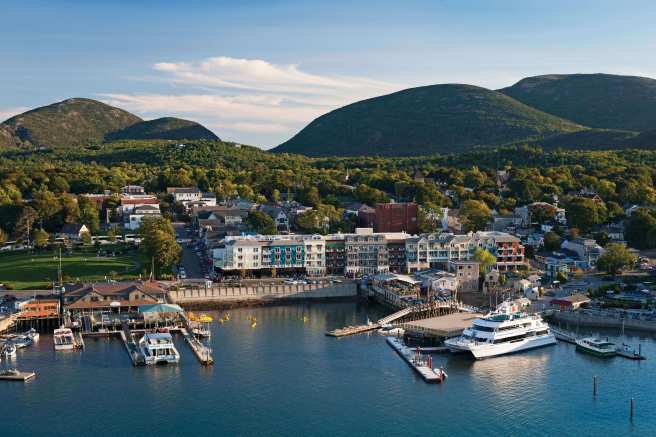
  10. Its principal gateway is Bar Harbor, a city of 5,000 full-time residents that swells with summer people and their second homes, tourists, and often a big cruise ship or two that add several thousand more people to the crowd. Be warned that parking is at a premium in high summer.

For more adventurous souls, let me suggest exploring two hours to the east, to the Bold Coast, for a less spoiled alternative.