Back to places I’ve inhabited or at least visited

A rather elaborate sequence of dreams after drafting a letter to our former landlords. I had fallen asleep especially early, around 8 p.m., and this was kicking in probably around 4 a.m. and continuing until 6:

I’m in Yakima (actually had an elaborate “east of Yakima” dream about six months ago, heading through the small towns off toward Tri-Cities … no trace of its content now). Except that this one could as easily be Binghamton or even Manchester.

It picks up as we’re coming over the crest of a high hill overlooking the city. We’re on a clean concrete boulevard on a sunny day, the downtown arrayed below us – and golden hillsides overlooking it from the other side. Blue sparkling river flows through it. (Columbia River, as it is up in Wenatchee?) We’re chatting about my return visit after so long.

Actually, I now remember there was an earlier episode about taking my family out West … spurred by the letter, actually … so they become part of the crowd in this series, even when they’re masked as others, I suppose. In actually, it’s a golden morning after a very glum Sunday.

It’s a smooth sweep downhill, skirting the downtown. We’re talking about a movie that was done here. (Maybe even picking up on another recent dream of visiting Ivar’s orchard, which in reality could have been in York County as easily as Washington State.)

Next thing I know is we’re driving along the sparkling blue river. From the angle of the sunlight, we must have been headed east. The freeway is in a set of elaborate caging – wiring like extended lobster pots, actually – sprinkled by a earlier shower perhaps or occasional irrigation. A vast serpentine structure along the river and overhead – was the other side cliff? “They haven’t done a movie with this yet, have they?” Laughter. And our guide (Phyllis?) replying, “Not yet.” It was very cinematic and joyful.

We pull off at a small mill area … like those of New England. (I now remember yet another recent dream, of what I pegged as eastern Ohio or even West Virginia: driving along an industrial valley, leaving the freeway and visiting within the varied small cities. Many shades of Warren, Niles, Youngstown, with moats thrown in. Maybe this dream repeatedly. Trying to reconnect with something lost.) We park and walk past or through a small Catholic church and out on a shaded plaza beside a mill. In the window, I see someone sitting. Looks like Carl P., only turning to face us, is a woman. Not pleased by our banter, either. We start to borrow a picnic table bench to use elsewhere, then I turn around and replace it. Glancing down the street beside the church, I notice that what first appeared to be triple-deckers beside the mill are actually one long, complex series of stucco apartments with Roman Catholic crosses in strategic places.

I think we had been visiting in one of the apartments … a rather erotic introduction for me … though it’s all fuzzy now. Again, later vague memories of other apartment dreams and student-residents. Colleges or art schools. Maybe Cincinnati and theaters or music.

We exit through the church, and dash across the street to a parking lot – all set high above the river, like the Sam Hill museum and Stonehenge in the Horse Heaven Hills. The headlights of a procession approach – either a wedding or, as it turns out, a funeral. Now off to the side, we watch two groups in conflict – the funeral contingent above, with the hearse, and a group taunting and jeering below. Some kind of minor thug – a woman? – is to be buried after a funeral mass.

But first, we’re off. Somehow, our own crowd has changed. It’s more crowded, and Phyllis must be driving. A teenage orphan is snuggled up next to me and several others. (It’s getting very erotic.) She’s freckled, open-faced, and has somehow managed to live on her own – a victim of the thug’s oppression. A blanket’s thrown over us. I reach down to scratch my leg (I’m wearing shorts) but am scolded for touching someone else. Lift the blanket, and a face looks up at us. “Sorry. I’ll keep my hands up here, to myself.” Laughter. There are other bodies pressed in against us, too. It’s a crowded, but joyful trip.

Turns out this is part of a group that sees this as the moment of liberation from the thug’s circle.

A leap again, and we’ve stopped at a small roadside restaurant called, it turns out, Baklava’s. Looks like a Carvel’s or Baskin-Robbins. We’re running around in some confusion. I see bagels for sale, but not what I’m seeking. (Something big and fluffy, like a cinnamon roll, or even baklava.) “Oh, the coffee comes with baklava,” I’m told, and yes, the coffee is dark and thick.

After I get my order, one of our companions (not Phyllis?) goes up to the counter, where the manager (I presume) in a red-plaid shirt is at the counter. She squirts him with a fountain pen-turned-hypodermic, hitting him with a dark liquid. He falls over backward. He was one of the thugs and we’ve made our hit. We run from the store and no one pursues us to the parking lot. Good thing, since my car keys are tangled in my pocket. (So I’m driving now?) Even with the delay, there’s no sensation of panic. We’re on the side of justice, however illicit. The people’s side. Justice has been served. It’s still morning.
It’s our principal ‘big city’

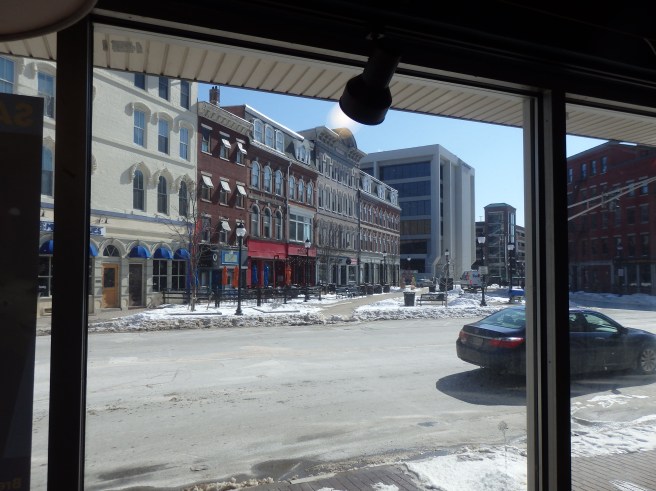
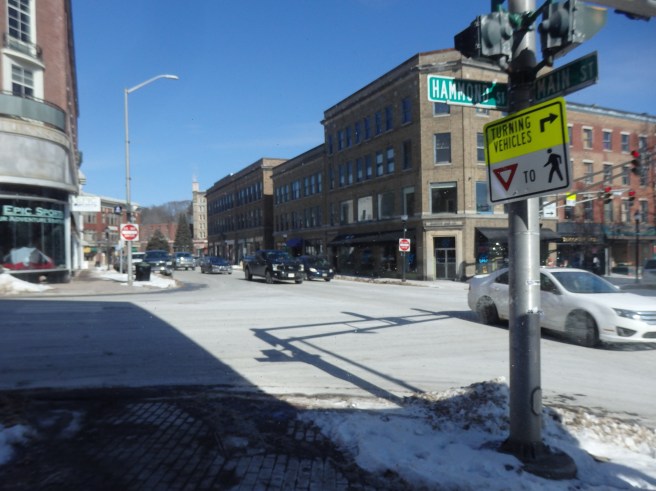
Bangor, Maine, population of 31,753, is the third-largest city in Maine. For us in Way Downeast, it’s also where we go for airline flights, medical specialists, the mall and big-box stores, and much more. It also has the region’s daily newspaper.

Well, a bald eagle did fly over just after I shot this and put my camera away.

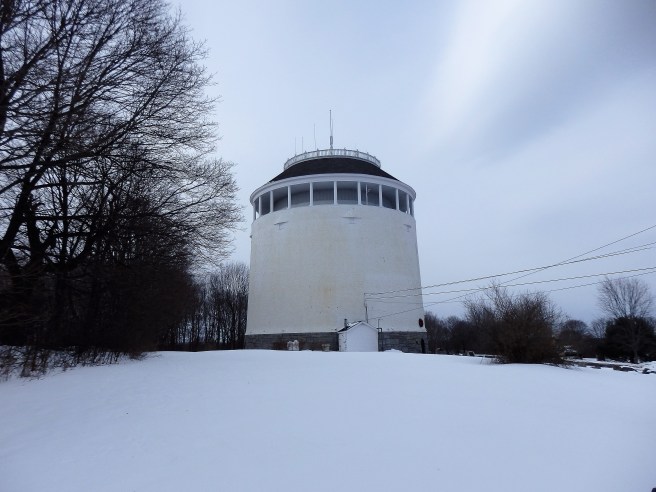
Thomas Hill Standpipe overlooks the city and valley below.

Oh, yes, it’s still a 2½-hour drive from Eastport.


As an alternative to ‘they’ for just one body?

I’m sorry, but I have real difficulty in using a plural pronoun to refer to just one person. I don’t want to get into the political ramifications here or gender limitations of our language or other arguments. To call one person “they” has me looking for the rest of the group. And when that “they” is being discussed at the same as “their” family or coworkers, I’m left with no idea who’s really being discussed. Life’s already confusing enough.

How about a whole new set of pronouns?

Let me offer “vey,” “vem,” “veir” for consideration. (I actually misheard “they” as “vey,” which got the ball rolling.)

It’s a way we can tell vem apart from veir family, household, even team.

Yes, I know the gender identity objections, especially when all (collectively) are placed under a masculine pronoun. I can even object to that practice by noting the confusion at times of ambiguity when trying to apply it specifically to males-only.

What can we do to gain greater all-around clarity rather than muddy the language further? 


Sometimes a small city can have a big impact

Bangor, Maine, has about the same population as Dover, New Hampshire – 30,000-plus.

But it’s the center of a wide region and has the spotlight to itself. In fact, though I live a 2½-hour drive away, it’s the place we often turn to for what many folks take for granted.

Here’s some perspective.

  1. It’s where the Penobscot River meets the ocean, so historically it was the world’s leading producer of lumber, which was floated down from the North Woods, milled, and then packed on ocean-going ships.
  2. Well, that did lead to Old Money, which can be seen in the remaining stately homes and churches built by lumber barons in the 19th century.
  3. The river also separates the city from Brewer, which adds another 10,000 or so to the metro population and provides some of the services and products we seek.
  4. Not just the mall and big-box stores, though some of them do deliver way out to our fringe of the state. Don’t overlook new auto dealerships and their service departments, either. Well, we do have one dealer out here in Sunrise County, but it’s not Toyota.
  5. The vast Northern Light Eastern Medical Center on the bank of the Penobscot River is the hub of an integrated health system spanning much of the state. Frequently, that means this is where your specialist is.
  6. Bangor International Airport. It’s where you have to go if you need to a commercial airline connection or are meeting an arrival.
  7. Media. Starting with the Bangor Daily News and Maine Public’s studio.
  8. University of Maine in neighboring Orono. Well, its impact spills over into downtown Bangor, should you be looking for funky.
  9. By the 1880s, Bangor was also a leading producer of moccasins, more than 100,000 a year. Should that be a footnote?
  10. The downtown was struck by major fires in 1856, 1869, 1872, and 1911 – the last one destroying the high school, post office, custom house, public library, telephone and telegraph companies, banks, two fire stations, six churches and a synagogue, about 100 businesses and 285 residences.


I’m not the only one around here hungry for more

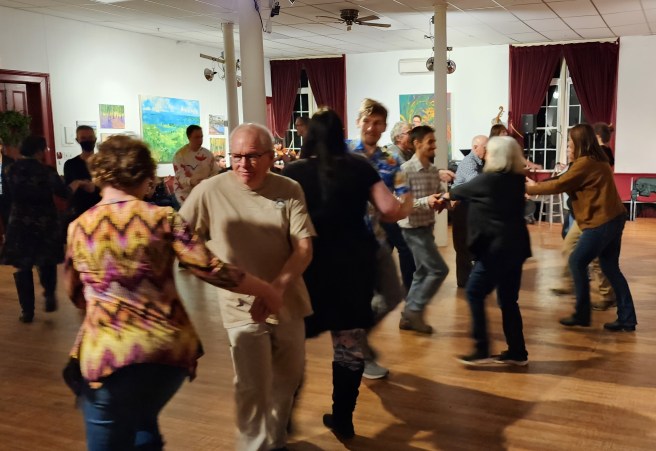
Last month we had our first indoor contradance this far east in Maine since the outbreak of Covid, and it was a blast.

I’ve posted before about the New England tradition from colonial times, which hippies then spread around the globe. Not that you have to identify as one to attend. Let’s just say free spirited?

A typical contradance is something for all ages and abilities, singles and couples alike – you do mix during the evening – and the live music is reason enough to come out for a substance-free environment. As we say, if you can walk, you can dance. Besides, a caller has us practice the figures, as they’re termed, before the music begins. It’s a great community-builder, for sure. A great way to meet neighbors of all kinds, or even a potential mate, if you’re unattached. It’s low-pressure, OK?

The whole point is to have fun, mistakes included. Just keep smiling. As I tell the newbies, we experienced dancers make just as many mistakes, mostly because we’re too busy talking.

Our dance last month had mostly beginner dancers, and they were delightful. I’m hoping and expecting to see them back Saturday night at the Eastport Arts Center, bringing a few friends in tow. Frankly, that’s how we all got addicted to this activity, word of mouth with an invite, or even being dragged, as I was, to show up.

Not that you need that much to enter the door.

Remember, just keep smiling.

Going, going, Gohn

About halfway back in my life, I found myself among Plain-dressing rural Christians. Some of them were also Plain Quakers who retained the “thee” and “thou” speech of Friends’ tradition. My bff of the time was one of them.

Plain dress, should you ask, is what the Amish wear, as well as old-order Mennonites, Brethren, and some other strands, in their own subtle distinctions.

There were reasons I didn’t go all the way, but I did acquire some items, including broadfall pants that have no zipper or belt loops. They were surprisingly comfortable and very well made, in America, no less. After 35 years or so, my denim and blue corduroy pairs are finally showing some wear. I have no idea how many regular brand-name blue jeans these have outlived, but now it’s time to order more of the Plain style.

For many folks, that means Gohn Bros. in Middlebury, Indiana, whose no-nonsense, illustration-free catalog can be downloaded online or ordered by phone or mail. The owners of the store, we should note, aren’t Amish, though they’ve served that demographic for generations. I’ve heard of other faithful buyers who found the store through the Whole Earth pages of hippie lore. Maybe this post will add to it.

I am happy to see that the small-town emporium survives. A few minor changes appear in the options as enhancements rather than copouts. For instance, I can now substitute belt loops for the suspender buttons or opt for gray or black denim rather than blue. My, my.

Here I am, actively paring down my possessions, trying to use up what’s already on my hangers and in my dresser drawers, yet I’m feeling tempted to order a few new shirts, maybe a dress coat, too.

Don’t worry, it’s not Armani. Instead, these selections are much more everyday practical me. Just think, too, they’ll always be in timeless style.

Seems the concept is related to rebels

As I drafted a recent post agonizing over the future of Boston Revels – and by implication, other performing arts organizations – I found myself pondering the origin of the reveling tradition itself. I kept mistyping “revel” as “rebel,’ only to learn that the two words share a common origin. Aha!

Surprise?

A online little research soon led to the Inns of the Court in England and Wales – places that were both a kind of law school and a professional association as well as lodging for members – and to their elaborate entertainments and wild parties that included a lord of misrule.

Suddenly, I was connecting to Thomas Morton and his Merrymount settlement in early New England, something I discuss in detail in my Quaking Dover book.

I’ve long been aware of an irony in the Boston Revels esteem, knowing how alien a Christmas or Midwinter celebration would have been to the city’s Puritan founders, even before getting to any riotous misrule. Now the plot thickened through an awareness of the way Morton was persecuted and his colony forcibly destroyed by Myles Standish at the helm of the New World neighbors.

Today’s family-friendly holiday Revels shows are greatly sanitized from their Medieval forerunners that would have been presented any time between Halloween and Groundhog’s Day – Morton’s big celebrations were for May Day, a seasonal stretch adding yet another pagan dimension.

Moreover, their ancient roots reveal ways English law was independent of the church, diverging the church courts that ruled in continental Europe. The Inns of the Court also nurtured Elizabethan theater and their revels are mentioned in Shakespeare.

Could they even be the source of a rebellious thread in our laws and courts? Or at least of what passes for drama and theatricality therein?