We’re in the midst of a quiet but widespread labor strike

The so-called “worker shortage” needs to have a new label, along with a clearer perspective. In too many ways, that “explanation” often comes down to blaming the victim, with its sense that people who are unemployed are lazy.

Not that those bandying the charge would accept the conditions of those “help wanted” positions. You know, the “entry-level” openings that are really no-respect, dead-end drudgery and require “reliable transportation” on late nights and weekends at minimum wage. Sorry, it doesn’t add up.

Or the plight of the long-haul independent truckers who are burdened by the costs of their rigs and the long hours away from their homes and families. As many of them age, they’re hanging it up and nobody’s stepping into the trap. Well, that’s one aspect of the “supply-chain problems” we’re encountering.

And then we should also admit the number of people who are simply unemployable today, sometimes for medical, mental, or emotional conditions.

What we’re seeing is a confluence of long-simmering problems finally erupting in the aftermath of Covid.

The health-care system is a prime example, far more complicated than we dare get into here. But Europe seems to train its doctors at less cost and in less time than we do in the USA, and there are arguments that primary-care physicians are capable of delivering much that we’re turning over to costly specialists. Much of the staff, meanwhile, has minimal health benefits, if any.

Wages adjusted for inflation have been declining for decades.

Breaking the unions has been a factor, along with company expectations of 24/7 availability plus worker loyalty without extending reciprocal security.

Keeping stores open seven days a week, by the way, is a relatively new custom. It does add to the low-pay “help wanted” slots.

At the core, what workers are selling is their time is exchange for something, not all of it money. They’re finding that many jobs aren’t worth the cost to them once child care, transportation, clothing, and the like are factored in.

There’s also the trap of being pitted against lower paid labor elsewhere (not just China) without reaping any of the profits from higher productivity here, which has been ballooning in the wealth of the superrich but definitely not trickling down.

One of the surprises has been the number of workers in their 50s who have been dropping out, especially males. Perhaps they’re working on their own “under the table,” but many have simply “had it” with the drag. Work, from what I’ve too often seen, no longer earns any respect. And the traditional work ethic carries an unwritten requirement of being paid a livable wage in exchange. Again, it’s not adding up.

Has anyone connected crackdowns on undocumented residents and their being deported with the shortages? These were the invisible workforce that was sustaining so much of the economy. As I was saying about respect?

Posts on my Chicken Farmer blog examine work and jobs in much more detail from a personal level.

From that perspective, I’d say we’re encountering a free-market reaction to low pay and unrewarding employment situations. This one-by-one, “disorganized labor” job action will be much more difficult to address than the traditional sitting down at a negotiating table and emerging with a new contract.

Is anybody even talking about the big picture here? I’d like to know.
Not all firewood provides the proper heat

Living in places where firewood is readily available – unlike, say, Manhattan or the Arctic Circle – has made it relatively affordable to heat by a wood-burning stove, at least when we’ve had one. (Let me repeat, it’s high on our renovations and home improvement list.)

OK, my Eagle Scout training left me quite aware that green wood – that is, freshly cut – burns inefficiently, unlike wood that’s had time for the sap and related moisture to dry out. That said, here are some other points.

  1. Seasoning can take as little as six months, though old-timers prefer at least a full year. Or more, if stacked in a way that allows sufficient circulation to avoid rot and fungus.
  2. Softwoods – generally conifers like pine, juniper, spruce, and cedar but also including poplars – ignite easily and burn hot, but they don’t blaze long. They also have a lot of creosote, which will need to be cleaned from the chimney as a housefire hazard.
  3. Hardwoods – maple, oak, hickory, ash, and birch – are denser and burn slower and longer, and while they release less immediate heat, there’s also less smoke and they add up as a layer of radiantly hot coals.
  4. All firewood has creosote, so annual chimney cleaning is recommended. Some sources say every two cords. Chimney fires are especially vicious.
  5. In colonial New England, a house typically required 40 cords or more of firewood a year. Imagine cutting, splitting, and stacking all that – even before bringing it indoors.
  6. Salvaged wood – such as lumber, poles, and fencing – often contain preservatives that release hazardous vapors as they burn.
  7. Destructive insects and plant diseases can be spread when transporting firewood more than a few miles from its source. That’s why it’s illegal to import firewood into Maine. Now I’m wondering about the guys from Maine who delivered to our house in New Hampshire.
  8. A cord is a stack 4-by-4-by-8 feet of standard 16-inch wood. Many stoves, though, require a shorter log.
  9. Do you really get a full cord when it’s delivered? I’ll spare you some old jokes.
  10. Favorite woods include apple and tamarack/larch, both for their aroma and a clean burn that leaves little ash.

As for air pollution? I really don’t want to go there. It could be a Tendril all its own, once we find the right tech geek to sift through the varied reports.


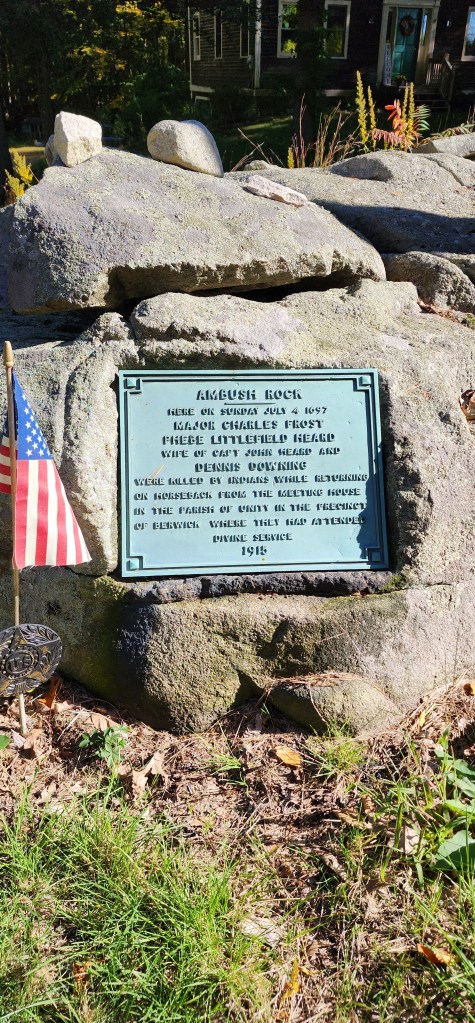
Ambush Rock

What the marker in Eliot, Maine, doesn’t mention is that Major Charles Frost and Dover’s Richard Waldron concocted the mock wargame that led to the hanging of Native men sent to Boston and the sale of about 350 Penacook women and children into slavery in the West Indies.

This was hardly an attack on an innocent party, then. The Natives waited years to extract revenge, and did it at a time and place that spared others.

My history Quaking Dover adds details.

For me, it’s a big meet-an-author event

A program Thursday night at the Dover Public Library promises to be lively fun.

Hosted by Dover 400, the folks behind the year-long celebration of the town’s settlement 400 years ago, I’ll be one of three authors of new books about the community’s past. Each of us brings something different to the table, and I’m really looking forward to meeting the others, as well as an audience full of additional insights and angles.

The program will allow each of us to address some prepared questions and briefly discuss our book before turning into wider discussion and an audience Q-and-A.

Retired librarian Cathy Beaudoin, the unofficial (and unrivaled) Dover historian, will be moderating. As an aside, I do wish she’d write the big volume about the city’s textile mills and the ways they transformed the community. She’s already curated a comprehensive lode of entries you’ll find on the public library’s website.

As a handy book you can follow around town, J. Andy Galt contributes an updated set of neighborhood walks that were originally conducted by the Dover Heritage Group. As I’ve previously posted, the city is pedestrian-friendly and has quite a range of architectural styles. In many neighborhoods, every house you pass seems to possess a history, if you stop, look, and have a few tidbits of info in hand. From the directions to one of those walks, Dover Friends Meeting finally learned where our second meetinghouse, from 1720, had been moved and now sits as a private residence.

Former Woodman Institute trustee Tony McManus brings a newly published, wide-ranging collection of newspaper columns he’s written on local history, especially the people involved.

And I’ll be there looking at the early developments from the perspective of the Quakers, for decades the town’s biggest minority.

As a grand finale, there will be an opportunity to sign books we’ll have for sale and meet one-on-one with readers. I couldn’t do that with ebooks.

(The snow date is March 9.)

English relations with the Natives were strained from the very beginning

One of the troubling revelations I found in researching my new book Quaking Dover is the depth of the English injustice and violence toward the Indigenous people of what we know as New England. It goes all the way back.

Forget the happy images of that first Thanksgiving feast where the Natives are portrayed as the special, very welcome, guests of the Pilgrims.

Squanto, after all, had been kidnapped, enslaved, and spent five years in England before the first English settlement took hold on Plymouth Bay.

Explorer Martin Pring, who established a fortified camp at Truro on Cape Cod in 1603, fled under attack by enraged Natives after he had set his mastiffs on them and fired his cannon in their direction.

The Pilgrims’ military leader, Myles Standish (not one of their faith, by the way), led the 1623 Wessagussett massacre, prompting Natives to abandon their villages for safer ground.

The Pequot war, 1637, was ultimately a land grab ending with the construction of New England’s first slave ship to trade the Native survivors into slavery in the West Indies in exchange for Africans.

And that’s before King Phillip’s war, with the mock wargame in Dover, or the waves of combat across northern New England until the treaty ending the French and Indian wars in 1763.

The outlook, of course, of “savages” and “heathens” was only part of the problem. The English insisted on addressing legal conflicts only in colonial courts. Not surprisingly, the decisions all seemed to come down against the Natives, with no independent course of appeal.

The pressure finally exploded in 1689 with the devastating raid on Cochecho Village and then Oyster River, both in Dover – hostilities that would continue another seven decades.

Are you ready for a fuller story?

When you see someplace you’ve known now in the news

The train derailment in East Palestine, Ohio, has me mentally revisiting a part of my landscape from forty years ago.

At the time, I lived two counties to the north but was a member of one of three old-style Quaker Meetings in Columbiana County, where the accident took place. So I was down there at least once a week most of the year. The county was a mix of industrial and suburban, especially where it bordered Rust Belt Youngstown, and rural Appalachia along with touches of New England. One corner abutted the Ohio River and West Virginia.

The rail line in the headlines was like those running through a small city where I had worked in another corner of the state, a place I call Prairie Depot in my fiction. And East Palestine itself could be adjacent to the city at the core of my novel, Hometown News.

Churches included Mennonite and Brethren, in the peace tradition, as well as Evangelical Friends at the other end of the Quaker spectrum.

Retracing the terrain via satellite maps, I was struck by how much I’ve forgotten, even parts I had known fondly. Others were pretty gritty, even back then.

From a distance now, it’s like encountering a ghost in a haunted house I thought I’d left behind.