In an effort to keep the fuel oil bill down, the family decided to set the furnace thermostat no higher than 57 degrees.
But I’m freezing.
I’m threatening to turn the air conditioner on, hoping for 65.
~*~

You never know what we'll churn up in cleaning a stall
In an effort to keep the fuel oil bill down, the family decided to set the furnace thermostat no higher than 57 degrees.
But I’m freezing.
I’m threatening to turn the air conditioner on, hoping for 65.
~*~
yes, the spoiled prince and the virginal pussy
pul-leaze!
my ears grate
the striated penis
smiles
all the way to the end
screw me in the middle of the night
burn the bone clear
I’m still the skinny intellectual
regarding fairy tales
The end of the road
is not the end of the world.
~*~
This could even be a book title.
On the other hand:
~*~
If this is an escape,
it’s a place of no escaping.
The cheapest ones still came to 27 cents apiece. Add postage to that, and paying bills can add up.
As for paying directly online?
As much as I’m a fan of the U.S. Postal Service and am trying to do my part to assure its survival, I am listening to my wife’s advice to switch over to online bill paying. Before I do anything drastic, though, I want to hear from others.
What’s your experience been?
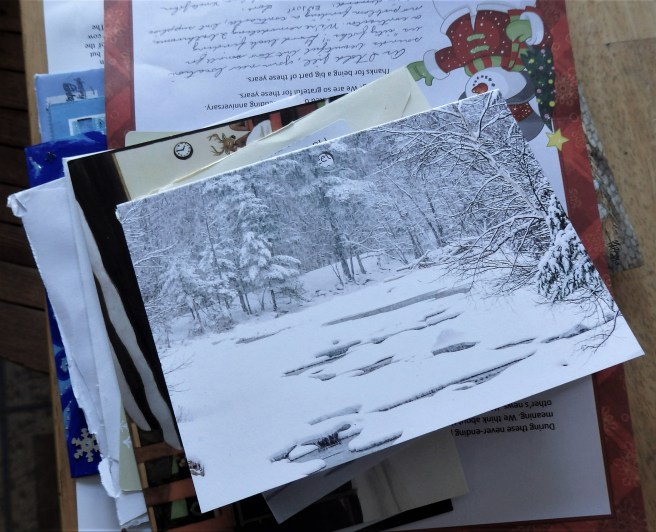
Those (real, postal carrier delivered) cards and letters are a fading tradition, but some of us cling on. Hearing on paper from old friends and some special family members each year is quite different, and warmer, than anything we’d receive online.
Even if it is from the governor or our U.S. senator. In a small state, we’ve usually met them face-to-face.
My latest book is nothing like the others I’ve written. It’s not one of the novels, which required me to learn entirely different approaches to a story than I’d used in the daily newspaper business. And it’s not extended essays, like my usual Quaker materials. Nor is it poetry, where most of my literary efforts have been.
At the start, my genealogy came closest, but those are more research notes for others to follow up on – and if I ever get the energy to return to those, they do need a major cleanup.
As much as I’ve loved history, from childhood on, I’m not a trained historian. The closest I came was majoring in political science.
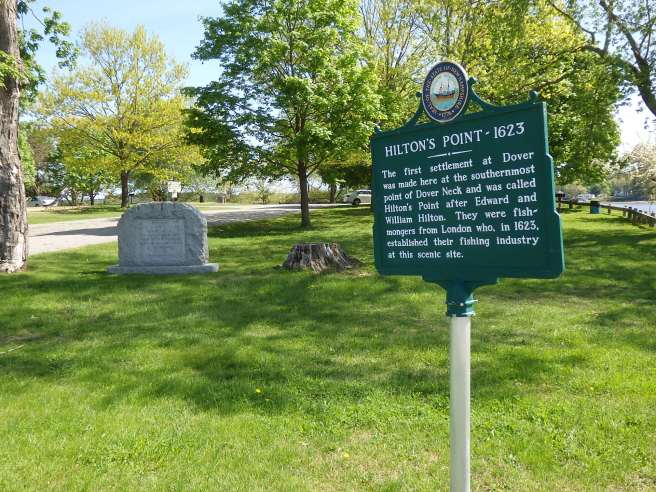
But for the last 50 years, I’ve been a Quaker and become quite grounded in the movement’s history and theology. And that’s what prompted the new book, along with Dover’s upcoming 400th anniversary.
I do like the big picture, and that’s what evolved here. Not just Dover Friends Meeting, then, but the broader forces that shaped and impacted it. So I went digging, drawing on others who had closely examined the early records or, in some cases, drawing on published journals and other early accounts.
What I collected seemed to write itself, which was an exhilarating experience – until I showed it to a circle of Beta readers. And then it was back to the drawing board, cutting the first half of the book by two-thirds and refining the tone by inserting myself into the text. The journalist in me, trained to be invisible, did so uneasily but trusted in the generous advice of a fellow poet and writer.
Also insightful has been historian Stephen Sanfilippo’s quip about being a “footnote historian,” the professional who can spend much of his career investigating minutia that become a paper or dissertation that in turn become a footnote in a “general” historian’s book, one that looks at the broader scene.
Much of my book is a step from that, drawing more on the general historians before me, but that’s led to its own encounters. I’ve often found myself in conversation with them, wishing we could actually sit down together rather than having all these years, even centuries, between us.
The first was Annie E. Pinkham, whose A Brief History of Dover Friends Meeting, a 1935 mimeographed paper, became the springboard for this project. Her material is no doubt based on much of what she had heard passed down in her husband’s family and maybe her own, though I’ve since found that her version of the earliest days of the town reflect common misunderstandings.
I’m also grateful to some people I knew personally, a generation older, who went through the Quaker minutes themselves – Shirley Leslie and Silas Weeks and I sense a few others. Their summaries were sufficient to round out the history, though there are many points where I now see that a more thorough investigation, of a doctoral dissertation nature, might glean answers that currently elude us. (Back to the footnote historians!)
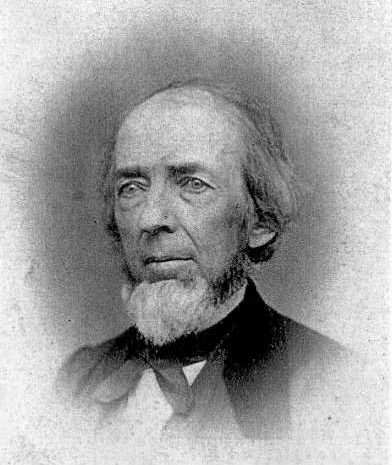
Another voice I’ve been deeply grateful to is George Wadleigh, who struggled with many of the town’s often conflicting details and missing data when assembling his own history of Dover, dated April 1882 but not published until 1913.
The volume is prefaced with “NOTICE. It was the intention of the collector of these notes to complete them to a later date, then to revise and publish them, but he did not live to do so. They are now published without the revision the collector would have made, in order that his work may not be entirely lost.”
Originally, I thought that was Wadleigh’s own insertion, but finding that he died two years after dating the preface and that the book had to wait 31 years before publication, the “collector” seems to be Wadleigh himself, with the notice being added by one of the editors.
Either way, Wadleigh apparently had access to perspectives and possibly documents unavailable to earlier historians. He also may have had long discussions of the materials and their implications with other elders. From 1831 to 1868, he was editor and publisher of the weekly Dover Enquirer newspaper.
And then there are bloggers like Mark Everett Miner, some of them working as genealogists. I’m curious to see what they make of my take.
Beyond that, I hope I’m ready for the nitpicking and correction I’ll no doubt hear if anyone actually reads what I’ve produced.
As Stephen Sanfilippo has said, repeating the advice of one of his mentors about working in history, if you think you have the answer, you’re mistaken.
Or as I learned doing genealogy, every new answer you get raises ten more questions.
The work is never done.
Welcome to the dialogue.
~*~
Welcome to Dover’s upcoming 400th anniversary.
Not a bearded old fart but a wise, calming, older woman?
Would it change the workings of the story for you?
~*~
That’s something I’d been pondering even before Regina Renee Ward’s amazing Bible half-hour presentations at New England Yearly Meeting’s sessions last summer. (Do check them out at NEYM’s website, even if you have an allergy to Scripture. She understands that aversion.) Aware of our varied backgrounds and outlooks, she tenderly took us very deeply into ourselves, personally and as a gathered body, via her selected verse of the day and its context plus brief commentary.
One of the books she recommended was Christena Cleveland’s God Is a Black Woman, and I wound up ordering a copy.
Let me say I definitely find it refreshing. Should I add, eye-opening? She was transformed by her encounters with the famed Black Madonna icons in Europe. Take it from there.
~*~
It has me returning to the concept of thinking in metaphor, which I feel is essential to religious slash spiritual practice.
Metaphor compresses image and concepts and actions in ways that legalistic, “thou shalt not” teachings fail to comprehend.
We can begin with the ways we envision something like God or Christ. To that, let me add, the concept of Holy Spirit becomes quite liberated from the earlier English translation of Holy Ghost. The first is definitely infinitely bigger than the second.
~*~
Well, the story of the Garden of Eden is one I come back to endlessly. It’s pointedly not a children’s tale, despite the efforts of Sunday schools, and that rib Adam lost is something, uh, more erotic. OK?
For now, though, I’m quite wrapped up in my new book about one community’s Quakers in early New England – which as readers of this blog, I hope you’re aware of.
So here we are! How ‘bout a walk?
 Jnana's Red Barn