Like eagles, they can have long wingspans that stretch straight out when soaring. And unlike eagles, they can hover, as they do over water before plunging in a power dive and coming up with a fish. Not that I’ll ever get a shot of that with a simple camera.
You might think it’s a minor thing, deciding whether your new book should be 9-by-6 inches or the usual trade paperback 8½-by-5½ inch dimension, but the smaller trim size does look and feel more professional, even elegant.
It’s easier to retrieve from some of my bookshelves, too.
It comes at an added cost, though – an additional $1.40 or so, out of my royalty.
You wouldn’t expect that for the smaller size, would you?
At some point, that might be the swing factor in raising the cover price.
For now, I simply want this one to be just right. Besides, it will still take a lot of sales for that difference to add up, and we are dealing with the story of a small faith community which just might not have that much interest for anyone else unless this takes off like, well, something about covered bridges in Iowa.
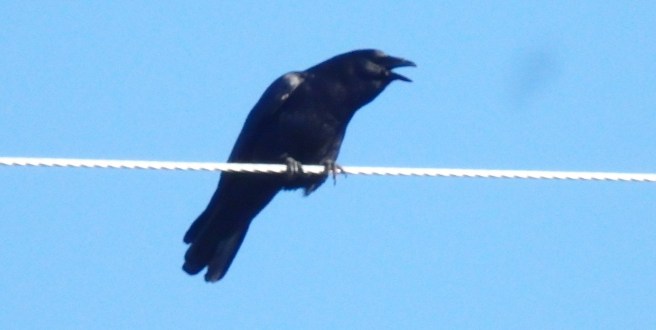
Gulls have a serious rival for dominance of the avian realm here. Eagles and osprey rule the roost, of course, but they are outnumbered by gulls and crows, like this one.What, they caw but don’t crow? English sure is a strange tongue.
For those of us who come to New England from other parts of America, the insistence that here we live in either a town or a city but nothing in between comes as a shock. There’s no saying “near” anywhere, even if the place has its own post office. Nope, either city or town, the difference being the kind of government it has.
Eastport, for instance, is a city, while neighboring Lubec, roughly the same size, is a town.
And each may have its own neighborhoods or villages, further complicating the picture. A town typically has its historic center, even when larger development came later somewhere else within the boundaries – maybe out along the railroad tracks, for instance, or the mills. Note that when you look at maps.
Maine adds a third twist to this model. Much of the state was surveyed into parcels, typically six-by-six-mile squares, that never lived up to expectations, at least in terms of habitation and development. They remain uninhabited, seasonally or year-’round, or lack sufficient population to self-govern themselves.
Here in the Pine Tree State, they’re designated as townships or even plantations, though some do have names or have reverted by necessity from self-rule to management by the state.
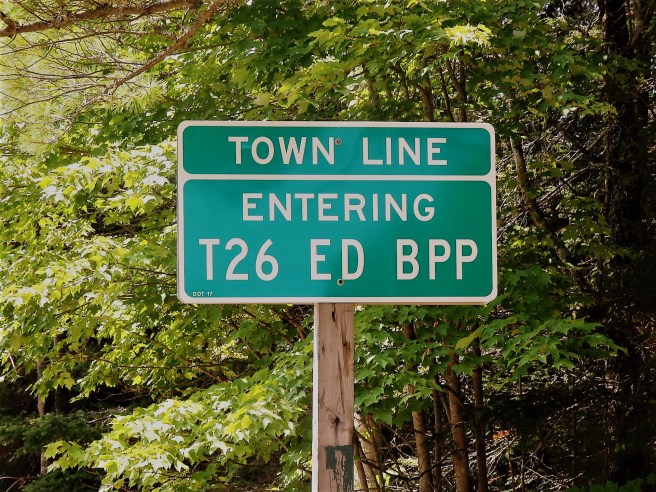
Thus, when driving along you might see a highway marker like the one announcing that you’re entering T26 ED BPP.
There are many more signs like this, equally baffling. This one translates as Township 26, Eastern District, Binghams’ Penobscot Purchase. Don’t ask me more, I’m already confused, as I’m sure you are.
There’s even another variation, PLT, for Plantation – and, no, it has nothing to do with fields of cotton or tobacco.
The Plt stands for plantation, which has nothing to do with a privately owned farm in Maine.
Significantly, more than half of the state is uninhabited. Hard to think of that, considering the urban and suburban density and congestion of so much of the rest of the Northeast.
Somehow, nobody’s counting mosquitos or moose in the equation.
What do you have to explain to others about the political setup of the place you live? Ward politics? The county sheriff? The nut jobs, right or left?
I’ve long been fascinated by what I’ve come to call the “shadow Meeting” – people who continued to worship as Quakers and uphold many of the values after being “read out of Meeting” for violating its discipline, usually over marriage procedures.
It’s a fact for several generations of my own ancestry in North Carolina.
One place I see it in Dover is with the Varneys.
The patriarch of this prolific Quaker line was Humphrey Varney (1636-1714), a brickmaker who moved to Dover from Ipswich, Massachusetts. He married Sarah Starbuck, widow of Joseph Austin, as her second husband.
After the Dover’s disastrous massacre, their son, Ebenezer Varney (1664-1753), married Mary Otis after her return from captivity, and their son Peter (1666-1732) wed Elizabeth Evans.
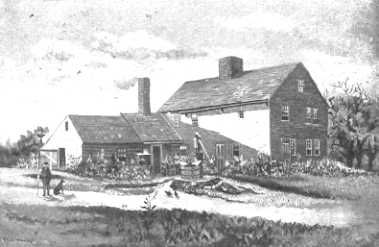
The Varney house, which stood near today’s Wentworth-Douglass Hospital, was once the largest home in Dover. After the massacre, it continued to keep its doors unlocked so that passing Natives could spend the night.
After that, well, it seems the Varneys married into all of the other Dover Friends families. Many of them also spread, most notably across Maine.
The family made its imprint on Dover, though I’m not sure how many remained Friends.
Jesse Varney was a morocco shoemaker when his store was consumed in flames in December 1810.
By 1837, Varney’s Block stood at Lower Square on Central Avenue near Washington Street. In 1844, a bigger building was erected.
In 1847, 99-year-old Eunice Varney died. She was the oldest resident and a member of the Society of Friends.
There’s Varney Road, extending Long Hill Road to Blackwater Road. And Varney Cleaners, founded by Fred Varney.
The Varney School on Washington Street, used from 1861 to 1953 and now as law offices, was named in honor of Judge John R. Varney. He died in an 1882 fire that destroyed the Washington Street Baptist Church building.
George Varney was a prominent merchant for more than 40 years and owned a drug store on Washington Street before retiring in 1920 at age 65 and passing the next year. He built a large home on Arch Street in 1913.
John R. Varney was co-owner of two newspapers – the Dover Enquirer, purchased in 1868, and the Dover Daily Republican, acquired in 1880.
My curiosity, of course, wonders how many of the Quaker values continued in their lives, as well as what directions their faith took. I like to think it worked like yeast.
The family also made a big impression in Manchester. The Varney School, now a private residence on the West Side, was named in honor of one of the city’s mayors.
~*~
Check out my new book, Quaking Dover, available in a Nook edition at Barnes & Noble.
that or the alternative, boredom, besides, we’ll have the rest of eternity to recover Ahem, amen, what’s this, a partner? or simply another vaporous angel?
The thought had once appalled me. Like was this the epitome of laziness, that you really didn’t bother to get dressed for the day? Or that perhaps you’d gained so much weight you wanted something that would hang loose rather than accentuate anything?
Skip ahead to retirement and then the Covid shutdown, and I’m having to admit there have been days when I’m living happily in sweats, especially in the depth of a northern New England winter.
Sometimes I even think of it as luxury, not having to venture outdoors.






 Jnana's Red Barn