Irrational.
It’s another word for nuts.
You never know what we'll churn up in cleaning a stall
It’s another word for nuts.
After discussing Maine’s unincorporated townships, I need to add that there are a lot of variants – 17, if I’m counting right. Among them are the BKP, BPP, NBKP, NBPP, and WBKP designations – translated as Bingham’s Kennebec Purchase, Bingham’s Penobscot Purchase, North of Bingham’s Kennebec Purchase, North of Bingham’s Penobscot Purchase, and West of Bingham’s Kennebec Purchase.
So just who was this Bingham guy?
In short, he was William Bingham, already a wealthy Philadelphian when he became filthy rich via privateering during the Revolutionary War. He was also a statesman and U.S. senator who parlayed his riches into vast land purchases, as noted above but also including upstate New York, where Binghamton, where I’ve also lived, was named in his honor.
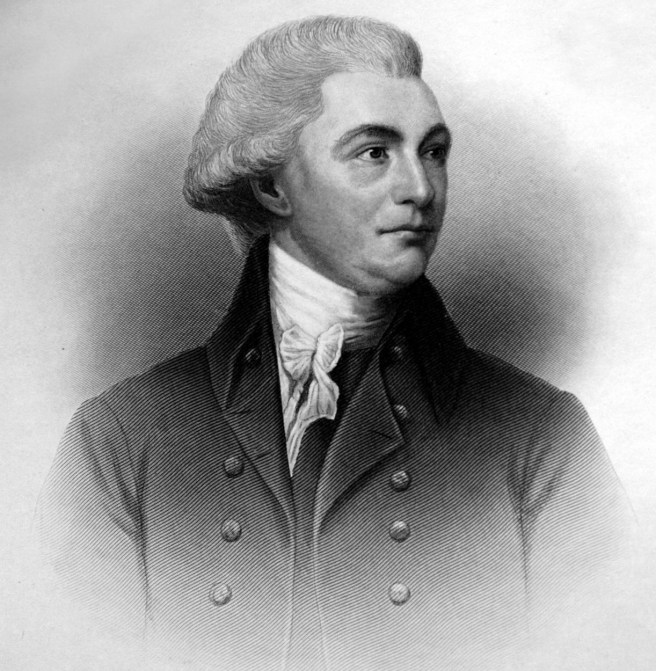
Quite simply, Bingham owned two million acres in Maine, making him land rich but cash poor.
His agent in Maine, Revolutionary War Gen. David Cobb, was responsible for laying out most of the roads associated with the Airline Highway (now eastern State Route 9). And when Cobb retired in 1820, John Black, agent for Baring Brothers Bank in London, felt that lumber was the wealth that would provide his boss the needed profit. There were further complications as well as marriages, but you get an idea how Baring township in the Moosehorn wildlife preservation got its name.
Cobb did, however, build a great house at Gouldsborough and soon faced some harsh realities that he notated between 1795 and 1800.
First, the land and climate of eastern Maine were not and are not suitable for farming. He noted that “those who come to view the country … have as frequently returned almost blind by the bites of flies and mosquitoes. You have no conception of the hosts of these devils that infest the thick forest at this season.”
More critically, he found “the great body of the people of this country possess no regard to the rights of private property,” calling them ” vicious inhabitants who disfigured its landscape. Every inhabitant here is now a trespasser, a plunderer. They live by it, and therefore they will not cultivate the finest soil in the world. They’re not doing this is the chief cause why the reputation on the country has been damn’d. If the people who live by lumbering are indulged in cutting the forests wherever they please, they will have but little … appreciation of the soil.”
For the record, the soil itself wasn’t nearly that rich.
But continuing, in his estimation, “The greater part … follow lumbering and fishing … and they are very intemperate, very lazy and very poor. It may be said in truth … the majority of the inhabitants are drunkards.”
There are those, of course, who would question whether much has changed since.
Or, as is sometimes said of Eastport, it’s a drinking village with a fishing problem.
PEPPERCORN
GARLIC
Or even one along Puget Sound?
Slow rain outside, misty, foggy, nothing pressing to do, you just want to stay abed a while longer – or return after a leisurely hot shower. Maybe there’s some activity in the next room or down the hall, but it doesn’t matter.
Reminds me of a visit to a neighboring college back in Indiana, when I cracked open my poetry course assignment to an appropriate new vision – one of several breakthroughs that October weekend, actually. Savor another cup of coffee, reflect, recharge. You need those, at least in some proportion to the rest of your goals and life mission. Even if an ingrained Protestant work ethic guilt tries to kick in.
The fog around the island also reminds me of Washington state and visits to friends on the other side of the Cascades mountains. The same smoky indolence.
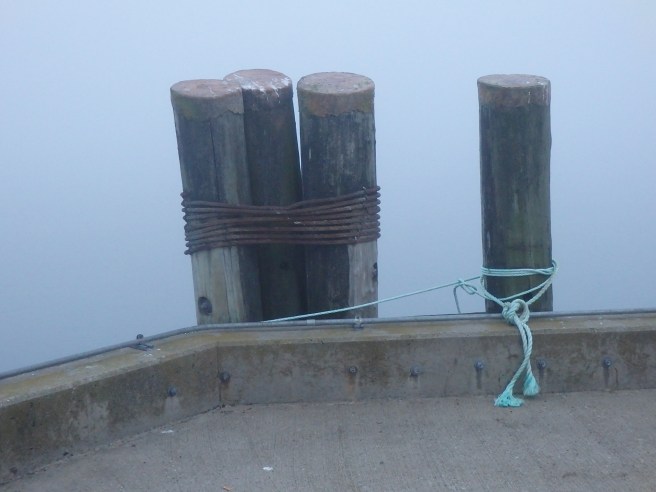
Do you have any memories of a special time or place of moody experiences like these?


because I haven’t really known how to shop for myself expertly I’ve hated selecting birthday or Christmas that is, excepting books and records and a few groceries I’d like for myself you’d think spending would be a simple if you had enough cash and my dependable depression reflected insufficient variety or sassy style on the racks here but price tags on anything I desired conveyed, As I learned, kid, look, you aren’t worth anything as far as your job and life are concerned and maybe if you stole from dying widows or threw single-parent kids into the street, you’d be rich and then honestly, most men still dread shopping so what do you really want in gift wrapping?
You might think the ideal time to work in a forest would be spring or fall, but that’s not how it’s turned out in logging in the great northern forests of New England and New York state. Instead, the time to be out harvesting trees is deep winter. Yup, below zero around here.
I first learned of this when trying to order firewood after an uncommonly warm winter in New Hampshire. Because the ground hadn’t frozen hard enough long enough, the cutters hadn’t been able to access much of the woods with their heavy equipment. The result was a marketplace shortage.
For contrast, mud season can be notorious, so much so that come spring, logging roads are closed to prevent destruction. Much of Maine, in particular, is either standing water, once the ice melts, or boggy, including soft peat bogs. And in late spring and early summer, hoards of nasty black flies swarm about – the defenders of wilderness, as some contrarians contend.
~*~
Folklorists examining the songs of Maine have noticed that many of the songs from the old lumberjack camps originated at sea. You know, as shanties and the like. At first, these scholars were puzzled, but then they realized that winter was a treacherous time to be out on the water. Many sailors instead headed for the forests, to work in the camps for the season. Somehow, though, any songs originating in the woods failed to travel the other direction.
Historically, the logs were stacked along streams, awaiting the spring melting and surging high waters that the timber could ride to ride millponds. That, in turn, could be exciting, demanding, and deadly work where mariners would continue.
From there, the sailors went back out on the ocean.
Mechanization has changed much of that, on land and sea, but not the reality of mucky soil.
We’ll see what global warming does to the industry.
grass / shoe / potato
Rabbit Rocket Sprints


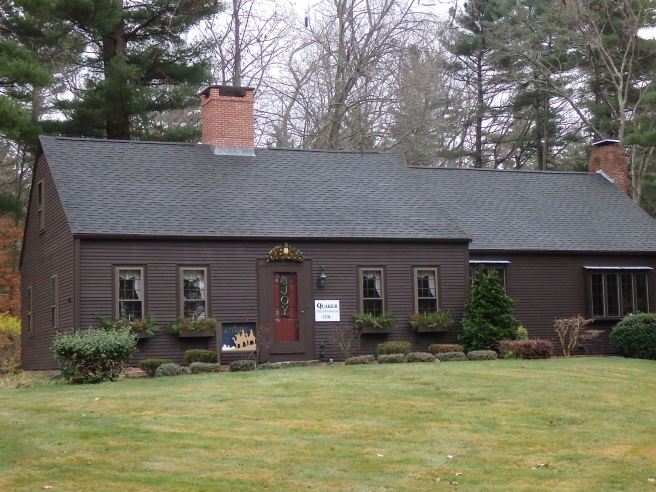
Through the first century of English habitation in New Hampshire, the other Quaker Monthly Meeting was at Hampton, and like Dover, it soon had satellite worship groups before coalescing in today’s Amesbury, Massachusetts.
Its full history is one that needs to be told. I’d like to know more about how it and Dover interacted.
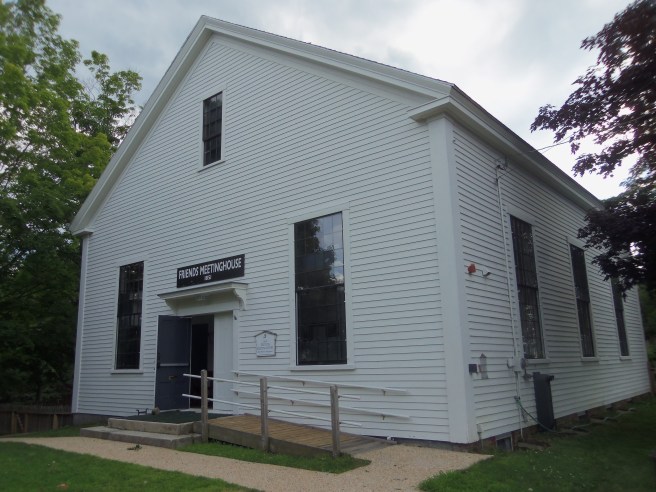
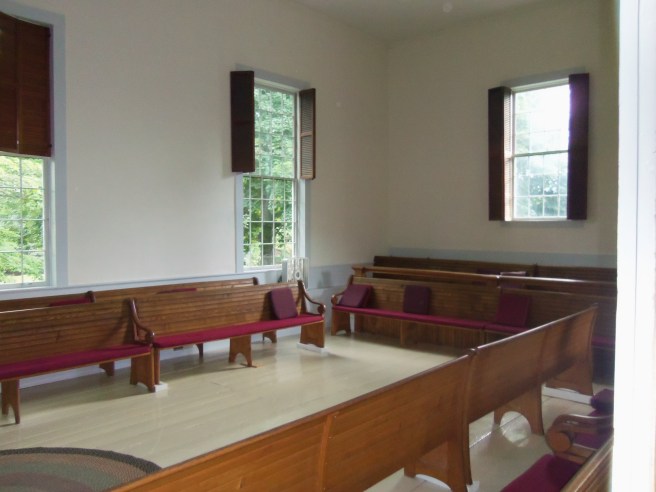
Its Hussey family was one that came to be part of Dover Meeting. The family had two well-know weddings that occurred in the present Dover meetinghouse – May 3, 1769, of Samuel Hussey and Mercy Evans, and October 3, 1804, of their daughter Abigail to John Whittier of Haverhill, Massachusetts – another of Hampton/Amesbury’s Preparative Meetings.
Dover’s Hussey farm was on Baer Road in today’s Rollinsford but Somersworth at the time of the second wedding. It’s some beautiful farming country.
John and Abigail Hussey Whittier became the parents of the influential poet and abolitionist John Greenleaf Whittier, who was a frequent visitor to Dover Friends. Her portrait, reproduced in my recent post about the Whittiers, hangs above the stairway from the main floor to the lower level of the meetinghouse.

The Hussey family has a significant presence in New England Quaker history. Settler Christopher Hussey, described as the most prominent man in early Hampton, was one of the purchasers of Nantucket Island in 1659, where son Stephen eventually moved as it became a Friends stronghold.
Though Christopher was not a Quaker, his other son, John, was severely fined and threatened as an early Quaker, as Elizabeth Hooton related from her American visits. He was a Friends minister, married Elizabeth Perkins from another distinctive Hampton Quaker family, and they had 17 children, mostly daughters, before migrating as Friends to New Castle, Delaware, in 1688 or 1692.
There is argument whether John and Rebecca Hussey’s son Richard (1660-1733) remained behind and moved to Dover or whether it was an immigrant. Either way, a Richard Hussey who was a weaver moved to Dover by 1691, wed Jane Canney, and had a dozen children. Among them was Joseph (1699-1762), who then married Elizabeth Robinson and sired Samuel Hussey (1714-1814), leading to the Whittier connection.
Some of the Nantucket line, however, reconnects in Berwick, Maine, complicating the picture, especially when a Hussey marries another Hussey.
Stephen Hussey’s second son, Bechelder, moved from Nantucket to Biddeford, Maine, which leads to son Stephen, who had 12 children, the last three born in Berwick.
More prominent among the Berwick Quakers were the children of Ebenezer Hussey, Stephen’s fifth son, who wed Abigail Hale.
What is known is that in 1770, James Hussey – possibly Richard and Jane’s grandson or great-grandson – moved from Dover to North Berwick. His son William (1800-1870) created an efficient plow in the 1830s.
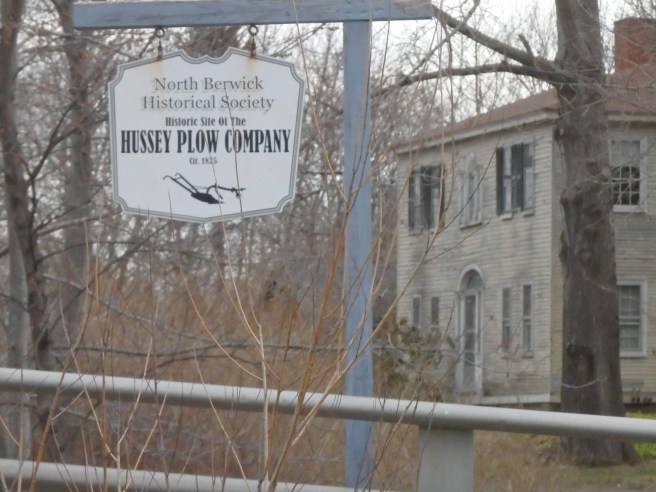
The enterprise drew on Quaker connections, beginning with Joseph David Hoag’s relocation from Charlotte, Vermont, to North Berwick in 1825. The son of famed Friends minister Joseph Hoag, he brought with him a cast-iron plow created by blacksmith Jethro Wood of Scipio, New York, another Quaker. Wood’s mother, incidentally, was Diannah Hussey, a niece of Ann Starbuck on Nantucket.
Got all that? Just go with the fact it was a potent mix.
As a farmer, William Hussey felt that the plow’s moldboard was much too short. After pouring lead to make a rough pattern of a longer board, he had castings made at a foundry in Newmarket, New Hampshire. The results were carted by horses to North Berwick, where skilled carpenter Henry Estes made the wooden framework. William then traveled among his farmer friends to sell the plows.
With the distinctive size and shape of the furrow board, the plow could be pulled by less power than its rivals. As the company’s business envelopes proclaimed, “If I don’t hold easy, draw lightly, and turn a flat furrow, after five days return me.”
In his later years, William Hussey ran the N. Hobbs Inn at Bracey’s corner, but as a staunch temperance advocate, he refused to sell liquor. He was also an ardent abolitionist.
That led his son, Timothy Buffum Hussey (1831-1913), to establish the T.B. Hussey Plow Company, now operating as Hussey Seating and the oldest business in Maine.
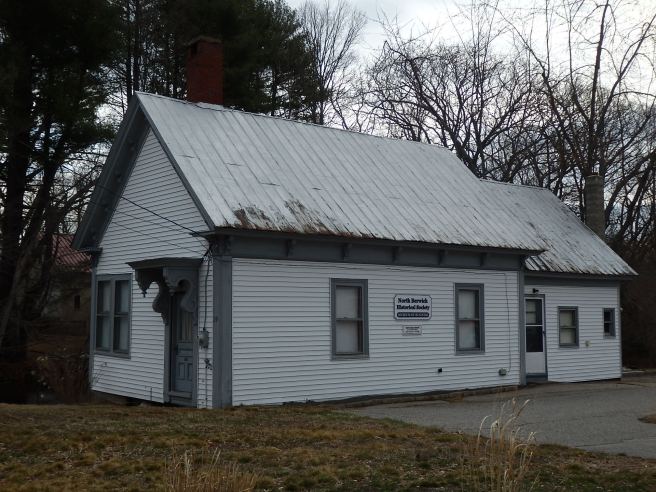
The company’s early headquarters.
After graduating from Friends School in Providence and teaching there, his son, Timothy Buffum Hussey (1831-1913), took over the business in 1855. With his younger brother, William Penn Hussey, he also operated a foundry nearby.
After the American Civil War, he bought up cannons and melted them down in the foundry to make plows – wryly upholding the swords-into-plowshares prophecy of the book of Isaiah.
After an 1895 fire nearly destroyed the firm, the Husseys refocused on building steel products including fire escapes and bridge supports. I like to think that the shift in focus came to their mind during Quaker Meeting.
Through much of this, Berwick was an independent Monthly Meeting – but it was still part of Dover Quarter and, thus, my history. Besides, when Berwick was laid down as a Meeting, its remaining members, including Husseys, once again were in Dover’s rolls.
~*~
Check out my new book, Quaking Dover, available in an iBook edition at the Apple Store.
Welcome to Dover’s upcoming 400th anniversary.
 Jnana's Red Barn