Savoring those rare moments when I don’t feel an inner compulsion to be moving on from whatever I’m actually doing. That is, when I’m free of that old weight of duty kicking in.
As happens in Quaker worship. As well as Orthodox Easter and other feast days.
The North Atlantic.
Birds at the feeder. Or sighting an eagle or osprey anywhere, even hawks or hummingbirds.
Fresh tomatoes or asparagus. Along with other things straight from the garden.
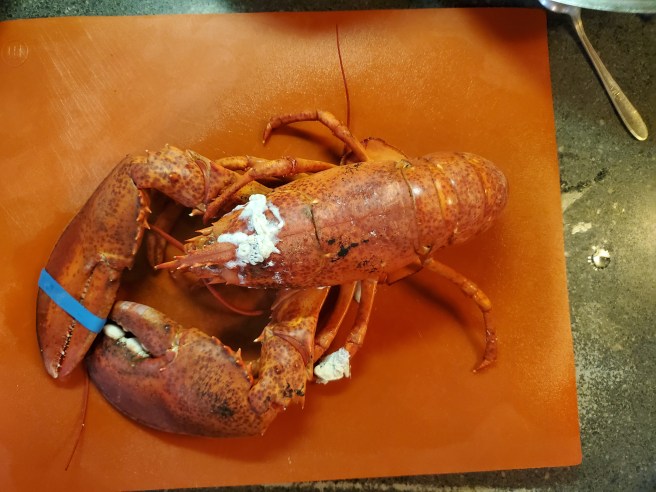
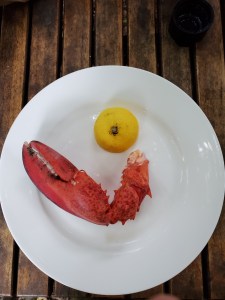
Lobster, scallops, mussels, crabs. The joys of living so near the ocean.
A good poem or novel, especially by an unknown writer.
Musical performance that breaks free of convention while remaining true to the score.
The mystery of the big bang, something out of nothing, a scientific paradox, all leading to human consciousness. A honeybee cannot be an accident, nor can a human.
you no doubt recall a cheery visit in Rhode Island or a ferry trip to Block Island an hour-and-a-half each way in gray eight-foot swells (we, too, rent a Mo-Ped to zip around on while out there) or a smoky Cog Railroad to the top of Mount Washington, a strategy that beats hiking to the 6,288-foot-elevation’s windy sub-alpine summit
In my novel Nearly Canaan, Joshua and Jaya settle into a place unlike anything they would have imagined. It’s desert, for one thing, where nearly everything has to be irrigated, for another. Quite simply, it’s a lot like Yakima, in the middle of Washington state. But it’s also close to fresh Dungeness crab, a shellfish with a heavenly taste all its own.
What you should know.
It draws its name from Dungeness, Washington, on the Olympic Peninsula.
It’s not King Crab, mind you, an Alaska specialty, but it is threatened by ocean acidification.
It has five pairs of legs. (I haven’t counted the ones on a lobster.)
It is found largely between Alaska’s Aleutian Islands and Santa Barbara, California. But don’t overlook that Washington state connection, right in the middle.
About one-quarter of the crab’s weight is meat. One crab usually satisfies one person, though sometimes it will be shared by two.
It has a delicate flavor and a slightly sweet taste. Don’t ask me to compare it to chicken or anything else. Not even lobster. It’s as different as cod is from salmon.
It’s the State Crustacean of Oregon. What else do they have?
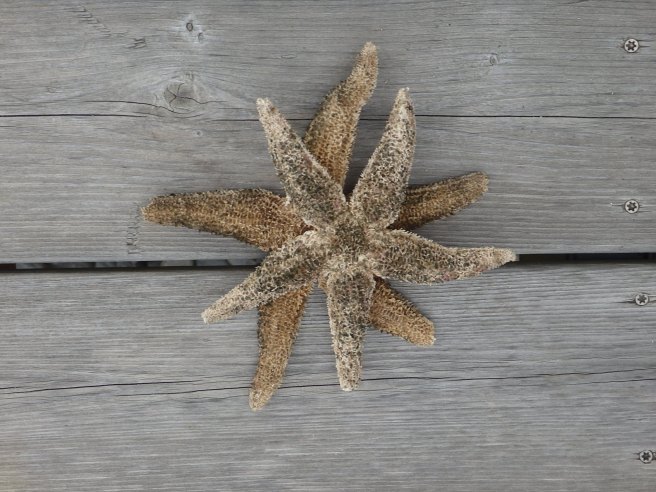
If you go out at night trying to find one with a strong light focused in the water, you can likely rake up one right next to a decaying starfish.
You really can’t get it here, wherever that is, outside of the Pacific Northwest.
If you haven’t guessed, I really do miss them. They don’t travel well.
These days some of my favorite daily encounters come at our city’s indoor pool, where I swim laps. In addition to the familiar faces of fellow swimmers, there are the interactions with the lifeguards, many of them still in high school. When they’re not actively watching us in the water, they have rounds manning the front desk, where they might also be doing their physics homework or working on a paper. In other words, they were the right age to help me with my novel What’s Left, not that I’m ever that direct. No, just a wild question or subtle ear’s enough to keep me grounded in their direction.
In revising a manuscript, I sometimes chance upon a “zipper” that seems to run along the entire piece and releases something trapped within it. Tugging along page after page is an amazing experience, when it happens, which is not nearly as often as I’d hope. Mercifully, that’s what’s happened in the ninth revision of What’s Left, my novel thanks to comments from some of the early readers. The key this round came in having her talking to her father throughout, at least in her head and often in the midst of other people, rather than simply about him. It gives the work a whole new dimension and makes the story far more intimate, especially when she makes irrational leaps that match her emotions.
This, in turn, allowed her to relate much of her investigation as it happened as a young teen, rather than looking back on it from her early twenties, and had her aunt Nita and her best friend, cousin Sandra, present as co-conspirators.
Note that none of these revisions changed the way I saw the novel as an author — I knew how it begins, develops, and ends — but they change it entirely for the reader.
Yes, the changes were extensive. When one of the lifeguards remarked, “What? You’re not done yet?” I came back the next week with two pages from the hardcopy I was working from — half of the sentences containing crossed-out words and phrases, several moved to new locations, and a taped-on flap of new notes to add in, all needing to be keyboarded. It’s typical professional work, as you’ll discover reading the Paris Review or any number of writer-oriented magazines.
Still, they were astonished. I doubt they’ll look at a 500-word assignment quite the same again.
The point is that all of these changes are for the reader. Curiously, the very shift of having Cassia speak directly to her father throughout soon has the reader stepping into his shoes, hearing through his ears in a new intimacy.
And now I trust the story’s ready for you, as its reader.
~*~
It’s not always simply a coincidence, is it?
Have you ever started out on your way to one place and wound up somewhere quite different? Somewhere that turned out to be right? Tell us about what happened.
~*~
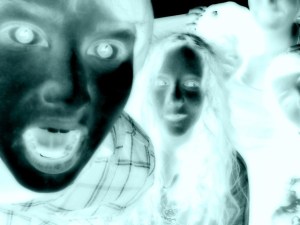
Working with photographic film, as Cassia learns to do with her father’s archives, means learning to “read” negatives like this one by Yuukikatrarra. She’s good.
If you look carefully at honey bees returning to the hive (and you have only a fraction of a second to see this), the legs of some are loaded with pollen, almost like a basket. Here’s one. Look for the yellow. (Photo by Rachel A. Williams)


 Jnana's Red Barn