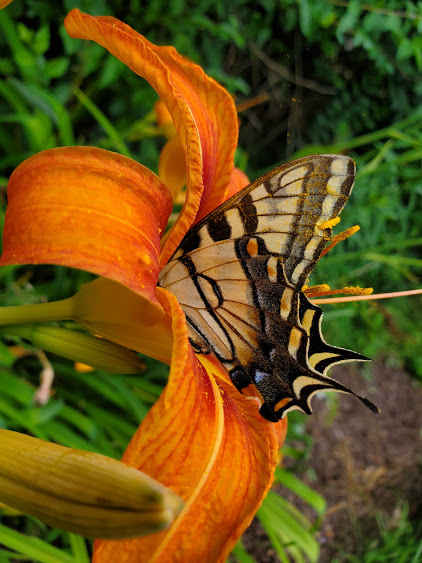
that buzzing housefly sounds fat
small lawnmower in the air behind me
You never know what we'll churn up in cleaning a stall
that buzzing housefly sounds fat
small lawnmower in the air behind me
As a slogan, “must-see TV” gave a network brilliant focus, from the planning of shows to their execution and viewing.
The goal wasn’t just to get ratings numbers for advertising sales but rather hook those active viewers who were passionate about the series and wouldn’t miss the next show for anything. And afterward, they just had to talk about it with somebody or everybody.
As an author, I can be envious. The fact is, we writers need something more than passive readers, not that we don’t value them, too. We want to connect with those hanging on every breath. Even just one. It really does come down to passion.
What really excites you these days?
more than a leap draws me through limbs of imperfect distortion when ducking under its timeless shadow how you freely interrogate berries and dark-skinned nuts as if it matters where we land under countless utility lines and trees apart from the shoreline of slurping defiance
Learning a foreign language includes acquiring an awareness of subtle distinctions. Oh, we really can have pity on anyone trying to navigate English as a second language!
Here are ten things I’m finding in Spanish.
Of course, I don’t have those accent marks on my English keyboard or cell phone. Things can get really tricky when I’m trying to reply en Español.

Cassia’s conversations with Rinpoche lead her to crucial new understandings of her father.
In earlier drafts of my novel What’s Left, I considered these possibilities, but rejected them as, well, too wordy, esoteric, or preachy:
Your Baba was on the cusp of some original thinking about Christ as Light, Rinpoche tells me. He was connecting that with an ancient line of Greek philosophy about a term known as Logos. It was all very, very exciting. He was seeing Christ as much more than the historic person of Jesus, much as we see Buddha as something much more than a historic person — you know, Gautama — too.
Well, that happens to be a hobbyhorse I ride. Let’s give her father a break!
Rimpoche continues. Your Baba had scorn for those who claim a personal spirituality without any disciplined tradition. He wanted to encourage people to delve into a practice — not that they’re all equal, but they have their own unique wisdom to impart — and that led to his organizing some fascinating ecumenical dialogues, ones that included your Orthodox priest, plus a rabbi, a Sufi or yogi, an evangelical, and so on.
Maybe we’d better leave all that for a later discussion? Cassia has more pressing questions, many of them regarding his photographs and family.
Throughout his monastic studies and labors, he’s pressed to concentrate totally on what’s happening in the moment. Even while sleeping. Looking through a lens would, according to Manoula, place a filter between full experience of that timeless breath and himself. It would place a mask across his face when he most needs to be fully naked, as it were. Who knows what he wears in the monastery, for that matter. We can guess from the photos he took later, on his return visits — and his portraits of his teacher and fellow practitioners. For now, he needs to see not just with his eyes — and his Third Eye — but also with his nose, tongue, lips, ears, and especially his fingers and extended skin. And from there, to embrace the eternal realities rather than the ephemeral illusions flickering and dashing around him. Through this stretch, he heeds fellow monks who create beautiful colored-sand mandalas and then scatter them to the wind rather than preserve their work. This emphasis on the present while pursuing eternal truth may seem to be a paradox, but he submits to the instruction and its flowing current.
So that, too, was filtered out of the final revisions. As was this:
Baba and Rinpoche had grown close when they were both residents in the monastery. Rinpoche was then just another of the aspirants, albeit a Tibetan refuge with a lineage. Their teacher blessed their venturing into the Heartland to establish the institute here, and Rinpoche, with his mastery of Himalayan languages, took up an offer to teach academic courses at the university while leading a spiritual community from the house.
~*~
Like Rinpoche, Cassia’s father was in many ways a teacher. In their case, they were dealing with ancient Buddhist lore. Good teachers, as you know, are rare.
Tell us about your favorite teacher.
~*~

In one poem, which I’ve crunched here from my own journal entry, he replies: “You ask me how to pray to someone who is not. All I know is that prayer constructs a velvet bridge and walking it we are aloft, as on a springboard, above landscapes the color of ripe gold transformed by a magic stopping of the sun. That bridge leads to the shore of reversal where everything is just the opposite and the word is unveils a meaning we hardly envisioned. Notice: I say we there, everyone, separately, feels compassion for others entangled in the flesh and knows that if there were no other shore they will walk that aerial bridge all the same.”
Elsewhere he wrote: “’I could not have had a better life than the one I had,’ she writes to me in February 1983 from Warsaw, Irena who has lived through the occupation of her country by two enemy armies, had to live in hiding trailed by the Gestapo, then adapt herself to Communist rule, witness the terror and the workers’ responses in 1956, 1970, 1976, 1980, and the martial law proclaimed in December 1981.”
I’m not sure I agree fully with his theology, but I completely appreciate the richness of his grappling with 20th century unbelief and its practice with his discovery that there is, indeed, something larger than what we admit – something few other artists in our time have been able to pull off convincingly enough to be considered sound artistically. (Milosz won the Nobel Prize, 1980.)
He also wrote: “To find my home in one sentence, concise, as if hammered in metal. Not to enchant anybody. Not to earn a lasting name in posterity. An unnamed need for order, for rhythm, for form, which three words are opposed to chaos and nothingness.”
And, he quoted from Renee le Senne: “For me the principal proof of the existence of God is the joy I experience any time I think that God is.”
Again, Milosz: “To wait for faith in order to pray is to put the cart before the horse. Our way leads from the physical to the spiritual.” And himself: “My friend Father J.S. did not believe in God. But he believed God, the revelation of God, and he always stressed the difference.”
How existential!
~*~
Gee, I didn’t even mention making real money!
So what would you admit to?
 Jnana's Red Barn