Well, let’s see. Banana Republics were company-owned countries managed by puppet dictatorships relying on intimidation and militarized police for the benefit of a few to the detriment of the public.
The new twist sounds like a foreign policy coming home to roost like a ghost from the past.
Fellow blogger Mark Bialczak’s recent posts about his romantic getaway from his home in Upstate New York to the Cape (as we New Englanders refer to Cape Cod) kinda guilted me into giving myself a day off and taking a few hours at a beach a bit over a half-hour’s drive from my little city farm.
Yeah, I know I’m retired (or was, before signing on as a Census enumerator … yesterday was a day off for me). Still, somehow, I get tied down at home. Haven’t swum in the ocean in the past three years, for that matter, not since getting the city pool pass. I always think there’s too much other stuff to tend to.
So yesterday, telling myself the season’s running out, I hopped in the car a tad before noon and simply took off. I thought about heading north to the mountains, but I’d already done a work-related drive in the direction earlier in the day, so I veered east into Maine and settled on Fort Foster, a Kittery town park situated at the mouth of the Piscataqua River.
Regular visitors here at the Red Barn have seen many images from this tranquil alternative to the more popular beaches just up the coast from it. For us, it’s closer than the beaches in New Hampshire, and always less crowded. During the summer, there’s an admission fee, which limits traffic, and for several seasons I opted for a season pass, sometimes spending an afternoon in the water before heading an hour inland for an evening shift in the newsroom. Even so, as I said, for the past several years, I’ve just been more of a homebody, with writing and revising as a top priority.
After Labor Day, the park gate is open only on weekends through September, but it is possible to park outside and walk in, which was the case yesterday. Despite the number of cars lined up along the road, I encountered few people in the park itself, most older couples or individuals walking a dog.
En route, I stopped at the Chauncey Creek Lobster Pier for raw oysters on the half shell, which is always a rare treat for me. It’s a lovely setting, a deck over the water in a narrow tidal passage off Pepperell Cove, and typically crowded. Some diners even arrive by boat. After Labor Day, though, the tourists thin out, making for a perfect time to enjoy our local attractions. Maybe it has to do with Covid somehow, but the oysters yesterday were smaller than usual, especially for this time of year, when they’ve fattened up for winter. No complaints, though, they were still tasty. If only I could learn to shuck them myself. It’s a skill, one that can lead to emergency-room stitches for an amateur.
‘Nuff background. Here’s a sampling of what I enjoyed a mile or two later.
The road into the park splits, with one branch crossing a marsh filled with cattails. As I walked along it, I was struck by the way Whaleback lighthouse seems to pop from the trees, rather than its usual position surrounded by tides.For the most part, I had the oceanside trail to myself. Autumn was definitely in the air.This pebble beach is my usual place to swim. It’s less buggy than the sandy stretches further on, and less crowded than the pocket beaches along the river. My fingers indicated the water was still warm enough for swimming, though I hadn’t brought a swimsuit. September can be some of the best times for swimming, but the cooler air can be a problem. The current also looked a bit rough, not that you see it in this photo.A wave pours into a tide pool. Had I come prepared, wearing old sneakers and a swimsuit, I would have been in the water, looking under rocks for starfish, urchins, anemone, and other colorful life.
No matter how much my novel What’s Left is framed by the ending of my first published novel, most of its characters and action are entirely new.
Well, if you can call going a few more generations “new,” they’re fresh characters in my fiction, filled with color all their own.
Cassia herself and her brothers and cousins and aunts Pia and Yin are certainly original to this story. And yes, a lot has happened in the 50 years since her father joined in with the family.
As one now-deleted line admitted:
Your very presence alters the vibe. There’s the whole nonconformist groove.
This was a description of what her parents’ generation was doing to the restaurant immediately after the fatal car crash, but it could fit much more widely.
In each revision of the novel, Cassia took another step forward. She’s always started her quest at age 11, but most of it was told as a young adult recalling her string of discoveries. Now, however, much of it emerges when she’s 13 and moving up through her teens. For contrast, the final section comes a decade later, after she’s ranged the wider world.
Crucially, in the final revision, she’s speaking directly to her father throughout, rather speaking about him. And, as noted, much of the action has moved forward into her early teen years.
Somewhere along the way, her quest took a flip. It became more about her discovering just who she is and her role in the action. And that’s when she started dictating passages to me, the author.
When I selected her name, Acacia, I didn’t realize how prominent it is in the Bible. In the King James translation, it’s rendered as shittim — what an ugly word! — but Moses was very fond of the extremely hardy wood, and it’s mentioned more than 30 times, often as a required material for holy construction. Americans are most likely to encounter it as the fragrant black locust tree, thorns and all. (OK, officially that’s considered false acacia, but still … close enough for me.) Its flowers are quite fragrant.
~*~
Well, an author can’t include all the details.
What do you think Cassia’s favorite food would be? (Don’t you dare say the Streetcar!)
~*~
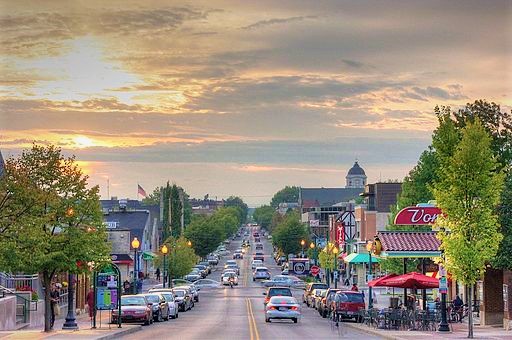
Kirkwood Avenue in Bloomington, Indiana, a town that inspired much of the novel. Cassia’s family compound and restaurant would have been off to the left.
One of the ideas at work — oops! — in my novel What’s Left, is work itself.
Most of us tend to think of it as menial labor, I suppose, but it doesn’t have to be. In the story, for example, Cassia’s aunt Pia has a way of making every task fun and meaningful. And Cassia and her brothers and cousins all put in hours at the family restaurant from an early age on.
~*~
Her aunt Nita also had some insights on work. Here’s one I cut from the final version of the book — we simply had more on our plate than we could manage:
Day by day Nita worked her column like a line cook … a station chef. And she dared tell me journalism’s not like an assembly-line job?
~*~
The poet Donald Hall once broke labor out into three kids: work, jobs, and chores. Maybe you’ll see how they differ.
Tell me about something you do for the pure joy of doing it, even though other people might think of as, uh, tedious work.
For some of you, this could be gardening or cabinetry or decorating cakes or arranging flowers or, well, you get the drift. For others it might be an art or sport or public service.
Is it something you also get paid to do? Or could you?
Raise taxes on the super-rich to bring them more into line with the rest of the populace. Like if you own 50 percent of the wealth, you pay at least 50 percent of the federal budget. Use the income for health care, education, and similar benefits for all citizens. (Yes, it’s income redistribution … but so is an economy where cheap imports keep lowering wages.)
Support environmental action and sustainable economics. We’d be back in the Paris climate control accords, for certain.
Raise the cap on Social Security contributions by the rich. Of course, we can afford Social Security if we’re willing. Just raise the cap on the superrich.
Demand auditing controls on military expenditures. Bernie’s right on this one.
Impose a national sales tax for health care relief for domestic manufacturers. This would level the playing field when it comes to imports versus homegrown.
The next step? Medicare for all.
Raise the minimum wage. Nobody can live on the current level. It’s an insult to the value of labor.
Recognize a shorter work week as the basis for benefits and workplace protections.
Break up the banking and financial conglomerates. Too big to fail is an invitation to another colossal collapse.
Name Barack Obama to the Supreme Court.
~*~
OK, since we’re dreaming, I’d also have a problem-solving Congress. One without Mitch McConnell.
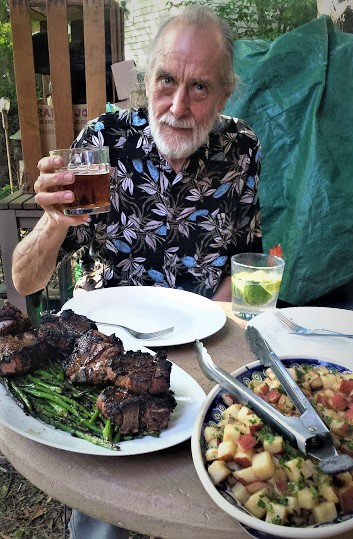
Charcoal-grilled lamb and asparagus are accompanied by German-style potato salad in our Smoking Garden. The gin-and-tonic beside me belongs to the photographer. I’m sticking to beer. These really are some of the best days of summer. (Photo by Rachel Williams)
Textbook versions of history gloss over a lot of details, especially when it comes to the lives of common people rather than the powerful and rich. The biographies of great figures add to that top-down perspective.
One of the things I love about genealogy, especially in nonconformist traditions or ethnic subcultures, is the way it opens alternative understandings of the hopes, dreams, and struggles of life outside of the spotlight.
I look for it in fiction, too, as well as poetry.
My own novel What’s Left springs from that kind of investigation from a Greek-American experience. My new The Secret Side of Jaya adds three other takes from the agricultural prairie, the Ozarks, and finally Native American strands.
Maybe histories aren’t always told by the victors. Not if you look closer or take a longer timespan.
They had been snoozing right in front of me when I got my camera out. And this is where they were when I managed my first shot, already crossing the Cocheco River.




 Jnana's Red Barn