Learning more about the Buddha and strands of his legacy

In my four Freakin’ Free Spirits novels, Cassia’s father is a Tibetan Buddhist scholar as well as a noted photographer. There’s even a rumor he was accidentally reincarnated in Iowa rather than in the Himalayas.

In my survey of other ebooks at Smashwords, I’ve found a range of helpful books on Buddhism. Most are of the nonfiction variety, but some tell of personal experience more than textbook classifications. A few even go for flip, self-deprecating humor. Especially illuminating are the ones by Westerners who have long practice to draw on.

Of the lines of teaching, my bias has long been toward Zen, with its spare aesthetic, and Tibetan, which is far more liturgical, esoteric, and colorful. In fact, the more I investigate, the more I’m convinced that Tibetan is a lot like Greek Orthodox Christianity (as I intuitively assumed when drafting my first novel). Zen, meanwhile, is more like Quaker Christianity – something others have also noted.

Without getting technical, what I’ve found most informative in my recent readings is the much different nature of the Buddhism that headed from India into Indochina rather than the branch that headed north in China and then on to Tibet, on one side, or Japan, on the other.

It’s quite a rich mix. To see what I’ve found, turn to the book reviews at my Jnana Hodson at Smashwords page.

Got any related books to recommend?
Matters of real value

In my novel What’s Left, she has every reason to wonder about what she’s going to do when she grows up. Unlike many of us, Cassia could continue in her family’s business — there’s some security there — but she looks beyond that and sees … well, this is one view I cut from the final version of the novel:

Yet, when we look around, we see everybody doing the exact opposite: most people can’t wait to get away from their office or factory or showroom or classroom. American society these days exalts its leisure and scorns people who aren’t making the big bucks. That’s backward!

~*~

One of the lessons I learned as a cub reporter was the importance of respecting secretaries and janitors. They could give you some of your best story tips, if you listened. Most of them knew far more about the operation than the managers at the top.

Who do you know who’s not highly paid but makes a huge difference for those around her? (Or him.)

~*~


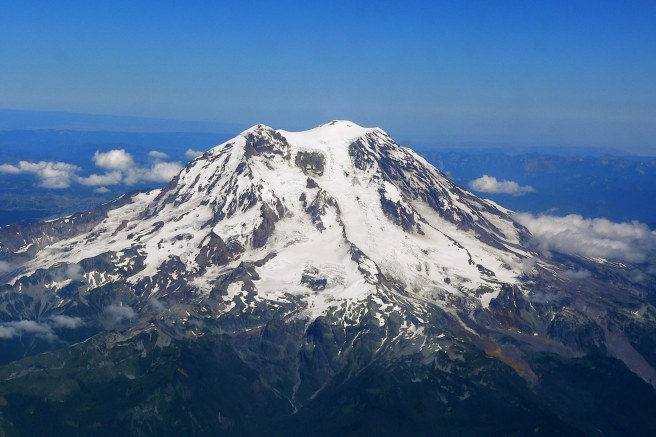
How could you not be impressed by Rainier?

I’ve never seen a photograph that captures the breathtaking majesty of Mount Rainier. Even from miles away, it can seem to hover over your head, perhaps even reaching on around for the back of your neck.

Like Joshua and Jaya in my novel Nearly Canaan, I lived in the desert to the east. That meant we usually frequented parts of the national park that the folks from nearby Seattle were least likely to visit.

It’s been 40 years since I was forced to move elsewhere. Here are ten things that still impress me.

~*~

  1. The park: Established March 2, 1899, Rainier is America’s fifth oldest national park. It covers 369 square miles, making it the 21st largest in the continental U.S. and the third largest in Washington state.
  2. The central mountain: Also known as Tahoma, Rainier rises to 14,411 feet above sea level, making it the second tallest peak in the continental U.S. Unlike its rivals, its base is only miles inland from sea level. Measured from base to summit, or by its topographic prominence, that’s 13,210 feet – more than K2 in the Himalayas. It’s the most heavily glaciated mountain in the continental U.S.
  3. It’s a stratovolcano: Rainier is an active volcano, with sulfur-fuming pits in the ice at its summit. Considered one of the most dangerous volcanoes in the world, it leaves about 80,000 people and their homes at risk of an eruption.
  4. Distance from the summit to downtown Seattle: 59 miles, if you’re a crow.
  5. Diversity of ecosystems: About 58 percent of the park is forested, ranging from dense evergreen forest to open ponderosa. The tall Douglas firs and western red cedars are nearly as impressive as the sequoias further to the south. Another 23 percent of the park is subalpine, above the forests but having evergreens at distances. In season, this is wildflower heaven, with orange paintbrushes, lupines, and white-starred avalanche lilies in profusion. Above that, half of the remainder is alpine, having unique vegetation, while the other half is permanent snow and ice.
  6. Year-round ice and snow: Depending on your source, 26 or 27 major glaciers cling to the mountain. They release thunderous booms of breaking ice during the summer. Combined with permanent snow patches, they cover about 35 square miles.
  7. Ice caves: By late summer, the mouths of some of the glaciers melt away to form mystical blue caverns. They’re dangerous to enter but unforgettable if you’ve ever been in one.
  8. Reaching the summit: Climbers are required to register for permits before setting out. They must possess technical skills regarding ice axes, harnesses, and ropes and be in good physical condition. They face a 9,000-foot elevation gain over eight or more rugged miles. And then they repeat it in reverse. For most, it’s a two-day trek. About 10,000 people set out for the summit each year, with half of them succeeding. The mountain claims an average of two lives a year.
  9. Thermal hot springs: Furthest away from Seattle is the Ohanapecosh Hot Springs. Once a resort, it now features trails that are delightful to hike in winter.
  10. Two lodges: Situated at 5,100 feet elevation in the subalpine terrain, Paradise receives an average of 53 feet of snow a year. Sunrise, at 6,400 feet elevation, is the highest point the roads reach. The lodges are often snowed in till the Fourth of July.

~*~

If you’ve ever been there, what would you add?

Mount Rainier from the air. Notice the clouds are below the summit. And much of the white covering is glaciers.

Let’s not kid ourselves, it’s popularity, not excellence

We wanted to give a local business a boost, so we went online to cast a vote in “Seacoast’s Best” polling. You’ve no doubt seen other places touting some similar honor.

We very quickly realized that for many of the designations, we had little or no awareness of most of the nominees. Like we knew the six women running for the region’s Best Nurse? Or we’d eaten at all six parlors in line for the Best Pizza? No, a vote went to the one you might already know, if you didn’t skip over it altogether.

Such results are bound to be quite different from those based on a few knowledgeable critics who evaluate on quality criteria and point us in unexpected directions.

Now that’s a Best I’d respect.

Just what more can go wrong in 2020?

Here we are a full six months into the year, and the surge of record-breaking goes unabated.

Racist police brutality is unmasked nationwide, along with the violent suppression of peaceful protests and free speech.

Russian bounties on American soldiers goes unchallenged in the White House.

Wall Street is living in a disconnect with the economy in general while new Covid-19 cases and deaths soar to their highest levels yet – and promise to rocket quickly.

The widespread resistance to public health measures, and then their lifting, threatens to turns the economic hit of the earlier self-quarantining into a wasted expense. Now brace for the truly hard impact when we see what a full outbreak adds up to in costs, including lifetime chronic health problems for many survivors.

And we thought toilet paper and chicken or pork shortages were big?

Already, a wave of evictions is hitting renters who suffered from the mandatory unemployment in April and May. Where can they go? Looks like a lot of vacancies for landlords, too, not that they get any sympathy.

Here where I live, state government revenue is down 20 percent. The next budget round will be a bloodbath.

Who knows what’s going to happen to the crucial election season. National conventions? Door-to-door campaigning? Rallies?

Gee, remember the Senate’s so-called trial of Trump on impeachment charges back in February?

Oh, yes, drought or near-drought in June.

Curing my lifetime of writing headlines, I often felt I’d already seen everything. Nothing could brace me for this.

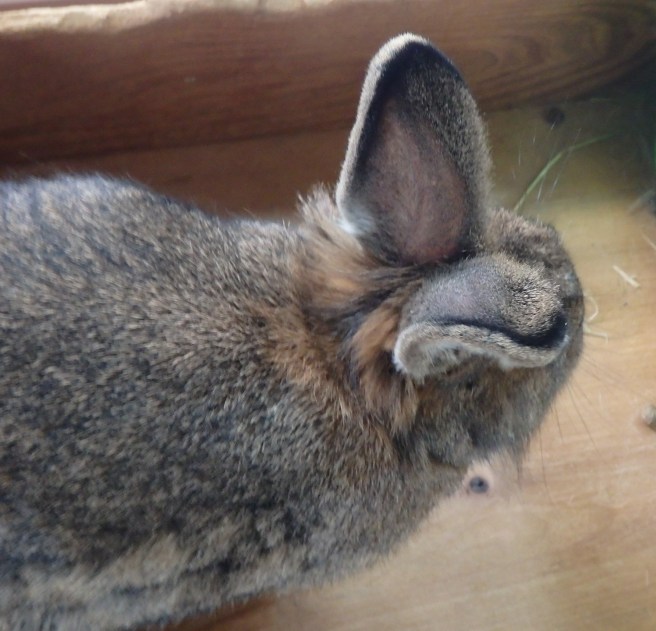
And now there’s an outbreak of rabbit Ebola, fatal in 80 percent of the cases. Yes, that’s what they’re calling it. Seriously. Wild or domestic, they’re doomed. Bunnies!

Forget the MAGA hats, it’s time for the sackcloth and ashes, friends. We need to repent and be saved. How about some true leadership, based on hard facts and courage?

Happy Independence Day, everyone.