Ten facts about the Ohio River

In a whimsical twist in my novel What’s Left, I placed the town along the Ohio River. Well, the navigable waterway is a defining element of southern Indiana.

  1. Length of the Ohio River: 981 miles
  2. Length along Indiana: 240 miles before adding twists. Drains all but the northernmost area of the state.
  3. At its mouth: It is considerably larger than the Mississippi, making it the main hydrological stream of the whole river system.
  4. Number of states feeding into the Ohio River: 15.
  5. Largest tributary: Tennessee River, 652 miles long. Its watershed includes Virginia, North Carolina, Georgia, Mississippi, Alabama, a corner of Louisiana, as well as Tennessee and Kentucky.
  6. Largest northern tributary: Wabash River, 503 miles long. It originates in Ohio and flows across Indiana before becoming part of the border with Illinois.
  7. Average depth of Ohio River: 24 feet.
  8. The biggest city along its way: Pittsburgh, metropolitan population of 3.5 million. The river begins with the confluence of the Allegheny, from upstate New York, and the Monongahela, which drains part of West Virginia and Maryland as well as Pennsylvania, at Point State Park in the Gold Triangle.
  9. Next largest: Cincinnati, metropolitan area population of 2.2 million. Can be seen as the waterway’s hub.
  10. Major hurdle: Louisville, Kentucky, sits at the Falls of the Ohio, which once presented a barrier to river traffic. The McAlpine Locks and Dam stand where the Louisville and Portland Canal was built in 1830 to allow vessels to bypass the falls. It was the first major engineering project on the river and, by some accounts, the first on an American waterway.

On seeing pileated woodpeckers

The pileated woodpecker is one of the largest members ot the family, rather comical and awkward looking, at that. It’s also not commonly seen, so sightings are always exciting, at least if you have an eye for birds. (Pronounced PIE-lee-ay-tid or PILL-ee-ay-tid, by the way.)

I remember one of my first encounters was while having dinner with the Ostroms at their house perched atop a wooded ravine outside Bloomington, Indiana. One alighted just outside the window, to our shared surprise and wonder.

More recently, as I was driving with my elder daughter down a road in Maine, one was flying just ahead of us but veered off before she could look up.

A week later, on a different road, the same thing happened.

She accuses me of making those up.

So the other day, after a meeting at the Unitarian-Universalist Fellowship in Durham, I noticed two people in the parking lot who were staring at something in the trees just beyond. I caught the red head and then the full bird. Yup. Amazing, considering this was an urban neighborhood.

And then, on another trunk, I spotted on more red head and big body, which then swooped down to join the first.

The pileated ‘pecker is a large bird – 16 to 19 inches long with a wingspan up to 30 inches, as I’m reading, likely the largest of its family in North America – and they can do some serious damage to trees they decide to nest in. Think of a beaver with wings. Again, from some quick referencing online, I’d guess you can look for a nest based on the pile of wood chips below.

My companion, in her early 90s, apologized that she’s never been able to really see birds, not even as a child. “My eyesight’s always been poor,” she apologized. So much for a witness. At least she could attest that two others were also commenting on the birds before us.

As for said daughter? She insists I’m making this up, too.

For the record, I don’t think I ever seen more than one classic redheaded woodpecker in my life. Hairy woodpeckers and downeys and flickers, of course, are another matter. Old friends, I’d say.

Of course, the Woody Woodpecker cartoons don’t count, do they?

Not my picture, alas. Bird photography is truly a specialty.

Xristos anestiek nekron …

As Greek Orthodox Christians everywhere sing joyously while waving candles aloft in the darkness before dawn this morning, the hymn continues:

Thanato thanaton patisas,
ke tis tis mnimasin,
zoin xarisamensos.

And in English-speaking places, they alternate that stanza with a translated version before repeating both over and over:

Christ is risen from the tomb
trampling down death by death!
And on those in the tombs, he has granted life!

XRISTOS ANESTIEK!

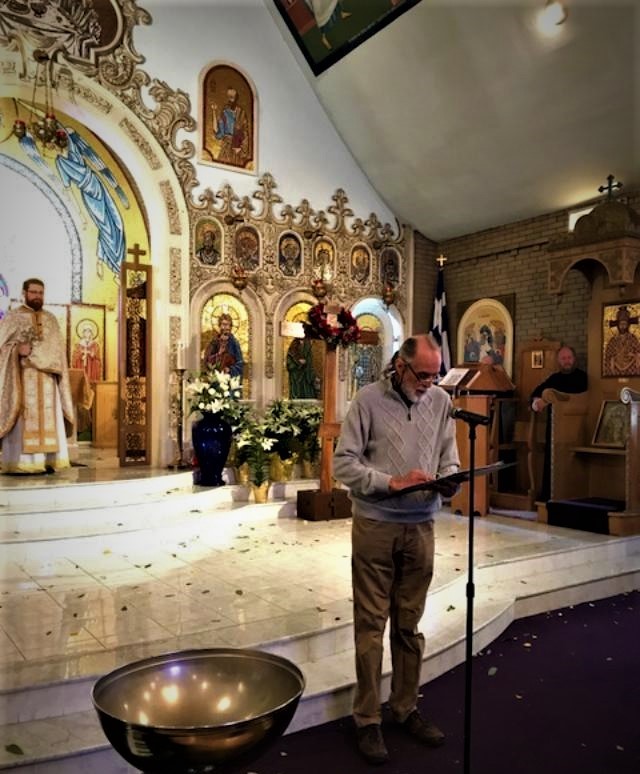
Having celebrated the Resurrection in a service that ends around 2:30 a.m., the Greek Orthodox return for a vespers at 11 a.m. One of the traditions here is for the morning’s Gospel reading to be given in every language spoken by those in the room. Here I am, making my public debut in Spanish with the text about Doubting Thomas. (Photo by Maria Faskianos)

Too good to last?

Her uncle Dimitri, the oldest of three brothers, has Adonis good looks and style to match. He earns a prestigious Masters of Business Administration degree and possesses sharp financial skills. He also advocates radical values in politics and social justice, has taken up Buddhism, and uses astrology to evaluate potential colleagues – as he does in luring Cassia’s future father actively into the family.

In my new novel, What’s Left, she assumes all of this is the way life should be, right up to the tragedies that send her spiraling.

Continue reading “Too good to last?”

Ten popular Greek dishes

In my novel What’s Left, Cassia’s family runs a landmark restaurant but realizes many of the Greek dishes they make at home are just too exotic for their clientele in southern Indiana, at least during most of the timespan of the story.

They do add roasted Greek potatoes as an option, but that’s about it.

Well, by the early ’80s, when they have a vegetarian line going, they might add dolmathes, the stuffed grape leaves, or vegetarian stuffed peppers to their offerings, perhaps along with tzatziki, the distinctive cucumber yogurt sauce distinguished by its dill and lemon.

Oh, but how much are the holding back on? Consider these ten options.

  1. Gyro. It’s a yummy handful, a wrap made of warm pita bread filled with strips of seasoned grilled lamb and beef with tzatziki and sliced tomatoes. (No onions on mine, please. They don’t agree with my system.)
  2. Souvlaki. Around here, it’s usually kabobs of char-broiled marinated pork, ordered by the skewer. “Give me two sticks, please,” is the way to order. Rounded out with things like rice pilaf, beans, and Greek salad on the plate. My favorite came from a wood-fired stove at the Common Ground Fair in Maine.
  3. Spanakopita. Or spinach pie, made of filo dough baked with layers of spinach and cheese.
  4. Loukaniko. Greek sausage made with orange peel, too. Great appetizer.
  5. Kolokythokeftedes. A Cretan vegetarian appetizer ball featuring feta cheese. (Feta is big in our house.)
  6. Lamb shank. This slow-baked, savory hunk o’ meat is one of the glories of our local Greek festival. Or, for those who want something a little less messy to eat, the slices of roast lamb are delightful, assuming you like lamb. If not, go for the lemon-pepper roast chicken. (Admittedly, I’m cheating in trying to keep this a Tendril. Just ten dishes? Oh, my, impossible!)
  7. Pastichio. Layers of baked macaroni with cheese and seasoned beef are a common entrees , as is Moussaka, made of layers of baked eggplant, potatoes, and ground beef.
  8. Keftethes. Meatballs. Bet you can’t eat just one.
  9. Baklava. This honey-infused filo is a heavenly dessert, but be warned, it has to be eaten while fresh. That honey can get sticky.
  10. Let’s not overlook Loukoumades. Bite-sized golden puffs of fried dough often sprinkled with syrup, walnuts, and cinnamon are another celestial way to round out the meal. I have heard some heated discussion, though, about whether the next generation can live up to the standards this one requires. The debate can be quite amusing, especially when the stand is being operated by closely supervised children.

Now, as for your Greek favorites?


Coming to the culmination of Great Lent

In his “Note on the Religious Tendencies” published by Liberation magazine in 1959, the Zen Buddhist and poet Gary Snyder remarked, “The statement common in some circles, ‘All religions lead to the same goal,’ is the result of fantastically sloppy thinking and no practice.” His very next sentence is equally startling. “It is good to remember that all religions are nine-tenths fraud and are responsible for numerous social evils.”

Well, the essay is largely a defense of the beat generation, and he was an American studying in monasteries in Kyoto. I wonder if he’d admit today how much social progress and learning have come about through religion, too. That could make for an illuminating debate.

I did hear him once mention that on the Buddhist spectrum, Zen starts at one extreme and Tibetan tradition at the other, but that as followers of each advance in their practice – as he said this, his outstretched arms began to sweep over this head – they eventually approach and then cross places. Just as his arms were doing. Go far enough, of course, and each would land where the other one had set forth.

Without going into detail, I find a lot in common there when it comes to Quakers and Eastern Orthodox on the Christian spectrum.

The one is plain, even austere, and very much centered in the present. The other is visually and tactily rich, accompanied by an accentuated awareness of mortality and death.

As regular readers of this blog are aware, I am a Quaker who’s been fascinated lately with Greek Orthodox life. It doesn’t all spring from questions arising as I drafted and revised my novel What’s Left, either. Besides, Cassia’s family wasn’t all that observant of their native faith, even if members were toying with the Tibetan Buddhism her father practiced.

Admittedly, few Americans know much about either Quakers or Orthodox Christians, despite their impact on the larger society. Ditto for Buddhism.

Today is an especially important day for the Orthodox.

Continue reading “Coming to the culmination of Great Lent”

Be the church

These T-shirts worn by members of Durham Community Church (UCC) at a Jericho Walk around the federal building in Manchester uphold the perspective of the church as the body of believers rather than the house of worship or the organizational structure. This was at a vigil opposing the deportation of refugees.

When it comes to viewing the world, real photography will always stand out

To call me visually oriented would be an understatement.

For most of my life, I’ve viewed the world through imaginary frames and lenses.

I had four years of art training in high school and when recently reviewing many of those pieces was impressed by their high quality. I seriously considered continuing on into college and a career beyond but realized the struggles of making a living that would follow. And so I veered into journalism, where I applied many of those skills in designing newspaper pages, photo essays, and cropping pictures. Thousands and thousands of them.

It also led to a love of typefaces and calligraphy and book design.

Maybe I haven’t strayed that far.

I’ve also worked with some of the best photojournalists in the field and known a number of outstanding artists. I even married one.

On a more mundane level, I sometimes shift into cartoon mode and begin seeing people as whimsical drawings. Or I ponder how they would photograph. (No, I’m not staring at you the way you think I am, sorry if it’s making you uncomfortable.)

Well, for that matter, I did meet some famous cartoonists when I was working for the newspaper syndicate and selling their work to our clients.

Continue reading “When it comes to viewing the world, real photography will always stand out”

An aunt unlike the others

In my original draft and early revisions of What’s Left, I tried to keep her aunt Nita relatively equal among Cassia’s aunts and uncles. This was difficult, since Nita had been an important influence on Cassia’s father, from college all the way up to his disappearance in an avalanche, was Cassia was 11.

There was no avoiding the fact that as Cassia wanted to know more about her father, she’d have to turn to her aunt Nita for answers.

In the ninth revision, though, I decided it was time for Nita to out-and-out become Cassia’s guardian angel, a role she’d fulfilled repeatedly for Cassia’s father. I think it was a brilliant flash, allowing much of the action in the new novel to take place during Cassia’s preteen and teenage years.

Continue reading “An aunt unlike the others”