TEN MORE THINGS ABOUT DOVER

  1. Hardworking leaders. We’ve been blessed by people who want to get things done. The town’s made a huge turnaround in the past 20 years, from a time when the mill windows were boarded up to the vital business incubator it is today.
  2. In general, we tend to vote more to the left, in a working-class streak. In a small state like ours, you’ve probably met the governor and at least one of your U.S. senators. And our city counselor lives across the street.
  3. Family friendly. We actually have four high schools – the city’s (which is moving into a new building), St. Thomas Aquinas, Portsmouth Christian Academy, and the state-chartered Cocheco Academy of the Arts. The Rotary and Kiwanis clubs have been active influences in shaping this direction.
  4. The Greek Orthodox church, one of the oldest in North America. Outwardly, they’re at the opposite end of the Christian spectrum from my Quaker plainness – something I find challenging and refreshing. But they’re welcoming and wonderful and have provided great grounding for my upcoming novel. And, as I’m finding, they’re everywhere in this town. The interior of their house of worship, by the way, is visually gorgeous.
  5. Public transportation to Boston. C&J buses run hourly to Logan airport and South Station. They’re clean and quite comfortable. And Amtrak’s Downeaster heads to North Station five times a day – what a delight! – as well as the other way to Portland, Maine, or a little beyond.
  6. Yes, we neighbor Maine.
  7. Fresh food. Farmstands are just minutes from downtown, as well as two farmers markets. Sweet corn’s no problem. Pick-your-own strawberries, blueberries, peaches, and apples as well. And then there’s the seafood – not just lobster, either.
  8. Market Basket. Well, technically it’s across the line in Somersworth, but this legendary supermarket chain is significantly cheaper than its competition while being highly responsive to its local customers. (It has the best tofu around. The Asian restaurants all get theirs there.)
  9. Police and fire and rescue services. They respond instantly, as we found out back when we had a phone button on autodial. (And they were very friendly about it.) Just as telling, women aren’t afraid to walk home late at night downtown. And, from what we hear from immigrant communities, they’re sensitive and supporting.
  10. Garrison Hill observation tower. The walk from our house starts through our neighbors’ yard, twists up some side streets and then through the woods to the top of the hill and then up the flights of stairs to the crown of the tower where the panorama spreads out over the village -like setting of downtown or, the other way, clear to one flank of Mount Washington. And then it’s the reverse. Great for quick exercise or a jaunt with our guests. See where we live?

~*~

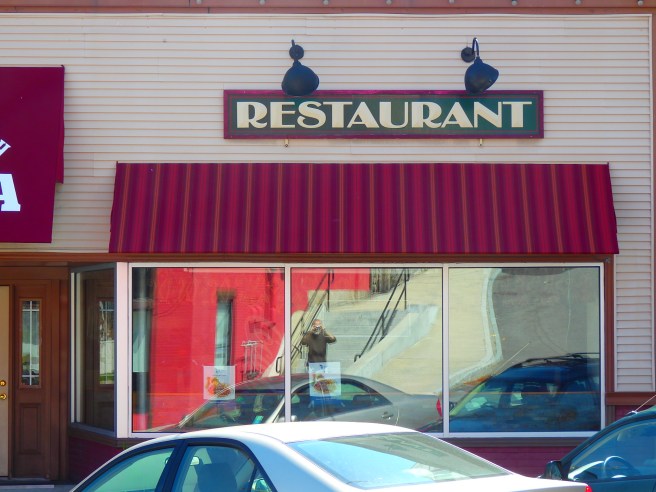
What don’t you like about the place you live?
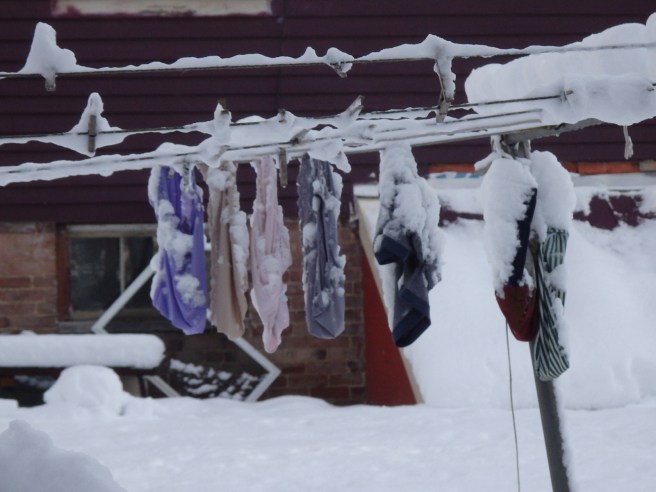
Laundry on the line.


THERE ARE GOOD REASONS I KEEP STICKING WITH NITA

Nita Zapitapoulos is a special character for me. Long before she becomes Cassia’s aunt, in my new novel What’s Left, she appears in all four of my Hippie Trails volumes as a guardian angel and colleague for Cassia’s future father. She also appears obliquely in notes to my Hometown News novel as a journalism professor.

The character was loosely inspired by a sidekick’s descriptions of the girlfriend he’d come to visit. I may have even met her at the time, although I’ll confess she wasn’t of Greek descent at all. I wish I still had the letters with his lavish descriptions of what so attracted him in his whirlwind adventures. She and I may have even passed each other in the same newsroom while working in different departments; I, though, have never been a photojournalist.

A few years ago, far from where all this took place, a mental connection flashed for me during a conversation after a committee session. “Did you know …?” Yes, she remembered him. We’d both lost contact with him decades ago.

In real life, she’s quite different from the impressions that prompted my fictional character. Still, from everything I see now, I’d say they’re both pretty amazing.

Continue reading “THERE ARE GOOD REASONS I KEEP STICKING WITH NITA”

TWO BROTHERS/BROTHERS-IN-LAW ALONG WITH TWO SISTERS/SISTERS-IN-LAW

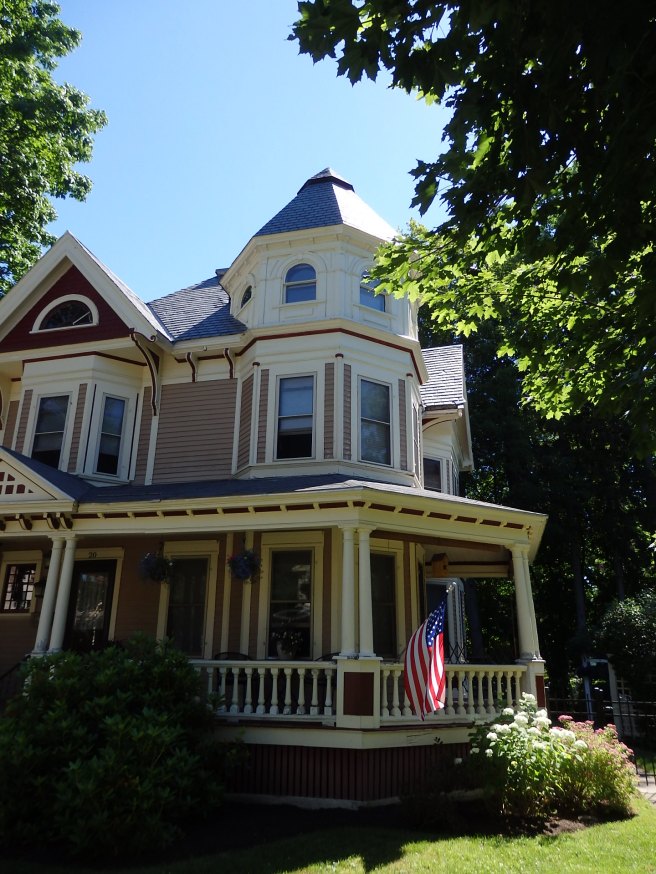
A large Queen Anne-style house with a distinctive witch’s hat tower something like this is the headquarters for Cassia’s extended family in my new novel, What’s Left. If only this one were pink, like hers.

Centering the story of my new novel, What’s Left, in a Greek-American family required me to consider just what each member might have undergone in the years from arriving in the New World up to her father’s introduction to her mother. (Or more accurately, before her father-to-be meets her mother-to-be.)

While creating a suitable scenario presented a fascinating challenge, I did have to start wondering just why Cassia herself – or the typical young adult reader, for that matter – would have any interest in such ancient history.

I hope a hint of scandal helps, along with a few other twists, before their curiosity kicks in.

~*~

Much of the novel revolves around Cassia’s prolonged examination of old family photos – images that might amuse younger viewers or even intrigue them. Think of looking at high school yearbooks from earlier decades. Yes, those geeky hairstyles are real. As for the dress?

Any collection of family photos is bound to include birthday parties. What’s your favorite cake for the occasion?

TEN FINE THINGS ABOUT DOVER

For the past 18 years I’ve lived in a small city. One of 30,000 men, women, and children in addition to dogs and seagulls. And it’s felt right. Way back in my past, many folks expected I’d wind up in New York City, and while I do hold a certificate in urban studies from my university, my career took me in another direction.

Well, here are 10 reasons I like where I am:

  1. Quaker Meeting. It’s my core community, my circle of kindred spirits, and we’re the fifth oldest congregation in the entire state. The four before us were all state-supported Colonial Puritan institutions. We were the renegades.
  2. Walking distance to whatever is usually essential. What a civilized way to live! We’re a mile from downtown, in one direction, and the hospital, in the other. (Oh, yes, we can stop somewhere nice for a drink and not worry about having to drive home.) It’s pedestrian-friendly place, really. Cars have to stop or, well, I’ve seen them halted by cops on big horses.
  3. I really like our mounted patrol. As do most of the kids.
  4. The Community Trail. As long as we’re walking, we have the option of a former railroad line that’s become a narrow woodsy park heading out from the train station (I often take that route to Meeting on Sunday morning) or a riverside meander heading upstream. Sometimes I think I’m much further north, in the mountains, especially when I’m on cross-country skis in deep winter.
  5. Centrally located. Within an hour’s drive we have Atlantic beaches one way, forested mountains in another, and the Hub of the Universe in a third. OK, Boston depends on the traffic, but I do rehearse weekly in a choir there.
  6. Waterfalls in the heart of downtown. The river falls to the tide and runs through an arch in the big brick mill. It used to power the mill, too. The scene’s quite charming and sometimes dramatic. And salmon are returning to the fish ladder.
  7. The city’s indoor pool. I swim a half-mile four or five times a week. Nice bunch of fellow swimmers and lifeguards. Not bad for a Christmas present!
  8. Our neighbors. They’re a story in their own right.
  9. Architectural diversity, as you might expect in the seventh oldest settlement in the continental U.S. We’re always seeing something unexpected when we stroll.
  10. We’ve become the downtown for the state university one town over. A third of its students live in apartments here, so we have a bit of that college town flavor. But not so much that we lose our blue-collar edge.

~*~

What do you like about the place you live?
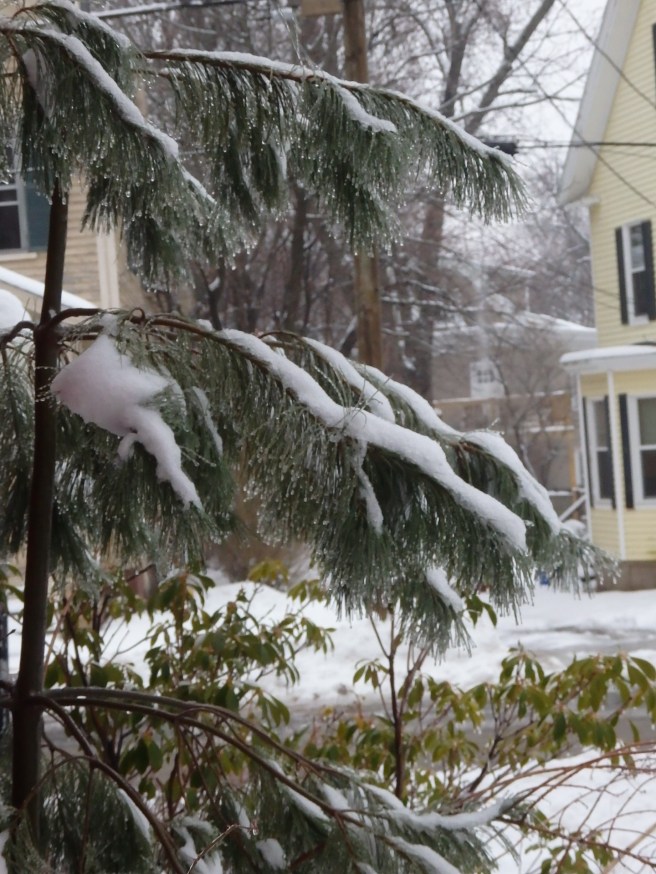
And for a little sobering perspective. It’s wet and cold on the bough.


WHERE’S DADDY?

In my newest novel, What’s Left, the common image of a nuclear family is punctured when her father vanishes in an avalanche halfway around the globe when she’s 11. Daddy’s no longer present in the family picture. Only her mother, two older brothers, and Cassia herself. (Plus her aunts, uncles, and close cousins, who completely alter the picture.)

Her obsession to rediscover him brings her face to face with much more than her loss.

Continue reading “WHERE’S DADDY?”

WORKING FOR A FAMILY

Carmichael’s, the restaurant her family owns in my new novel, has me looking more closely at others.

Large or small, family-owned businesses stand apart from other company models. Upward mobility into management may be limited for non-family, for one thing, and succession from one generation to the next can impose special hurdles – few family-owned enterprises survive into the fourth or fifth generations. And then inheritance tax issues can hit heavily, if key players fail to prepare properly. And that’s before we get into sibling rivalries and family spats.

On the other hand, they can be more flexible in aiming at long-range results or adapting to change.

In my new novel, What’s Left, these all play into the story. Her family isn’t like other employers, for sure. And it’s primed for exciting big growth.

Continue reading “WORKING FOR A FAMILY”

TEN THINGS I DON’T LIKE ABOUT WINTER IN NORTHERN NEW ENGLAND

The sidewalks are buried in plowed snow, so you have to walk in the street. Gotta keep taking the ash out from the wood-fired stove. And it’s dark two-thirds of each day. But that’s not the worst. Just consider …

  1. Slipping on ice and shoveling snow, especially at the end of the driveway where the city snowplows pack us in.
  2. Driving in freezing rain.
  3. Comparing the weather reports to each other and to what actually happens. Rarely does anything match.
  4. Watching the woodpile shrink.
  5. Utility bills.
  6. The house is always cold – and stiff winds make it only worse.
  7. Things break.
  8. Frozen pipes or drains.
  9. Cabin fever.
  10. The rock-hard ground.

~*~

How do you feel about winter?

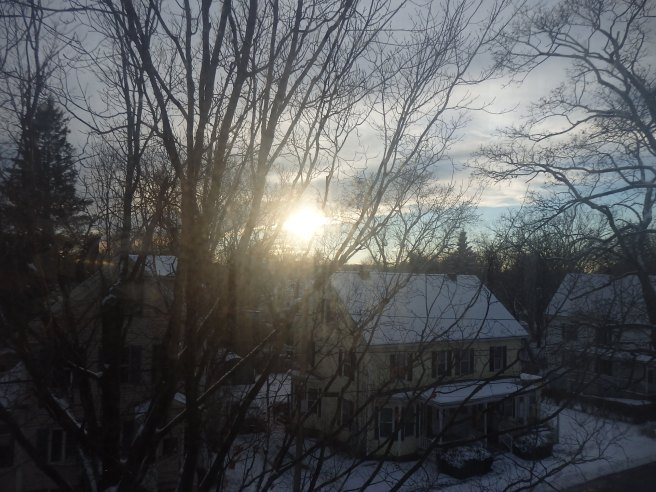
Sunset over the neighbors’.

THE TOWER VIEW

A large Queen Anne-style house with a distinctive witch’s hat tower something like this is the headquarters for Cassia’s extended family in my new novel, What’s Left. If only this one were pink, like hers.

As I viewed photographs of the kind of Victorian house her family would gravitate toward, having a round tower at one corner seemed natural – especially one capped by a pointy roof commonly called a witch’s hat. The idea of living in a tall-ceilinged attic, with its air of private retreat, holds romantic appeal anyway, but having it open out into a circle room with views overlooking the street in both directions strikes me as a plus. How about you?

Continue reading “THE TOWER VIEW”

SHIFTING GEARS ON HIGHWAY ‘18

You no doubt noticed a new look at my suite of blogs here at WordPress during the past year. In midsummer I converted to four quite different templates – or what WordPress calls themes – each one a sharp new presentation for the unique material of the blogs. The process also prompted a redefinition of their separate identities.

Much of my literary attention last year focused on my newest novel, which underwent two major revisions and a cleanup reading – along with a new title. You’ll hear a lot more about it through the coming year. In fact, the Red Barn will be engaged in conversations about the many themes running through the big book. Look for the new Cassia’s World category.

Doing that has me anticipating fewer postings here – typically three a week, rather than seven to 10. To be frank, there were weeks when I felt things were getting way too hectic. Sometimes less really is more.

One other refinement: My Tendrils category will be getting more playful. I hope you like it – more way than one.

On the other sites, Chicken Farmer, I Still Love You is settling more fully into its inland New England character. More photos, mostly of historic brick mills, will accompany the serialization of my Big Inca novel, before giving way later in the year to poetry that fits the region.

As Light Is Sown steps up its pace to two postings a week, mostly short entries drawn from my books Religion Turned Upside Down and Stillwater. Consider it provocative inspiration. I hope.

While I’m not anticipating any further big genealogical reports at Orphan George, I am looking forward to excerpting from helpful correspondents over the years as one way of acknowledging their generous assistance. Maybe I’ll throw in some more family photos, too. We’ll see.

Finally, my Thistle/Flinch imprint will explore fresh typographical concepts in six of the new releases – venturing somewhere between broadsides and chapbooks, I expect. This new lineup of free offerings is all poetry.

~*~

What are you looking forward to in the new year?


Here’s the latest at THISTLE/FLINCH.


BRACING FOR THE NEW YEAR

Much happened in my life in the past year that I haven’t mentioned in the blog. My attention was largely focused on the new novel, which underwent three major revisions, completely changing its focus from, first, what Cassia discovered about her hippie father to, second, what she discovered about her Greek-American family through his photos to, third, finally the way she emerged from the emotional loss and grew stronger and wiser as a consequence. Now that What’s Left (the third title, by the way) is finally released as an ebook (Cheers!), you can tell me if it was worth three years of angst, fasting, and flagellation on my part.

One personal accomplishment was my reading the Bible straight-through at the beginning of the year. I started with Everett Fox’s extraordinary translation of the Five Books of Moses and ended with David Bauscher’s translation of the New Testament from Aramaic, while covering most of what’s in-between in the New Jerusalem version. Wanted to hear it all afresh. My notes from the experience will probably fuel an upcoming series, likely at my As Light Is Sown blog.

Also on the religious front, I attended the entire Holy Week (what they regard as Passover) services in the Greek Orthodox tradition. Outwardly, it’s about as far as you can get from my quietist Quaker aesthetic, but again, it was a powerful way of hearing the story afresh. With the shortest service running about an hour-and-a-half and the longest well beyond that, the closest comparison I could come up with would be Bach’s St. Matthew Passion (nightly) or Wagner’s Ring Cycle, which runs shorter in time and isn’t repeated the next morning. It was a miracle the priest and psalmists had any voice left by Easter. And the final services border on chaotic, wax-dripping celebration. Well, that’s the short take. My one regret is that I’ll never again be able to experience this for the first time.

In late spring, I felt called to assist our neighboring Indonesian immigrant community as a number of Christian refugees face deportation to a land where they fear profound religious persecution. As many of us have found, accompanying them to monthly immigration appointments an hour from home has been a life-changing experience. The vigil outside the federal building has been the biggest ecumenical gathering in the state, with clergy and laity blending together. I’m getting teary simply typing this. A last-minute federal court stay has us hopeful, but nothing’s certain as we await the final rulings. I am so proud that my Quaker Meeting has stepped up to this challenge, supported by at least a dozen other congregations in our corner of the state. Whatever action we take, we cannot do alone, but we feel God’s Spirit leading.

At home, our garden flourished, especially with an unprecedented fall in which the first frost didn’t strike until November 8 — a full month later than normal. We still had our own tomatoes up to New Year’s Day.

Continue reading “BRACING FOR THE NEW YEAR”