shoes belong under bed
old habit
curious entry considering
I was sleeping on
a mattress on the floor
You never know what we'll churn up in cleaning a stall
shoes belong under bed
old habit
curious entry considering
I was sleeping on
a mattress on the floor
You know the common declaration that the book was better than the movie. Almost nobody acknowledges the reality that a movie can cover no more than 20 pages of a novel, or so I’ve heard – basing it on a short story would be much more fitting. (Who’s counting, anyway? A lot of a movie script involves fleshing out details. Say for five pages here, five pages there, five more for the finale. You get the idea.) There’s also the problem that cinema presents surfaces, while fiction can delve into individuals’ perceptions, reflections, and emotions in ways that even a first-person narrator cannot equally convey. Falling back on a voiceover, from a critical point of view, usually reflects a shortcoming in the movie itself. Perhaps you’ll come up with exceptions, and I’m open to argument. The point is, a filmscript has to discard a lot to fit into an acceptable running time for commercial release.
All that got stirred up after hearing a broadcast of Puccini’s 1884 opera Manon Lescaut, a retelling of Massenet’s once popular 1874 opera Manon, which still gets performed, unlike Auber’s largely forgotten 1856 version.
Usually, the discussion involves comparisons between Puccini and Massenet’s works, which I’ll touch on later, but this time I picked up on a clue from Sir Denis Forman’s “irreverent guide to the plots, the singers, the composers, the recordings” A Night at the Opera, a go-to book I’ll highly recommend. Manon is not one of Puccini’s blockbuster hits, something Sir Denis dismisses as “rather a dim little affair. It is made up of scenes from the Abbe Prevost’s long novel and whole chunks of the narrative take place between acts. This is dramatically inept because we lose any sense of continuity in Manon’s downward spiral and the agony does not pile on as it should.” OK, so my lack of enthusiasm for this work isn’t my fault, even though there are dramatic high points throughout, as Sir Denis cites.
He really grabbed my attention when he proclaimed, “The libretto is not good. Puccini’s Manon has a worse script than Auber’s, a much worse one than Massenet’s, and all three fail to mobilize the original Prevost’s story, which is full of good stuff and could make a rattling good television series today.”
That was good enough to send me down the rabbit hole. The novel in question is Histoire du Chevalier des Grieux et de Manon Lescaut, the seventh and last volume of the Memoirs and Adventures of a Quality Man Who Retired from the World. First published in 1731, the novel was deemed scandalous in 1733 and 1735, seized and condemned to be burned, ultimately leading Prevost to revise and republish it in 1753, with an important episode added.
The operas – and I presume the stage and movie adaptations, too – all focus on the beautiful young woman in question, Manon Lescaut – but quickly diminish the storyteller, the young Chevalier des Grieux. The action begins when she’s being conveyed by coach on her way from school to a convent, accompanied by her brother, Lescaut. When they stop at an inn for the night, the normally shy des Grieux sees her, is stunned by her beauty, somehow strikes up a conversation, and immediately falls in love. Her brother, meanwhile, is engaged with Geronte di Ravoire, a very rich government official who instantly plots to abduct her, perhaps with her brother’s approval or assistance. In private, des Grieux boldly proposes that they run off to Paris together, she accepts, and they escape successfully. Just in time, of course.
End of Act I, more or less.
Puccini’s Act II begins with her being Geronte’s mistress, however bored and also yearning for des Grieux and some sexual stimulation. Massenet instead opens with her cohabitating in poor student squalor with des Grieux when his best friend, who plays a prominent role in the novel but is utterly absent in Puccini, arrives, ostensibly trying to intervene before des Grieux is surprised by the appearance of his brother, who abducts the kid and returns him to his father’s estate. The friend, in cahoots with the brother and stern father, has forewarned Manon, who then chooses to side with Guillot’s luxury (yes, the sugar daddy is given a different name, to the same effect). The novel paints a darker scene. Des Grieux has gloated of handing control of his purse over to his lover and is proud of all she’s been able to purchase; he’s shocked, of course, when he finally hears her explanation of “donations” from Geronte; she coyishly claims the exchanges do nothing to diminish her affection for the poor boy, who still believes she’s innocent in all ways. In the novel, she’s revealed as a coconspirator in facilitating the abduction, which then permits her to disentangle herself to commit to dissolute wealth and ease. Unlike the operas, the novel then plunges into des Grieux’ pits of despair and anger, including incarcerations, along with her string of rich patrons she fleeces and promptly flees, each time pulling des Grieux back into the picture to assist her escape. To thicken the plot, des Grieux has turned to seminary and priesthood, only to fall once more for Manon’s pleading and charms. In the book, she’s more manipulative, and the novel’s more about him than her.
Ultimately, in the operas, Geronte/Guillot has the police arrive as she’s trying to pack up jewelry she received in payment for her services. You might say she accidentally spills the beans. She’s imprisoned and convicted on theft and prostitution charges and sentenced to exile in frontier New Orleans. The operas cast her as a tragic victim of injustice in a cruel world. The novel, however, has her more of a repeat offender who never lives up to her end of the bargain with a succession of libertine benefactors. In contrast, des Grieux can be seen as darkly comical in his obsession even in the face of her repeated duplicities. Come here, come here, go away, go away. (The story painfully reminds me of a similar upheaval in my own past. I can’t say that he or I were truly victims of anything but our own fantasies or fancies.) The first stage adaptation cast the story as a dark comedy, but that effort fell flat.
From the novel one can venture that she’s not the innocent virgin des Grieux is when they run off together. Perhaps that’s the reason she was bound for the convent, a response to her earlier sexual behavior or escapades. She certainly appears experienced in their initial passionate coitus on the road to Paris, the deflowering of des Grieux. It’s enough for him to consider themselves married. Throughout both the book and the operas, it’s easy to view Manon’s brother as something of a pimp or procurer. He’s not exactly her protector at the inn or anytime thereafter. As Wikipedia says, despite its “poor critical reception, the novel quickly seduced the public.” Frankly, it does border on pornography.
The author, more formally Antoine Francoise Prevost, parallels much of his own life in Memoires and Adventures, which includes Manon.
And then? Let’s turn to Sophia Coppola’s third movie, Marie Antoinette, with all of the lavishness of French ruling class excess at the end of that century. Trace through the history of Marie’s husband’s grandfather, Louis XIV, and you’ll learn of the custom of mistresses – it seems every rich male had them, along with multiple estates – and clergy were often active in the arrangements.
In the end, I feel much more sympathy for the ill-fated queen than I do for the conniving courtesan. Puccini, though, compensates des Grieux with a big aria that expresses the rapture of desire, “Donna non vidi mai.”
~*~
The novel in digital formats is available for free in English translation at gutenberg.org and Internet Archive [https://archive.org/details/manonlescaut00pruoft or audiobook https://archive.org/details/manon_lescaut_1606_librivox%5D. It may also be purchased in Kindle and print editions at Amazon.
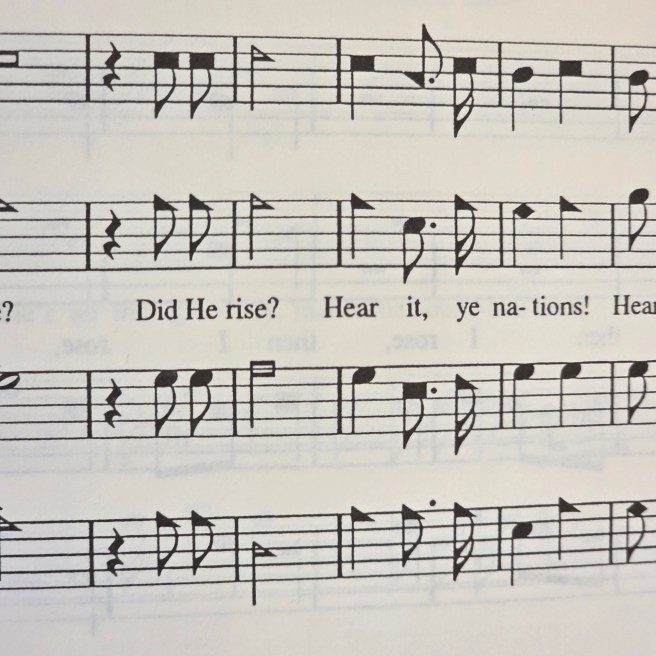
Music written with distinctive shapes for each pitch became a way of training American amateurs to sing harmony in a choir. Fa-so-la plus mi, rather than do-re-mi, for starters. Known as shape-note singing, it led to a distinctive style of hymn performance called Sacred Harp, especially popular in the South. Here’s a bit from the Easter Anthem by colonial New England composer and tanner William Billings. I learned the piece with Mennonites and can attest that shape notes can be so much fun.

THEY WERE “PKs,” meaning “preacher’s kids,” a difficult role for nearly every child put in its unwanted spotlight. Beyond that, theirs does appear to be a tight-laced family, even with its strong strain of moral and social progress. We can even wonder what the brothers’ diagnosis would have been today; there are speculations of “somewhere on the spectrum.”
Still, they did put humans into the air and, more importantly, brought them down safely.
We’ll put their technological breakthroughs aside today and instead focus on the more personal surroundings of Wilbur (1867-1912) and Orville (1871-1948), sons of Bishop Milton Wright and Susan Catherine Koerner Wright.
Like me, they were both born in Dayton, Ohio, and we were members of a congregation their father had founded. (He also founded a seminary.)
And, gee, a photo of the house they grew up in looks almost identical to my grandparents’.
Here are ten more interesting points gleaned from the Web:
For a broader view, let me suggest The Bishop’s Boys: A Life of Wilbur and Orville Wright by Tom Crouch.
The United Brethren denomination also figures prominently in my posts at Orphan George.
We can wonder how much of the history I could have captured if I had owned a camera. The images I’m digging up for this series help some, but skirt much of the grittier realities I faced.

The city itself was already well into Rust Belt decline and probably would have been intolerable apart from the hippie-era adventure of living in a college-town slum.
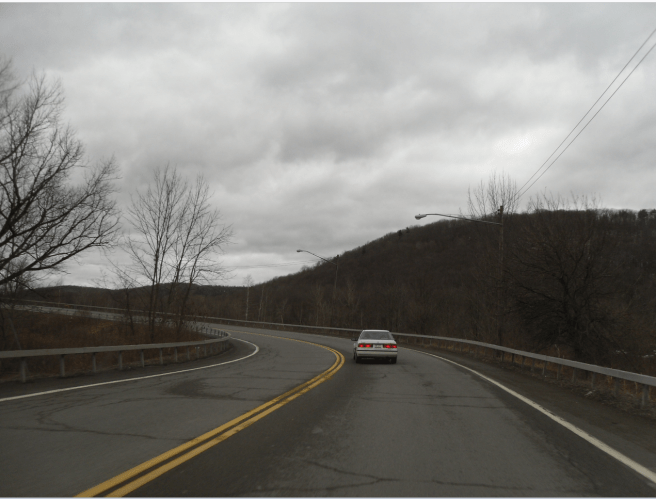
This was my introduction to the East Coast, and my first time of living in proximity to mountains, albeit the Allegany foothills of the Apalachin range (New York spellings). I was still spellbound. The region was called the Southern Tier, to the west of the Catskills and south of the Finger Lakes. The city,- or Tri-Cities when neighboring Johnson City and Endicott were included, was generally working-class and infused with a spectrum of ethnic minorities.
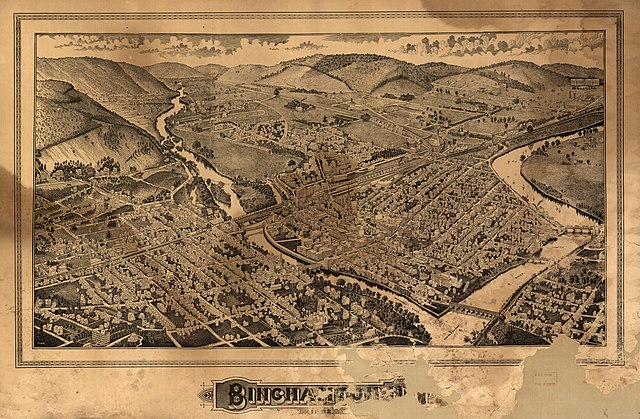
The city was nestled into the valley and once had water-powered mills along the riverbanks.
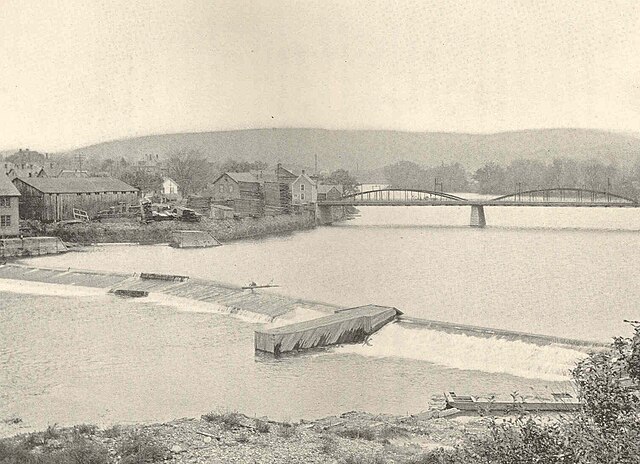
The Susquehanna itself was a fascinating river, as I present in my chapbook of poems carrying its name.
Working downward in time for our old house history meant starting with Anna M. Baskerville, the subject of a Dec. 4, 2002, post here.
We finally met her son, Reggie, and learned much more than we had already gleaned.
He and his mother came from Yeadon in Delaware County, Pennsylvania — suburban Philadelphia. Landing in Eastport was nearly accidental. His first wife had a friend who skied in Maine, and on a lark, they visited the coast, including Eastport.
That led to buying the property in rundown condition, as he says, in November 1996 to use as a vacation house. As he notes, the house wasn’t habitable beyond that but you could buy homes in town dirt cheap. His words.
Somewhat of a handyman, he set to work. The cellar was prone to flooding, two to three feet, and its sump pump, like many in the neighborhood, fed into a line that had been cemented shut on the other end. The city finally corrected that. So it wasn’t a septic problem, exactly, but definitely storm infiltration, with water shooting dramatically through the cellar walls. Somebody definitely curbed that problem before we took over. Reggie also installed covered the cellar floor with plastic sheeting topped by gravel to reduce water infiltration and make walking easier. By 1999, the house was improved enough that his mother could move in. He and his wife and their two small children also lived here a few months before moving to their own home nearby. Like ours, it was old and needed lots of work. Credit Reggie for learning to do better work than many of the local tradesmen.
As he tells it, Anna had worked hard from age six in the South, where a Black child could be hired out. From that point on, she was always at the service of others, including a large family. Once Eastport came on her horizon, she declared this would be her house. For once in her life, she could sleep as late as she liked, eat whenever she wanted, and come and go as she willed. And she pretty much did.
Eastport’s the kind of small-town community where people know where you live not by your address but by the last name of a previous owner. Give them a street and a number and they take a moment to try to determine which house you’re in., even when you tell them it’s on the corner and briefly describe the exterior. Give them the family name, though, and they immediately light up.
To everyone we’ve met, ours is the Baskerville House and likely to remain so.
I love the literary allusion, of course, to Sherlock Holmes and The Hound of the Baskervilles (and the fact it takes place largely in Devonshire, which plays into so much of my history of Dover, New Hampshire, where we previously lived.). Hound/house are, of course, nearly homonyms. Beyond that, there’s also the fact that Baskerville was a basic serif typeface back in the letterpress days when I entered journalism. The high school newspaper I edited used it for the body type. It’s an old style that largely didn’t make the leap to digital, though I see it has recently joined my Windows options. (Not so for my beloved Caslon of the same era.)
What we liked about the place, besides its location and TLC potential, was the fact it felt good inside. Close-your-eyes good, even when the room’s chilly. I’ve certainly felt comfortable in extended solitude and all the writing that’s come within it.
Something that struck me after moving to New England was how often people — even highly rational professionals — calmly asked new homeowners if their place had ghosts. I’m not kidding. And Maine seemed especially prone to that.
Nobody’s asked us, though. Instead, they confirmed that ours always felt good to them, too.
The Baskerville at the heart of this period of ownership was Anna, arriving in Eastport as a retired Black nurse.
From what I’m told, she was stout, had red hair, and loved to sing — especially in all of the churches, where she was always welcome. And she, too, found this place hard to heat but stayed in it and loved it.
When I said we’ve sensed no ghosts but the place feels good, others piped up that’s likely Anna’s presence or spirit. I’ve known similar imprints elsewhere, especially in old Quaker meetinghouses.
Naturally, we want to know more about her.
~*~
One story I heard was about her introduction to the town. She had a longstanding fear of deep water, and because her new residence was only a block from the ocean, the family arranged for her to arrive after dark and get used to the house first. Maybe they figured they could deal with any distress better in the morning.
So, as I’m told, when Anna M. Baskerville awoke and opened the blinds and saw the expanse of water, she inhaled and, as she proclaimed later, “I knew I was home.”
Yes, we know the feeling, too. And we still want to know more.
She was fond of sitting in front of the wood fire in the kitchen cook stove and singing gospel songs and spirituals. In warmer weather, she’d open the front door and sit behind the storm door, basking in the sun.
She had raised a large brood, ruling with what Reggie calls a firm hand and a low tolerance of nonsense. She was also a woman of few words. Typical was the time the Commons gallery was opening. During an open house, when the guests were conversing and eating, she began singing without any preamble. The room fell silent as she delivered “Bless This House” in her rich, deep voice. She was described as warm and supportive.
She was also a very devout member of the Congregational church in Eastport, as a fellow parishioner told me.
Everybody we’ve met who knew her has had only positive things to say. That in itself is a rarity.
In the meantime, we’re trying to keep our renovations in line with what we hope she would have approved. There are good reasons to respect the past.
~*~
So, at Registry of Deeds in Machias, I found the most recent entry by using the property plot number, the one to us in December 2020. No surprise there.
It led to the Baskervilles, of course, but before them, the Tennesseans.
The French learned some harsh lessons in their attempt to establish their first North American settlement on a small island perhaps ten miles north of where I know live.
“It was difficult to know this country without having wintered there; for on arriving in summer everything is very pleasant on account of the woods, the beautiful landscapes, and the fine fishing for the many kinds of fish we found there,” Samuel Champlain wrote. “There are six months of winter in that country.”
I’ve previously contended that New England has a five- or six-month winter, so that passage offers me some confirmation.
As that winter dragged on, however, more than half of the men and boys developed what Champlain called a “mal de la terre,” or “land sickness” – scurvy, a disease caused by Vitamin C deficiency. It was common among sailors stuck on ships for months at a time, and many captains knew to keep citrus fruits on board, or beverages made from evergreen tree needles. During the European Age of Sail between 1500 and 1800, it was assumed that half of all crews would die of scurvy.
It wasn’t pretty.
“Their teeth barely held in place, and could be removed with the fingers without causing pain,” Champlain wrote of the horrific suffering the settlers endured over the winter of 1604-1605. “This excess flesh was often cut away, which caused them to bleed extensively from the mouth.”
Eat your apples and oranges and grapefruit, then, as well as lemons and limes.
Here we are, Thanksgiving Day, and I’m finally getting around to my reactions to Nathaniel Philbrick’s 2006 hit, Mayflower: Voyage, community, war.
Admittedly, having examined some of the period he covers, from the origin of the faithful and their sailing in 1620 through their struggles up to 1677, but from the settlements north of Boston, I come at the book from a different perspective than most readers. I appreciate his efforts to present the Separatists – the term he settles on rather than “Pilgrims” – as distinct from the Puritans who would invade New England a few years later. I also appreciate his emphasis on the non-members of the faith who participated in the Plymouth Colony settlement as well as the heavy financial burden the enterprise carried, which are details I develop more briefly in my own volume, Quaking Dover: How a counterculture took root and flourished in colonial New Hampshire.
What struck me in my reading was how little awareness Philbrick conveyed regarding the activities not just on the Piscataqua watershed, the center of my book, but north of Boston in general, including Salem, especially in the years before the Puritan influx. Sir Ferdinando Gorges, whom I see as the godfather of New England, is not even mentioned, though he and his investors were active behind the scenes in England. The Piscataqua venture was a source of food for the desperate Plymouth settlement and provided twice as much funding for anti-piracy efforts, among other things.
Philbrick, not surprisingly, takes a conventional gloss on Thomas Morton and the Merrymount settlement without noting that its roots were in Devonshire folkways, not just in personal eccentricities. Dismissing him as “a jolly down-on-his-luck lawyer from London” overlooks the argument that the settlement was thriving and apparently more successful, economically and as an attraction, than Plymouth.
Philbrick’s examination of the attempted Wessagussett settlement as a Plymouth satellite clarified some of the events for me, since it falls between Plymouth and Dover as the oldest permanent settlements in New England. I am also glad that he included the struggles and near devastation of the Jamestown settlement for perspective. The Virginia colony, like the Mayflower, tends to be romanticized in the public eye. The gritty realities need to be spotlighted, too.
He acknowledges the second ship to the Plymouth settlement, the Fortune, in the fall of 1621, which doubled the population of the colony as well as its growing pains. The next ships, the Anne and Little James, arrived in the summer of 1623, but only one is named, briefly. I follow their impact through immigrant William Hilton, the brother of the founder of Dover, New Hampshire, and a Fortune passenger. His wife and children came on the Anne. Though he’s often erroneously identified as co-founder, he didn’t arrive north until he was ejected from Plymouth after he and his wife had a child baptized by the Anglican John Lyford, an event that triggered events that Philbrick briefly notes. I am now wondering if Lyford later, in 1628, performed the first Anglican wedding in New England, the one uniting Samuel Maverick and the widow Amias Cole Thomson on an island in Boston Harbor. That, too, weaves back to my book.
Within the period covered in Mayflower, Quakers were making inroads into the Plymouth colony, though Philbrick makes only fleeting reference to the persecutions led by the Puritans.
While he goes into great detail regarding the Pequot War and the one after, known as King Philip’s, he makes no mention of the mock war games in Dover in 1676 that sent an estimated 400 or more Natives into captivity and is often credited as bringing the King Philip’s conflict to an end. Some were hanged but many, women and children, especially, were sold into slavery and exported.
Still, he develops a much more complex understanding of conflicts among the varied tribes and their leaders than is usually seen. The concept of a unified “Indian” front quickly crumbles away.
I’m also interested in the Winslow lines that left Plymouth, including those who came to the Piscataqua region about the time William Hilton did and others who joined with Dover Friends in establishing a Quaker presence in what eventually became Greater Portland, Maine.
For southern New England, the closure of King Philip’s War, where Philbrick’s book ends, essentially ended the conflicts with the First Peoples. Not so in the north, where fresh outbreaks would hammer on for decades, abetted by the forces of New France, ending only with the Treaty of Paris in 1763.
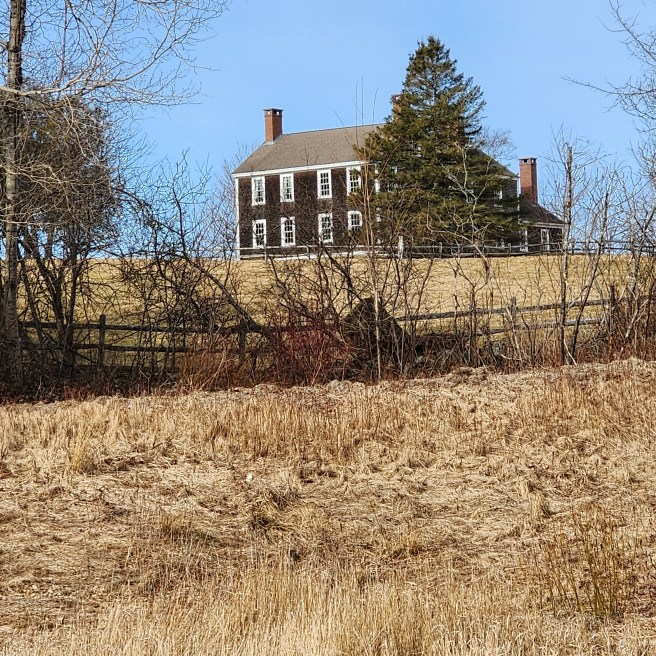
The Dr. Albert Lincoln homestead along U.S. 1 in Dennysville presents an iconic image from the Civil War era, if you catch a view while driving past. Today the well-maintained second home is also a working cattle farm.
When I moved to Eastport nearly five years ago, old-timers began telling me of the intense antagonism between the North End, or Dog Islanders, and the South End, aka Assault and Battery (for Battery Street) or Sodom and Gomorrah. Their antagonism toward Lubec just to the south was the only thing strong enough to unite them.
Yes, when it came to the antagonism toward Lubec, the town to the south, they unified in their venom, which was something like the reaction of Dog River residents toward Wolverton in the Canadian comedy series Corner Gas.
Only four months ago, at a historical society forum, did I first hear that the residential section between them – where I live – was known as Middle End, a designation that many of those who grew up here had never heard yet was common in usage by others.
It’s the neighborhood containing the majority of the homes in town, much of it proposed for National Historic Registry recognition as the Eastport Central Neighborhood district. Well, it does have its merits.
Our house would be the oldest within its boundaries, built by the man who originally held title to half of Middle End. His brother-in-law, Caleb Boynton, held the other half. Shackford’s sons and sons-in-law and presumably their wives were active in developing their share, what they surveyed with numbered plots as Majorville.
A middle, by definition, is between ends rather than being an end or even having one, I suppose. For me, that leads to a quaint contradiction. Is there even another Middle End on the planet? Google maps proffer a nada.
The Eastport neighborhood is largely to the west of downtown, with a little wrapping around to the south and north, so it wouldn’t exactly form a West End. And to the east of downtown? It’s all water and very quickly beyond that, Canada.
Well, if they had only called these “sides,” but for whatever reason, they didn’t see things that way.
The End.
 Jnana's Red Barn