The Hunter is typically a male, an image of strength and tribe. In this case, Truckers.
Citizens’ Band radio, take a totem, new name for self:
Wildcat
Canadian Redhead
Blue Marlin (a Chevy van)
Kentucky Kid
The Illinois Playboy
Bluebeard
Old Dutchman
Bumblebee
with a talking stick / in your hand, in the air / at the wheel of an 18 / yes, eighteen-wheeler
Sometimes talking four-wheeler, too:
“Four-wheeler, she’s clear”
that is, not a Bear
“Ya got ears”
“Keep an eyeball out for”
~*~
Time check
Road check
~*~
“At 205, Eight-O
westbound Bear flipping around”
~*~
“Green stamps” are dollar bills
(reflecting store promotion trading stamps
of the time)
hence, “on the green stamps”
means turnpike tolls
perhaps bridges, too
~*~
“Was you in Harrisburg Pee A last night?
I was a-talkin’ to you”
~*~
In Gilligan’s Island, meaning Ohio
during Governor Gilligan’s term
“The Bears got seventy-five dollars out of me,
lost you,” meaning fine paid
A rig is reported doing “a roly-poly,” that can’t be good.
The signoff of departing or divergent interchanges:
“Have a good trip”
“Don’t feed no Bears”
“Catch you all later”
Beginning my 30th year. [I wouldn’t turn 30 for another year. It’s just that you start life at age 1, not zero.]
Quaker Meeting in our house last night, 17 in our little place [in town], Ward’s observation, “This is a comfortable room.”
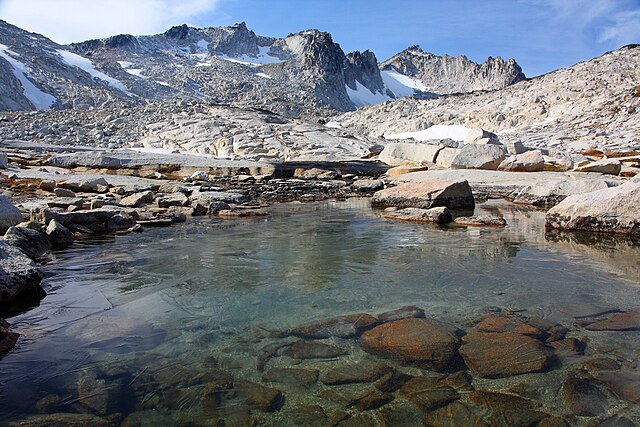
Swiss-born Louis Ulrich spoke of gearing up to ascend Mount Stewart again, “a cure or a kill.” He was in his late 70s at that point. The mountain summit rises 9,415 feet above sea level and is notorious for its rugged steep sides.
“How are you going?”
“Up my gully.”
Otherwise known as Louie’s Couleur on the official maps. He was in the trio that made the first known ascent to the summit, pioneering his technical-climbing route.
As I would discover, beyond Wenatchee and Leavenworth two hours to our north:
Enchantment Lakes Wilderness Area at Mount Stuart, photo by Jeffrey Pang. via Wikimedia Commons.When we had Meeting in Louis and Anna’s home, I was drawn to a curiously striated large rock on their fireplace mantel. It was the size of a bowling ball but much heavier. Turns out to be a mastodon tooth found on one of his outings.
~*~
Throughout our valley, set up next to the mountains, there was great concern about drought, especially the lack of snowfall, which was the source of the irrigation water.
As I noted from one trek:
The Wildcat is not raging … despite a snow shower off in the mountains …
Or, regarding the Lady in the White Continental: And since there was no snow at White Pass she took the twins and flew to Switzerland.
Thing is, she can’t ski.
Well, I’m now thinking the twins soon became Olympic skiers.
~*~
People think of writing, perhaps especially poetry, as work but here I’m seeing more the frustration when it’s constipated.
Much later, I would come to see the practice of writing crossing over into prayer.
~*~
What I couldn’t see was how much change was about to occur in the multiple fronts of my life in the coming months.
My mother-in-law sent a copy of the R-T — nothing there but sadness — the only merit to the pages at all were touches I had added: Datebook, Round the Square — a paper the current staff can’t handle …
And then, Friday night, 2 pitchers of beer with Gil, many revelations, that he has his eye on many people and when he gets his own paper, he’ll go after them … and that I’m No. 1 on his list. “It’s almost eerie how you take a project of mine and do what I want and improve on it” … would especially like to see me in a weekend editor capacity, responsible for the whole paper … also, details about the new photographer, as photo chief over Dean / fireworks … desire to revamp the p.m. edition but no idea what the publisher wants … As Gil said to Tippet: “Hodson’s my man, he never was part of the news desk pool” … that Kent can’t stand [fill in the blank], “Every office has the squealers who camp in the boss’ office” … Gil keeps waiting for the bubble to burst, for the dream to fade, but it doesn’t … [how was Kent able to create Gil’s position and then mine?] … In that regard, this was my golden era … not a later leap, back in Ohio, despite its aspirations … I came in there a step too late and D.P.’s fatal blow sent us reeling …
Here, though, our initial changes seem to be working: “We’ve thrown just about everything at you and you’ve improved it all,” as Gill confided in me.
~*~
Early February ’77:
Bummed and surprised after Whiz-Boy’s first slide show at the office and the threatened reaction of the drones, sleepwalkers like Marriott and the admen … the comfort of mediocrity, newspapers dying in their sleep versus the growth and excitement of life and excellence …
Early March:
Awoke at 4:30 despite falling off at 10:30 or 11 at Whiz and Wisteria’s, where we felt the awkwardness of office status distinctions. He was officially a step above me, meaning having dinner with the Kents and Gils the night before and, besides, they get a free membership at the Y.
My wife was secretly resentful, but it’s not a just world.
Monday night, the 4th, at work — everything going well until the end, when heds piled up (Marriott on the rim), meaning we didn’t finish shipping until 12:20, didn’t get off the floor until 1 … bad night, horoscope said it was good day for my career …
The workweek was too long. Arriving at the office on Tuesday, already a day behind. The TV booklet was due out back on Monday. On Friday I lose three hours to the arts section and meetings. No time to breathe in between, no sense of creation. That’s no way to work.
August:
Kent “unveiled” his master plan yesterday — going to a more “magazine” style (my God, how many typographical sins have been committed under that category? How many magazines practice any kind of layout of that order?). Where we had variety, flexibility, we now have one rigid style; where we once kept mediums with mediums, we are now ordered to mix them, not necessarily attractively. … We now have a complex set of directives of what size goes with what hammer, depending on the number of columns used in that instance.
The new plan requires twice the time to perform, and twice the space, of the old …
Surprisingly, Gil was never consulted. Whiz is not a makeup man; Gil is. Gil is supposed to be in charge of the desk. But these orders came down on him as much of a surprise as to the rest of us.
Realize I need to sit back now, just do my job, not offer any help (it’s requested but never used). Let Kent do himself in or split somewhere with Gil.
The entire newsroom reaction: resentment. Fishback’s Q in the staff meeting wasn’t about feature photographs at all. It was about content and guts. Just where are we really going?
Enough of this. Must remember not to pull any “grand plans” when I’m in the place. Take everyone into my confidence.
[One thing I did win here was raising datelines to their own line of type, flush right, in the manner of the New York Herald Tribune.]
Previous posts this year have presented my curiosity in petroglyphs and petrographs even before I relocated to the Pacific Northwest and saw them in the wild. That time in my life was accompanied by a growing appreciation of tribal mythologies, which I believe enhances an understanding of the region’s unique biosphere. Living at the edge of the Yakama reservation meant the ancient stories I was reading were local news.
The Indigenous spirit was something I missed in my dwelling-places since in my moves eastward across the Midwest, Baltimore, and then New Hampshire.
Eastport, however, with its Passamaquoddy legacy and presence, has revived that. The tribe somehow survived oppression and is rediscovering and reclaiming much of its culture, thanks to the pioneering efforts of individuals like the late Wayne A. Newell, who wrote more than 40 books in the supposedly dying Passamaquoddy language before his first book in English in 2021, Kuhkomossonuk Akonutomuwinokot, Stories Our Grandmothers Told Us.
The late Fredda Paul was doing something similar within herbal medicine and healing lore, while also continuing the storytelling tradition. They are both deeply missed.
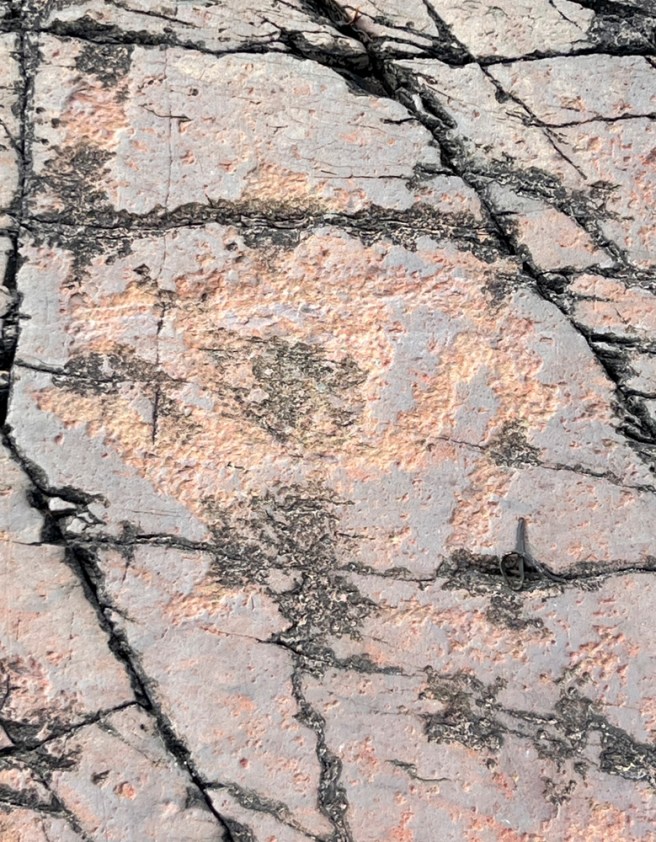
Tribal historian Donald Soctomah has furthered their work. These days, he’s part of a circle documenting and preserving the local petroglyphs in the face of rising sea levels. His online presentation earlier this year with the Border Historical Society in Eastport had me realizing I may have been overlooking impressions here – many are stippled into the rock surface in a way that they’re visible only early in the morning or late afternoon, especially if the stone is wetted. A video, A Song of the Drum, and several short YouTube videos from Machiasport can be found for free online.
This petroglyph depicts a woman giving birth. It was chipped into rock using smaller stones, a style different than the long incisions made by sharper instruments.
Another wonderful video, Rhythm of the Heart, on the life of birch-bark canoe maker David Moses Bridges, is also available for free online. It’s a moving testimony. He passed way too early.
In reviewing my journal scribblings, I’ve been surprised how little I recorded about my introductory months at the Herald-Republic. By the way, that had been “Republican” for much of the paper’s history. What I am seeing, though, is how much I was Gil’s right-hand man, rather than the newbie at the bottom of the pecking order. Still, I was a utility player who had to jump in wherever the need arose. Not exactly a floater but close.
For the first time in my career, I was working closely under a manager who was actively grooming me. It was definitely different from my internships at the Journal Herald, which had presented some solid coaching all the same.
I don’t know how much of this period was reacclimating myself to daily journalism after my year-and-a-half break in academia, but in addition to adapting to a new landscape quite different than any I had known, I was also observing the lay of the land inside the newsroom, where Kent and Gil hadn’t made any big changes yet.
Astrologically, my Aquarius was a complementary opposite to Gil’s Leo, and from the ashram, I had learned to let him shine. In return, he respected my need for independence. It worked well. He was an avid sports fan, contrary to me, and had even been executive sports editor at the Miami News in one of his stints.
One bit of interesting coincidence was that in the Air Force, he had almost been posted in Enewetak in the Air Weather Service, 1957-’58, when Sam [my father-on-law] was the meteorologist in charge during hydrogen bomb tests.
In trying to catch up now, I see that he was born in Omaha in 1936 and died in Newburgh, New York, in 2015. I always thought of him as a Californian and learn from his obituary that he moved there after his military service, attended college, and then worked at a series of California papers before joining Kent as the assistant managing editor in Yakima.
~*~
As for my floater situation? As I noted:
Tenth straight day of work. The Sunday night/Monday morning doing me in. But have built the GR boards (timeless backup stories ready to paste up if the system crashes) and removed deadwood. …
On day shift this week and told I’ll be editor of special sections — day shift, M-F, beginning early December … [four months away] .
~*~
Photo by Cacophony at Wikimedia Commons.
~*~
Should you wonder why I go by Jnana:
Ours was a newsroom of Jims: both the current and future publishers, the city editor and his assistant, the sports editor, our local columnist, maybe a reporter or two … ultimately, a third of the males in the newsroom … as for the composing room, advertising, the pressmen? It was like being named “Boy.”
Even so, I was back to my pedestrian given name in this setting, unlike Bloomington. Here, Jnana became reserved for my friends, fellow Quakers, and literary endeavors. You’ve probably figured out by now that I have often functioned by relying on a compartmentalized life.
In the initial job description, if there had actually been one, I would have been doing some basic reporting, including the lead for Crossroads, the weekly religion tab section we ran on Saturdays.
I was also working nights and weekends, including one Saturday or Sunday night when I wound up in the copy desk slot rather the rim after Belcher handed it over to me after he had had it with superiors’ memos. We finished pasteup with one minute before the 12:30 deadline. I’m a whiz.
My basic schedule seems to have been day shifts, 10-7 tues-fri, then late weekend Saturdays while Gil’s in slot. So I do scrub work on advertising-driven special sections and love it … He’s appreciating my willingness and flexibility … he asked about weekend slot, “Kent was in Sat.” and then asked if I was comfortable there, adding he has plans … so things looking good (did new TV listings logo last night, it’s OK) …
One reporter’s husband had Keogh as his PhD chairman at IU… turns out Rash is the top man in his field in the country, yet one more humble Quaker in my exposure.
In retrospect, the early office was more conflicted than I recalled … my erratic hours did give me most Mondays off …
Kent’s big dream, with me being assigned much of the effort, was a weekly outdoors tab to be called Action Northwest. At this stretch, it was still in the early planning stage.
Essentially, I was learning the local ropes first.
As my Bloomington/Daffodil entries in this presentation became grouped by subject, rather than chronological order, we lost a sense of the progression of the notebooks themselves. Take a look now.
18, Cornell Campus Store, 90 sheets, kraft cover. Undated. The Cornell spiral-bound lined volumes have wide margins, 3½ inches. My, how I loved those wide margins! Such luxury! Poetry drafts, early ashram experiences. A few bits saved for possible current poems now.
19, Cornell Campus Store, 90 sheets, kraft cover. Undated. Let me repeat, these Cornell spiral-bound lined volumes have wide margins, 3½ inches. More poetry drafts, early ashram experiences. A few bits saved for possible current poems now. (How is it I had a stash of these varied campus notebooks?)
20, Cornell, 90 sheets. Undated, except one entry in late November. “Swami Jnana-Devananda into winter: ashram.” Mostly quotes: Zen, Ginsberg, Hutterites, etc. Includes Swami’s return from first India trip. The onset of my ashram residency. 23:XI:71
Vol 21 Winter ’72: ashram. Begins with our first week-long seminar. Some really bizarre group action, both from the guests and the staff. includes trip to Ohio for Grandma’s funeral; she died June 21
Vol 22 summer ’72, ashram, and well into autumn. More tracings in the water / into Sannasyn, 8:VII:72 11:45 am.
Unnumbered red cover stenographer book, mostly October 1972. Includes trips to New York City and Binghamton.
Vol 23? Starts 23:XII:72 and ends with leaving ashram.
Vol 24? Miscellaneous, though where the pages fit in is uncertain now:
24, Yellow Varsity. Has inner cover His Holiness Sri Swami Jnana-Devananda in the middle of Erewhon 22 January 1973. So my ashram residency ended earlier than I recalled …
25, green Indiana cover, beginning 19 February ’73 in a Bloomington visit, then turning into the first of the Fostoria series. Some overlap with the previous volume.
26, hunter green cover, beginning December 1973. Filed out of sequence, opening with many Tibetan notes. Three-inch left margins.
27, blue IU (Aristotle’s Inc.), 23:III:73 on inside cover
29, hunter green, 17:I:74, Fostoria. By now I’m dating the entries, in one of the new styles (colons or periods, depending). National Blank Book Company Holyoke, Mass. Wide margins!
30, BGSU, 24:VII:74, Fostoria. Verge of marriage.
END OF CRATE 1: the plastic milk carton cubes, which were so handy in all of my moves from place to place and then turning into instant bookshelves later. Remember those?
31, Hunter Green cover, begins 18:X:74 Another wide-margin notebook. Glory be!
32, avocado green Penrite 4 Subject Divider Theme Book, 98 cents, 2409 W. Second St., Marion Indiana 46952. Undated entries, mostly stabs at verse and a few other notes in closing up in Fostoria and traipsing on to Bloomington. The last three divider sections remained blank.
28, green Campus twin-wire, 59 cents, product of Mead Corporation, Dayton, Ohio. Out of order.
This does have me wondering if you saved any of your college notebooks or the like in your life journey to wherever you are now. What souvenirs have you kept? Or what have you intentionally discarded? Perhaps even with regrets later? Photos, letters, cards as well?
By the way, I hate to think what a spiralbound notebook costs nowadays.
The first of my extra-long spiral notebooks was a, Citadel, 8-by-12½ medium ruled with a 3-inch wide margin.
Begins on the new moon, 28 June 1976, “as we await our future.”
We were back house-sitting on Harrison Lake, just a sliver of that moon against caps of rosy storm clouds over the hardwood hills at the end of the water, one of a series of lakes backed into the first of the “Brown County mountains.” Elsie Sweeney’s palatial contemporary temple overlooked everything, facing the sunrise. [She was a spinster philanthropist from the Cummins diesel engine family.]
Also:
Nervous about job interview, Center for Law and Poverty. Bought new pants (fancy but I can live with them) and tie. Actually, for Yakima, if that works out but will do the dry run with this.
Indianapolis more active, dressier, cosmopolitan than I’d seen it before. The director was pretty mellow, surprisingly so. The job was $9,500 to $10,500 a year, with four-weeks’ vacation. I would have to develop contacts, write my own material, edit, etc. Doesn’t look too bad, if Yakima doesn’t come through. Some PR and video work, too.
Fourth of July fireworks in Woodsville, after worship in Waynesville earlier in the day. Different corners of the state.
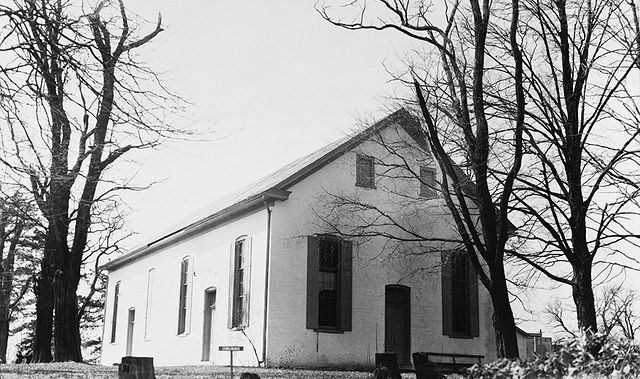
The Quaker meetinghouse in Waynesville, Ohio, in a 1937 photo by E. Schrand and J. Mitchell via Wikimedia Commons.
Waynesville Quakers — Miami Monthly Meeting. The house of worship was built in 1810, during Madison’s administration. It originated with South Carolina Friends (Quakers) who nearly all relocated north in reaction to slaveholding. Many came first to Waynesville and then moved on within western Ohio and all of Indiana. Miami Monthly Meeting held their memberships until new meetings were established, resulting in Waynesville’s being the largest monthly meeting in all of Quakerdom by 1805 and explaining the large size of the house, with three rows of facing benches (the ministers and elders’ gallery). It’s the oldest meeting west of the Alleghenies. (A detail that may allow Friends in Tennessee some leeway.) The meeting was central to the Underground Railroad, I was told.
Worshiping there was a fine way to spend the Fourth of July 1976, the bicentennial of the nation.
Do note, the Underground Railroad was founded and organized in the South.
Followed by limbo
Feeling of hopelessness, of inutility, a faith-draining thing. This waiting, suspension, is costly: can’t send any poems out (mss), we don’t expect to be here long. Kat can’t sign up for summer school, we need the funds and must be prepared to run. Plus the energy lost sending our job applications, etc. the money in samples and resumes (a quarter each) and postage. “We’ll be back to you in a week,” the liars, so polite.
Waiting for mail that doesn’t come, telephones that do not ring.
And then the whirlwind
Weir Cook airport, same rotunda where I departed on my first-ever flight (the Florida Easter). Put together the details for the Yakima trip yesterday afternoon.
Sentimentality now about Daffodil/Bloomington. Figured out what’s bugged me: everyone is so slow — the farmer syndrome.
Is the Waynesville Meeting working its magic again? (The Fostoria job came through after I worshiped there …)
Can we afford the move ($1,000 loan from my parents?). Will all of our goods fit into an 18-foot U-Haul?
Washington state newspapers seem to have the fanciest letterheads: color print jobs, imaginative graphics. A good sign, it seems.
Bill and Mig stopped in Chicago, hoping to see his brother still alive. Instead, Bill arrived in time to conduct the funeral.
The interminable earwash of airport lounges. Last time I flew American to the Northwest was breaking up with Nicki.
Bob Suter’s advice: “Don’t stick your finger in front of any turtles”
Long trek at O’Hare to new international section — Customs and all the rest — not much traffic, empty inside — airlines share the gates — glassed-in halls within halls — was beginning to wonder if this flight was going on to Japan or if I had the wrong gate designation …
Midwestern farming towns, seen from the air: two parallel tracks cut through: one the highway, the other the railroad tracks Can hardly tell which is which, shining in sunlight: white concrete, white gravel, plus white blazing roofs.
2½ more hours to Seattle
Over central South Dakota, at 35,000 feet the outside temperature was minus 59 — Centigrade!
Flying over Billings, Helena, Great Falls — echoes of that futile trip to lure Nicki back … my first Far West exposure …
~*~
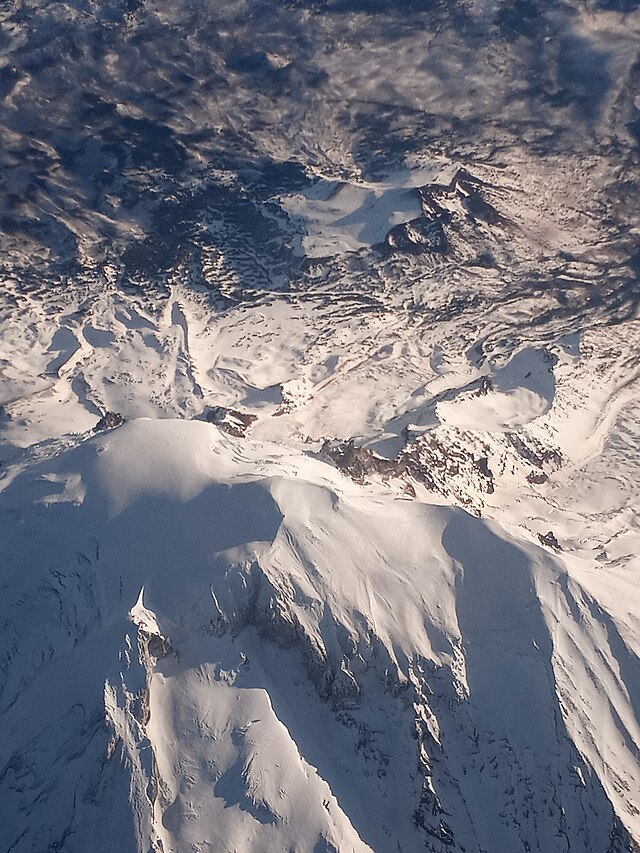
The sky scudded over from there. Only gray below me. But then, at one point, I looked down at something incomprehensible and amazing.
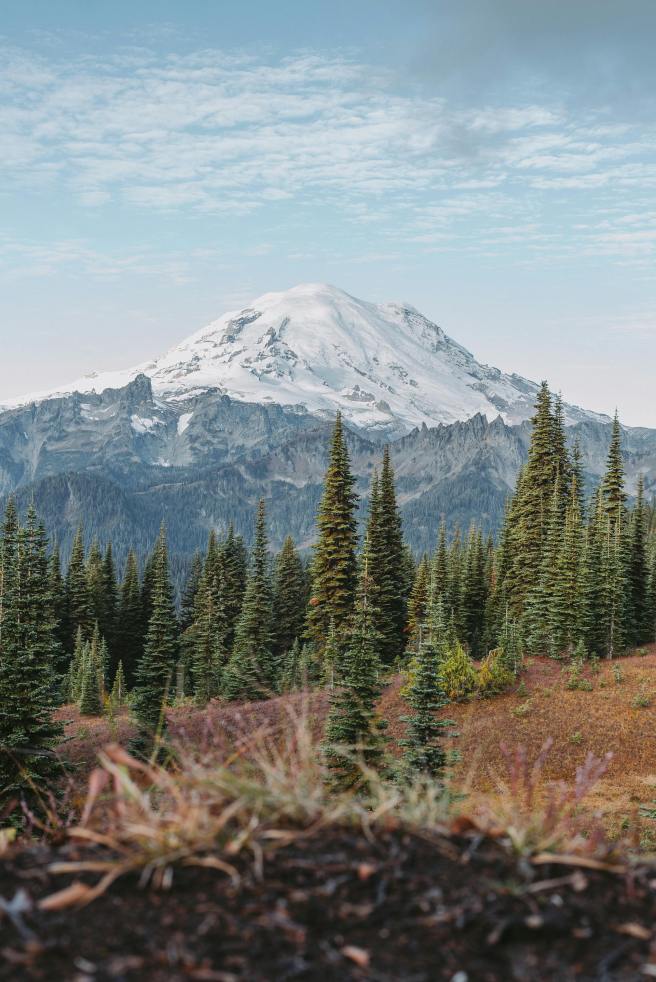
Rainier from above by Feed Me Paper at Wikimedia Commons.
Yes, we had flown directly over Mount Rainier and its glaciers.
~*~
As for the rest of the trip?
Don’t think things today could have gone much better. Spent six hours with Kent, the m.e. Lunch with him and Gil, the assistant m.e. (who was critical of some of my layouts with Marcy’s photos … and one pic I should have cropped). Gil telling about almost grabbing rattlesnakes beside lost golf balls … sluggish, unmoving bastards, sez he …
Good meeting with Human Resources, too. (Is the department always headed by a woman?)
A short meeting before I left. Accepted the offer, $260/week … more than double what I had been earning …
Sounds like I’ll be doing mostly editing, special sections and weekend news, as well as lead articles for Crossroads …
[I should note that this flight was also at my own expense. If the job had not come through, we would have been screwed.]
Back home
Received a letter from Indianapolis, no dice, as if everything were working with Divine plan …
Maybe they didn’t like my looks? You never know.
Indianapolis? I’d just as soon live in Scranton.
Got a few nice poetry rejection letters but mostly silence …
As you’ve noticed, I fell into the practice of journaling rather haphazardly. At times compulsively, even. I started to say the “habit” of journaling, but it was rarely that effortless,
I was still in spiralbound volumes — eight years before a stretch of using hardbound sketchbooks followed by a return to spiralbounds before the hardbounds took hold a dozen years after the journal at hand.
No. 45, for those keeping track, was the first of the 8-by-12½-inch books I’ve truly appreciated. The added inch-and-a-half of length fit my hand and pen well, though not the bookshelves or the milk crates that generally wound up holding my journals.
Eventually, there were 17 of those in all, plus three fat softcover sketchbooks, 15 black-cover spiral sketchbooks, and three bargain thin hardbound journals nearly that tall. Thirty-eight in all, out of 200-plus. Why did that shape vanish from the market? Probably because I preferred them. I have long run contrarian to the marketplace, not exclusively involving my tall, skinny clothing size.
Somehow, I had thought that my legal-size notebooks started at the Cornell bookstore, but it now looks like my first ones were bought in Bloomington.
In looking up what’s called “legal pads” (as if the others are clandestine?), I find most today have shrunk to 11¾ inches height, though at least one exists at 8½ by 14 for those willing to pay a premium. And that’s not bound. As for filing those in storage cabinets? I’m not a lawyer nor a legal secretary. It no doubt requires special filing furniture.
~*~
The first third of the volume covered our final month-and-a-half in Bloomington, aka Daffodil, followed by my flight to the Pacific Northwest.
As I look ahead, I see pages that were used to draft and refine poems that found publication as well as other entries that more or less became fiction in my novel Nearly Canaan and the third novella in The Secret Side of Jaya.
I’ll skip over those in this series and instead look for the unexpected.