Do you ever feel trapped by your family?

In my novel What’s Left, Cassia’s brothers and cousins — the ones she calls the Squad — are essential for bringing the story fully up to right now. It’s their turn to move forward. What do they want to do with their lives? What does this family mean to them?

Cassia makes her own bold decision for her future — one I sense is enabled by their solid identity.

But there are the other cousins — the ones from the other side of the tracks, the ones who don’t fit in and never will.

So it’s not just about the family restaurant.

~*~

As she noted in an earlier draft, comparing her mother’s side of the family to her father’s:

From everything I’ve seen, his family wasn’t warm or truly close. They did what they were supposed to. Had what they were supposed to. Basically, they followed orders. So what Baba found and embraced with Manoula’s family was more disorderly and conflicting and yet also affirming when it came to his own existence. Privacy here is not taken for granted. Thea Nita, for all of her love of solitude, would spend far more of her working hours surrounded by the public, where the action and people were. Maybe that’s why the Buddhist meditation held such appeal for Nita and her siblings — it was one time they could really focus on themselves alone. 

~*~

There are flip moments when I’d say my family was defined by the TV programs we watched together. Think of the TV dinners we ate on those TV trays we set up between us and the screen (black-and-white, for the most part). Even the pizza we ate on very special nights, scraping off the toppings to eat separately from the dough and its crust. Or the burnt popcorn we ate afterward.

Cassia’s close kinship was more active than that, but working with her father’s photos did give her a place of retreat.

Do you ever feel trapped in your family? Or in your social circle? At moments like that, where would you rather be?

~*~


When one road’s blocked, try another

Sometimes details advance a story. And sometimes they raise unnecessary hurdles. In my novel What’s Left, what Cassia discovers about her deceased father (her Baba) is much better than this. So I cut it.

Hey, how many 12-year-olds would even know what a biochemist is? Or, for that matter, 16-year-olds, depending on when she’s making the connection? You still get the drift in the final version.

Under a different system of education, he might have become a biochemist or mathematician. He had leanings that way, which were not supported over time. So instead, he became a photographer — a very adept one who leaves behind what I’m finding to be an astonishing archive of social upheaval and redirection.

~*~

Oh, my, she wouldn’t ever say that last sentence, would she? Of course it had to go!

The point of her observation, though, remains pertinent. Many kids are thwarted at key points in their development, not just educationally, either.

What would you say has been a crucial obstacle in your past? How have you coped? Has it changed the direction of your life?

~*~

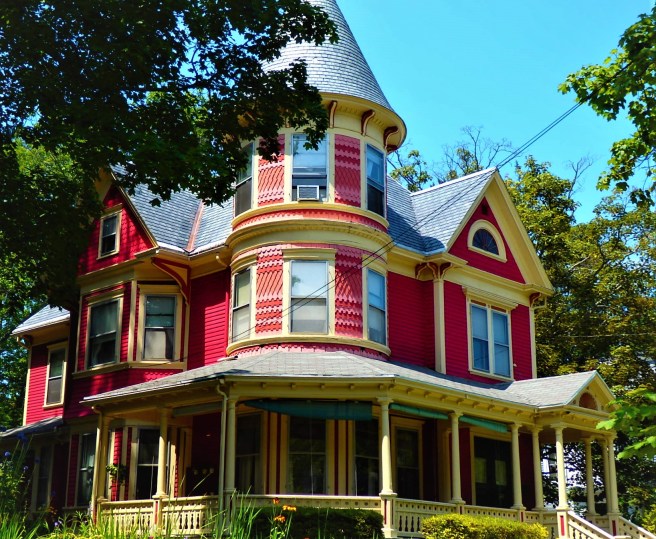
A large Queen Anne-style house with a distinctive witch’s hat tower something like this is the headquarters for Cassia’s extended family in my novel What’s Left. If only this one were pink, like hers.

~*~


High on the trail, the view becomes clearer

In my novel What’s Left, what she discovers about her deceased father (her Baba) is much zestier than this passage. So I cut it. You’ll still get the drift in the final version.

As a kid, your Baba figured out he never quite fit in with his surroundings. He thought about things he couldn’t explain to others, though to be fair about it, he rarely caught their signals, either. Deep within himself, he sensed there was much more to life than what was happening around him. I think he wanted the big picture, which is what he must have felt when he was climbing mountains.

~*~

Too many things are trying to happen there, I’m afraid. We can move along better without having to trip over the added baggage. I do like the image of climbing mountains to feel the big picture, though — something I see as recharging his soul.

Where do you turn to recharge yourself? Anyplace special? Music? Dancing? A deep bubble bath? Meditation? Or is it something else altogether?

~*~

I’m also thinking about typical encounters with professional photographers. There were strange, formal portrait sessions when my sister and I were very little. Do families still do that anymore? Then there were the senior portraits in high school or yearbook group shots, which were akin to elementary class pictures earlier. But weddings are the big event for many, the mother lode of the profession.

Tell me about your parents’ wedding pictures. What do they reveal? What do they mask?

Greek-run restaurants are a staple of the American scene. Cassia’s family ran one. This was another, in Lowell, Massachusetts, where her aunt Pia was from.

~*~


An aside on poetry readings

Catching up on my stack of Harper’s magazine, I came across a remembrance of the poet Etheridge Knight, and it stirred a long buried memory.

Etheridge? I paused, before remembering he was a black inmate of the Indiana State Penientiary when he began writing seriously. Damn good stuff, as I discovered.

My introduction came in the mid ’70s when Roger Pfiingston asked if I wanted to go with him up to Indianapolis, aka Naptown, to a reading and open mic. I was free that night. The trip from Bloomington was a little over an hour, and he was driving.

The event was at a bar in the inner city, not a familiar terrain, and Etheridge was hosting. I should go back to my journals for details, but I recall it as a warm and comforting evening. I think Jared Carter was the featured reader. Another damned good Indiana poet.

I was a bit nervous about one of the pieces I’d brought with me, one that quoted a friend’s father about a lover in the ’30s, but I read it anyway.

The line in question triggered delighted, loud laughter from Etheridge, especially. I was sooooh relieved!

Looking back, I see it as one more confirmation – and welcome – as my identity as a poet.

What a wonderful community!

Simply building the hole in the doughnut

The application of positive and negative spaces — that is, the contrast of light and dark — is a basic concept in visual art. One of these will appear solid; the other, empty. Think of black versus white, with no shades in between.

In another way, think of a doughnut or bagel, defining an empty hole.

In my novel What’s Left, she applies a similar strategy after her father vanishes in an avalanche when she’s 11. She yearns to know much more about who he was — in fact, intends to recover him in her own way — so she assembles everything she can find to create a positive impression and then dives into the remainder, the negative, to dig up the rest. Maybe you’d see this as trying to assemble a jigsaw puzzle.

Since he was a professional photographer, she carefully investigates another kind of negative for answers — the many strips of film stored in his studio. At first what she views is reversed from normal perception, where everything that’s light should be dark and everything that’s dark should be light, but then she learns to transform what’s there into contact sheets and glossy prints. Just like he did.

Photo studio trash in the old day, back before digital took over.

Thanks to digital photography, negatives are ancient history. Maybe that’s somehow appropriate, since Cassia’s life at that point would now be ancient history, too, even as she’s investigating what she would consider ancient history.

Have you ever handled photographic negatives? Is there some other way you’ve looked at things reversed from normal? How about funny mirrors? How did it change your perception?

~*~

Remember, What’s Left is available at Smashwords.


What I’m encountering in a raft of ebooks

As an author of ebooks, I’ve been lately engaged in an orgy of reading works by my fellow Smashwords writers. Admittedly, many of my selections have veered toward writings that reflect topics in my own novels – hippies, yogis, subway riders, millennials, Buddhists, Greek-Americans, and the struggles of new adults, especially. Still, it feels good to get a sense of what others are up to, and their formatting does give me a better sense of my digital options.

As I do so, I often leave brief reviews as a guide for other readers with similar interests. You have no idea how much these mean to a writer, so let me urge you to do the same whenever possible. As one responded, just knowing that she was heard was warm and welcome affirmation.

Just because many of these books are what the big imprints would deem “not viable for commercial publication” does not mean they lack value.

One of my favorites is a two-part memoir by the daughter of Lebanese immigrants who wound up in Nebraska somewhere around the turn of the 20th century. Her candor and details, however simply told, strengthen my understanding of what I present as Cassia’s ancestry in What’s Left. I dread to imagine what would have happened to the memoir in an attempt to jazz it up for wider sales. We should feel honored being allowed in behind the doors of a particular family history so honestly revealed.

It’s something like visiting artists’ studios or art galleries rather than going to the big museums. The scale’s definitely different.

One thing I’m finding is that I apply a more laid-back standard in reviewing these volumes. Yes, they are cheaper, for one thing, but I also read these more like manuscripts than finally processed books. I’m looking especially for freshness and energy, the edge often absent in the book industry. Remember, the big houses no longer nurture talent in the hopes of reaping a hit five books later. Everyone has to start somewhere, and this is where the action is now. Besides, even commercially published works these days aren’t particularly well edited. Alas.

Still, I’m having some common complaints, the pet peeves of an aging copy editor.

“Grey” instead of the American “gray.”

“Towards” rather than the American “toward.”

“That” instead of “who.”

Punctuation errors, especially with single and double quote marks.

Short stories posing as novels. Admittedly, I’m frugal, but these short entries are rarely worth the same as a fully fleshed out book.

To see what I’ve been reading, go to the book reviews at my Jnana Hodson at Smashwords page.

Got any favorite ebooks to recommend?

Entering a photographer’s private world

Her father’s photographic trove gives Cassia the pieces she eventually assembles into a massive picture puzzle of his world. It spans some big changes in his own life, as well – especially regarding her own family.

In my novel What’s Left, this task also means she has to master some now obsolete technological skills, including reading photographic negatives, where blacks and whites are reversed, moving around in a dusky darkroom, using a photo enlarger, and developing glossy prints in trays of chemical liquids she’s mixed on her own. (My, have those things changed thanks to digital photography!)

Continue reading “Entering a photographer’s private world”

Kinisi, from Greek for ‘motion’

I’ve long been fascinated by the inner workings of English in very short segments. Typographical errors, for instance, when they seem to release some other possibilities. Aram Saroyan’s Lighght would be a prime example, presented as a poem in its entirety.

We accept the silent “gh” without question in conventional writing, but a second one brings us back to the perplexity we had as children learning some very strange spellings. And then, maybe, it points to the wonder of light itself.

There’s also the question of just how short a poem can be. One word? Two? A single line? Two lines?

Beyond that is the concrete poem, including those where typography itself seems to embody its own beauty, apart from any obvious meaning.

More recently, I’ve become fond of two or three synonyms or antonyms in juxtaposition.

I’ve played with all of these concepts, some of the results now appearing in my Thistle Finch chapbooks and others in my Kinisi series here.

And some of them could simply be prompts for a writing exercise.

Trying to figure out what to call them has always been a challenge. I wound up with Kinisi, from the Greek root for kinetic, when I noticed what attracted me to these fragments was some mysterious innate motion generated by the bits.

Here’s hoping they leap and dance in your imagination, too.


Ten things ‘What’s Left’ and ‘Nearly Canaan’ have in common

Considering that they were drafted 30 years apart, I thought these two novels would have nothing in common.

Boy, was I wrong.

Here are ten overlaps.

~*~

  1. American Midwest. Southern Indiana for Cassia. The Great Plains or somewhere similar for Jaya and Joshua.
  2. Asian spiritual practice. Tibetan Buddhism for Cassia’s father. Hindu-influenced yoga for Jaya.
  3. Relationship and family focus. Five generations for Cassia, including her close cousins known as the Squad. Three same-age couples for Jaya, plus her in-laws and landlords out west.
  4. Livelihood. Family-owned restaurant and real estate for Cassia’s clan. Nonprofit public services for Jaya.
  5. Women in business. Cassia’s whole family, from her great-grandmothers down to herself. Jaya in nonprofits management.
  6. Career uncertainty. Cassia’s cousins have difficult decisions to make about whether to stay with the family business or find other livelihoods. Three of the spouses in Nearly Canaan struggle in their search for suitable employment, while the other three are caught up in their professions.
  7. Far West. As a young adult, Cassia works with clients across the western half of America, while Jaya and Joshua eventually relocate to the Pacific Northwest.
  8. Death and loss. They’re central to both books.
  9. Food. Cassia has all of that Greek heritage. Jaya and Joshua move to a land of orchards and fresh seafood.
  10. Restaurants. Cassia’s family owns a landmark café. Jaya is introduced to Joshua where he’s a flippant waiter.

~*~

Any of this appeal to you?