Yeah, yeah, yeah, what do I know? Like I’m an expert on anything?

Through the period of my life right after college, I kept relocating every year-and-a-half to a new job and location. The shock provided more grist for my writing than I would have anticipated, but not the time to digest it.  Each round, I was just getting settled when I was interrupted and uprooted. That set me in four different states over six years at the beginning, followed by three more over the next ten. Altogether, that added up to 11 mailing addresses in seven states before I packed pack up for New England. No matter how adventurous I might find adjusting to the new environments, it was ultimately stressful. There were days I hardly knew where I was waking up. More emotionally difficult has been the way friendships fade over such distances.

As a writer who was also tackling the demands of a new job, I had little time to digest the fresh material, much less revise it, either as poetry or prose, especially if I wanted to dig beneath the surface.

As for my love life?

It’s a wonder I didn’t go loco.

Beware, the Romantic Cult of the Artist

Yes, we’ve admired madmen, especially those of a tragic sort via what I see as often incestuous works of art. You know, celebrations of other works of art or, especially, their creators.

In effect, there’s a question. Other works based on mythology, classical or Nordic, typically, face immortals who are still caught in some dimension of time – how else could they spawn children?

Turning the focus from flawed gods to the Immortal Artist, then, implicitly asks: Are madmen closer to God? Or filled with demons to be cast out, perhaps as artworks?

You know, the cliché history of poet suicides or pianist-composers who die at an early age or libertine actresses, that sort of tragedy, not always as a consequence of defying the gods, either. Think of all the poets in the core opera librettos – a shorthand for the librettist himself or the social commentator – as well as the composers or singers. It’s a long list.

Remember, too, in many Native cultures, there’s a special place for the madman as gateway to ancient wisdom or healing or a netherworld.

Admired madmen but also feared them. Just don’t get too close, even with a morbid curiosity.

Like the artist, they exist at the fringe of the village.

It’s implicit even in hymns about hymns and the raising of voices.

And also my speaking here as a fellow poet and novelist.

~*~

It’s hard to look beyond our own boundaries and explore the greater world beyond.

This is crucial, if we’re to engage others, in light of murder, rape, warfare, and other oppression and injustice around us. Is art really far from fostering imitation in life itself? Or is it rather for escape from any reality? Do we desire encounter or flight?

Earlier, I admired dazzling tricks and outward style, derring-do, and jests with fancy footwork. Shining surfaces and surreal images.

Over time, that’s changed.

My heroes have become more human and flawed, as well.

~*~

Throughout much of Friends’ history, many of the fine arts were offensive to the faithful; most painting, drawing, sculpture, fiction, theater, music, and opera were seen as superfluous vanities, engagements that took our attention away from worship. “We Quakers only read true things” is how one Friend expressed the matter when returning an unread novel to a neighbor. For a people who refused even gravestones, worldly adornments detracted from loving a heavenly Father with all their heart, mind, and soul, as well as loving one another as Christ had loved his/its followers.

Tertullian issued a related warning, in De Spectaculis, Latin circa 200 CE. Essentially: “The Author of truth loves no falsehood: all that is feigned is adultery in His sight. The man who counterfeits voice, sex or age, who makes a show of false love, anger, sighs and tears He will not approve, for He condemns all hypocrisy. … Why should it be lawful to see what it is a crime to do?” (Translation by Kenneth Morse)

As was recognized in Zen some centuries ago, when people started writing and singing and painting and acting from their spiritual practice, the flowering is already past its zenith. Nonetheless, we also know the power of the Zen-suffused works as they extended on to pottery, architecture, tea ceremony, even martial arts.

When I view Japanese and Chinese art, the Zen/Chan pieces jump out in their freshness from the well-schooled stream of traditional art.

Thus, with poetry or musical performance that knows living silence: a whole higher dimension. Necessity for revolution here. Transformation. Transfiguration. Transcendence. Transparency, too.

Is this a matter of like recognizing like spirit?

~*~

My real distrust of the celebration of the artist as a demigod comes in a plea for greater humility.

Yes, we work – as the poem Toltecatl, translated as “The Artist” by Denise Leverov details lovingly before countering with “The carrion artist: works at random, sneers at the people, / makes things opaque, brushes across the surface of things, / works without care, defrauds people, is a thief.”

The contrast is telling.

We’re hardly alone in work. Plumbers work, paying the price in their knees. Farmers work. Teachers work. Mothers, especially, work. Go on down the line, and admire all who do so with developed skill and intelligence and service. Who can say one field is truly superior the others?

~*~

I’m left wondering about a crossover identity of artist and priest, an expectation that the artist is expected to guide others into love or even the natural wonder around us.

It’s a fine line, between being a priest and a demigod. An inflated ego is a constant temptation, among others.

Still, how can I not love the movie “Amadeus”?

Who do you look to for inspiration?

I’m looking for a new motto

I really didn’t use this online, but it did give me a focus:

blogging about Dover

and the world beyond

But now I’ve packed up and relocated. The way this Red Barn blog functions, though, Dover will continue to be a big part of the lineup. It’s a happenin’ place, for one thing, and my next book is a unique history aimed at the community’s 400th anniversary, which takes place in 2023.

As I refocus, I’m open to suggestions. Officially, the heading’s subtitle used to proclaim “a space for work and reflection.” Somewhere along the line, it became “come view the world from my loft,” but now even that is, no pun intended, up in the air.

This blend of here and there has me thinking of dreams, which have one foot in the present and one in the past, or so I’ve heard. From previous moves, I know that my previous home will be part of my awareness for a long time ahead.

Thanks for the memories. And for the new adventures.

Now, though, how should I define my new reality?

How does the rest of the family face up to the challenge?

Family-run businesses present their own unique operating models.

Under the ideal version, the members have an understanding of each other and their mission along with a loyalty that’s unrivaled. The business is part of their identity. Each member of the family understands his or her abilities and place in the enterprise. Often, they learned the operation from childhood on, starting at entry level. For their employees, however, that can come at the price of exclusion and upward mobility.

Sometimes the organization is headed by a patriarch or matriarch with the authority to make and enforce difficult decisions. In this model resentments and perceived sleights can mount over the years before erupting. Or the family head may no longer fit the kind of executive the company needs at a particular stage of its growth; a founder, for instance, may have technical expertise but not the people skills for marketing or adapting to a changing market.

What have you seen or experienced?


Their turn is coming up

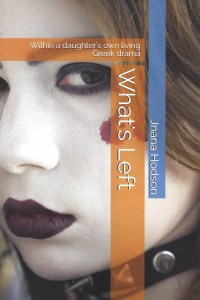
In my novel What’s Left, her generation of the family will face some crucial decisions that resemble those their parents were charting when her father-to-be showed up in the household.

In a passage I cut from an earlier draft, she wonders:

What would you do?

While Dimitri and Barney have niches in the business, Nita has her chosen career. Tito, meanwhile, will likely have his hands in both the Zap enterprises and an independent law firm.

That leaves Manoula, who hopes to head off in a literary direction, not necessarily as a writer.

~*~

As I’m revisiting this, I’m getting a bit steamed. I realize how little guidance I had regarding my future. We didn’t talk much about it at home, and even college was somehow mostly off the table. The so-called guidance counselor at my large high school was mostly a disciplinary officer and military-draft registrar. College? No help from him!

I got more from the editor of the first newspaper that hired me as an intern. He had a knack for nurturing talent. I just wish he hadn’t retired when he did.

Dimitri seems to possess much of that skill, perhaps even more than Nita. They’d likely ask:

What would you really like to be doing with your life? What do you need from us to help? So what do you really want to do with your life? And what do you need to get there?

~*~

It doesn’t get more Greek than this.

We could throw in a few exotic festivals to liven things up

One of my favorite lines I cut out of my novel What’s Left, was this quip:

I want some backbone in my religion. You can’t sit without it.

But as I looked at the flow of the story, I just couldn’t find a good place to develop some pushback from Cassia in her teens, where it would have been most appropriate.

Still, if you know anything about the practice of meditation itself — often called sitting — you just might enjoy the double-meaning.

Another way I thought of raising more color regarding their Buddhist identity was through rounds of Tibetan holidays. The names and special touches alone can be charming: New Year’s archery; incense to drive away evil ghosts; Sho Dun “yogurt festival”; the Meeting of the Eight Guardians (stay inside to avoid evil outdoors); Golden Star to wash away greed, passion, jealousy and to abandon ego; the washing festival. Think of the picnics and ritual bathing.

I might have also built something on the Eight Auspicious Symbols, including conch shell, parasol (crown), victory banner, golden fish, or treasure vase. The Endless Knot is the name of a chapter, though.

Beyond that, I kept looking for synonyms for Buddha or Buddhism. One of my favorites, which I didn’t use, is the hanging cliff-side wonders. Some of those monasteries are no place for anyone with a fear of heights!

~*~

Many traditions have special dishes for specific holidays — secular or religious. Sometimes it’s even a family thing, rather than something everyone does.

What’s your favorite “holiday food”?

~*~

Church-sponsored Greek festivals are popular events in many towns across America. And, yes, men do much of the cooking. Opa!

Looking at highly motivated people for inspiration

Do you ever look around and see people who seem to get a lot more done than others? I could tell you about some of the lifeguards at the indoor pool where I swim, the ones who do their school homework when they’re not watching us splashing around. Uh, swimming laps — something they can do four times faster than us geezers.

Well, in my novel What’s Left, the narrator has a similar question, one regarding many members of her family. (You won’t find it in the final version of the book — but it’s true all the same.)

I return to the question, How do they manage? All that they do?

~*~

Her aunt Nita, as we’re told, sticks to a routine and limits her evening activities. Her father could easily split his workweek into 20 hours of photography and 20 of Buddhist focus. Her mother would be putting in more at the press but still devoting considerable free time to practicing and rehearsing music.

Some others just seem to go without sleep or rise before dawn to get an early jump on things.

Tell us about somebody you know who seems to be super-human. Do they have some secret you see?

~*~

A fragile, old film negative sits atop a light box. Cassia had to learn how to handle these gently. Very gently.