Their turn is coming up

In my novel What’s Left, her generation of the family will face some crucial decisions that resemble those their parents were charting when her father-to-be showed up in the household.

In a passage I cut from an earlier draft, she wonders:

What would you do?

While Dimitri and Barney have niches in the business, Nita has her chosen career. Tito, meanwhile, will likely have his hands in both the Zap enterprises and an independent law firm.

That leaves Manoula, who hopes to head off in a literary direction, not necessarily as a writer.

~*~

As I’m revisiting this, I’m getting a bit steamed. I realize how little guidance I had regarding my future. We didn’t talk much about it at home, and even college was somehow mostly off the table. The so-called guidance counselor at my large high school was mostly a disciplinary officer and military-draft registrar. College? No help from him!

I got more from the editor of the first newspaper that hired me as an intern. He had a knack for nurturing talent. I just wish he hadn’t retired when he did.

Dimitri seems to possess much of that skill, perhaps even more than Nita. They’d likely ask:

What would you really like to be doing with your life? What do you need from us to help? So what do you really want to do with your life? And what do you need to get there?

~*~

It doesn’t get more Greek than this.

We could throw in a few exotic festivals to liven things up

One of my favorite lines I cut out of my novel What’s Left, was this quip:

I want some backbone in my religion. You can’t sit without it.

But as I looked at the flow of the story, I just couldn’t find a good place to develop some pushback from Cassia in her teens, where it would have been most appropriate.

Still, if you know anything about the practice of meditation itself — often called sitting — you just might enjoy the double-meaning.

Another way I thought of raising more color regarding their Buddhist identity was through rounds of Tibetan holidays. The names and special touches alone can be charming: New Year’s archery; incense to drive away evil ghosts; Sho Dun “yogurt festival”; the Meeting of the Eight Guardians (stay inside to avoid evil outdoors); Golden Star to wash away greed, passion, jealousy and to abandon ego; the washing festival. Think of the picnics and ritual bathing.

I might have also built something on the Eight Auspicious Symbols, including conch shell, parasol (crown), victory banner, golden fish, or treasure vase. The Endless Knot is the name of a chapter, though.

Beyond that, I kept looking for synonyms for Buddha or Buddhism. One of my favorites, which I didn’t use, is the hanging cliff-side wonders. Some of those monasteries are no place for anyone with a fear of heights!

~*~

Many traditions have special dishes for specific holidays — secular or religious. Sometimes it’s even a family thing, rather than something everyone does.

What’s your favorite “holiday food”?

~*~

Church-sponsored Greek festivals are popular events in many towns across America. And, yes, men do much of the cooking. Opa!

Looking at highly motivated people for inspiration

Do you ever look around and see people who seem to get a lot more done than others? I could tell you about some of the lifeguards at the indoor pool where I swim, the ones who do their school homework when they’re not watching us splashing around. Uh, swimming laps — something they can do four times faster than us geezers.

Well, in my novel What’s Left, the narrator has a similar question, one regarding many members of her family. (You won’t find it in the final version of the book — but it’s true all the same.)

I return to the question, How do they manage? All that they do?

~*~

Her aunt Nita, as we’re told, sticks to a routine and limits her evening activities. Her father could easily split his workweek into 20 hours of photography and 20 of Buddhist focus. Her mother would be putting in more at the press but still devoting considerable free time to practicing and rehearsing music.

Some others just seem to go without sleep or rise before dawn to get an early jump on things.

Tell us about somebody you know who seems to be super-human. Do they have some secret you see?

~*~

A fragile, old film negative sits atop a light box. Cassia had to learn how to handle these gently. Very gently.

When siblings and their spouses work together

My novel What’s Left includes reflections on a first generation of a family business dynamic, somewhat like one I also describe in passing in Nearly Canaan.

In reality, the model of a restaurant run by two brothers and their wives was one I observed in a small Midwestern city where I edited the local newspaper. In this case, their roots were Italian, not Greek, and the economy was essentially farming and two large factories, without a university or county seat to boost business.

Do you have any insights on ways siblings interact when they run a business together?


Room to welcome everyone

They definitely weren’t suburban. A big pink Victorian house suits Cassia’s colorful extended family in my novel What’s Left. And guests, even guests of guests, are typically welcome.

Have you ever been welcomed in a home like Cassia’s? How does it differ from yours?

~*~

Theirs also had a witch hat, something like the one here.

Old soldiers never die, as we used to sing

My novel What’s Left began percolating as I considered the dimensions of the hippie movement and realized it had never really died but continued disguised in many streams of action. Yes, I’d published my Hippie Trails series but so much still felt unfinished.

And, as a consequence of Cassia in the new novel, I went back and transformed the others into Freakin’ Free Spirits.

Looking at the world today, what pressing issues do you consider unfinished?

~*~

My novel is available at the Apple Store, Barnes & Noble’s Nook, Scribd, Smashwords, Sony’s Kobo, and other fine ebook distributors and at Amazon in both Kindle and paperback.

Within a daughter’s own living Greek drama

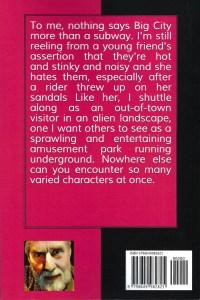
Why I love tracking the hip groove of the underground

The paperback cover …

My subways novel started out to be my big hippie tome, building on a metaphor of hitchhiking, which was ubiquitous for us, but the extended concept ultimately got to be too unwieldy for one book. The supportive details were stripped away for what’s become Daffodil Uprising and Pit-a-Pat High Jinks, leaving the metropolis altogether.

Spurred on by Richard Brautigan’s “Trout Fishing in America” with a dash of William Burroughs, the initial drafts played surrealistically in a tension between the wide-open roads of the countryside and the underground realms of the biggest cities.

Then, four or five years after taking up the project, I was pawing through a used books bin in the desert of Washington state and came across a 1915 engineering volume, “Building Subways in New York,” which included “Elevated Railway Steelworks.” I still have it. How on earth had it ever landed out there amid the sagebrush?

I had already lived in Upstate New York four hours from Manhattan, and nearly all of my friends, housemates, and lovers were from The City. That was followed by my residency in a yoga ashram two hours away in the Poconos, so yes, I had learned to ride the trains. (Nowadays, it’s mostly Boston’s a little over an hour south of me.)

… and the back cover.

The original “Subway Hitchhikers” had a structure that ran like trains passing in opposite directions, which readers could find confusing rather than energizing. It also had a lacy air that reminded me of Robert Rauschenberg’s pop art “combines.” Gone, too, in the revisions is the protagonist’s hippie handle, substituting a more conventional nickname that better links this story to the others.

In the revised version, Subway Visions, there’s more focus on characters, plus new sections on Kenzie’s encounters of Tibetan Buddhism in a tenement near Greenwich Village as well as a graffiti artist known as T-Rex.

What’s evolved has a much straighter narrative and more arresting development, now linked to Kenzie’s ongoing life in the hills to the north. And elements of fantasy and heightened playfulness now augment the earlier surrealism.

I suspect I still have some classic coin tokens in my possession, somewhere.