Just before taking the unanticipated buyout

Hard to think that it was right around this time ten years ago when my newspaper career took the big turn.

The atmosphere at the office was tense, with contract negotiations approaching a deadlock. Actually, there was little back-and-forth but rather a take-it-leave-it set of ultimatums from the front office.

As much as I loved journalism, I had long dreamed of being liberated from the daily workplace grind to pursue my bigger passions fulltime – writing serious works that would stand as a legacy, plus more time for Quaker endeavors and activities of personal renewal. I envisioned a bigger studio at home and had several book manuscripts that looked promising, if only I could get them in motion faster. When you had an interested book publisher, as I tentatively did, you had to act fast, something that’s difficult when you’re actively engaged elsewhere. My big break, all the same, hadn’t happened, even if I was being published widely in the small-press literary scene. You had to build a name, after all, as well as connections.

The job itself had long ago turned into a production-line mentality, rather than a more deliberate craft. Gone were the big projects that allowed enough space for deep research, reflection, and revision. Even at the prestigious big dailies, the clout that came with having a byline had largely evaporated. I began joking, with a degree of factual backup, that I really earned my wages in a one-hour span every Saturday night, when our biggest paper of the week in terms of circulation, heft, content, and income, was about to hit the press. Missing that deadline by even a few minutes was costly and had consequences. In that hour, and the two that followed as we made corrections and updated editions, everything funneled down through me, carrying with it blame for any big errors.

Well, I was a pro. Suck it up.

The possibility of buyouts had been floated by the union but required a certain number of members to step forward as interested candidates – tell us more – before that possibility was soundly yanked away from the table by management. I felt left like a pawn in that high-stakes game. For me, the pension and Medicare were both still a year off, and a steady income between here and there was looking more and more imperiled. I’d stuck my neck out, after all, and could now be seen as disloyal – if the paper was still running at all.

A few weeks later, brusquely, I was called into HR and essentially told I had an hour or so to commit to a decision. What, it’s back on the table? Maybe I had a little longer to confer with my spouse, I don’t recall, but in the whirlwind, the closure still came down like a hammer.

And that was it – a bonus that included extended health coverage, plus opportunities for part-time employment, if I wished. No guarantees there, but good luck. Even so, I was giddy. This is it?

A few nights later, there was a cake in the newsroom in recognition of us who had walked the plank. Some of our younger colleagues, I suspect, wished they had the option, though part of our decision came in hoping what we did kept them employed duly, some even supporting families. These calculations get tangled.

~*~

My first month of liberation came as a welcome period of decompression. I loved sitting in our front parlor and reading in winter sunlight, for one thing. A favored new routine with my wife was strolling downtown every Wednesday around dusk, when a small pub featured a fine jazz guitarist. How civilized! I could even go to bed before midnight.

The paper soon found itself short-staffed, however, and I began receiving calls wondering about my availability. Enjoying the flexibility of picking-and-choosing, I soon found myself working three or four shifts a week, the max allowed under the agreement. The feeling was entirely different, free of the weight of internal politics and big responsibilities. My floating shifts liberated me to attend concerts and films and a host of other events not previously open on my schedule. I didn’t have to weave around others’ vacation time off, either, when looking ahead to conferences or travel.

But ten years ago already? It really does feel more like five.
My encounters in a yoga ashram altered my perception of life

I stepped out of my journalism career three times in my life before retiring for good. The first was when I decided to move to the ashram where I could immerse myself in yoga philosophy and practice. Responding to Swami’s invitation to settle into her rural setup was something I did slowly and deliberately, with a large degree of trepidation. As I relate in my Yoga Bootcamp novel, the daily life was intense and evolving. Leaving the ashram was a different matter, with others largely resolving the outcome – out you go. For weeks afterward, I felt myself falling helplessly through space. Eventually, I reestablished my feet on the ground and then headed off for a new life in a town I call Prairie Depot.

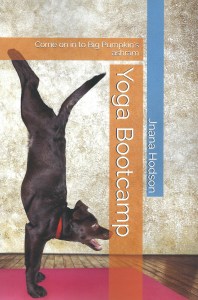
The paperback cover …

What happened for me during my residency was life-changing. I regard it as my master’s degree and my introduction to psychotherapy of an amateur sort. Among other things, it led me to the Society of Friends, or Quakers, which turned out to be the faith of my Hodgson ancestors from the 1660s down through my great-grandfather.

In the novel, I chose to confine the structure to a single day, in part because I had so many lingering questions I could not answer. Yes, within that day individuals could look back on their previous history, but the focus was on the NOW. And a lot could happen there in a 24-hour span. Besides, as I later learned through some candid discussions with a former Episcopal nun, monastic life has some commonalities of its own. As she said, some of the most intense interactions came in trying to choose the flavor of ice cream when the rare opportunity arose. I’ll argue you’re the most human under such rarified circumstances.

On top of everything, when I was drafting the book, I was out of contact with the place and its people. Critically, I had refused an order to return to the ashram after I’d married and moved to Washington state and a follow-up stipulation of heavy financial support was out of the question. A half-dozen years later, back on the East Coast, I had an opportunity to stop by but was not admitted into the house. I did learn that Swami had died and I sat by her grave. So much for making amends.

… and the back cover.

Since then, I’ve reconnected through social media with some of the key players and had a few assumptions, not in the story, deflated. In addition, Devan Malore’s “The Churning” reflects life there a few years after I’d moved on.

The story itself could have gone another way, if I hadn’t wanted to present the ideals that drew us together and kept us going. Especially the humor and playfulness.

More compelling for many readers would have been a more sordid tale of just one more “new religion” outfit run into scandal of a sexual or financial sort, preferably both. There were enough elements for that, as I’ve since learned.

The story first came out as a pioneering ebook in PDF format only and was later updated to Smashwords and its affiliated partners. A more recent, quite thorough recasting (again, blame the influence of Cassia in “What’s Left”) changed Swami from female to male and introduced Jaya as one of the eight resident yogis, thus linking her to the heftier Nearly Canaan novel. Besides, the transformation made Swami more acceptable to the expectations of many readers and allowed the Big Pumpkin and Elvis dimensions. The role was already unconventional enough, and this was more fun.

Am I still doing yoga? If you mean hatha, the physical exercises, let me say rarely and embarrassingly, at that. As exercise, I’ll substitute my daily laps in the swimming pool, and as meditation, my weekly Quaker meeting for worship. And no, I’m no longer vegetarian, other than when I voluntarily follow the Greek Orthodox “fasting” of Advent and Great Lent (again, blame Cassia), though I also eat much less flesh than most Americans. Actually, in these seasons, the Eastern Orthodox Christians are stricter than we yogis were.

I do wish there were a similar haven for youth today, one freed from the burden of student college debt. I’ll let “Yoga Bootcamp” stand where it does.


My work, as I see it

highly compressed

economy of expression

vivid imagery

an acknowledgement of mystery of the universal seed in the particular

if only I’d been able to uphold it in the newsroom

~*~

Yes, clean lines, stripped-down materials, and elegant craftsmanship meeting a love of the baroque in a quirky, inimitable style


This will be the Barn’s biggest year yet, I promise

It’s hard to believe the Red Barn has just passed its tenth anniversary. Frankly, I thought this blog would be going dormant by now, that we would have exhausted everything I have to say or show, but that’s not what’s on the horizon after all.

Instead, thanks to our downsizing and relocating to a remote fishing village with an active arts scene on an island in Maine (whew!), I promise you the best year yet. And, yes, Dover back down the coastline will still be a big part of the mix, but in a new way.

Each year, the Red Barn has changed its emphasis somewhat, and in doing so explored new fields while leaving others behind. Looking back, I’d say it’s made for a natural evolution. The poetry, for instance, has moved over to my unique digital Thistle Finch imprint. Much of the Quaker experience has gone to my As Light Is Sown blog. And newspapers just aren’t what they were, while their “war stories” fade into a foggy past.

During that decade, though, my novels were finally finding publication, and that provided a lode of new material and thinking to share with you.

Photography also became a much bigger part of the mix, thanks to my digital cameras, so much so that I can now claim shooting as one of my hobbies.

Add to that the bunnies and vanity plates and some wordplay, for a little fun, which will continue, as will the Tendrils.

The original visual artwork from my high school portfolio, alas, has been depleted. Let me confess that as the pieces came up, I often wondered why I had done this or that back then. There are some wild leaps of intuition that amaze me now, not that I’d ever venture such confidence these days. Ah, youth! (Sigh.)

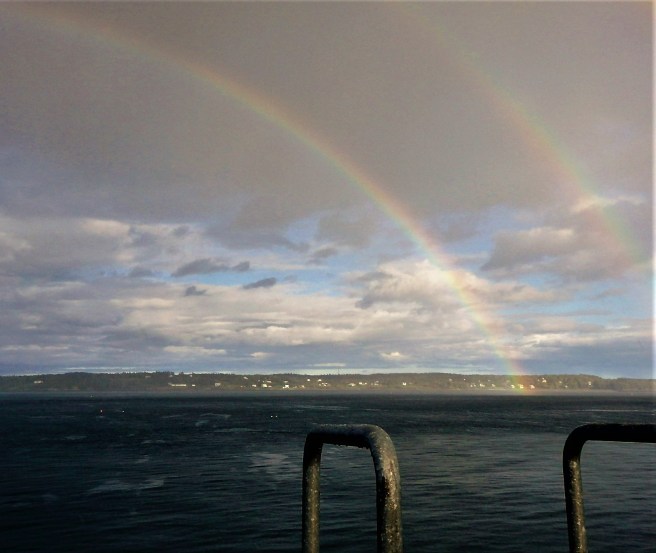
A double rainbow, as seen when I was caught in an unexpected shower behind us last summer.

What’s new this year is a close look at Eastport itself and the surrounding Bold Coast and Sunrise County. It’s a remarkable landscape with a host of fascinating characters and wildlife. Having been here a year now allows for some perspective in the discoveries, ones you, too, will be sharing. The encounters have opened a whole new world for me, even as part of upright New England. They’ve also revived many sensations I’d been forced to leave behind in the Pacific Northwest more than 40 years earlier. I hope to be able to convey that awe of natural wonder. I still can’t believe this landlocked Ohio boy looks out the window and sees the ocean daily.

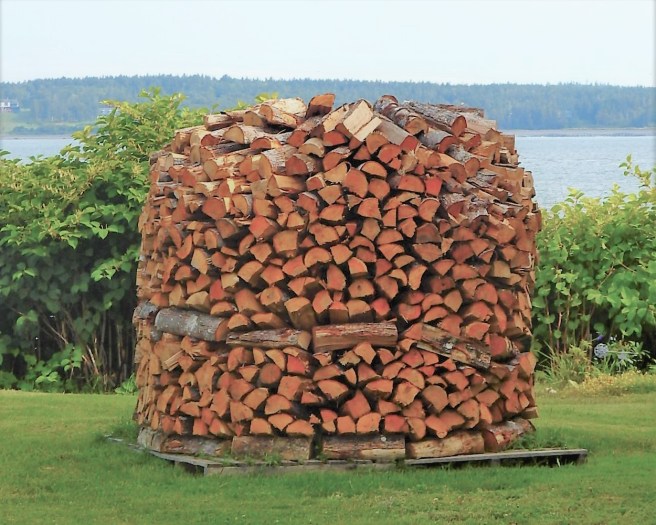
A neighbor’s first holz hausen firewood pile, though it took him three efforts to get it right. I didn’t miss stacking firewood last year, but I definitely missed the comfort of wood-stove heat through much of the winter.

The year also provided me with a writer’s retreat, long stretches of solitude while the rest of the family remained behind, apart from their festive visits.

I was already well into the first draft of my next book when we uprooted but quickly got back down to business here. Alas, after showing the manuscript to a circle of beta readers, it was back to the drawing board for a thorough reworking. I should have been suspicious when the book seemed to write itself. Without revealing too much, I will say the project keeps me connected to Dover but in a fresh way. You’ll definitely be hearing much more while it inches along toward publication.

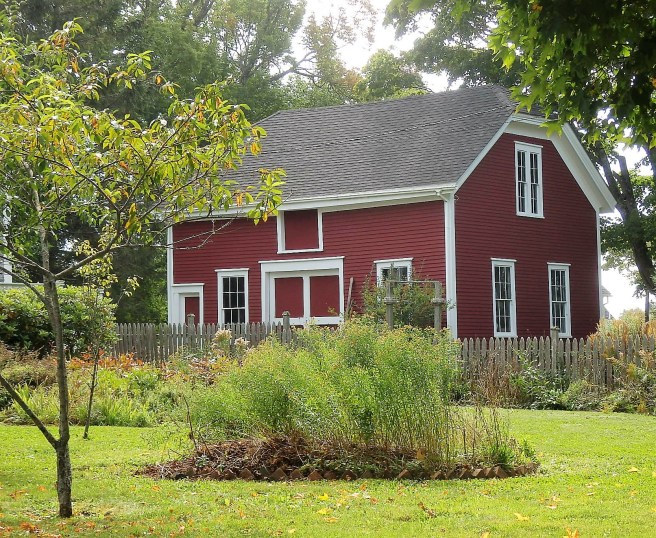
Another neighbor’s red barn just isn’t the same as the one I left behind.

The barn itself has become a memory, a symbol of the longest place I’ve lived in my life, and maybe even my roots in the farming heartland.


Not to get too sentimental, but …

What is life without memories?

The most tragic part of Alzheimer’s is what happens when one crosses that threshold and leaves the connecting memories behind.

Quite simply, stories – and storytelling, one way or another – are essential. Stories are, after all, ultimately memories within human existence, no matter how fanciful or mythical.

How else do we remember where we are in the universe? Or even why?

There are good reasons we swap stories, from pillow talk on.

Manifesto or perchance confession

Fellow workers in the field know the practice is not easy. They notice movements and deft accomplishments as well as slips and defects the wider public doesn’t. They’re also rarely moved by easy though flashy flourishes and scorn the con-artist and cheat.

I’m not referring solely to other writers or artists, either. Watch a gymnast evaluate a meet or a figure-skater a competition. Even a software writer or electrician. Or a surgical nurse.

That said, when I’m drafting and revising intensely, I’m also more appreciative of qualities in the writing of others. At the best is an admiration of something I lack, a time for humility and gratitude rather than jealousy or envy.

It’s work, after all. Which is why published pages are called “works.”

Given a choice, the rational decision would be to browse through great pages already given to us by others. Browse, as sheep or cattle – OK, I joke, but the fact is I seldom find what most calls me.

Writing is work, especially when you’re already working a regular full-time job somewhere else. Why else where there those periods in my life where I rose at four a.m.  to write and revise before going in to the office? How many others do likewise? At what personal cost to their lives and growth?

Real work, I’ll contend, is the practice of being fully alive. Aware. Totally there, at times.

Some people charge up and then release it in an extended explosion, as Kerouac did in his fiction.

I, in contrast, see it as a balance, between inspiration – breath within – and exhalation – the atmosphere without.

Creativity? No, God creates.

Man discovers, cultivates, nurtures, at best.

Practicing an art (and likely much more) means wrestling with power – including, in the Apostle Paul’s phrase, the “powers and principalities.” Powers of destruction, on one hand, and sustenance, on the other. Destruction that can, as seen too many times, include the artist. Hence, the fascination with Faust. With madness. Alcoholism. And on.

Self-absorption and inflated self-importance. We hazard much, often without the slightest awareness of the risks afoot. In Satan’s dominion over “the world,” which is the realm of the arts, or in Eastern thought, the traps of Maya, that spider web of worldly attraction and deadly illusion.  Either way, cause to be wary.

~*~

Self-discipline, route to true freedom, strips away false attachments, barriers, chaff.

Writing involves observing my own shifting mind while opening to manifold living energies around me. It means simplifying, following unexpected leadings and openings, sometimes to dead ends, other times to unanticipated ranges.

~*~

Some of my fellowship at the time would have argued that’s not where I should be. Some were praying for me through this period. The kind of work that once would have had me read out of Meeting. Is this acceptable activity for a free Gospel minister? All I can do is explore the Truth given to me.

“We Quakers read only true things.” Distractions from worship? Traps of the flesh? So where does fiction fall?

The piece goes its own way: a living organism: readers, editors see it differently from you. What you would cut they love. What you love they see as sore thumb.

Versus becoming so rarified we lose all sense of joy and delight. The danger of Plainness or strictness, that it suffocates personality, makes us so humiliated we cannot move forward in the Holy Spirit to perform bold action.

~*~

My poetry has been influenced by the craft of headline writing and news reporting more than I care to admit. The trade paid the rent, provided a point of resistance in my personal endeavors. The Political Science Fiction I once envisioned has since come together in real history as a horrid reality.

Not that we’re anywhere near done yet.

An artist’s handwriting

Coming across a handwritten note from a friend who’s a wonderful artist, I once again thought how amazing the handwriting is. Not just his, but other’s I’ve known.

Sometimes I’ve suspected they’re taught a special draftsmanship script, but now I’m seeing they differ.

Still, they are amazing.

Ending with “In peace and friendship …”