“Quaking Dover is a delightful and informative read. Thanks for your good work!” Beth Collea, Dover
“Truly interesting. I truly appreciate all the work and careful thought and interpretations you put into it.” Canyon Woman, New Mexico
“I really like your voice. It’s engaging, light, and easy to read.” Jim Mastro, science fiction author
“Love it!” Susan Wiley, Sandwich, NH
“I enjoyed your conversational writing style – sharing the research that you did — and confidentially whispering (in your writing style), ‘This is what this finding means and how it should be interpreted.’ … To ascertain what really happened you checked primary documents, read previous accounts of Dover, New Hampshire – triangulated your sources and showed us readers how you reached your conclusion. A very enlightening read — well researched, well written.” Joe Clabby, author of A History of Eastport, Passamaquoddy Bay, and Vicinity
One of the factors in our decision to relocate to Eastport was the quality of the local newspaper, which appears every second and fourth Friday of the month.
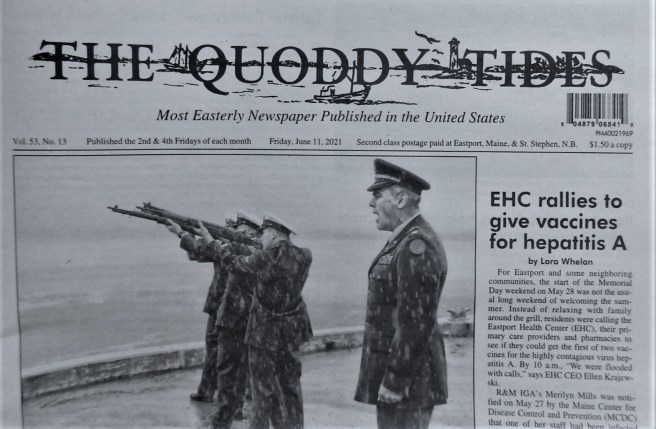
Typical front pages.
There’s nothing flashy about its tabloid-format editions, but everything I see strikes me as solid, even compelling, community journalism.
The quirky – and unique – use of Tides rather than Times in its name is not just humorous but altogether appropriate. The paper reports on all of the communities the tides touch on in Washington County, Maine, as well as many in neighboring Charlotte County, New Brunswick.
One of my ongoing criticisms of American newspapers over the past half-century is that very few of them give you a feel for the place they serve. Ownership by out-of-state corporations is only part of the problem. Continuing cutbacks in coverage is another. (I play with those and other factors in my novel Hometown News.)
For most dailies and weeklies, there’s a generic look and taste in the stories. Everybody has city-council and school-board meetings, for heaven’s sake, and most car crashes are just as boring.
Somehow, though, that’s not the case with the Quoddy Tides.
Consider the lead on a report of the start of the important commercial scallop harvest, a story that was presented on Page 2 but teased from the front page by a dramatic black-and-white photo of a fishing boat plowing through rough seas:
“Winds gusting over 50 knots did not deter many Cobscook Bay area scallop fishermen from going out on the first day of the season on December 1. About three-quarters of the fleet of over 20 draggers based in Eastport and about 10 boats from Lubec headed out that day.”
Remember, it’s not just windy with choppy surf. This is December, blowing icy water. As for a feel of the place, just listen to the quotes in the next sentence:
“Lubec fisherman Milton Chute observes, ‘The tops were blowing off the water like it was pouring,’ and Earl Small of Eastport says that while it was ‘sloppy steaming back and forth,’ once the boats were on the lee shore either off Lubec or down in South Bay, it wasn’t bad towing out of the wind. ‘It’s not as dangerous as people think,’ says another Eastport fisherman, Butch Harris, noting that two or three boats will fish together in case anyone gets in trouble. ‘It was a rough ride out, but once you’re there fishing it’s not that bad.’ Harris points out that scallop fishermen have only so many days that they’re allowed to fish. ‘If you don’t go, you lose it,’ he notes.”
Much of their quotes, I’ll venture, is pure poetry. And off the cuff, at that.
The rest of the story fills out the page, detail after detail. I bet you’ll think of some of this dedicated labor, too, next time you eat seafood.
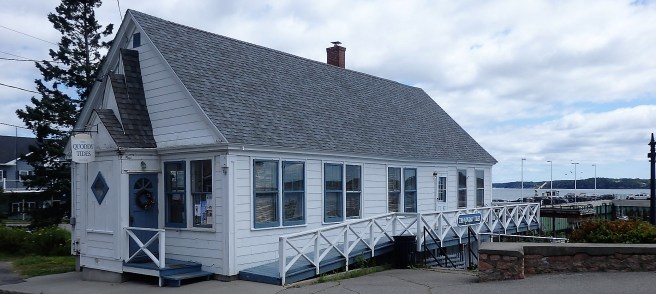
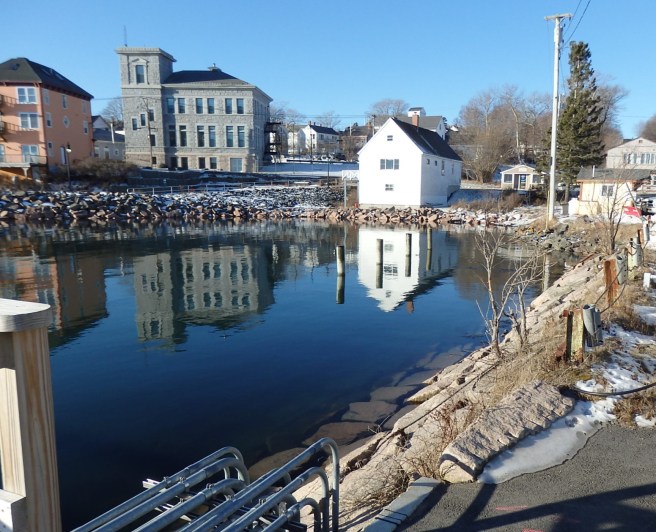
The newspaper offices occupy the 1917 Booth Fisheries headquarters downtown, once part of a sardine cannery.The building sits right on the harbor. The post office and former customs office stands to the left.
The Tides was founded in 1968 by Winifred B. French, the wife of Dr. Rowland Barnes French, M.D., and mother of five. They moved to Maine from Arizona in 1953 so he could help found the Eastport Health Center, itself a remarkable story in community medicine.
Winifred had no background in journalism, but she saw a need, studied hard, and ventured forth in launching and editing a small-town paper with a regional outlook. In 1979, for good reason, she was named Maine Journalist of the Year. Remember, the Tides isn’t a daily or even weekly newspaper, it’s every two or sometimes three weeks.
Reporters attend public meetings rather than chasing afterward by phone, correspondents provide meat-and-potatoes servings of neighborhood interest, Don Dunbar contributes top-drawer photography, and local columnists all weigh in for what becomes must-read pages throughout the area. The mix skirts the glib boosterism and doom-and-gloom morbidity too prevalent elsewhere.
Winifred died in 1995, but son Edward French and his wife, Lora Whelan, continue on her model. (Another son, Hugh, heads the Tides Institute and Museum – note that Winifred’s sense of “tides” continues there, too.)
I like the fact that the stories don’t carry datelines. Nope, the reader doesn’t get a chance to turn off on the basis of a single word. The region is closely interlinked by people living in one place and working in another or having family elsewhere, so it’s all of interest or should be – both sides of the U.S.-Canadian border.
I also like the fact that headlines come in just two sizes, with a serif face used for a touch of variety. There’s no need to scream to draw attention. Instead, we get an orderly and fair-minded sensibility.
So that’s an introduction. I could go on and on.
In some ways, it reminds me of Annie Proulx’ novel The Shipping News, without the dreariness and grimness.
Nothing flashy or sensationalized. Fits the character of the place.
One thing I would tweak is the nameplate, which goes back to the first edition. That shoreline still seems to strike out the paper’s name.
Still, it’s a joy to be retired and not have to be in the midst of producing all this. These days I do delight in being able to sit back and simply enjoy what I’m reading – even if I do on occasion feel an urge to “fix” something on the page.
What – or whom – do you look forward to reading the most? On a regular basis. (Apart from this humble scribe.)
Have to confess the Red Barn posts have been moving along on schedule, but just not as many or as varied as usual.
Seems I’m not alone that way, here on WordPress or other social media, for that matter.
On this end, I’m knee-deep in trying to get a big project in gear – the part that follows the publication of a new book, which is just around the corner. These next steps are time-consuming and emotionally a roller-coaster. I’m always feeling I’m way behind there, as well as uncertain of the way.
As a complication, about a month ago I suffered a physical fall in the middle of the night and was reminded once more how fragile the body gets in older folks, aka the elderly, and how risky that can be when living alone. I’m still feeling some of the aches after the bruises and what else and won’t be resuming the twice-a-week fitness classes till after Labor Day.
Quite simply, that’s slowed me way down.
And then there was my week at the annual sessions of New England Yearly Meeting of Friends (Quaker) off in Castleton, Vermont, now that we’re gathering face-to-face again. Getting across northern New England, however, is a remarkably drawn-out trip, no matter how stunning some of the scenery can be. I did see parts of Maine, New Hampshire, and Vermont for the first time.
Weighing on me especially has been the surreal political and social nightmare unfolding here in America. It’s not just Trump, either, but closer to home the threatened return of Paul LePage to the governorship of Maine. Trying to write about that has been paralyzing, and the news developments keep mounting at a dizzying pace.
So here we are and summer’s almost over. It hasn’t exactly felt lazy.
When I was revising two earlier novels into what became Pit-a-Pat High Jinks, I did wonder about a parallel volume from the point of view of his lovers. What a cad or sweetheart or lost soul or whatever they saw him as. Yeah, dump it all on.
You know, the self-centered hippie dude, Peace Love & all.
Well, there was a hot volume of erotica, Naked Came the Stranger, where each chapter was secretly written by a different person or party who then hid behind a character who got the author credit and posed for the interviews. The various writers didn’t even see the other material until the book came out, not that it ultimately mattered. She did have every color of eye you could imagine.
On this end, I’d welcome submissions for my own project, if only I had space to tackle it, but time is drizzling out, along with the original impulse.
I mean, the hippie chicks in his life weren’t the only ones screwed up, OK? Let’s be honest. Facing the music could be amusing and healing for all.
Don’t know about you, but I do find tags very helpful in searching for ebooks.
Well, they’re also very helpful in finding fellow bloggers. In fact, if you’re not using them, let me urge you to do so. I’ll even give some free advice, if you’re interested.
Part of the trick, of course, is in choosing ones that will connect with folks on the other end. When I was setting up Quaking Dover for release through Smashwords, the tags I had intended led to some others I thought would pitch the book far more widely and effectively, and, to my surprise, more accurately.
Here are the ten I went with:
Faith, Families, New England, Strong Women, Colonial, Quaker, Peace Movement, Spiritual Walk, Community Life.
The book’s already charted as Non-Fiction/History/American, so there was no point in duplicating those.
Do any of those appeal to you?
Check out my new book, Quaking Dover, available in your choice of ebook platforms at Smashwords.com.
Eastport is smaller – much smaller – than the model for my fictional Prairie Depot was, and I thought that place was small. Yet somehow Eastport feels more vibrant and whole.
At least in summer.
For a little perspective, the entire winter population could ride a single New York City subway train.
That’s not the way it used to be, not when I was younger and could dash things off in the flush of inspiration, but it is what I’ve encountered revising my last two books.
It’s not even Wes McNair’s advice to write 400 good words every day. Not unless one of those sentences is an over-the-top wonder of 250 to 300 words.
The turtle pace here seems to arise when I’m trying to weave some new material into an existing draft, making it connect on two sides seamlessly. It’s not just the craft of fine writing, actually, but also the thinking more deeply about the unseen significance of the subject at hand. What, exactly, is beneath the surface before us?
Of course, as a writer, this pace also has me wondering if I’ve simply used up all the easy stuff and left the bigger challenges for my senior years.
In theory, at least, for a writer, nearly anything – or everything – is potential fodder. In my case, that leads to a new blog post, poem, or scene in a novel, but for others maybe a movie or streamed series of episodes or podcast.
Nicholson Baker demonstrated this quite charmingly in his alleged novel Book of Matches, striking on a practice of lighting a fire every morning in the dark depths of a northern New England winter. Novel? It’s simply a very lovely piece of masterful writing and insight, period. Any conflict is subtle.
But I am drawing the line at trying to do anything with a chart of daily blood pressure readings, before and after doubling the dosage of a prescription.
And that’s after bypassing those colonoscopy photos, with or without commentary of a travel guide sort.
Those of my age might understand or sympathize, but younger readers would no doubt be put off unless they possess a truly twisted mind. I can’t imagine the backlash. Besides, it just ain’t sexy.
In all fairness, I hate to admit I’m finding it harder and harder to comprehend a lot of the humor, video content, and even dialogue from their end of the spectrum. That part’s just scary, perhaps reflecting the realities they face. Should we start with global warming and its consequences?
Perhaps a typo I nearly released a moment ago suggests its own new genre. Fuction. Or fruction. With or without a k.
We don’t need to resort to physical gestures, do we?
There are things I’d do differently if I were starting this blog over, but we do learn as we go.
I’d keep the merry-go-round approach but definitely tweak it. Well, the focus of the Barn has evolved over the decade, as has my life.
One of the things I didn’t know much about at the start was Categories, so the definition of some has become, shall we say, rather elastic. American Affairs is one, especially when I’m using it for a microcosm like Dover or Eastport. Still, I don’t want to create more, which I feel would lead to clutter.
Tags were even more elusive. At first, I had no clue I’d find them so useful when I turn to the WordPress Reader or to the Smashwords catalogue. Posting is another matter, where the advice is not to exceed ten per entry. Five somehow seems to be optimal. And then I chanced upon the difference between those that are what I consider factual, like the name of a state, and others that are more emotive, like “happy” or “fun” – which are supposed to get more hits. Again, how do we keep the list manageable?
So what I’d like to know is just how you use Categories and Tags, both as a blogger and as a reader. Any advice?
And while we’re at it:
Does anyone else miss WP’s daily Fresh Pressed selection? Maybe that dates me as a blogger, but it really was a great way to be introduced to new voices.