More accurately, I’ve become acutely aware of how much I still don’t know. Or even, does anyone see this fully?
The adage, “Write about what you know,” had me starting with my Quaker experience. But the adage should add, “Write about what you don’t know.” Frankly, that’s the part that’s exciting.
Think of it as working a puzzle, trying to figure out what goes in the gaps. You just don’t know without some hands-on trial and error. And perhaps a few friends or family members’ help.
From the other direction, I know a professional historian who quotes his mentor saying that if you think you have an answer nailed down, you’re badly mistaken.
I’ll spare you my list regarding the Quaking Dover project, for now.
Hard to believe this blog is now in its second decade.
With the Barn, a new year usually signals a slight shift in focus and content.
2023, for instance, will see a series excerpting dreams I’ve had over the years. Mine can be surreal and inexplicable and yet, I feel, illuminating. They’ll likely give you unexpected glimpses into my psyche even though I’m thinking of it as literature. Meanwhile, the prose poems that have been appearing on Saturdays have run their course. Hope you’ve enjoyed their compressed impressions of my earlier life and feelings, especially when they’ve reflected your own, too.
Dover’s 400th anniversary will continue to be a major theme, including things I’ve learned since the release of my book based on the town’s Quaker heritage. And there will be announcements of presentations based on the book as they come up through the year. The ones I’ve done so far have been a blast.
Now that you’ve been introduced to Eastport and its ways, the tone of those posts will also turn, shall we say, more casual? Or at least more of the everyday experience around here rather than a record of the connections I’ve discovered. Besides, living on an island in Maine is some people’s fantasy, at least through the summer. I’m hoping to add a streak of reality to that vision.
Kinisi will continue with their off-the-wall, quirky, flash slashes. Some fall into the realm of concrete poems, a la Aram Saroyan, and others take the trippy flashes of the sort Richard Brautigan produced. Others can be seen as prompts for others to build on. These minimalist notations do reflect the way I’ve often heard and seen the world, slightly askew, even though I have to admit I don’t “understand” many of them. They’re intended to dance to their own beat, OK?
And I have to admit my Tendrils on Tuesday are great fun to investigate and offer. I never thought of top ten lists as entertaining, forget the factual dimension. They definitely have much more to dig up as we go.
One big shift will likely be in photography, from my Olympus camera to my S-22 Ultra cell phone. We’ll see what you think. Eastport and the surrounding environment are certainly visually rich subjects. Click, click, everywhere you turn.
Overall, though, I’m intending to have fewer posts this time around, yet it still looks like that still means at least one posting each day. Or, as one renowned writing teacher taught his classes, “Write 300 good words a day.” Not that I’m keeping count, even as I keep hoping to cut back. Does keyboarding really become compulsive?
My life and outlook have certainly changed over the course after signing up for a WordPress blog, which then led to four related lines. Thanks for sharing so much of it here.
What are you looking forward to on your end in the new year?
I’m waiting to name a character Sorrell. And Hezekiah is what I would have loved to have named a son, not that I would have found support on that one. Maybe as a middle name?
In a story, I try to avoid using names of people I know, or at least know well. Ditto for close family. So they don’t count here. It certainly narrows the range. On top of everything, after multiple revisions, I don’t always remember what I’ve kept in the end.
Besides, a name should be suggestive.
Now for ten or so more.
Lane. Or Blaine. Unisex, very useful.
Perry. Unisex again.
Majik. Was a fisherman around here but could be unisex.
Dana. Well, since we’re on a roll.
Marilyn. Evocative, yet all-American.
Pierce. I see a cutting edge in his glance.
Bonita. Could go by Bonnie, too. From the Spanish, makes an alternative for Linda, which I also haven’t used, or Melinda, even better.
Trent. The family had aspirations and this was the golden boy.
Berry. Back in unisex, along with alternative spellings.
Lark. Even Clark. Or Clifford. Or Larkins.
For children, though, I’ve become very fond of handing down family names. Even using a maternal surname. Guess it’s the genealogist in me at work.
We haven’t even gotten to nicknames, which can really pop a character into focus. Think of “Willy” as one possibility.
In looking at the categories I’ve used since launching this blog a decade ago, I feel I should explain why I’ve resisted adding to them.
I simply wanted to retain some kind of focus on what I’d envisioned as a merry-go-round. Yes, the categories were the selected horses to ride.
Think of “American Affairs,” largely inspired by an academic department that Indiana University and Yale and a few others launched in the mid-‘60s to encapsulate a multicultural investigation of current affairs. I nearly embraced it as my own major, the way some Blacks turned to Swahili.
Hey, I had a girlfriend who saw that regarding her own eldest brother. Back off, please, and let’s get back to subject.
What I’ve found in practice here at the Red Barn is that my Am Affairs specific pigeonhole has increasingly probed local public states, especially in Dover, New Hampshire, and more recently, Eastport in Way Downeast Maine.
Or, as the adage goes, all politics are local. (Should that be “is”?)
The writer Tom Wolfe was someone I had thought followed this American Affairs college degree path, but I find myself mistaken, at least as far as academia goes. Still, I would list him as an inspiration here, just shorn of the heap of superlative adjectives, expletives, and adverbs.
But our localities do get lost in the national mass-media mindset, to the impoverishment of us all.
Or, as the French said, “Vive la difference!”
Actually, as I’m realizing, that also applies to my latest book, Quaking Dover.
There are many reasons I spend so much butt time at the keyboard, as poet/novelist Charles Bukowski once compressed the practice.
I’ve examined some of them elsewhere, but what I’m circling back to today is the necessity of bringing some kind of order to the seeming chaos of what happens to each of us in “everyday life,” at least through the lenses of my own encounters.
What emerges is hardly objective, no matter my training in objective journalism. If anything, I lean on the hopeful side of history. The side we see as progress, even in the face of the clouds of doom.
Long ago I crossed a threshold where I couldn’t move forward without drawing on so much that had accumulated before then. I think of it as turning the compost, to give it air and enrichen future crops, worms and all. Yes, those blessed red wigglers. Or wrigglers, depending on your spelling.
Am I self-deluded? Or is my practice of writing one of prayer, even in the face of so much hopelessness?
What is life, anyway, apart from what we experience subjectively?
So here we are, all the same.
Keep writing, those of you in this vein. No matter the outcome.
“Quaking Dover is a delightful and informative read. Thanks for your good work!” Beth Collea, Dover
“Truly interesting. I truly appreciate all the work and careful thought and interpretations you put into it.” Canyon Woman, New Mexico
“I really like your voice. It’s engaging, light, and easy to read.” Jim Mastro, science fiction author
“Love it!” Susan Wiley, Sandwich, NH
“I enjoyed your conversational writing style – sharing the research that you did — and confidentially whispering (in your writing style), ‘This is what this finding means and how it should be interpreted.’ … To ascertain what really happened you checked primary documents, read previous accounts of Dover, New Hampshire – triangulated your sources and showed us readers how you reached your conclusion. A very enlightening read — well researched, well written.” Joe Clabby, author of A History of Eastport, Passamaquoddy Bay, and Vicinity
One of the factors in our decision to relocate to Eastport was the quality of the local newspaper, which appears every second and fourth Friday of the month.
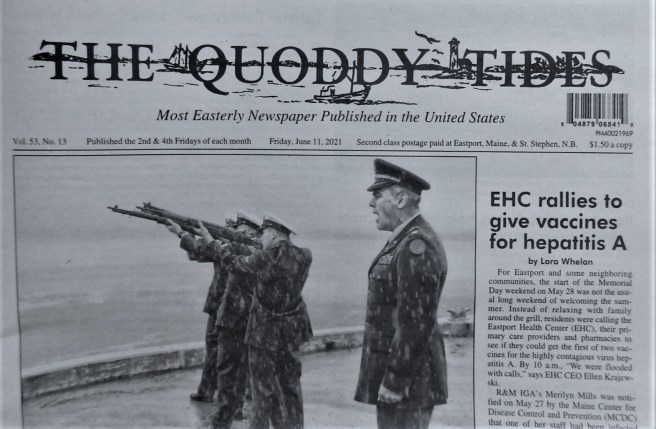
Typical front pages.
There’s nothing flashy about its tabloid-format editions, but everything I see strikes me as solid, even compelling, community journalism.
The quirky – and unique – use of Tides rather than Times in its name is not just humorous but altogether appropriate. The paper reports on all of the communities the tides touch on in Washington County, Maine, as well as many in neighboring Charlotte County, New Brunswick.
One of my ongoing criticisms of American newspapers over the past half-century is that very few of them give you a feel for the place they serve. Ownership by out-of-state corporations is only part of the problem. Continuing cutbacks in coverage is another. (I play with those and other factors in my novel Hometown News.)
For most dailies and weeklies, there’s a generic look and taste in the stories. Everybody has city-council and school-board meetings, for heaven’s sake, and most car crashes are just as boring.
Somehow, though, that’s not the case with the Quoddy Tides.
Consider the lead on a report of the start of the important commercial scallop harvest, a story that was presented on Page 2 but teased from the front page by a dramatic black-and-white photo of a fishing boat plowing through rough seas:
“Winds gusting over 50 knots did not deter many Cobscook Bay area scallop fishermen from going out on the first day of the season on December 1. About three-quarters of the fleet of over 20 draggers based in Eastport and about 10 boats from Lubec headed out that day.”
Remember, it’s not just windy with choppy surf. This is December, blowing icy water. As for a feel of the place, just listen to the quotes in the next sentence:
“Lubec fisherman Milton Chute observes, ‘The tops were blowing off the water like it was pouring,’ and Earl Small of Eastport says that while it was ‘sloppy steaming back and forth,’ once the boats were on the lee shore either off Lubec or down in South Bay, it wasn’t bad towing out of the wind. ‘It’s not as dangerous as people think,’ says another Eastport fisherman, Butch Harris, noting that two or three boats will fish together in case anyone gets in trouble. ‘It was a rough ride out, but once you’re there fishing it’s not that bad.’ Harris points out that scallop fishermen have only so many days that they’re allowed to fish. ‘If you don’t go, you lose it,’ he notes.”
Much of their quotes, I’ll venture, is pure poetry. And off the cuff, at that.
The rest of the story fills out the page, detail after detail. I bet you’ll think of some of this dedicated labor, too, next time you eat seafood.
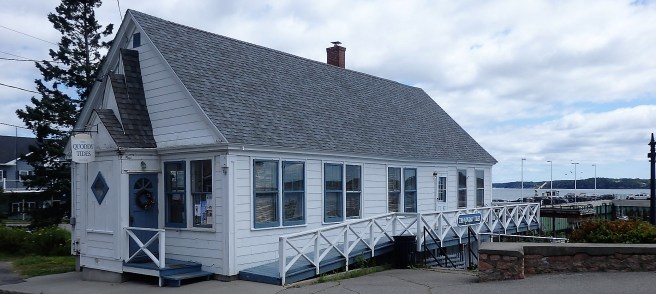
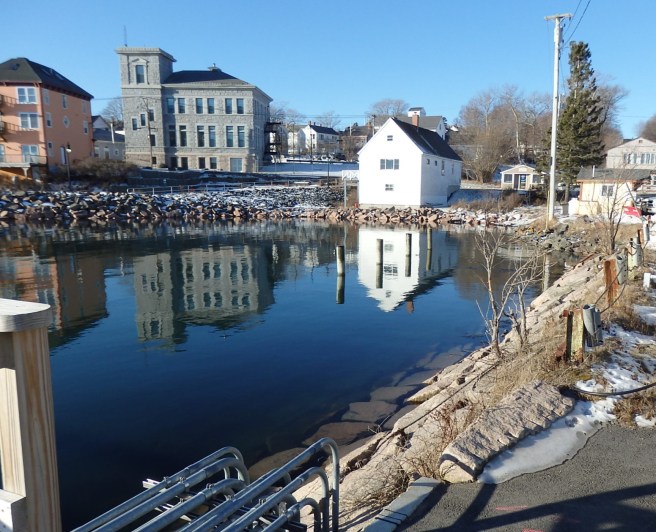
The newspaper offices occupy the 1917 Booth Fisheries headquarters downtown, once part of a sardine cannery.The building sits right on the harbor. The post office and former customs office stands to the left.
The Tides was founded in 1968 by Winifred B. French, the wife of Dr. Rowland Barnes French, M.D., and mother of five. They moved to Maine from Arizona in 1953 so he could help found the Eastport Health Center, itself a remarkable story in community medicine.
Winifred had no background in journalism, but she saw a need, studied hard, and ventured forth in launching and editing a small-town paper with a regional outlook. In 1979, for good reason, she was named Maine Journalist of the Year. Remember, the Tides isn’t a daily or even weekly newspaper, it’s every two or sometimes three weeks.
Reporters attend public meetings rather than chasing afterward by phone, correspondents provide meat-and-potatoes servings of neighborhood interest, Don Dunbar contributes top-drawer photography, and local columnists all weigh in for what becomes must-read pages throughout the area. The mix skirts the glib boosterism and doom-and-gloom morbidity too prevalent elsewhere.
Winifred died in 1995, but son Edward French and his wife, Lora Whelan, continue on her model. (Another son, Hugh, heads the Tides Institute and Museum – note that Winifred’s sense of “tides” continues there, too.)
I like the fact that the stories don’t carry datelines. Nope, the reader doesn’t get a chance to turn off on the basis of a single word. The region is closely interlinked by people living in one place and working in another or having family elsewhere, so it’s all of interest or should be – both sides of the U.S.-Canadian border.
I also like the fact that headlines come in just two sizes, with a serif face used for a touch of variety. There’s no need to scream to draw attention. Instead, we get an orderly and fair-minded sensibility.
So that’s an introduction. I could go on and on.
In some ways, it reminds me of Annie Proulx’ novel The Shipping News, without the dreariness and grimness.
Nothing flashy or sensationalized. Fits the character of the place.
One thing I would tweak is the nameplate, which goes back to the first edition. That shoreline still seems to strike out the paper’s name.
Still, it’s a joy to be retired and not have to be in the midst of producing all this. These days I do delight in being able to sit back and simply enjoy what I’m reading – even if I do on occasion feel an urge to “fix” something on the page.
What – or whom – do you look forward to reading the most? On a regular basis. (Apart from this humble scribe.)

 Jnana's Red Barn